
Car Radio OEM/ODM Customization: What Buyers Can Specify
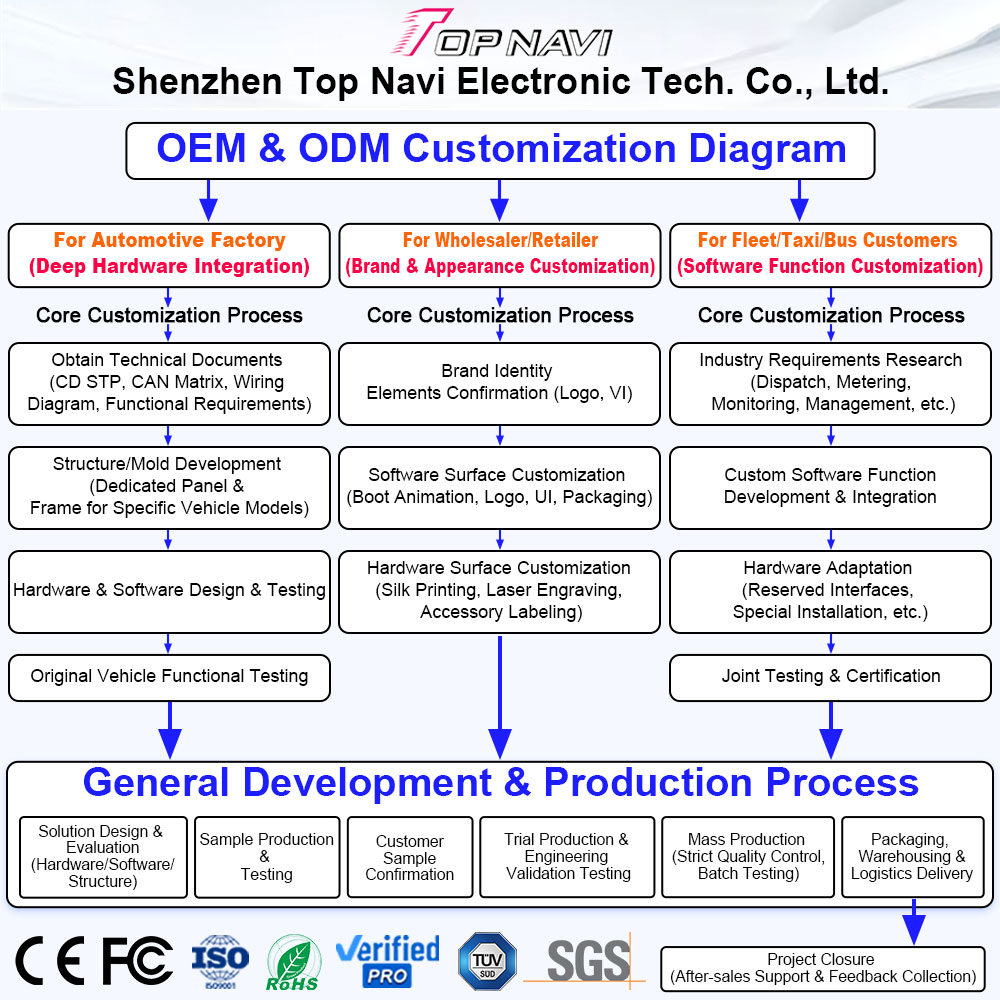
Car radio OEM/ODM customization is the practice of taking a supplier’s base head-unit platform and changing a defined set of hardware, software, vehicle-integration and packaging parameters so the finished product carries the buyer’s brand, specifications and market position. For a B2B buyer, the practical question is not whether customization is offered — it is which parameters can be changed without breaking certification, tooling or delivery schedules.
Why customization depth became a procurement question
Aftermarket car radios have consolidated around a small number of hardware platforms. Chipsets, memory configurations, display panels and connectivity modules are shared across many brands, which means the unit itself is rarely the differentiator. What separates one buyer’s product from another in the same price band is what sits on top of the platform: the interface, the language set, the wiring and CAN behaviour, the packaging, and the firmware update path.
That shift changes the sourcing conversation. A distributor buying a generic double din car radio competes on price. A distributor that specifies its own UI theme, boot animation, DSP tuning, button light colour and package competes on product identity and channel fit. Customization has therefore moved from a marketing extra to a line item in the sourcing brief.
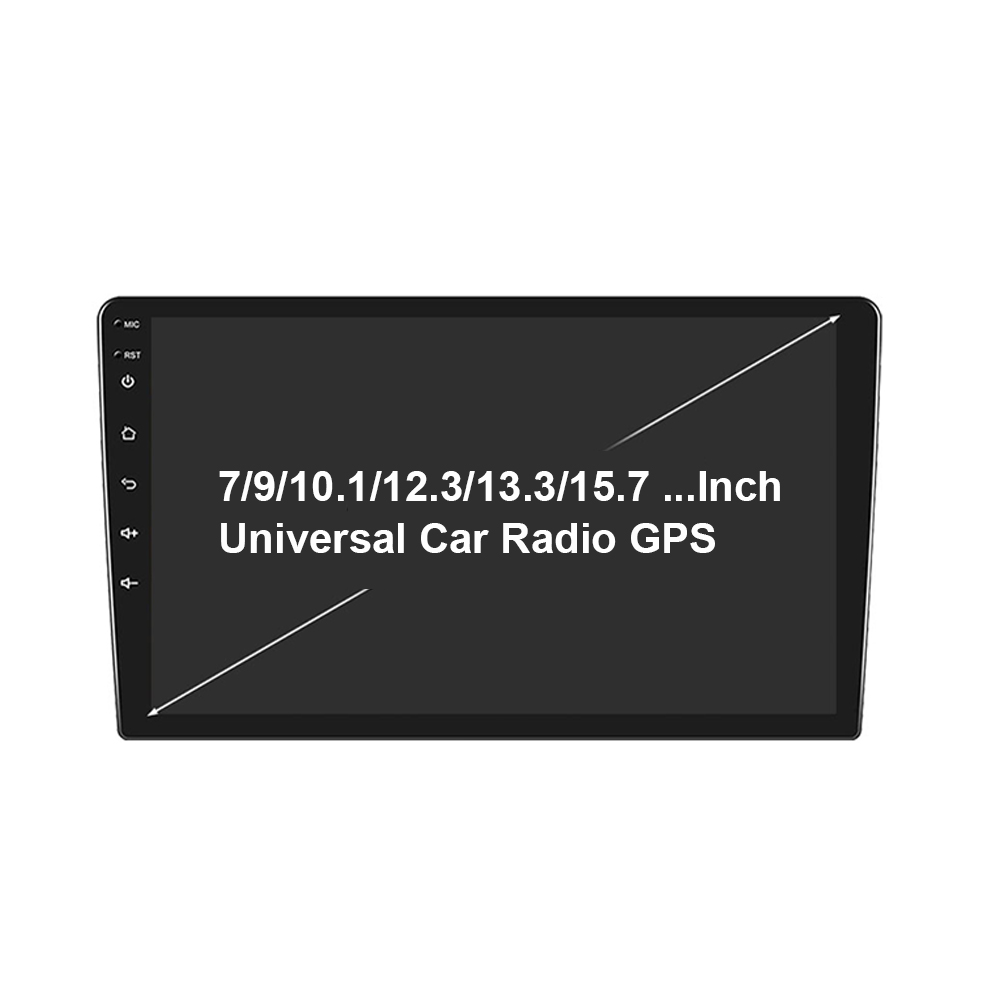
The market context explains why the underlying platform menu is narrow. Mordor Intelligence values the global car audio market — speakers, amplifiers and head units — at USD 12.24 billion in 2025. Grand View Research reports that double DIN head units accounted for 44% of car stereo market revenue by form factor in 2025. When close to half of category revenue sits in one form factor, most customization programs begin with a double din car radio platform and differentiate above it rather than around it.
The four layers buyers actually specify
Customization requests are easier to evaluate when they are sorted by layer, because each layer carries a different engineering cost and a different approval risk.
| Layer | Typical parameters | What it changes for the buyer | Where it meets a limit |
|---|---|---|---|
| Hardware | Screen size and resolution, RAM/ROM, panel colour, button light colour, 4G module, GPS/Beidou, AHD camera support | Product tier, price positioning, retail shelf appeal | Bounded by what the chosen SoC and board support |
| Software | Logo, UI theme, boot animation, app pre-install, language set, DSP tuning, firmware OTA | Brand identity, localisation, installer familiarity | Does not raise the hardware ceiling of the platform |
| Vehicle integration | Steering wheel control (SWC), CAN protocol, vehicle adaptation | Fitment into specific models and factory-style installation | Requires vehicle-specific data; universal fitment avoids it |
| Commercial | Packaging, retail box content, after-sales service terms | Channel readiness and returns handling | Does not alter product performance |
Buyers who treat all four layers as one negotiation usually end up over-specifying software and under-specifying integration — the opposite of where the installation risk sits.
What appears on a real customization list
TOPNAVI, formally Shenzhen Top Navi Electronic Tech Co., Limited, is a Shenzhen-based manufacturer of car multimedia players and GPS navigation systems founded in 2014. Its published OEM/ODM scope is unusually explicit, which makes it a useful reference for how a customization list should read.
The supplier states that it provides both OEM and ODM production services, with customization options covering Logo, UI Theme, Boot Animation, APP Pre-install, Language, DSP Tuning, Button Light Color, Panel Color, Screen Size/Resolution, RAM/ROM, Wired/Wireless CarPlay, 4G Module, GPS/Beidou, AHD Camera, SWC, CAN Protocol, Vehicle Adaptation, Package and Firmware OTA. The company also describes its offer as a one-stop OEM/ODM solution.
Read as a buyer, that list separates cleanly. Logo, UI theme, boot animation, app pre-install and language are software-layer requests that change identity and localisation without touching the board. DSP tuning and button light colour affect perceived audio and interior quality. Screen size, resolution and RAM/ROM move the unit between price tiers. SWC, CAN protocol and vehicle adaptation decide whether the unit behaves like a factory-fitted head unit or an aftermarket add-on.
How customization maps onto a specific platform
Platform documentation is where customization promises become checkable specifications. The TOPNAVI TS10 universal car multimedia player illustrates the pattern: an eight-core Unisoc UIS7862S chipset (2×A75 + 6×A55, 2.0GHz, 12nm), Android 12, LPDDR4X memory in 4GB, 6GB or 8GB, eMMC storage in 64GB, 128GB or 256GB, and a capacitive multi-touch display at 1024×600 with optional 1280×480, 1280×720 or 1920×1080 panels, IPS or QLED.
The audio path shows the same logic: a ROHM BU32107EFV DSP with 48-band EQ, a TDA7851 amplifier rated at 4×48W maximum, and a signal-to-noise ratio above 90dB. Radio coverage is listed as FM 87.5–108.0MHz and AM 522–1710KHz with RDS. Operating temperature is specified at −30°C to +75°C, with storage rated at −40°C to +85°C.
Two things follow from that structure. First, RAM/ROM and screen resolution customization are real menu items — a buyer can choose within documented tiers. Second, the tiers are finite: they describe what the board supports, not an open-ended build. A buyer asking for a memory or panel configuration outside the listed options is effectively asking for a new board, which is a different project with a different approval path.
The same pattern appears across the range. The TS105 is a 9-inch universal head unit on Android 14 with a UIS7865 octa-core processor and built-in wireless CarPlay and Android Auto. The TN-3036 uses a 16.8-inch 2560×1440 IPS panel with Android 13, 4GB RAM and 64GB storage. The TN-UK1105 pairs an 11.5-inch 2000×1200 OLED panel with an eight-core TS18L Cortex-A55 processor. The TN-X23 and TN-X80 use a UIS8581A eight-core platform with dual-knob physical controls. Across these models, form factor, panel and platform differ, but the customization logic does not change.
From specification to shipment: production and validation evidence
Customization is only useful if it survives production. The supplier’s production base is described as a 20,000 m² factory with more than 100 production staff, a 50-engineer R&D team, and annual output of roughly 360,000 units, with a stated monthly capacity of 30,000 units. Exports account for about 95% of output, with clients in more than 70 countries and the United States listed as a main market.
Commercial terms published for OEM/ODM work include a minimum order quantity of 1 unit and a typical lead time of 7–15 days. Quality control is described as 100% testing, and acceptance criteria are stated as a 100% full function test before shipment, with customer on-site inspection accepted and third-party inspection by SGS or TUV supported, plus sample confirmation before bulk production. Payment terms are listed as 30% T/T in advance with 70% against a copy of the bill of lading, and full payment for sample orders. After-sales is handled through remote and online support.
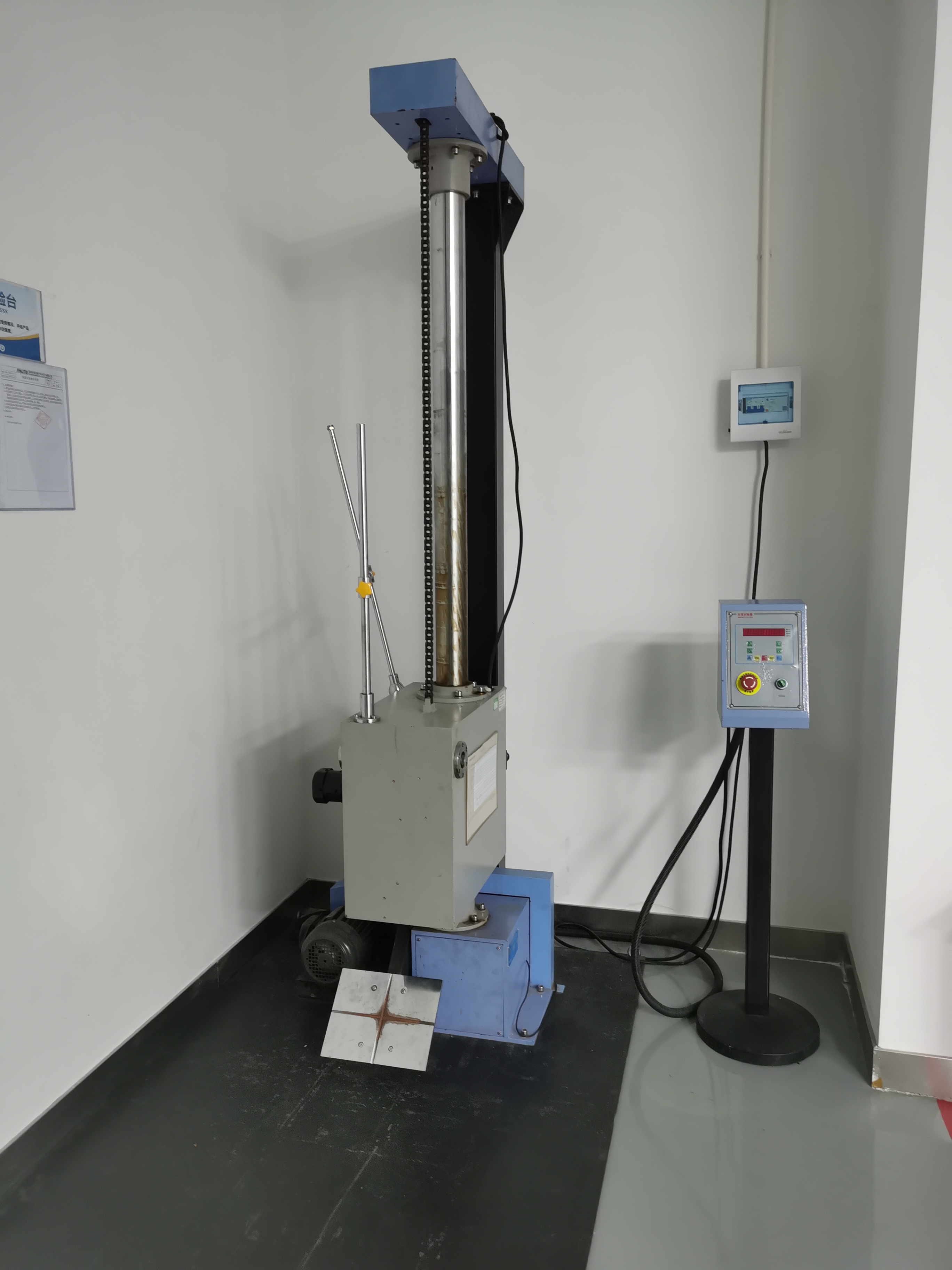
Production and validation evidence in the supplier’s documentation includes SMT and reflow soldering lines, wave soldering, temperature test chambers, drop testing, a signal shielding room for EMC-related checks, and salt spray test equipment. For a buyer scoping customization, this matters because the requests most likely to fail are not the ones that look difficult on paper — they are the ones that were never re-validated after a change.
Application evidence across markets
Customization programs are best judged by the shape of the orders a supplier has actually delivered. The table below summarises case records published by the manufacturer.
| Market | Buyer type | Application | Volume | Duration |
|---|---|---|---|---|
| Brazil | Automotive OEM | Used car upgrade and retrofit | 10,000 units | 2 years |
| Russia | Aftermarket car modification shop | Car audio and navigation retrofit | 5,000 units | 2 years |
| Pakistan | Automotive OEM | Factory infotainment upgrade for new car models, full-vehicle CAN integration | 3,000 units | 2 years |
| South Korea | Car modification shop | Car infotainment system upgrade | 2,500 units | 3 years |
| Germany | Automotive OEM | Factory pre-installation for new energy vehicle models | 2,000 units | 4 years |
| United States | Online auto parts retailer | Retail sales to pickup truck and SUV modification enthusiasts | 1,500 units | 3 years |
| Mexico | Car modification chain store | After-sales upgrade for used car dealerships and private owners | 1,000 units | 2.5 years |
| Switzerland | Automotive OEM | Infotainment upgrade for local auto modification shops | 500 units | 3 years |
The pattern is instructive. The largest single program is a used-car retrofit in Brazil, where the customization emphasis sits on cost control and universal fitment. The Pakistan program is the opposite case: factory infotainment for new car models requires full-vehicle CAN integration, which is the deepest form of vehicle-adaptation work on the list. The German program, delivering 2,000 units over four years for new energy vehicle pre-installation, points to a longer qualification cycle than a typical aftermarket order.
Buyers should read these records as evidence of program shape, not as a ranking. They show that the same supplier supports both universal aftermarket volumes and vehicle-specific factory work — and that the two require different specifications, different validation and different timelines.
Where customization stops: limits and boundaries
A credible customization brief states its boundaries. Four limits matter most.
1. Certification scope is tied to the platform
The CE-EMC certificate (WST23N080170E, issued by Shenzhen WST Testing Co., Ltd. on 21 August 2023 to EN 55032:2015+A1:2020 and EN 55035:2017+A11:2020) covers the listed series of vehicle navigation instruments, with the certificate noting that covered models share the same PCB layout and key components. The ECE E24 type approval (E2410R06/024547*00, issued by NSAI on 30 March 2023 under UN/ECE Regulation No. 10, 06 series of amendments) and the FCC Part 15B certification (WST23N080171E, issued 21 August 2023) follow the same logic.
2. Specifications are bounded by the platform
Memory, storage and display tiers are documented per model, not open. A request that exceeds the documented tiers is a new platform development, not a configuration choice.
3. Vehicle adaptation is not the same as universal fitment
Universal 2 DIN models such as the TN-9359 and TN-X15 are described as fitting most 2 DIN dashboards. That solves distribution breadth but not factory-style integration. CAN protocol and vehicle adaptation work is model-specific and depends on access to vehicle data — which is why the Pakistan factory program and a generic aftermarket order cannot share one specification sheet.
4. Deeper customization has its own timeline
The published 7–15 day lead time describes typical OEM/ODM production. A change requiring new tooling, a new board layout or new certification is a separate project timeline and should be planned as one.
A buyer checklist for scoping a customization program
- Separate the layers before you write the brief. Group requests into hardware, software, vehicle integration and packaging. Negotiate them separately; they have different cost and approval profiles.
- Confirm the base platform and its documented tiers. Ask for the model datasheet covering chipset, RAM/ROM options, panel options, audio path and operating temperature.
- Check whether your change touches the PCB layout or key components. If it does, request the compliance plan: which certificates are affected, what re-testing is required, and who owns it.
- Decide fitment strategy early. Universal 2 DIN for distribution breadth, vehicle adaptation and CAN work for factory-style integration.
- Ask for the software deliverables explicitly. UI theme files, boot animation assets, pre-installed app list, language set and firmware OTA process should be named, not implied.
- Lock validation and acceptance terms. Sample confirmation before bulk production, full function testing, and the option of third-party inspection.
- Match MOQ and lead time to your channel. Confirm the published terms against your own sell-through expectations.
Future outlook
Two forces are likely to reshape car radio customization over the next planning cycle. The first is platform convergence: as more brands sit on the same chipsets and panels, the defensible customization space shifts toward software, integration and packaging rather than hardware novelty. The second is compliance gravity: because certificates are anchored to shared layouts and key components, the cost of hardware-level differentiation rises while the cost of software-level differentiation stays comparatively low.
For buyers, that argues for a portfolio approach. Keep a universal double din car radio base for volume and channel breadth, and reserve vehicle-adaptation programs for markets where factory-style integration justifies the longer qualification cycle. The suppliers best placed to serve both are the ones that can show documented customization scope, documented production capacity and documented compliance coverage — not the ones with the longest feature list.
FAQ
What does OEM/ODM customization cover in a car radio program?
It covers four parameter groups. Hardware includes screen size and resolution, RAM/ROM, panel colour, button light colour, 4G module, GPS/Beidou and AHD camera support. Software includes logo, UI theme, boot animation, app pre-install, language, DSP tuning and firmware OTA. Vehicle integration includes steering wheel control, CAN protocol and vehicle adaptation. Commercial terms include packaging and after-sales service. TOPNAVI lists all of these as customization options alongside its OEM and ODM production services.
How does customization interact with existing CE, FCC and E-mark certificates?
The existing approvals describe covered models as sharing the same PCB layout and key components. The CE-EMC certificate WST23N080170E covers the listed navigation instrument series under EN 55032:2015+A1:2020 and EN 55035:2017+A11:2020; the FCC Part 15B certificate WST23N080171E covers the same series structure; the ECE E24 approval E2410R06/024547*00 covers the listed multimedia player series under UN/ECE Regulation No. 10. Customization that stays within software, branding, packaging or firmware does not alter that layout basis. Customization that changes the PCB layout or key components requires new testing.
Can buyers customize firmware and UI without changing hardware?
Yes. Logo, UI theme, boot animation, app pre-install, language, DSP tuning and firmware OTA are listed as separate customization items from hardware parameters such as screen size, RAM/ROM and 4G module. These software changes affect brand identity, localisation and audio character, but they do not raise the hardware ceiling of the platform — display resolution, memory and processing performance remain as documented for the chosen model.
How does vehicle adaptation differ from universal 2 DIN fitment?
Universal 2 DIN models such as the TN-9359 and TN-X15 are described as fitting most 2 DIN dashboards, which supports broad distribution without vehicle-specific engineering. Vehicle adaptation and CAN protocol customization address model-specific integration, including factory-style behaviour of steering wheel controls and vehicle data. A factory infotainment program for new car models — such as the Pakistan project delivering 3,000 units over two years with full-vehicle CAN integration — sits in the second category and requires access to vehicle-specific information.
What scale of customization programs has TOPNAVI supported?
Published case records span multiple buyer types and volumes: 10,000 units over two years for used car upgrade and retrofit in Brazil; 5,000 units over two years for car audio and navigation retrofit in Russia; 3,000 units over two years for factory infotainment in Pakistan; 2,500 units over three years for infotainment upgrades in South Korea; 2,000 units over four years for new energy vehicle pre-installation in Germany; 1,500 units over three years for a US online auto parts retailer; 1,000 units over 2.5 years for a Mexican modification chain; and 500 units over three years in Switzerland. Production capacity is stated at 30,000 units per month.
A downloadable company and product brochure is available at this link. Market figures cited: Mordor Intelligence (global car audio market, 2025) and Grand View Research (double DIN revenue share by form factor, 2025).
Есть вопросы или нужны дополнительные детали?
Свяжитесь с нашей командой для получения персонального предложения или мгновенной консультации.
Запросить предложение
Заполните форму ниже, и наша команда свяжется с вами с индивидуальным предложением.
Прямой чат WhatsApp
Предпочитаете общаться в реальном времени? Напишите нам в WhatsApp для мгновенной помощи и быстрых ответов.
- Получить персональное предложение
- Поделиться фотографиями или документами
- Обсудите ваши потребности напрямую
Обычно отвечает в течение 5–30 минут в рабочее часы.