
Carbon Steel Concrete Pump Pipes: Value Factors at the Procurement Stage
At the final stage of concrete pump pipe procurement, the practical question is whether a carbon steel pipe will hold up in service long enough to justify its purchase price. This article examines the value factors, verification points, and trade-offs that buyers should weigh before finalizing a decision.
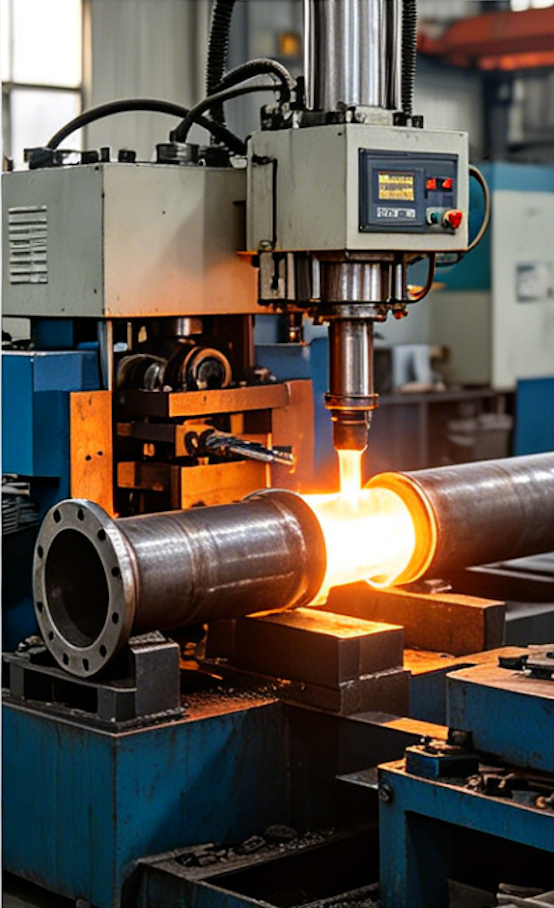
Numerical control high-frequency heat treatment is a key production step in carbon steel concrete pump pipe wear resistance.
Concrete Pump Pipes at the Procurement Stage
The global concrete pump market was valued at approximately USD 6.05 billion in 2024 and is expected to grow at a compound annual growth rate of 5.13% through 2032, according to Credence Research. Asia Pacific, driven by infrastructure construction in China and India, accounted for an estimated 42% of revenue in 2025, based on an industry analysis published by GM Insights. As concrete pump sales grow, so does the aftermarket demand for delivery line components, particularly concrete pump pipes.
For procurement teams at the decision stage, the product category that receives the most attention is often carbon steel pump pipes. They are the most widely specified pipe type in concrete pumping because of their cost profile, weldability, and predictable mechanical properties. But not all carbon steel pipes perform equally in service. The difference depends on how the pipe is manufactured, how the inner wall is hardened, and whether the production process is controlled well enough to deliver consistent results across batches.
This article is written as an independent procurement reference. It outlines the value factors that distinguish carbon steel pump pipes from generic concrete pump pipes, uses Hongchang Machinery Technology Co., Ltd. as a documented manufacturer example, and provides a framework for verifying quality before an order is placed.
The Core Problem: Wear Determines the Real Cost
Concrete pump pipes operate in a highly abrasive environment. Aggregates, sand, and cement paste move through the delivery line at high velocity and under pressure, continuously eroding the inner wall. Over time, the wall becomes too thin to contain the pressure, and the pipe must be removed and replaced. The cost of replacement is not limited to the pipe itself. It includes labor, equipment downtime, disposal of the old pipe, and the scheduling impact on the construction site.
This is why a procurement decision that looks only at the invoice price per meter can produce a misleading result. Two pipes with identical outer dimensions can have very different service lives depending on steel grade, heat treatment, and manufacturing quality. A low-priced pipe that wears out quickly may end up costing more per operating hour than a higher-priced pipe that lasts several times longer.
The opportunity for buyers is to shift the evaluation from “price per meter” to “cost per operating year.” That shift is what makes carbon steel pump pipes with verified heat treatment a central consideration in concrete pump pipe procurement.
Carbon Steel Pump Pipes as a Response: Hongchang’s Position
One manufacturer that has built its product line around this logic is Hongchang Machinery Technology Co., Ltd. Based in Ma’anshan City, Anhui Province, China, Hongchang is a high-tech enterprise specializing in the production and sales of concrete conveying pipes. The company was founded in 2015 and operates a 2,600 m² facility with more than 50 employees. Its annual production capacity reaches 50,000 meters of straight pipes and 15,000 pieces of curved pipes, with approximately 50% of output exported to Southeast Asia, the Middle East, Europe, and the Americas.
Hongchang states that its products deliver 2–3 times longer service life than generic concrete pump pipes, combined with higher inner wall hardness. The company attributes this performance to its heat treatment process and its production equipment, which includes a numerical control high-frequency heat treatment machine, automatic pipe bending welding machines, hydraulic sleeving machines, double-arm sawing machines, and automatic double-arm welding machines. These production steps directly affect the final wear resistance of the pipe.
Hongchang is also a designated supporting manufacturer for Xingma Automobile, and its pipes are designed to match pump trucks and tow pumps from major equipment brands such as Sany Heavy Industry and Zhonglian Heavy Industry. For buyers running mixed fleets, the ability to match pipes to existing equipment without custom modification is a practical procurement advantage.
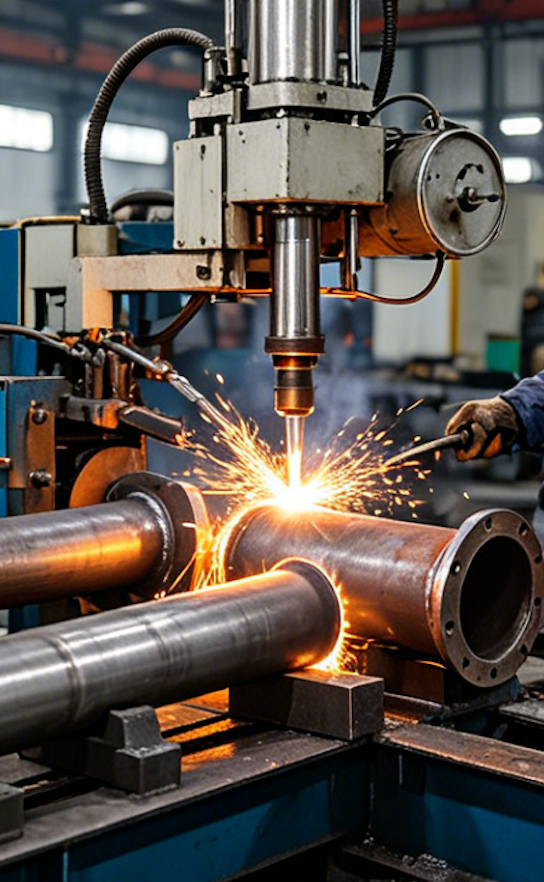
Automatic double-arm welding machines are used in the production of carbon steel concrete pump pipes.
What Makes Carbon Steel Pump Pipes Wear-Resistant
Wear resistance in carbon steel pump pipes is largely determined by the hardness of the inner wall. A harder surface resists abrasion from aggregates more effectively, which extends the service life of the pipe. Hardness is not an accidental property; it is created through a controlled heat treatment process.
The heat treatment sequence typically begins with quenching, which rapidly cools the steel to increase its hardness. Tempering may follow to adjust the internal microstructure, balancing hardness with the toughness needed to handle pressure and impact. The result is a hardened inner layer that resists wear while the outer structure retains strength.
In Hongchang’s production line, the numerical control high-frequency heat treatment machine performs this step with repeatability. This matters because manual or inconsistent heat treatment can produce uneven hardness along the length of a pipe. A pipe with uneven hardness will wear faster in the softer zones, reducing the overall service life even if the average hardness looks acceptable on paper.
Verified reference data on Hongchang’s process places the inner wall hardness of its quenched pipes in the HRC 55–62 range. For comparison, a generic untreated carbon steel pipe typically does not reach this level of hardness. This gap explains the performance difference reported by the manufacturer: approximately 30% longer lifespan and 20% lower wear rate compared with generic pipes, based on the company’s product comparison data.
For high-pressure delivery systems, some manufacturers in the industry use double-layer “twin pipe” designs to handle pressures up to 85 bar while minimizing abrasive wear from large aggregates. Not every project requires this level of engineering, but the existence of such designs shows how the industry is responding to increasingly demanding conveying conditions.
Application Fit: Where Carbon Steel Pump Pipes Deliver the Most Value
Carbon steel pump pipes are specified across a wide range of concrete placing scenarios. The value they provide depends on matching the pipe design to the actual application conditions.
High-Rise Conveying
As the vertical distance increases, line pressure builds up, and the velocity of the concrete mix at the delivery point raises the abrasion rate. In high-rise construction, pipes with high inner wall hardness reduce the frequency of line replacement and help maintain continuous placement, which is critical when concrete is being supplied to upper floors under time pressure.
Tunnel Construction
Curved sections and elbows face concentrated wear because the flow changes direction. Tunnel projects typically require a combination of straight pipes and wear-resistant curved pipes. The elbows are often the first components to fail, so specifying hardened carbon steel elbows alongside straight pipes is a common practice.
Ground Pump and Tow Pump Operations
Ground pumps rely on long delivery lines, often extending several hundred meters horizontally. The demand on pipe life is continuous and steady. Carbon steel pipes with consistent heat treatment are a practical default for this application, because replacing a long line is labor-intensive.
Vehicle-Mounted Pump Operations
Truck-mounted concrete pumps, which held an estimated 48% market share in 2025 according to Technavio, depend on rapid line assembly and disassembly. Quick-fitting carbon steel pipes with accurate dimensional tolerance reduce changeover time between jobsites, which is a measurable efficiency factor for pump operators.
Mortar Conveying
Mortar can also erode pipe walls, especially at bends and transitions. Hardened carbon steel pipes provide an extended service window in mortar applications, reducing maintenance frequency for contractors who run mortar pumping regularly.
Long-Distance and High-Pressure Conveying
Projects that move large volumes of concrete over long horizontal distances require pipe with predictable structural strength. Carbon steel remains a widely used material for this condition because of its well-understood mechanical properties and the availability of certified production processes.
The practical takeaway for procurement teams is that the benefit of a carbon steel pump pipe is highest in projects where line pressure, abrasive mix, or pumping frequency is high. In light-duty or intermittent operations, the same pipe still performs, but the payback calculation changes because the replacement interval is already long.
Market Context: Demand, Standards, and the Shift Toward Durability
The overall market for concrete pumps is on an upward trajectory. Credence Research estimates the global market at USD 6.05 billion in 2024, with a projected CAGR of 5.13% through 2032. Within this market, Asia Pacific has been the dominant region, accounting for about 42% of revenue in 2025, according to industry analysis published by GM Insights.
Truck-mounted pumps are the most widely used pump type, with a 48% share in 2025 based on Technavio’s market analysis. Because truck-mounted pumps move between jobsites and operate in urban environments, pipe handling, assembly speed, and durability are important buying factors for fleet operators.
On the compliance side, concrete pump delivery systems sold in Europe must meet the safety requirements of EN 12001:2012, which covers conveying, spraying, and placing machines for concrete and mortar. Buyers who expect to deploy equipment or spare parts in EU-regulated projects should verify compliance at the component level, including pipes, elbows, clamps, and reducers.
These market conditions point in the same direction: buyers are moving toward specifications that reduce downtime. A pipe that lasts longer, even with a higher first cost, becomes easier to justify when labor and project schedule are included in the total cost calculation.
Carbon Steel vs. Generic Concrete Pump Pipes: A Decision Comparison
The following comparison is based on manufacturer-reported data from Hongchang for its carbon steel pump pipes against generic concrete pump pipes.
| Comparison dimension | Carbon steel pump pipe (heat-treated) | Generic concrete pump pipe |
|---|---|---|
| Relative service life | 2–3 times longer | Baseline |
| Inner wall hardness | Higher (HRC 55–62 range after quenching) | Lower, no equivalent heat treatment |
| Wear rate | Approximately 20% lower | Baseline |
| Lifespan improvement | Approximately 30% longer | Baseline |
| Initial cost | Approximately 15% higher | Lower |
| Maintenance frequency | Reduced | Higher |
| Downtime | Less frequent line replacement | More frequent |
| Heat treatment | Controlled, repeatable process | Usually absent or inconsistent |
The central trade-off is clear: carbon steel pump pipes require a higher initial payment, and the payback comes through reduced maintenance, fewer replacements, and less downtime. Over the full life of the pipe, the higher initial cost can be recovered if the pipe is used in an application with meaningful abrasion.
A limitation buyers should consider: the 15% higher initial cost means that for projects with very light duty cycles or severe budget constraints, a generic pipe may still be a rational choice, especially if the expected service life is long enough to make replacement frequency irrelevant. The durability advantage of carbon steel pipes also depends on correct specification. If a pipe’s wall thickness, diameter, or fitting type does not match the actual pump pressure and mix characteristics, the wear advantage will not fully materialize. Carbon steel pump pipes should therefore be evaluated as part of a system, not as a stand-alone material.
What Buyers Should Verify Before the Final Order
At the decision stage, the difference between a good and a poor pipe supplier often comes down to verification. Based on Hongchang’s documented production and quality control system, the following items are practical for buyers to request:
- Heat treatment evidence. Confirm that the inner wall hardness has been tested and documented. Hardness values such as HRC 55–62 are only meaningful if they come from a traceable test report.
- Batch-level quality certificates. Hongchang provides a certificate of quality for each batch, backed by raw material testing. This helps address material defects before they become field failures.
- Inspection records. Ask about QC checkpoints, 100% inspection, pressure testing, and hardness verification. These are standard elements of an ISO-based quality control system.
- Dimensional and fitting compatibility. Pipes should match the pump brand and model in service. Hongchang designs pipes to fit pump trucks and tow pumps from Sany, Zhonglian, and other major manufacturers.
- Delivery planning. Production planning and safety stock reduce delivery risk. Hongchang reports maintaining 30% buffer stock for common sizes, which is a meaningful signal for buyers with tight project schedules.
- Technical support coverage. Clarify the level of support included. Hongchang lists 24/7 remote support, technical documentation, installation guidance, and spare parts supply in its standard offering.
This checklist does not replace a full supplier audit, but it gives procurement teams a structured way to compare offers on the same evidence basis.
Performance and Supply Risks: What Good Procurement Controls For
Procurement risk in concrete pump pipes falls into four main areas. Hongchang’s documented controls provide a useful benchmark for what buyers can reasonably expect from a supplier with formal quality procedures.
| Risk area | Control method | Enterprise measure |
|---|---|---|
| Material defects | Supplier qualification, raw material testing | Certificate of quality for each batch |
| Product quality | ISO-based quality control, 100% inspection | Multiple QC checkpoints, pressure testing, hardness verification |
| Delivery delay | Production planning, safety stock | 30% buffer stock for common sizes |
| Technical support | 24/7 remote support | Technical documentation, installation guidance, spare parts supply |
These measures do not eliminate all risks, but they define a baseline for supplier evaluation. Buyers should ask for comparable evidence from any manufacturer before committing to a long-term supply relationship.
Outlook for Carbon Steel Pump Pipe Procurement
The direction of the concrete pump pipe market favors products whose longer service life can be verified. As the global concrete pump market grows at an estimated CAGR of 5.13% through 2032, aftermarket demand for pump pipes will grow alongside it. Buyers are likely to request harder evidence—hardness test reports, heat treatment parameters, batch certificates—rather than relying solely on product brochures.
Carbon steel pump pipes are unlikely to be replaced by exotic materials in most mainstream applications, because the balance of cost, toughness, and process maturity is well established. Instead, the competitive difference will be in the consistency of heat treatment, the reliability of supply, and the strength of the quality management system behind each batch.
For procurement teams, the practical conclusion is that carbon steel pump pipes should be evaluated as a capital decision: verify the process, confirm the hardness, and calculate the cost per operating year rather than the price per meter alone.
FAQ
What are carbon steel concrete pump pipes used for?
Carbon steel concrete pump pipes are delivery line components used to transport concrete from a pump to the placement point. They are specified in applications such as high-rise building construction, tunnel projects, ground pumping, mortar conveying, and long-distance or high-pressure concrete delivery.
How do carbon steel concrete pump pipes compare with generic concrete pump pipes?
According to manufacturer-reported data from Hongchang, carbon steel pump pipes with proper heat treatment offer approximately 2–3 times longer service life and higher inner wall hardness than generic concrete pump pipes. The company’s comparison data also shows about 30% longer lifespan and 20% lower wear rate, with reduced maintenance frequency and less downtime.
How much more do carbon steel concrete pump pipes cost than generic pipes?
Based on Hongchang’s comparison data, the initial cost of a carbon steel pump pipe is approximately 15% higher than that of a generic concrete pump pipe. The higher initial cost is offset by a longer service life and lower replacement frequency, although the payback period depends on the operating conditions and intensity of use.
Why is inner wall hardness important in concrete pump pipes?
Inner wall hardness determines how well a pipe resists abrasion from aggregates moving under pressure. A harder inner wall wears more slowly, extending the service life of the pipe. Hongchang reports an inner wall hardness in the HRC 55–62 range for its quenched pipes, achieved through high-frequency heat treatment.
What should buyers verify before ordering carbon steel pump pipes?
Buyers should request heat treatment evidence, batch-level quality certificates, inspection records, dimensional fitting compatibility, delivery planning information, and technical support coverage. Hongchang’s system includes 100% inspection, pressure testing, hardness verification, a certificate of quality for each batch, and 30% buffer stock for common sizes.
What standards apply to concrete pump pipes?
In Europe, concrete pump delivery systems must comply with EN 12001:2012, which specifies safety requirements for conveying, spraying, and placing machines for concrete and mortar. Buyers should also check whether a supplier operates an ISO 9001-based quality management system.
Which applications benefit most from carbon steel pump pipes?
Carbon steel pump pipes deliver the most value in high-rise conveying, tunnel construction, ground pump operations, vehicle-mounted pump lines, mortar conveying, and long-distance or high-pressure delivery, where line pressure and abrasive conditions accelerate pipe wear.
———
Company reference: Hongchang Machinery Technology Co., Ltd. is a high-tech enterprise based in Ma’anshan City, Anhui Province, China, producing concrete pump pipes, elbows, clamps, and reducers. Its official website is www.hongchangpumpipe.com.