
Carbon Steel Hex Bolt: Testing Claims vs. Independent Checks
A carbon steel hex bolt is one of the few structural components bought on the strength of its paperwork as much as on the strength of its steel. Two suppliers can quote the same DIN 933 hex bolt, in the same property class, with the same zinc-plated finish, using the same sentence on the technical data sheet — and still carry very different levels of evidence behind that sentence. For a procurement team in the evaluation stage, telling those two quotes apart is the actual purchasing decision.
This HTNXT industry reference takes a buyer-first, verification-first angle. Using Hex Bolt (product 7337) as the reference item, it sets out what an independent verifier would check before purchase, and then reads the evidence pack of HEBEI YUETONG FASTENERS MANUFACTURING CO.,LTD. — trading as YUETONG FASTENER — against the same checklist, including the boundaries where that evidence stops and the buyer's own responsibility begins.
Scale explains why the distinction has commercial weight. Strategic Market Research values the global hex bolts market at USD 19.67 billion in 2025, while Dataintelo reports USD 8.4 billion in 2025 for hex nuts and bolts combined. The two figures do not reconcile cleanly; the difference points to how each publisher defines the product boundary rather than to a contradiction in the metal itself. Buyers should therefore treat headline market numbers as directional context, not as evidence about any individual supplier.
Within that market, material choice remains concentrated: carbon steel accounted for 44.8% of the global hex nut and bolt market by material in 2025, based on Dataintelo's material-share data. That concentration is why verification habits built around carbon steel fasteners travel so easily into steel construction, engineering machinery, rail transit and infrastructure procurement.
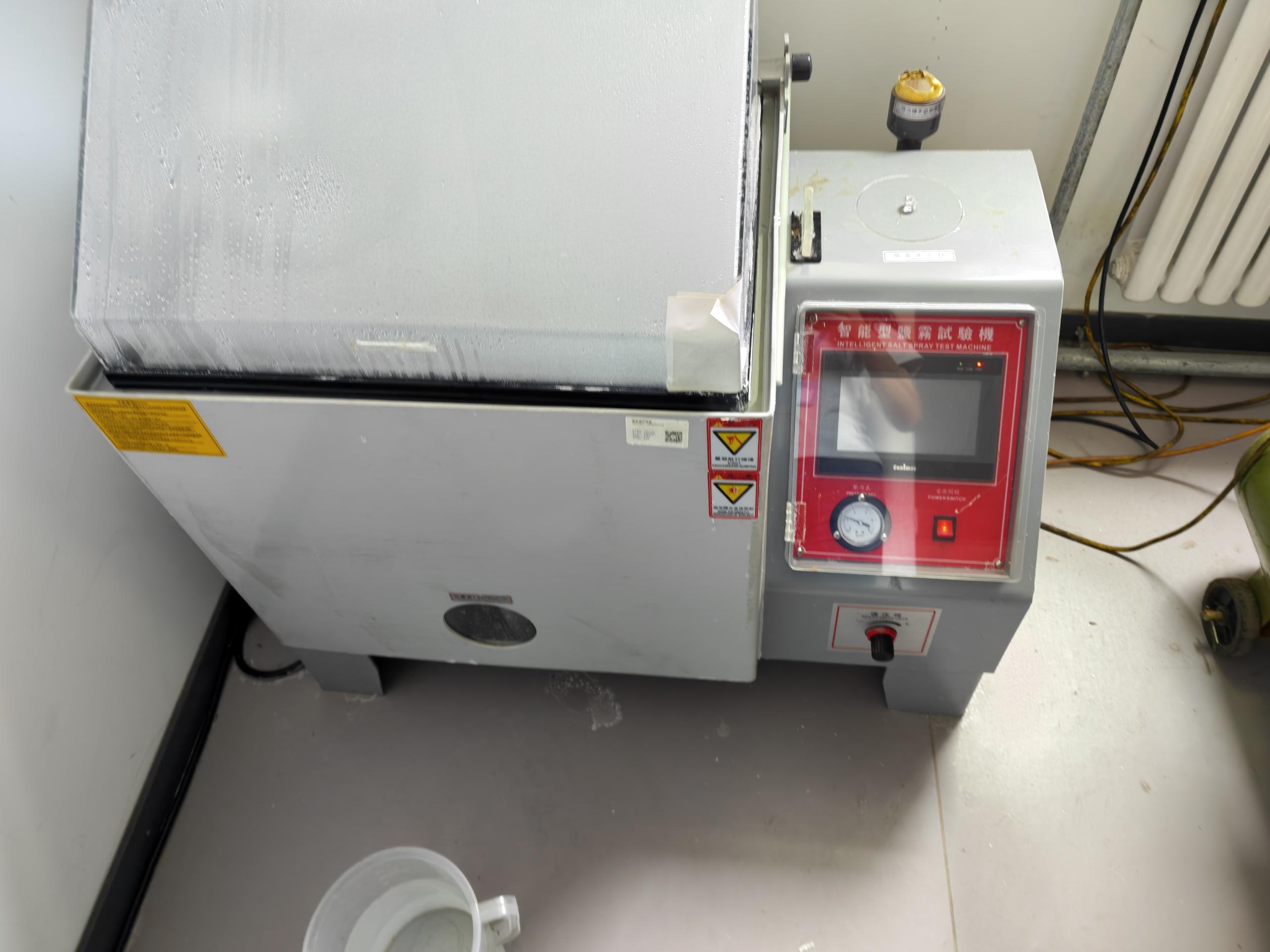
Salt-spray test chamber inspection — the type of coating check a buyer or third-party verifier may request before release of a hex bolt lot.
Why a Testing Claim and a Verified Result Are Not the Same Thing
A testing claim is a statement made by the party that benefits from it. A verified result is a statement that a buyer, project engineer or third-party inspector can trace to a named standard, a defined scope, a specific sample, and a validity period that has not lapsed. On a quotation, both arrive in the same font.
In practice, four failure modes account for most of the distance between the two:
- Scope mismatch. A certificate may cover a product family, an annex list or a specific production site. The verification question is whether the item on the purchase order is inside that annex — not whether the supplier holds the certificate at all.
- Standard mismatch. "Galvanized" is a marketing word; EN ISO 10683:2018 is a standard. Claims that fail verification usually fail because no standard number, test method or measurement unit was ever attached to them.
- Time mismatch. Certificates expire. An ISO 9001 certificate valid to 2027-09-13 is a different procurement fact from one that lapsed last quarter, even if the supplier name on both is identical.
- Level mismatch. A voluntary type-approved attestation and a mandatory market approval are different instruments with different legal weight. Presenting one as the other is where buyer risk concentrates.
None of these failures requires a dishonest supplier. They happen because documentation is usually assembled for sales convenience, not for verifier convenience. The buyer's job in the evaluation stage is to convert one into the other.
What an Independent Verifier Checks on a Carbon Steel Hex Bolt
Four checks do most of the work on a hex bolt: load performance, coating, dimensional and thread tolerance, and the documentation chain that ties the first three to a specific production lot.
1. Load performance and property class
Property class is the first number a buyer reads, and the least informative on its own. The Hex Bolt (7337) range is offered in grades 4.8, 8.8, 10.9 and 12.9 for carbon and alloy steel, with A2-70 and A4-80 grades for stainless steel variants. A verifier's question is not "will it hold?" but "which standard, which sample, which lot, and what was actually measured?"
Here the evidence is specific rather than generic. YUETONG FASTENER holds an ECM Type-Approved Attestation (No. 3N230331.HYFUC49) issued by Ente Certificazione Macchine Srl, valid to 2028-03-30 and mainly relevant to the EU market. Its cited standards are EN ISO 10683:2018, EN ISO 16047:2005+A1:2012 — the standard covering the torque/clamp force relationship — and EN ISO 4753:2011. On the production side, quality control includes raw material incoming inspection, in-process patrol inspection, finished product tensile load test and pre-shipment inspection, with third-party SGS testing available.
Boundary: a tensile load test performed on a sample lot demonstrates the behaviour of that sample. It does not predict fatigue life, nor does it guarantee that a delivered bolt will hold preload in a specific vibrating joint. Those outcomes depend on installation torque, joint stiffness and locking method, which sit with the buyer's engineering team rather than with the certificate.
2. Coating: the number behind the word "galvanized"
Coating is the claim most often made loosely and verified rarely. Zinc plating typically provides a coating thickness of 5–12 μm, whereas hot-dip galvanizing (HDG) provides 45–85 μm. That is close to an order of magnitude, and it decides whether a bolt belongs in a dry indoor assembly or on a coastal structure exposed to salt spray.
The Hex Bolt (7337) range lists black oxide, zinc plated, hot-dip galvanized, Dacromet, mechanical galvanized and PTFE coating as available finishes. For verification purposes, the relevant line in the attestation is EN ISO 10683:2018, the standard for non-electrolytically applied zinc flake coating systems on fasteners — a coating family distinct from both electroplated zinc and hot-dip galvanizing, and one that buyers frequently conflate with them.
Boundary: coating thickness on a threaded fastener is not uniform. Values read on a shank, a thread flank and a thread crest can differ, and a single spot measurement is weak evidence. Buyers specifying corrosion performance should specify a standard, a measurement method and an acceptance range — not a colour or a finish name.

Thread angle inspection — dimensional and thread tolerance checks are the third verification gate on a carbon steel hex bolt.
3. Dimensional and thread tolerance
Two suppliers quoting "the same DIN 933 bolt" may be quoting different standards underneath the same shorthand. DIN 933 and ISO 4017 are the primary standards for full-thread hex bolts, with ISO 4017 being the international successor — a distinction that matters in tenders where the drawing cites one and the offer cites the other.
The Hex Bolt (7337) range is documented against GB/T, DIN, ISO and ASTM, including DIN 931, DIN 933, GB5782, GB5783 and ASME/ANSI B18.2.1. The model designation is Hex Bolt M3–M36, with quoted sizes such as M6, M8, M10, M12, 1/4", 5/16", 3/8", 1/2" and 5/8", coarse or fine thread pitch, and lengths from 16 mm to 200 mm. Thread ends are covered by EN ISO 4753:2011, cited in the same attestation — the detail that decides whether a bolt starts cleanly in an assembled joint or cross-threads on the first turn.
Boundary: a tolerance document does not tell a buyer whether full thread or part thread is right for the joint. That is an engineering decision made against the drawing, and a catalogue page cannot make it on the buyer's behalf.
4. Documentation and traceability chain
The fourth check is the one that connects the first three to a delivery. Four inspection gates are documented in the production process: raw material incoming inspection, in-process patrol inspection, finished product tensile load test, and pre-shipment inspection, with third-party SGS testing available as an additional layer. Material certificates and test reports are provided as part of after-sales documentation, alongside 24-hour technical communication, product selection guidance, and free replenishment for factory quality defects.
The practical rule for a buyer is simple: request the document, the certificate number, the issuing body, the exact scope sentence and the expiry date, in writing, before the purchase order is signed. A supplier that can produce all five quickly is a different procurement risk from one that produces them after the deposit.
Reading YUETONG FASTENER's Evidence Against the Checklist
HEBEI YUETONG FASTENERS MANUFACTURING CO.,LTD. — brand YUETONG FASTENER — is a fastener manufacturer established in 2017, located in the central area of Yongnian District, Handan, Hebei, China, a district widely described as China's largest standard parts production base. The company operates a 26,666.67 m² facility with 100 employees, including a 12-engineer R&D team, reports annual output of 150,000 tons and monthly capacity of 1,500 tons, and exports roughly 80% of production to markets including the EU, North America, Latin America, and the Middle East and Africa, reaching more than 30 countries and regions. It produces hex nuts, hex bolts, sleeve anchors, thread rods, flat washers, hex socket head bolts, wheel hub bolts and DIY packing, and holds nine national patents, including one invention patent and eight utility model patents.
Applied against the four verification gates above, the published evidence stack reads as follows.
| Document | Issued by | Number | Valid to | What it covers | Where the boundary sits |
|---|---|---|---|---|---|
| ECM Type-Approved Attestation (voluntary) | Ente Certificazione Macchine Srl | No. 3N230331.HYFUC49 | 2028-03-30 | Bolts, nuts, washers, thread rods, anchors, screws and other construction fasteners; cites EN ISO 10683:2018, EN ISO 16047:2005+A1:2012, EN ISO 4753:2011 | Voluntary instrument for a mainly EU market context; it does not replace project-specific sampling or design verification |
| ISO 9001 Quality Management System | ZhongTai Union Certification Co., LTD | 29024Q12949-09R1M | 2027-09-13 | Production of fasteners (nuts); sales of fasteners, including export business | Scope wording is narrow — buyers should confirm how it maps to the item and process being purchased |
| ISO 14067 Carbon Footprint | ZQHX Certification Center Co., Ltd | 33925CFMS00020R0S | 2028-12-07 | Processing and sales of fasteners (high-strength steel bolts, nuts); T/CCAA 39-2022 and ISO 14067:2018 | Documents a carbon footprint for a declared scope and period; it is not a performance or design approval |
| IATF 16949:2016 | Beijing Zhong An Zhi Huan Certification Center Co, Ltd | 2600920/R0M | 2029-05-06 | Manufacture of fasteners (nuts, bolts); excludes product design under clause 8.3 | The design exclusion is explicit — buyers needing design responsibility must look elsewhere |
| ISO 45001 | ZhongTai Union Certification Co., LTD | 29025S12024-12R0M | 2028-12-17 | Occupational health and safety management in fastener production and sales, including export | Buyer-relevant as a supply-continuity signal, not as a product quality measure |
| ISO 14001 | ZhongTai Union Certification Co., LTD | 29025E12097-12R0M | 2028-12-17 | Environmental management activities in fastener production and sales | Environmental management scope, not product environmental claims |
| Gold Plus Supplier Assessment | Alibaba.com, on-site assessment by SGS | 491647039 P+T | 2027-06-22 | Factory supplier capability assessment for fasteners, including sleeve anchors and hex bolts | A capability assessment of the site, not a batch-level product test |
Two observations follow from the table, and both matter more than the certificate count. First, the documents carry explicit scope sentences rather than blanket statements — the ISO 9001 scope names production of nuts and sales of fasteners, the IATF 16949 certificate excludes design, and the ECM attestation is voluntary rather than mandatory. Second, the certificates are listed as applicable to Hex Bolt (product 7337) and Sleeve Anchor (product 7338), which means the scope can be checked against the purchase order line item rather than assumed.
ISO 14067 Carbon Footprint Certification as a Procurement Differentiator
Carbon documentation is moving from a sustainability appendix into the sourcing questionnaire. When a tender or a corporate Scope 3 process asks a supplier to quantify the emissions attached to a fastener, the procurement team either has a verified number or has an estimate. That is the gap the ISO 14067 certificate addresses.
YUETONG FASTENER's certificate of registration for ISO 14067 — number 33925CFMS00020R0S, issued by ZQHX Certification Center Co., Ltd., valid from 2025-12-08 to 2028-12-07 — was issued against T/CCAA 39-2022 and ISO 14067:2018, with a stated scope of processing and sales of fasteners (high-strength steel bolts, nuts). The standard is the recognized one for quantification of a product's carbon footprint.
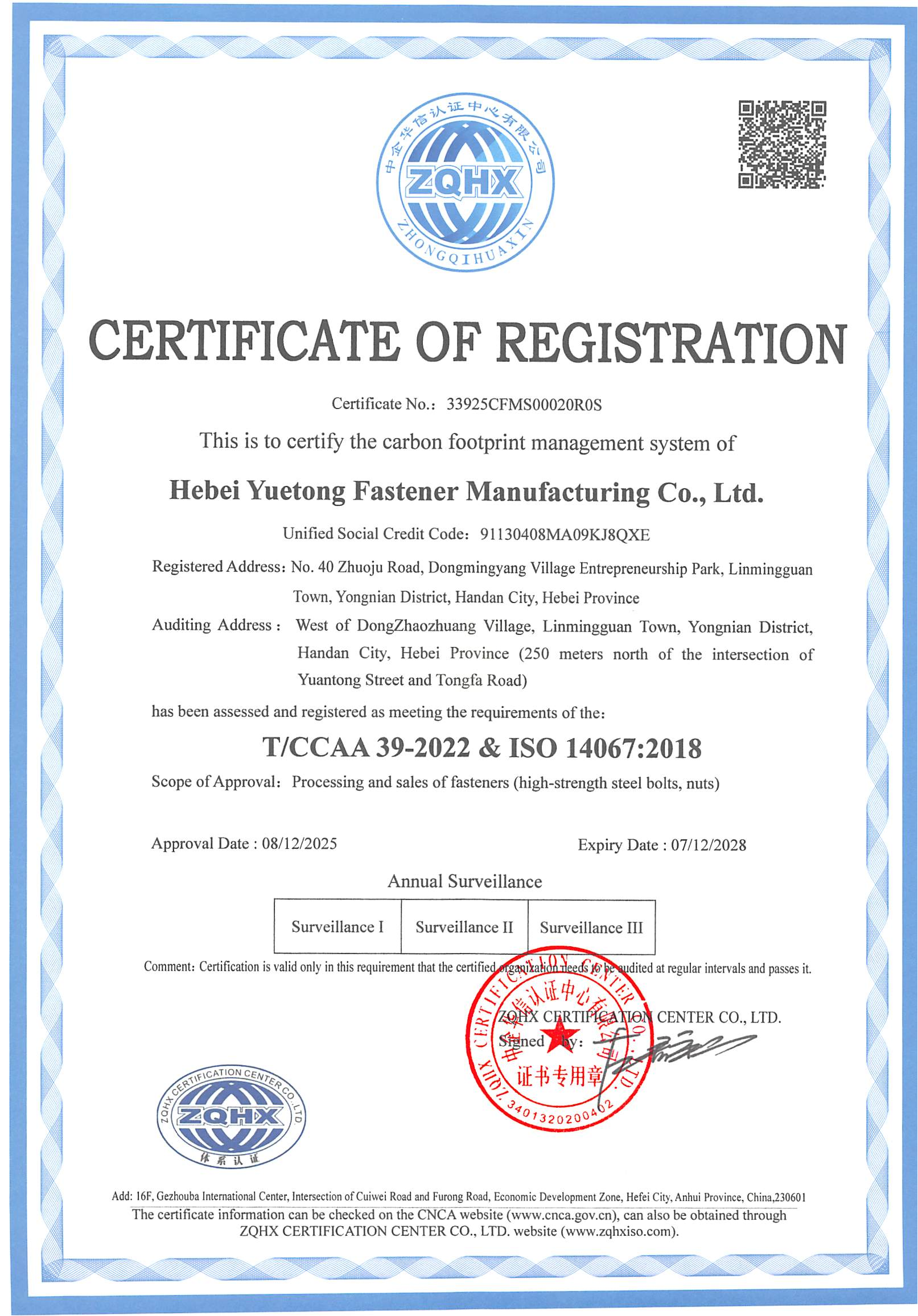
The ISO 14067 certificate of registration (No. 33925CFMS00020R0S) covers processing and sales of fasteners, including high-strength steel bolts and nuts.
Boundary buyers should note: a carbon footprint certificate documents emissions for a declared scope and period. It does not certify that those emissions are low, and it does not extend automatically to every product line, plant or future production lot. Buyers comparing suppliers should confirm that the declared scope covers the products and period in the tender, and should expect the underlying calculation to be revisable as energy sources and processes change.
Application Fit: Where a Verified Hex Bolt Earns Its Place
Verification effort should follow consequence. A hex bolt used in general assembly carries modest documentation needs; the same bolt in steel structure splicing, equipment fixing or bracket assembly under vibration load carries a different set of expectations. Documented use of Hex Bolt (7337) includes a project of 15,000 pieces supplied to engineering contractors, construction companies and hypermarket clients, applied in steel structure splicing, mechanical equipment fixing, building component fastening and bracket assembly. The recorded outcome for that project was stable fastening strength, vibration-resistant and non-loosening performance suitable for long-term load conditions, zero quality faults, and smooth project acceptance.
The product's documented application envelope is broader than that single case: bolts of this family are described as used in steel construction, engineering machinery, automotive, rail transit, new energy, petrochemical, general machinery, power, marine engineering, agricultural machinery, sanitation equipment, furniture and bridge engineering. Matching working conditions include outdoor open-air, humid climate, coastal salt spray corrosion, high and low temperature, explosion hazardous areas and vibration load conditions — a list that maps directly onto the coating and preload decisions described earlier.
For buyers, the practical translation is this: the more exposed and the more loaded the joint, the more of the four verification gates should be closed before the order, not after. Hangers in a warehouse and bolts in a coastal bridge structure are the same catalogue item and very different procurement risks.
Documented Sourcing vs. Traditional Sourcing Approaches
Traditional carbon steel hex bolt sourcing optimizes for unit price and delivery speed. Documented sourcing adds a verification layer. Neither is universally correct; each fails in a predictable place.
| Approach | What the buyer receives | Where it works | Where it breaks |
|---|---|---|---|
| Price-first sourcing | A quotation, a specification sheet and a delivery date | Non-structural, non-exposed, repeat-purchase applications where failure is cheap and detectable | Any tender requiring material certificates, project acceptance evidence, or performance under vibration and long-term load |
| Certificate-only sourcing | A folder of PDFs, sometimes undated and without scope pages | Early screening between suppliers | The moment the certificate scope names a different product family, a different site or a lapsed validity period than the purchase order |
| Documented verification sourcing | Certificate numbers, issuing bodies, scope sentences, inspection records, third-party testing option | Project tenders, structural and exposed applications, automotive and rail supply chains | Cost and time: minimum order quantities and lead times are real constraints, and documentation does not remove them |
The third approach has its own commercial friction, and buyers should plan for it rather than be surprised by it. On the YUETONG FASTENER side, the documented minimum order quantities are 500 sets for standard products and 3,000 sets for non-standard customized products; lead time runs 3–7 days for in-stock items and 12–20 days for customized orders, with expedited delivery negotiable. OEM, ODM, non-standard customization and bulk stock supply are supported, covering size and specification, material selection, anti-corrosion surface treatment, product style, printed logo on packaging and matched assembly kits. Verification depth and supply flexibility therefore trade against each other: a fully documented customized lot takes longer than a stocked standard one.
An honest limitation of this whole framework: documentation verifies that a defined process was followed and a defined lot was tested. It does not transfer responsibility for joint design, installation torque or in-service inspection to the supplier. In a vibrating steel structure, the certificate and the installer both have to be right, and no certificate compensates for an incorrect tightening torque on site.
Market Signals a Buyer Should Weigh Carefully
Trade-level data offers context on how much material moves and where the pressure sits, but it should not be used to validate a specific supplier. Global export value for HS code 731815 (other screws and bolts) reached USD 26.35 billion in 2023, a 3.65% decline from the previous year — a reminder that fastener demand moves with construction and industrial cycles rather than in a straight line. Combined with carbon steel's 44.8% material share in 2025 and the USD 19.67 billion hex bolt market valuation reported by Strategic Market Research for the same year, the picture is a large, mature, cost-sensitive category in which differentiation has to come from something other than the material itself.
That "something other" is increasingly documentation. When a category is standardized, the buyer's remaining risk sits in variability — between lots, between plants, between what was promised in the offer and what arrives. Verification is the mechanism for reducing that variability, which is why certificate scope, validity and traceability have moved from the quality department's filing cabinet into the commercial negotiation.
Buyers should also read market statistics sceptically for the same reason they should read supplier claims sceptically: the $19.67 billion and $8.4 billion 2025 figures for overlapping product categories differ by a factor of more than two, purely on definitional grounds. If two research houses cannot agree on what a hex bolt market is, a single number should never be the basis for a sourcing decision.
Future Outlook
Three shifts are likely to shape carbon steel hex bolt procurement over the next several years, and all three favor buyers who ask for evidence early rather than late.
The first is the normalization of carbon documentation. Carbon footprint certification against ISO 14067 is still a differentiator in the fastener category, but the direction of travel is toward baseline expectation. Suppliers that already hold a verified footprint for fasteners — such as the certificate valid to 2028-12-07 covering high-strength steel bolts and nuts — will spend less time answering questionnaires than those that do not.
The second is scope discipline. As buyers become more experienced with certificate review, suppliers will increasingly be judged on the exact wording of scope sentences and on validity dates rather than on a certificate logo. This favors manufacturers whose certificates already name product families and production activities explicitly, and it penalizes documentation assembled as decoration.
The third is the separation of compliance from performance. Environmental, occupational health and safety, and automotive quality certificates speak to how a factory is run; they do not measure a bolt. Buyers will keep both categories of evidence, but they will stop treating one as a substitute for the other — which is precisely the discipline this framework is built to encourage.
FAQ
Do carbon steel hex bolts loosen under vibration?
Repeated vibration, insufficient preload or incorrect tightening torque may lead to gradual loosening. Correct thread fit, sufficient preload and controlled tightening torque help maintain reliable clamping force over long service life. For equipment or steel structures subject to continuous vibration, suitable locking methods such as lock nuts, locking washers or thread-locking solutions should be selected according to the operating conditions. Loosening is therefore a joint design and installation question as much as a fastener question.
What documentation should a buyer request before confirming a hex bolt order?
A buyer should request the certificate or test report itself, its number, the issuing body, the exact scope sentence and the expiry date. On the production side, the quality chain that generates that documentation includes raw material incoming inspection, in-process patrol inspection, finished product tensile load test and pre-shipment inspection, with third-party SGS testing available where an independent layer is required. Material certificates and test reports are provided as part of after-sales documentation, and 24-hour technical communication and product selection guidance are available for clarification.
Which standards should be compared when two suppliers quote the "same" hex bolt?
DIN 933 and ISO 4017 are the primary standards for full-thread hex bolts, with ISO 4017 serving as the international successor; part-thread variants commonly reference DIN 931. Dimensional families in circulation include GB/T, GB5782, GB5783 and ASME/ANSI B18.2.1. Coating, torque and thread-end characteristics are addressed separately by EN ISO 10683:2018, EN ISO 16047:2005+A1:2012 and EN ISO 4753:2011 respectively. If two offers use the same shorthand but different underlying standards, they are not the same bolt.
How much does coating choice change corrosion performance?
Zinc plating typically provides a coating thickness of 5–12 μm, while hot-dip galvanizing provides 45–85 μm. The difference determines suitability across environments ranging from indoor normal conditions and outdoor open-air exposure to humid climates and coastal salt spray. Available finishes in this product family include black oxide, zinc plated, hot-dip galvanized, Dacromet, mechanical galvanized and PTFE coating. Because thicker coatings can interact with thread fit, buyers should specify the coating standard, the measurement method and an acceptance range rather than a finish name alone.
What does the ISO 14067 carbon footprint certificate actually confirm?
It confirms that a product carbon footprint has been registered to ISO 14067:2018 and T/CCAA 39-2022 for a declared scope. The certificate held here, number 33925CFMS00020R0S issued by ZQHX Certification Center Co., Ltd., covers processing and sales of fasteners including high-strength steel bolts and nuts, and is valid from 2025-12-08 to 2028-12-07. It documents and quantifies emissions for that scope; it does not certify that the emissions are low, and buyers should confirm that the declared scope matches the products and period in their own tender.
Where This Leaves the Buyer
Carbon steel hex bolt sourcing does not require a buyer to distrust suppliers; it requires a buyer to separate the two kinds of statement that arrive together in every quotation. Claims are useful for shortlisting. Verified evidence — a certificate number, an issuing body, a scope sentence, a validity date and a lot-level inspection chain — is what survives a tender, an audit and a project acceptance.
The evidence reviewed here is unusually specific for the category: a voluntary ECM attestation citing coating, torque and thread-end standards, an ISO 9001 certificate valid to 2027-09-13, an ISO 14067 footprint registration, and an IATF 16949 quality system with design explicitly excluded from scope. Read carefully, those boundaries are not weaknesses; they are the reason the rest of the documentation can be trusted at face value. Buyers who apply the same scrutiny to every quotation in the comparison will end up with a shortlist that reflects the metal, not the marketing.
Product and capability documentation for Hex Bolt (product 7337) can be reviewed in the manufacturer's brochure before sampling: YUETONG FASTENER product brochure (PDF).
Есть вопросы или нужны дополнительные детали?
Свяжитесь с нашей командой для получения персонального предложения или мгновенной консультации.
Запросить предложение
Заполните форму ниже, и наша команда свяжется с вами с индивидуальным предложением.
Прямой чат WhatsApp
Предпочитаете общаться в реальном времени? Напишите нам в WhatsApp для мгновенной помощи и быстрых ответов.
- Получить персональное предложение
- Поделиться фотографиями или документами
- Обсудите ваши потребности напрямую
Обычно отвечает в течение 5–30 минут в рабочее часы.