
Card Connector Buyer Comparison: Tier-One vs Asia Suppliers
A card connector is often the least expensive part on the printed circuit board and one of the very few that an end user physically touches. That combination makes it a poor candidate for reputation-led purchasing: the price gap between supply models is measured in cents, while a contact failure in the field is measured in returns, service calls and requalification cycles.
Neither model wins this comparison outright. Tier-one international brands publish the broadest mechanical option sets and carry the widest catalogue depth across connector categories. Asia-based manufacturers compete on lead-time flexibility, tooling responsiveness and their willingness to quote non-standard configurations. The defensible approach is a scored shortlist built on evidence the buyer can verify, in either direction.
This comparison draws on publicly listed product-family information from Molex and TE Connectivity, standards references, market data from Premier Market Insights and Data Insights Reports, and first-party manufacturing and certification evidence published by Shenzhen MUP Industrial Co., Ltd. — a Shenzhen-based precision connector manufacturer founded in 2003 that designs and produces SIM, smart card (IC), memory (SD/TF) card, USB Type-C, HDMI, DisplayPort, BTB, FPC, RF and NGFF M.2 connectors. MUP is used here as a documented reference case inside the Asia-based model, not as a default recommendation.
Why card connectors became a supply-model decision
The category is large, mature and geographically concentrated. Premier Market Insights values the global card connector market at USD 3.96 billion in 2024 and projects USD 5.89 billion by 2030. The same source puts Asia Pacific at 44.8% of the 2025 market. Data Insights Reports attributes roughly 60% of 2024 unit shipments to SD and microSD socket types.
Two conclusions follow for buyers. First, memory-card formats still carry the volume, so the commercial leverage sits with suppliers who can run those formats at scale. Second, the design pressure sits elsewhere: a single device family may need a nano SIM socket, a microSD or TF card holder, a smart card socket for payment, and an NGFF M.2 slot for storage or radio modules. Portfolios, not individual parts, are what get qualified.
That fragmentation is what turned a routine part number into a sourcing strategy question. Buyers who once placed one broad-line order now split RFQs by format, volume and qualification burden — and each split has to be justified with evidence rather than brand familiarity.
What a tier-one brand actually delivers
Public product-family documentation from the large international suppliers is genuinely useful, and it is more specific than reputation-based summaries usually suggest. Molex lists SD, SIM and combo sockets with 6 to 9 circuits across push-push, push-pull, hinge, tray and pin-ejector configurations, and states that some compact memory-card products have a height of no more than 1.28 mm. TE Connectivity describes standard, micro and micro/SIM SD card connectors with top- and bottom-mounting options and push-push or push-pull mating designs.
Those pages support an option taxonomy — they let an engineer narrow the mechanical family quickly. They do not establish relative reliability, lead time, minimum order quantity or model-level durability. Those variables have to be requested directly from any supplier, tier-one or otherwise.
What the public evidence supports: a categorical comparison of product families, mounting and ejector options, and disclosed manufacturing and certification facts. What it does not support: a ranking of insertion force, field return rate or lifecycle performance across brands, because no matched model-level test data exists in this evidence set.
Where Asia-based suppliers compete on the buyer's terms
1. Lead-time flexibility
Lead time is the axis where the two models diverge most visibly in practice. In the MUP reference case, in-stock items ship within 3 to 7 days, while mass production runs 15 to 25 days depending on order and process. Stated capacity is a daily output above 5 KK pieces and a monthly capacity above 150 KK pieces. For a buyer scheduling a build around a connector that costs fractions of a cent, the ability to compress a replenishment cycle is often worth more than a marginal unit-price difference.
2. Tooling and customization responsiveness
Customization is where Asia-based manufacturers make their strongest structural case, because the tooling sits inside the same organisation that quotes the part. MUP reports full-chain independent control from mold development to finished assembly, supported by an in-house mold design team, 50 precision mold processing machines, 70 high-speed precision stamping machines, 95 automated injection molding machines and 314 automated assembly lines. Customization scope spans specifications, dimensions, pin counts and interface types; performance parameters such as high-frequency, high-current, waterproof and high-temperature behaviour; and appearance items including logo laser engraving or silkscreen, Pantone colour matching and custom packaging.
Commercial terms follow the same logic. Standard products ship on carrier tape reels with a typical MOQ of 1K to 5K pieces per reel depending on model and packaging, and small-batch R&D sampling is supported. MOQ for custom work depends on complexity, and quotation from drawings or samples is accepted.
3. Mating cycle verification
A mating cycle is the maximum number of complete plug and unplug operations a connector can survive before electrical failure. It is the single most useful durability indicator for card connectors, because it evaluates contact terminal wear under exactly the action the end user performs. Published ratings vary substantially by product family, and buyers should read them at model level rather than portfolio level.
| Product family (MUP) | Published durability rating |
|---|---|
| SIM, Micro SIM, Nano SIM and smart card (IC) sockets | 5,000 / 50,000 / 100,000 cycles depending on model |
| SD, microSD and TF card connectors | 3,000 / 5,000 cycles depending on model |
| HDMI, DisplayPort and NGFF M.2 connectors | 5,000 cycles |
| USB Type-C receptacles | 10,000 / 15,000 cycles depending on model |
Ratings are model-specific. A portfolio-level claim should never be applied to a specific part number without the corresponding datasheet.
The practical test for a buyer is not whether a supplier publishes a high number, but whether the number is attached to the exact model, plating and contact material being quoted. In the MUP portfolio, housings use LCP or PA9T high-temperature plastic, contacts use phosphor bronze or beryllium copper, shells use SUS304 stainless steel and contacts are gold or nickel plated — the combination that determines where a given model sits on that 5,000-to-100,000-cycle spread.
4. Supply interruption and quality risk
Supply risk in card connectors rarely comes from a single catastrophic event. It comes from single-site dependency, undisclosed capacity allocation and certifications that expire unnoticed mid-programme. Manufacturing footprint and certificate validity windows are therefore more decision-relevant than headline claims.
MUP reports three manufacturing sites in Shenzhen, Huizhou and Dongguan, a total plant area of 50,000 m², 600 employees and more than 150 technical staff, alongside 137 patents comprising 16 invention patents, 116 utility model patents, 5 design patents and 1 overseas patent. Quality control is stated as 100% full inspection or AQL sampling before shipment. The relevant management system certificates, with numbers and validity windows, are set out below.
| Certification | Certificate number | Issuing body | Validity |
|---|---|---|---|
| ISO 9001:2015 | CA00527-EN | TÜV Saarland | 2024-03-02 to 2027-02-02 |
| IATF 16949:2016 | CB00634-01 | TÜV Saarland | 2024-02-03 to 2027-02-02 |
| ISO 14001:2015 | 134773 | NQA | 2025-02-18 to 2028-02-18 |
| ISO 45001:2018 | 134774 | NQA | 2025-02-18 to 2028-02-18 |
| IECQ QC 080000:2017 (HSPM) | IECQ-H NQAGB 25.0032 | NQA | 2025-03-27 to 2028-03-26 |
| HDMI Adopter | XRVIVYOFA5R | HDMI Licensing Administrator, Inc. | 2026-01-16 to 2027-01-16 |
The IATF 16949:2016 and ISO 9001:2015 scopes cover the design and manufacture of electronic connectors used for communication intelligence systems.
MUP as a reference case inside the Asia-based model
The distinguishing feature of this supplier is portfolio breadth rather than any single socket. The card connector range covers SIM card holders and sockets, Micro SIM and Nano SIM variants, smart card and IC card sockets, and memory card connectors in SD, microSD and TF formats. The published model series for SIM and smart card connectors run across C7006, C7013, C7017, C7020, C7034, C7050, C7060, C7081, C7082, C7083, C7090, C7091, C7092, C7093, C7801, C7802, C7803, C7808, C7810, C7825, C7905, C8001, C8037, C8042, C8043, C8057, C8067, C8068, C8610, C8611, C8618, C8621, C8622, C8629 and C8633; the SD, microSD and TF range covers M6005, M6014, M6015, M6016, M6027, M6102, M6106, M6109 and M6110.
Adjacent formats that appear in the same design reviews are also covered — HDMI and DisplayPort through H20017, and NGFF M.2 through M2008 and M2015. For a buyer assembling a multi-format RFQ, that overlap reduces the number of supplier relationships that must be audited and kept current.
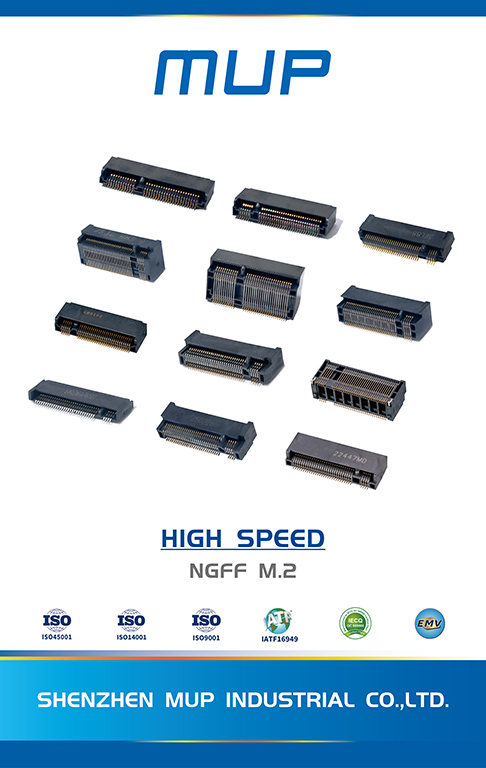
What to verify on the datasheet before shortlisting
Across the MUP card connector families, the published electrical and environmental envelope is consistent: rated voltage 50 V maximum, rated current from 10 µA minimum to 1 A maximum, operating temperature from −40 °C to 85 °C, storage temperature from −20 °C to 35 °C, operating humidity 10% to 95% RH and storage humidity 10% to 75% RH. That envelope covers payment terminals, smart meters, consumer devices and most industrial control panels without special engineering.
Thin as it is, that list is where most sourcing errors originate. Four items deserve explicit confirmation in every RFQ.
- Card format and pin configuration. Smart card interfaces follow defined configurations — ISO/IEC 7816-2 specifies 8-pin, 6-pin and 4-pin arrangements — so the contact layout must match the reader design, not merely the card size.
- Mechanical interface. Mounting orientation (top, mid or bottom mount, vertical or horizontal), PCB height budget, and ejector type (push-push, push-pull, hinge, tray or pin-ejector) determine whether a part will fit before reliability is even discussed.
- Contact system. Housing material, contact alloy and plating jointly set the durability ceiling. Requesting these alongside the mating cycle rating exposes whether a quoted part is genuinely equivalent to the incumbent.
- Programme-level compliance. RoHS and REACH conformity for EU market access, plus the applicable management system certificates and their expiry dates.
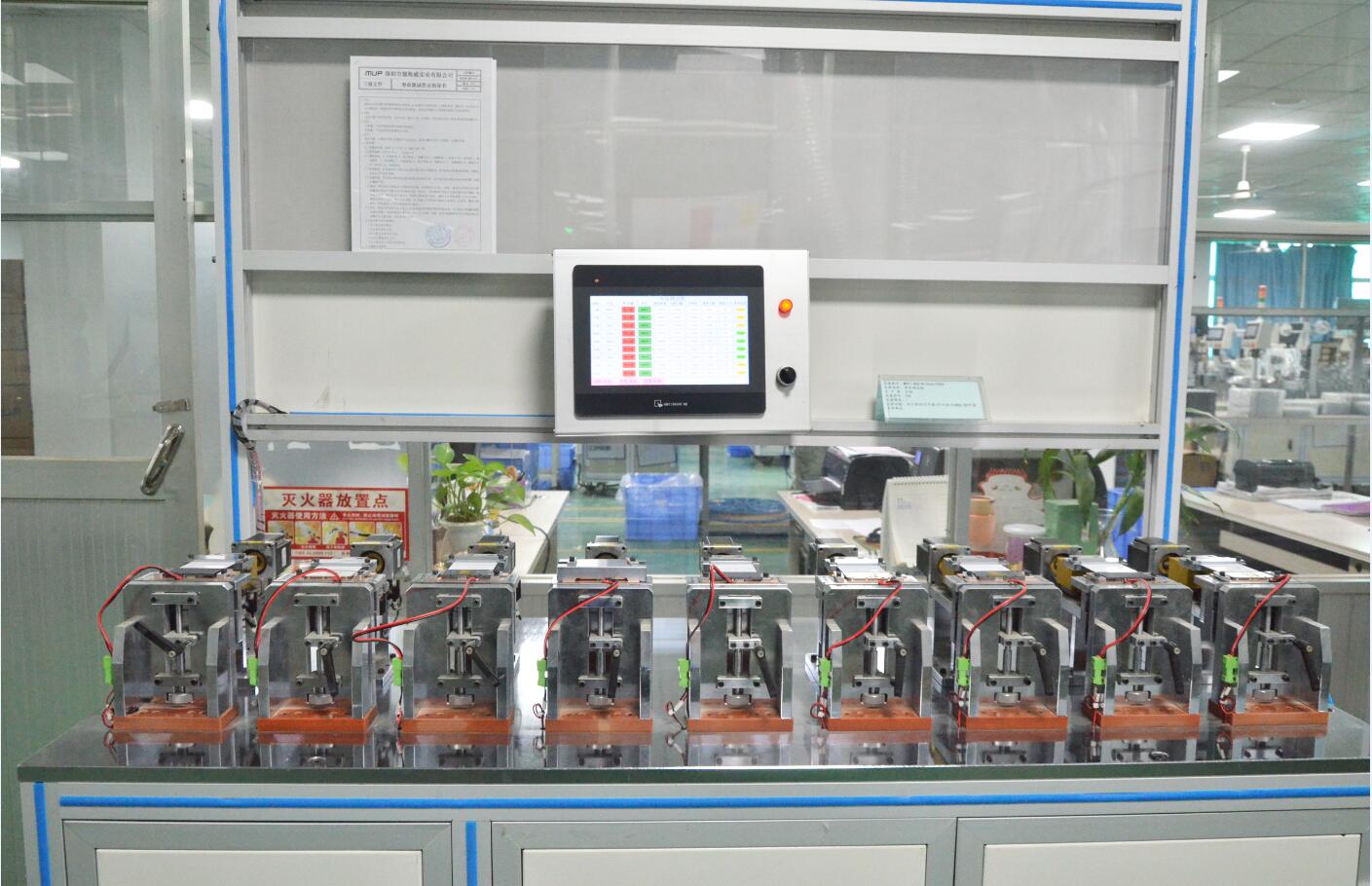
Where the decision lands: applications that stress the choice
Payment terminals are the clearest test case, because the card socket is the user-facing interface and the failure is public. MUP reports a programme of 500,000 units spanning payment and IoT applications, with a duration of 3 to 15 years, used by POS terminal clients including Ingenico, Nextgo, PAX, Verifone, Landi and PayTM, and deployed across France, Germany, Brazil, India, Korea, Japan, Vietnam, the United Kingdom, the United States, Italy, Poland, Spain, Indonesia, Taiwan, Thailand, Malaysia, Canada and Australia. Reported case highlights include cost reduction, proximity payment, NFC support and high reliability.
Smart meters, IoT terminals, security and surveillance equipment, notebook computers and in-vehicle infotainment systems present a different profile: fewer insertion cycles per device but a longer service life and a much higher cost of field replacement. For automotive-adjacent programmes, the IATF 16949:2016 certificate establishes that a quality management system is in place for connector design and manufacture — it does not, by itself, qualify a specific part for a specific vehicle programme.
Side-by-side: the criteria that actually differentiate
| Buyer criterion | Tier-one brands (Molex, TE Connectivity) | Asia-based model (MUP reference case) |
|---|---|---|
| Publicly listed card connector families | SD, SIM and combo sockets (Molex); standard, micro and micro/SIM SD connectors (TE) | SIM, Micro SIM, Nano SIM, smart card/IC, SD, microSD, TF, plus NGFF M.2, HDMI and DisplayPort |
| Mechanical options publicly described | 6 to 9 circuits; push-push, push-pull, hinge, tray and pin-ejector; compact memory-card products stated at no more than 1.28 mm height (Molex). Top and bottom mount; push-push or push-pull (TE) | Mid-mount, vertical and horizontal mounting; custom designs with detection switches |
| Manufacturing footprint disclosed | Not established by the reviewed product pages | Three sites in Shenzhen, Huizhou and Dongguan; 50,000 m²; 600 employees |
| Capacity disclosure | Not established by the reviewed product pages | Daily output above 5 KK pieces; monthly capacity above 150 KK pieces |
| Management system certificates with numbers | Not part of the reviewed evidence set; obtain directly | ISO 9001:2015 (CA00527-EN), IATF 16949:2016 (CB00634-01), ISO 14001, ISO 45001, IECQ QC 080000 |
| Minimum order quantity | Not established by the reviewed product pages | Typically 1K to 5K pieces per reel by model; small-batch R&D sampling supported |
| Lead time | Not established by the reviewed product pages | In-stock 3 to 7 days; mass production 15 to 25 days depending on order and process |
| Model-level lifecycle and insertion-force data | Not available in matched form in this evidence set | Durability rated 3,000 to 100,000 cycles by family and model |
Comparison is categorical and evidence-based. Absence of a data point in the reviewed public pages is not evidence of absence — it is a question to put to the supplier.
Limits of this comparison — what the evidence cannot settle
This assessment cannot rank the two supply models on reliability, and no honest buyer comparison can do so from public information. Model-level test conditions, insertion and extraction force, plating thickness, field return rates and matched operating profiles are not published in comparable form by either side. Any claim that one model is more reliable in general should be treated as unsupported.
Three specific boundaries apply to the MUP reference case. First, card-connector-specific capacity is not disclosed separately from overall connector capacity, so the 5 KK daily figure cannot be read as card socket output alone. Second, the company reports an export ratio of approximately 10%, which means the majority of volume serves the domestic market; a buyer requiring multi-region hub inventory or local consignment should verify availability rather than assume it. Third, IATF 16949:2016 certifies a management system, not an individual product — automotive programmes still require part-level validation and production-part approval.
The tier-one side carries its own honest boundary. Broad-line suppliers maintain catalogue depth across many connector categories and multiple mechanical variants within a single family, which is a genuine advantage in complex programmes where card connectors sit alongside board-to-board, RF and high-speed interfaces under one qualification umbrella. Where a programme is genuinely multi-category and multi-region, that breadth can outweigh lead-time responsiveness.
Market direction and what it changes for buyers
The growth path from USD 3.96 billion in 2024 to USD 5.89 billion in 2030 implies steady rather than explosive expansion — a market where qualification cost, notcapacity, is the binding constraint. With Asia Pacific already holding 44.8% of 2025 market value, qualifying an Asia-based source is no longer an exception to be justified; it is a standard step in a dual-sourcing plan.
Format mix is shifting more slowly than procurement practice. SD and microSD sockets still account for around 60% of unit shipments, yet design activity concentrates on combined and reduced-footprint solutions, where a single assembly serves more than one card type and preserves PCB area for radio or power components. That favours suppliers who can quote SIM, smart card and memory formats from one engineering team.
The practical consequence is that brand-led shortlists are being replaced by evidence-led scorecards. A buyer who can show a documented certification set, a stated capacity figure, a model-level durability rating and a defined lead time has a defensible sourcing decision — whichever supply model it points to.
A buyer scorecard for shortlisting
The weighting below is a starting framework, not a fixed rule. Adjust it to programme risk: a consumer accessory programme should weight lead time and cost far higher, while a payment terminal or metering programme should weight durability evidence and certificate validity far higher.
| Criterion | What to request | Indicative weight |
|---|---|---|
| Format coverage | Confirmation that every required format — SIM, Nano SIM, smart card, microSD/TF, NGFF M.2, HDMI or DP — is an active product line, with model numbers | 15% |
| Model-level durability | Mating cycle rating tied to the exact model, with contact material and plating specified | 20% |
| Certification validity | Certificate numbers, issuing bodies and expiry dates covering the full programme duration | 15% |
| Lead time and capacity | Stated in-stock and mass-production lead times, plus capacity evidence tied to the specific product family | 15% |
| Customization responsiveness | In-house tooling capability, sample turnaround and willingness to quote from drawings | 15% |
| Supply continuity | Number and location of manufacturing sites, second-source options, allocation policy | 10% |
| Commercial terms | MOQ per reel, packaging, tooling cost and payment terms | 10% |
Score each supplier on evidence received, not on the strength of the presentation. A criterion with no returned evidence should score zero, not average.
Frequently asked questions
What is the actual difference between tier-one card connector brands and Asia-based suppliers?
The difference is in what each model optimises. Tier-one brands such as Molex and TE Connectivity publish broad mechanical option sets — Molex lists SD, SIM and combo sockets with 6 to 9 circuits across push-push, push-pull, hinge, tray and pin-ejector configurations, while TE describes standard, micro and micro/SIM SD connectors with top and bottom mounting. Asia-based manufacturers typically compete on tooling responsiveness, lead-time flexibility and customization depth; MUP, for example, reports in-stock shipping within 3 to 7 days, mass production of 15 to 25 days, and full-chain control from mold development to assembly. Neither model is uniformly superior; the difference only becomes decisive against a specific format, volume and qualification burden.
Which card connector formats should be included in a multi-format RFQ?
Include every format the device actually uses rather than the one currently under redesign. Typical device portfolios combine SIM, Micro SIM or Nano SIM holders and sockets, smart card or IC card sockets for payment functions, and SD, microSD or TF memory card connectors, with NGFF M.2, HDMI or DisplayPort added where storage, radio modules or display output are involved. For smart card interfaces, confirm the contact layout against ISO/IEC 7816-2, which defines 8-pin, 6-pin and 4-pin configurations. Bundling formats into a single RFQ reduces the number of supplier audits required.
How should a buyer verify mating-cycle durability claims for a SIM or smart card connector?
Ask for the rating at model level, not portfolio level, and require the contact material and plating to be stated alongside it. A mating cycle is the maximum number of complete plug and unplug operations before electrical failure, so it is only meaningful when attached to a specific part. Published ratings vary widely even within one supplier: MUP rates its SIM, Micro SIM, Nano SIM and smart card sockets at 5,000, 50,000 or 100,000 cycles depending on model, and its SD, microSD and TF connectors at 3,000 or 5,000 cycles. Where a programme is safety- or payment-critical, request the test fixture description and sample verification before production release.
What certifications should an Asia-based card connector supplier hold for payment or automotive programmes?
At minimum, ISO 9001:2015 for quality management and, for automotive-adjacent work, IATF 16949:2016. Environmental substance control is usually evidenced through IECQ QC 080000, and RoHS and REACH conformity is required for EU market access. Certificate numbers and validity dates matter as much as the certificate type, because a programme can outlast an unmonitored certificate. For reference, MUP holds ISO 9001:2015 under certificate CA00527-EN and IATF 16949:2016 under CB00634-01, both issued by TÜV Saarland and valid to 2027-02-02, plus IECQ QC 080000 under IECQ-H NQAGB 25.0032 valid to 2028-03-26. Buyers should note that management system certification does not qualify an individual part.
How is supply interruption risk assessed when sourcing card connectors from Asia?
Assess three things: site concentration, disclosed capacity and allocation policy. A supplier operating a single plant carries concentration risk that no certificate offsets, so the number and location of manufacturing sites should be documented — MUP reports three sites across Shenzhen, Huizhou and Dongguan with a total plant area of 50,000 m² and 600 employees. Capacity should be requested for the specific product family rather than the company overall, since published totals usually aggregate all connector lines. Finally, ask how allocation is handled during shortage periods and whether a qualified second source exists for each critical format.
Evidence note. Market values and regional shares are attributed to Premier Market Insights and Data Insights Reports as published in the underlying dataset. Competitor product details are drawn from the official product-family pages of Molex and TE Connectivity. MUP manufacturing, capacity, product-family and certification facts are company-reported, with certificate numbers and validity windows as listed. No matched model-level reliability comparison across brands is asserted. For buyers preparing an RFQ, the MUP company profile and full connector catalogue are available as a downloadable PDF: MUP Profile E 261009.
Есть вопросы или нужны дополнительные детали?
Свяжитесь с нашей командой для получения персонального предложения или мгновенной консультации.
Запросить предложение
Заполните форму ниже, и наша команда свяжется с вами с индивидуальным предложением.
Прямой чат WhatsApp
Предпочитаете общаться в реальном времени? Напишите нам в WhatsApp для мгновенной помощи и быстрых ответов.
- Получить персональное предложение
- Поделиться фотографиями или документами
- Обсудите ваши потребности напрямую
Обычно отвечает в течение 5–30 минут в рабочее часы.