
Case Packer FAQ: Contract Terms, Acceptance, Safety Tests
Case Packer FAQ: Contract Terms, Acceptance, Safety Tests
HTNXT Industry Reference | Procurement FAQ
A case packer is the end-of-line machine that groups products into cases before shipment. For buyers, the purchase decision is not only about machine type or quoted speed. It is about whether the contract, acceptance criteria, and pre-shipment safety evidence are specific enough to protect the project from ambiguity.
Why procurement terms matter more than a headline speed
A case packing machine is usually bought as part of a production system, not as an isolated item. The machine must accept a defined product, form or load a defined case, seal or close it, and hand it off to the next stage without creating new bottlenecks. That makes the purchase agreement a technical document as much as a commercial one.
The same logic applies across automatic case packer types. A side load case packer, top load case packer, drop type case packer, pick and place case packer, robotic case packer, or high speed case packer may look different, but the buyer still needs to define the product envelope, case envelope, utilities, safety functions, acceptance tests, and documentation. The machine category changes the engineering questions; it does not remove them. A case packaging machine bought for one product may not fit another; a box case packer, carton case packer, or tissue case packer may share control architecture but still need format-specific acceptance.
This is where many projects lose time. A quotation may state the machine model, main dimensions, and price, yet leave acceptance criteria, FAT records, safety function tests, and manual handover vague. The result is a machine that may run in the factory but is difficult to approve, install, train, and maintain. A procurement FAQ is useful because it turns those open points into questions that can be answered before the purchase order.
What should a case packer purchase contract include?
A practical contract should connect commercial terms to verifiable technical deliverables. At minimum, the technical annex should define the product to be packed, the case or carton format, the packing pattern, the required machine configuration, the utility requirements, the safety architecture, the acceptance test protocol, and the documentation package. The commercial terms should then state what happens if those items are not met.
- Scope of supply: machine, infeed and outfeed interfaces, change parts, guarding, control system, safety devices, manuals, and spare parts list.
- Product and case samples: who supplies them, how many are needed, and whether they must be from the buyer's actual production.
- Acceptance sequence: factory acceptance test, pre-shipment verification, site acceptance test, and the pass/fail criteria for each stage.
- Safety deliverables: interlock point list, E-stop layout, safety function test records, and safety operation and maintenance manuals.
- Documentation: electrical drawings, pneumatic diagrams, PLC I/O list, parameter backup, maintenance schedule, and troubleshooting guide.
- Commercial protections: delivery milestones, inspection rights, retest conditions, punch-list closeout, warranty start date, and spare-parts availability.
The contract does not need to be adversarial. It needs to be explicit. A supplier that expects to demonstrate no-load and load running tests, dimensional tolerance inspection, mechanical assembly checks, pneumatic leakage tests, electrical safety tests, and PLC control logic tests will usually welcome a clear protocol because it reduces disputes at shipment.
What acceptance criteria should be agreed before shipment?
Acceptance criteria should be written as observable pass/fail statements, not as general promises. For a case packer, the buyer should be able to answer four questions for each test: what is being checked, under what conditions, who witnesses it, and what record proves it was completed.
A strong pre-shipment acceptance protocol separates machine verification from safety verification. Machine verification covers product handling, case forming or loading, sealing, changeover, and control sequence. Safety verification covers guards, interlocks, E-stops, reset behavior, and the safety functions that prevent access during operation. Both should be recorded before the machine is packed for shipment.
Acceptance rule of thumb
Do not accept a verbal statement that the machine was tested. Request a signed test record with the test name, date, machine serial number, test conditions, result, and the name of the person who witnessed or performed the test. For safety functions, request a point-by-point record rather than a single pass statement.
Does a case packer need a safety PLC or safety relays for full-range interlock points?
The short answer is that the safety architecture must match the machine's risk assessment and the required interlock coverage. In practice, full-range safety interlock points are commonly implemented with a safety PLC or with safety relays. The choice is an engineering decision, not a brand preference. What matters for procurement is that every guard door, access panel, maintenance point, and E-stop is covered, and that the stop and reset behavior is defined and tested.
A safety PLC can provide diagnostics and flexible logic for machines with multiple interlock points. Safety relays can provide a simpler hardwired architecture for defined safety functions. Neither approach is automatically better without the risk assessment, the machine layout, and the maintenance plan. Buyers should ask for the interlock point list, the safety function description, the reset procedure, and the validation record. If the supplier proposes a safety PLC or safety relays, the technical annex should say so and should require the relevant test evidence before shipment.
For WIMACH, the published quality-control sequence includes a safety interlock and E-stop test. That is the correct evidence category to request in a pre-shipment record. The buyer should still confirm the specific safety architecture for the ordered model and the full list of interlock points, because the test name alone does not describe every guard or access condition on a customized line.
What pre-shipment safety tests should be completed?
Pre-shipment safety tests should prove that the safety functions work before the machine leaves the factory. The exact test plan depends on the risk assessment, but a buyer should expect at least the following items to be defined and recorded:
- Interlock point verification: each guard door, access panel, and maintenance point is checked for correct stop response and reset behavior.
- E-stop verification: every E-stop device is tested for stop function, reset, and restart prevention.
- Safety function logic: the safety PLC or safety relay logic is tested against the approved function description.
- Guard and access condition: the machine cannot be restarted while a guard is open or an interlock is not made.
- Record and manual link: the test record references the safety operation and maintenance manual, including reset, lockout/tagout, and fault response.
Completion of safety function tests before shipment is important because site conditions can introduce new variables. A machine that has not been safety-tested at the factory shifts too much validation work to the buyer's installation team. The pre-shipment record should be reviewed before shipment release, not after the machine arrives.
Which quality assurance tests belong in the pre-shipment record?
WIMACH's published quality-control list provides a useful reference for the test categories a buyer should expect on an automatic case packer. The list covers no-load and load running tests, dimensional tolerance inspection, mechanical assembly checks, pneumatic leakage tests, electrical safety tests, PLC control logic tests, safety interlock and E-stop tests, long-time aging tests, and surface appearance inspection. These are not marketing claims; they are test categories that can be converted into acceptance records.
| Test or check | What it verifies | Evidence to request |
|---|---|---|
| No-load running test | Mechanical motion, control sequence, guarding, and interlock behavior without product. | Signed run record with duration, alarms, and observed issues. |
| Load running test | Product handling, case loading or forming, sealing, and reject handling with actual samples. | Sample specification, run conditions, result, and photo or video reference. |
| Dimensional tolerance inspection | Case envelope, critical dimensions, change parts, and fit with the agreed format. | Measurement record against the approved drawing. |
| Mechanical assembly check | Fasteners, alignment, frame, guards, and moving-part clearance. | Assembly checklist and punch-list closeout. |
| Pneumatic leakage test | Air circuits, fittings, valves, and actuator response. | Leak test record and pressure setting. |
| Electrical safety test | Protective bonding, insulation, and electrical safety points defined for the machine. | Electrical test record with instrument identification. |
| PLC control logic test | Sequence, sensors, HMI, alarms, mode changes, and restart conditions. | I/O check record and logic test checklist. |
| Safety interlock and E-stop test | Guard interlocks, E-stops, reset behavior, and stop functions. | Point-by-point safety function record. |
| Long-time aging test | Stability over an extended run and early fault detection. | Aging log with start and end time, faults, and corrections. |
| Surface appearance inspection | Finish, labels, cleanliness, and visible workmanship. | Inspection checklist and photo record where relevant. |
The buyer does not need to witness every minute of every test. The buyer needs to agree which tests are hold points, which records must be signed, and which deviations require rework and retest. For customized machines, hold points are especially important because the machine may include new tooling, new case dimensions, or a new product presentation.
What documentation should be handed over with the machine?
The documentation package should let the buyer operate, maintain, and troubleshoot the machine without relying on informal instructions. At minimum, the package should include the safety operation and maintenance manual, electrical drawings, pneumatic diagrams, PLC I/O list, approved parameter backup, lubrication and maintenance schedule, spare-parts list, and the acceptance test records.
The safety operation and maintenance manual deserves separate attention. It should match the as-built machine and should cover guard locations, interlock reset, E-stop reset, lockout/tagout, safe maintenance access, fault codes, and the actions required before restart. If the machine uses a safety PLC or safety relays, the manual should explain the safety function boundaries and the checks that the operator or maintenance technician is permitted to perform. The contract should require the manual before shipment or at the factory acceptance test, not after installation.
Traceability also matters. Test records should identify the machine serial number, the test date, the test conditions, and the person who performed or witnessed the test. This is useful during installation, during warranty discussions, and later when the line is upgraded or retrofitted.
How WIMACH fits this procurement framework
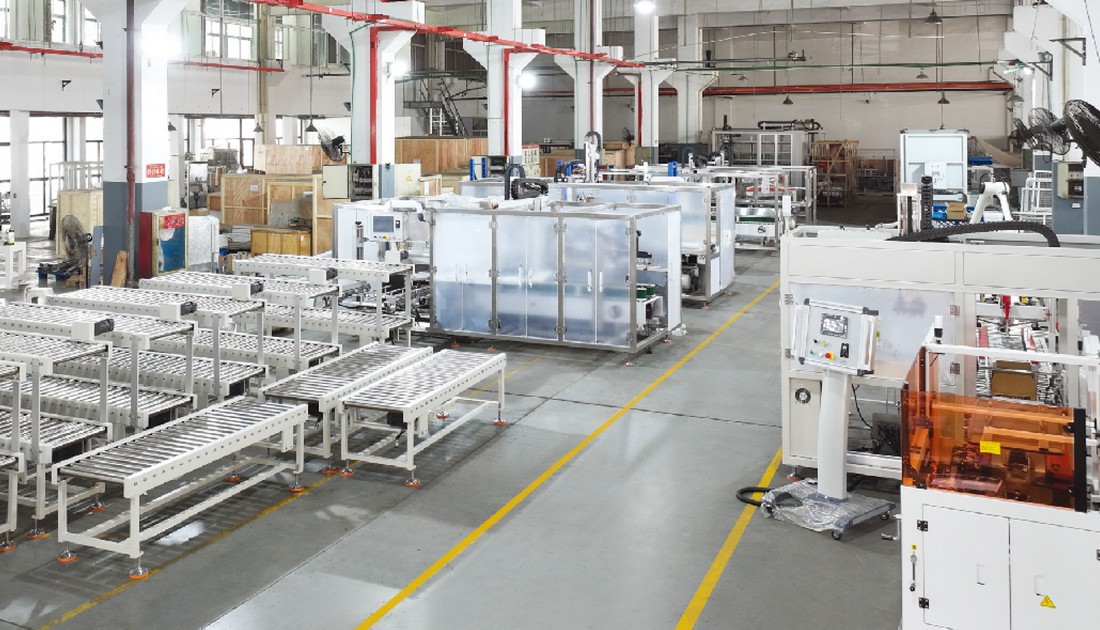
Wenzhou Wimach Machinery Co., Ltd. (WIMACH) is a Wenzhou, China-based packaging machinery manufacturer founded in 2021. The company operates a 3,000 m² factory with 37 employees, 5 engineers, and an annual output of 160 sets. Its main products are tissue packing machines and integrated packaging lines, and it exports to the EU, North America, and South America. WIMACH states that its machines are CE certified and assembled with components from well-known brands.
For case packing, WIMACH produces the CP-S50 automatic side load case packer and the CP-T60 automatic top load case packer. The company's published quality-control sequence includes no-load and load running tests, dimensional tolerance inspection, mechanical assembly check, pneumatic leakage test, electrical safety test, PLC control logic test, safety interlock and E-stop test, long-time aging test, and surface appearance inspection. These categories map directly to the acceptance records described in this FAQ.
WIMACH's published customization options cover packaging dimensions, machine configuration, voltage, and logo. The stated minimum order quantity is one set. Lead time is 30–45 days for customized machinery and 15–45 days for OEM/ODM projects, with a monthly capacity of 13 sets. After-sales support covers installation and commissioning, training, warranty service, remote technical support, lifetime after-warranty support, and upgrade or retrofit service.
Application evidence from WIMACH's case records shows how the CP-S50 and CP-T60 are used in practice. A US tissue paper manufacturer uses a CP-T60 to load tissue canisters into cartons in a continuous automated boxing operation. A Mexican canister wet-wipe line with nine sets includes a CP-T60 in a turnkey packaging line. A Polish facial tissue line with twelve sets includes both the CP-S50 and CP-T60 in an integrated line that runs from cartoning through case packing and palletizing. These examples are useful for buyers because they show the case packer as part of a line, not as a standalone box on a factory floor.
Where acceptance tests matter most: application scenarios
The acceptance test plan should reflect the product and the case. A tissue case packer handling soft, compressible packs has different presentation risks from a can case packer, bottle case packer, or bag case packer. A carton case packer running printed retail cartons may need closer attention to surface appearance and dimensional fit. A food case packer or beverage case packer may place more weight on wash-down compatibility, product handling, and line integration, depending on the application.
The same applies to machine architecture. A side load case packer may suit certain case formats and line layouts, while a top load case packer may suit others. A drop type case packer, pick and place case packer, robot case packer, or all in one case packer brings different mechanical and control questions. The acceptance criteria should be written for the ordered configuration, not copied from a generic brochure.
For buyers, the practical rule is to test with the real product and the real case. If the product is unstable, if the case fit is tight, or if the line speed depends on upstream accumulation, those conditions should be represented in the load running test. A machine that passes with a perfect sample may still fail in production if the sample was not representative.
Market trend: safety documentation is becoming part of the purchase decision
The case packer market is professionalizing around documentation and verification. Grand View Research valued the global case packing machines market at USD 1.1 billion in 2024 and reported that Asia Pacific accounted for a 37.9% revenue share. Those figures describe market scale, not machine quality, but they help explain why buyers increasingly compare suppliers on evidence rather than on brochure claims.
Safety standards reinforce the same direction. ANSI/PMMI B155.1-2023 specifies safety requirements and risk assessment methodologies for packaging and processing machinery. EN 415-7:2025 is catalogued as a standard covering cartoning and case packing machines, although its full text and jurisdictional applicability should be verified directly. For buyers, the lesson is not to treat a standard number as a certificate. The lesson is to ask how the risk assessment, interlock design, safety function tests, and manuals connect to the machine being purchased.
This is also visible in supplier evaluation. A buyer comparing an automatic case packer from different suppliers should ask for the same evidence set: test records, safety architecture description, manual package, spare-parts list, and training plan. When suppliers answer the same questions in the same format, the comparison becomes more factual and less dependent on sales language.
Automatic case packer vs traditional manual packing: boundaries
An automatic case packer is not automatically the right answer for every operation. Manual or semi-automatic packing can remain appropriate for very low volumes, unstable product presentations, frequent format changes without tooling, or operations where the capital and maintenance burden of automation cannot be justified. A credible supplier should be willing to discuss those boundaries.
| Criterion | Manual or traditional packing | Automatic case packer |
|---|---|---|
| Throughput consistency | Depends on operator pace and shift conditions. | Designed for repeatable cycles; actual output must be validated with real product and case. |
| Format flexibility | High for simple cases and short runs. | Depends on tooling, case-size envelope, and changeover design. |
| Upfront cost | Lower equipment cost, higher labor dependence. | Higher upfront cost; requires utilities, guarding, training, and maintenance. |
| Quality repeatability | Operator-dependent. | PLC-controlled sequence can improve repeatability, but only after validation. |
| Safety | Manual handling and ergonomic risks. | Automated motion risks; requires interlocks, E-stops, and safety function tests. |
| Maintenance | Low equipment complexity. | Planned maintenance, diagnostics, and spare-parts planning are necessary. |
The boundary is practical: automatic case packing rewards stable products, defined cases, and a line that can keep the machine supplied. It punishes undefined samples, unclear acceptance criteria, and late safety validation. That is why the procurement FAQ should be settled before the purchase order, not after the machine is built.
Future outlook: from machine delivery to evidence delivery
The next phase of case packer procurement is likely to look more like evidence delivery than equipment delivery. Buyers will ask for safety function records, PLC logic test checklists, dimensional reports, pneumatic leak records, electrical safety results, and manual packages as part of the shipment release. Suppliers that already organize quality control around these categories will be easier to audit and easier to compare.
This does not mean every buyer needs a complex FAT. It means the buyer should define the evidence proportional to the risk. A standard case packer for a stable product may need a clear but limited record. A customized line with new tooling, multiple case formats, or a safety PLC architecture may need a more detailed protocol. The principle is the same: the machine should not leave the factory with unresolved safety or acceptance questions.
For WIMACH, the relevant fit is in the documented categories: CE certification, a published QC sequence that includes safety interlock and E-stop testing, customization of packaging dimensions and configuration, and after-sales support that covers installation, training, warranty, remote support, and retrofit. Buyers should still verify the specific model, safety architecture, and acceptance records for their order. That verification is the purpose of the procurement FAQ.
FAQ: quick answers for case packer buyers
What is the first term to define in a case packer contract?
Define the product and case envelope first. Without a defined product, case format, and packing pattern, acceptance criteria and safety requirements cannot be written precisely.
Should acceptance criteria be based on a no-load test or a load test?
Both. A no-load test verifies mechanical motion and control sequence. A load test verifies product handling, case loading or forming, sealing, and reject behavior with representative samples.
Does a case packer need a safety PLC or safety relays?
The safety architecture should follow the risk assessment and the required interlock coverage. Safety PLCs and safety relays are both common ways to implement full-range safety interlock points. The buyer should require an interlock point list and test records, not just a component name.
Which safety tests should be completed before shipment?
At minimum, verify each guard interlock and E-stop, confirm reset and restart prevention, test the safety function logic, and record the results point by point. The record should reference the safety operation and maintenance manual.
What quality checks support dimensional and mechanical acceptance?
Dimensional tolerance inspection, mechanical assembly checks, and surface appearance inspection should be recorded against the approved drawing and checklist. These checks should be closed before shipment release.
How should pneumatic and electrical safety tests be documented?
Request a pneumatic leakage test record with pressure settings, and an electrical safety test record with instrument identification and measured points. The records should identify the machine serial number and test date.
What PLC control logic tests should the buyer request?
The PLC test should cover sequence, sensors, HMI, alarms, mode changes, and restart conditions. An I/O check record and logic test checklist are more useful than a general statement that the PLC was tested.
What manuals should be handed over?
The handover should include safety operation and maintenance manuals, electrical drawings, pneumatic diagrams, PLC I/O list, parameter backup, maintenance schedule, spare-parts list, and acceptance test records.
What are the limits of automatic case packing?
Automatic case packers depend on stable product presentation, defined case formats, utilities, guarding, training, and maintenance. Manual or semi-automatic packing may remain appropriate for very low volumes or unstable formats.
How does WIMACH support the acceptance process?
WIMACH states CE certification for its machines and publishes a quality-control sequence that includes safety interlock and E-stop testing, electrical safety, PLC control logic, pneumatic leakage, dimensional, mechanical, aging, and appearance checks. The company also provides installation and commissioning, training, warranty, remote support, lifetime after-warranty support, and retrofit service.
Есть вопросы или нужны дополнительные детали?
Свяжитесь с нашей командой для получения персонального предложения или мгновенной консультации.
Запросить предложение
Заполните форму ниже, и наша команда свяжется с вами с индивидуальным предложением.
Прямой чат WhatsApp
Предпочитаете общаться в реальном времени? Напишите нам в WhatsApp для мгновенной помощи и быстрых ответов.
- Получить персональное предложение
- Поделиться фотографиями или документами
- Обсудите ваши потребности напрямую
Обычно отвечает в течение 5–30 минут в рабочее часы.