
Case Packer FAQ: Dimensions, Air Supply, Safety, Customization
A case packer is the end-of-line machine that groups finished products — cartons, bundles, bottles, cans, or bags — and places them into shipping cases, preparing the load for distribution. When a packaging automation project moves from shortlisting to purchase order, the questions that block progress are rarely about marketing claims. They are technical: which case sizes the machine covers, what voltage it needs, how much compressed air it consumes, how much floor space it occupies, how its safety functions are verified, and which parts of the design can still be changed before the machine is built. This reference answers those questions for the automatic case packer category and documents the values that Wenzhou Wimach Machinery Co., Ltd. (WIMACH) publishes for its CP-S50 automatic side load case packer.
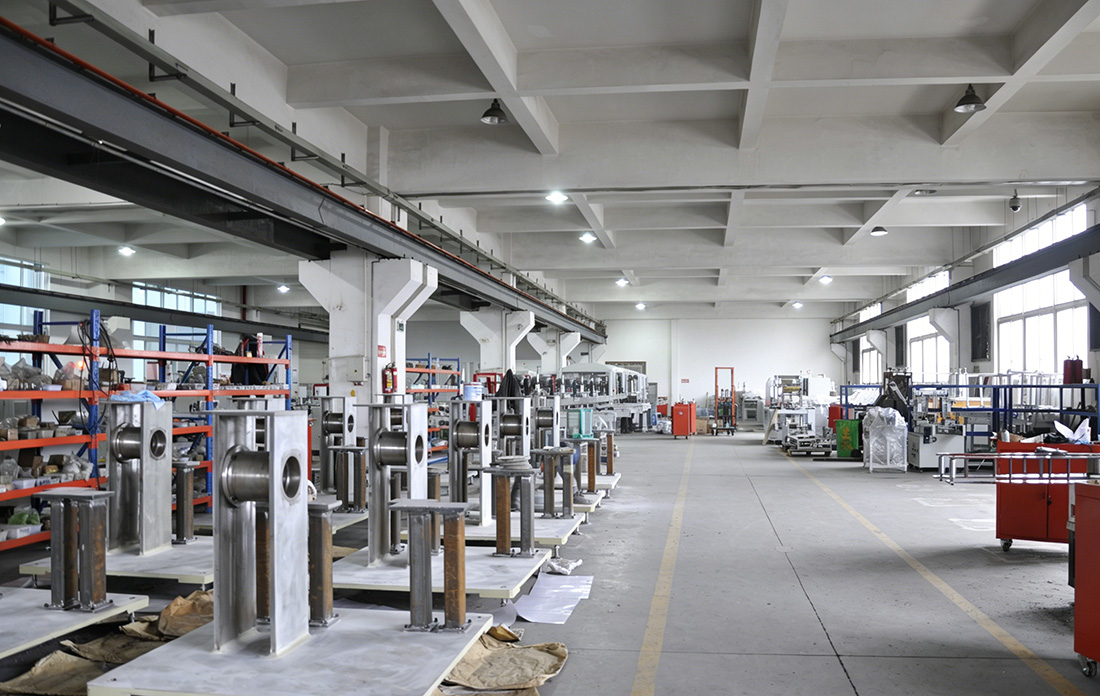
WIMACH production workshop, Ruian, Wenzhou, Zhejiang, China — where case packers and integrated packaging lines are assembled and configured.
Why technical answers decide case packer projects
Case packers are essential end-of-line machines that prepare products for shipping, and they sit at the final step of the packaging process, where individual products are grouped and placed into cases. Because they are the last mechanical stage before palletising or dispatch, their technical fit is decided by the plant, not by the catalogue. A case packing machine that runs at an impressive nominal rate but cannot accept the plant's existing case sizes, or that assumes a 480-volt three-phase supply in a factory wired for 380 volts, creates a problem no efficiency claim can offset.
Published specifications are also difficult to compare across suppliers. Units differ (inches versus millimetres), output figures are quoted under different case formats and product configurations, and control architectures vary by destination market. A published datasheet for a horizontal case packer manufactured by Schneider Equipment, for example, lists 480-volt, three-phase power with Rockwell Automation PLC and colour touchscreen HMI components, supports RSC, HSC, tray, and wraparound case formats, quotes case sizes in inches, and offers low-temperature hot-melt glue or tape sealing with optional stainless-steel construction for wash-down applications. Every one of those values is a configuration decision — not an industry constant. The opportunity for buyers is straightforward: suppliers who document their specifications clearly, and who confirm order-specific parameters in writing, are the ones who reduce commissioning risk.
WIMACH and the CP-S50 in documented terms
Wenzhou Wimach Machinery Co., Ltd. is a packaging machinery manufacturer based in Ruian, Wenzhou, Zhejiang, China. Founded in 2021, the company operates a 3,000 m² factory with 37 employees and a five-engineer R&D team, and reports an annual output of 160 sets. Its core range covers tissue packing machines and integrated packaging lines — facial tissue and paper napkin cartoning machines, soft tissue wrapping machines, toilet paper roll wrapping machines, case packers, and blister packing machines — supported by full-lifecycle services for all packaging machines. WIMACH states that all machines are CE certified and assembled with reliable components from well-known brands. Around 60% of output is exported, with main markets in the EU, North America, and South America.
Within the case packing category, WIMACH produces the CP-S50 automatic side load case packer and the CP-T60 automatic top load case packer. This article concentrates on the CP-S50, because side load case packers are typically specified where products must be pushed into the case in a controlled orientation rather than dropped from above.
Capacity and case-size envelope
Documented capacity for the CP-S50 is 1 to 16 cases per minute, and the documented product size range is 240 × 200 × 180 mm to 500 × 400 × 400 mm. Two considerations matter when those figures are applied to a real line.
First, the machine's rate is a range, not a guarantee of line output. Actual throughput results from the case size, the product arrangement inside the case, the infeed pattern, and the machine configuration. A line producing fewer cases per minute than the packer's top rate will not be improved by a faster machine; a line producing more will need either a second unit or a different model. Buyers should therefore convert their own production plan into cases per minute at the largest case in the range before comparing options.
Second, the case-size envelope is a boundary, not a target. Products whose cases fall inside 240 × 200 × 180 mm to 500 × 400 × 400 mm are within the documented range; anything outside it — a very small carton case, a very tall display case, or an oversized export case — has to be reviewed as a configuration question rather than assumed to fit.
| Parameter | Documented status | How it is confirmed |
|---|---|---|
| Loading type | Side load | Fixed by model (CP-S50) |
| Capacity | 1–16 cases/min | Confirmed against case format and product arrangement |
| Product / case size range | 240 × 200 × 180 mm to 500 × 400 × 400 mm | Checked against the buyer's case list |
| Operating voltage | Configurable item | Stated on the order specification for the destination market |
| Air pressure and consumption | Configuration-dependent | Stated in the pneumatic data for the ordered machine |
| Footprint | Configuration-dependent | Issued as a layout drawing before production |
| Net weight | Configuration-dependent | Stated on the final specification sheet |
Electrical requirements: voltage is a configuration item
Voltage is one of the most common causes of delay in case packer projects. Machines built for North America are commonly documented at 480 volts, three-phase, while equipment destined for European or Asian plants is normally built around local supply characteristics. Because WIMACH treats voltage as a configurable element of the machine — one of the customization points listed for its case packers — the buyer's responsibility is to state the plant's actual supply at the RFQ stage: voltage, phase, frequency, and any site-specific requirement such as a separate control transformer or an existing motor control centre.
Items that should be confirmed in the electrical package include supply voltage and phase, control voltage, PLC platform and HMI language, safety circuit implementation, and the interface to upstream and downstream equipment. Confirming these before production begins costs a short exchange of documents; discovering a mismatch during installation costs a rebuild.
Air requirements: pressure and consumption follow configuration
Automatic case packers commonly combine servo motion with pneumatic cylinders for case erection, flap handling, pushing, and sealing — the horizontal case packer specification referenced above, for instance, describes a combination of servo and air cylinder motion control in one compact system. The consequence is that air pressure and air consumption are not fixed numbers that can be copied from a product page: they depend on how many pneumatic actuators a configuration uses, how often they cycle, and which sealing method is installed.
For procurement purposes, two values must appear in the final technical documentation: the required supply pressure at the machine inlet, and the consumption per cycle or per minute at the specified rate. Both should be checked against the plant's compressor capacity and the pressure drop across the existing distribution network, because a case packing machine that meets the pressure requirement at the compressor but not at the point of use will produce inconsistent behaviour rather than a clean fault.
Footprint and net weight: request the layout drawing
Footprint and net weight are engineering outputs of the configuration, not catalogue constants. Infeed and discharge conveyors, the case magazine, the sealing unit, and any additional modules change both the floor area required and the mass the floor and lifting equipment must support. Before the order is placed, buyers should obtain the layout drawing for the exact configuration and check it against three things: available floor area, clearance for maintenance access and magazine loading, and the route by which the machine will be moved into position.
Safety architecture and pre-shipment verification
Safety in automatic case packing is an interlock problem before it is a labelling problem. WIMACH states that all of its packaging machines are equipped with safety PLCs or safety relays that implement full-range safety interlock points, that all safety function tests are completed prior to shipment, and that safety operation and maintenance manuals are supplied together with after-sales safety technical support.
For buyers, three artefacts should be requested during evaluation: the safety concept or interlock list, the record of pre-shipment safety function testing, and the safety section of the operation and maintenance manual. These are the documents that support a factory acceptance test and later audits.
The standards landscape should also be checked against the destination market rather than assumed. In North America, ANSI/PMMI B155.1-2023 specifies safety requirements and a risk assessment methodology for packaging and processing machinery. In Europe, EN 415-7:2025 is catalogued as a standard covering cartoning and case packing machines; the full official text and its jurisdictional applicability should be verified directly with a standards body or notified body rather than inferred from a catalogue listing. For most projects the practical requirement is simple: establish which standard the destination market applies, then ask the supplier to document how the machine's safety functions meet it.
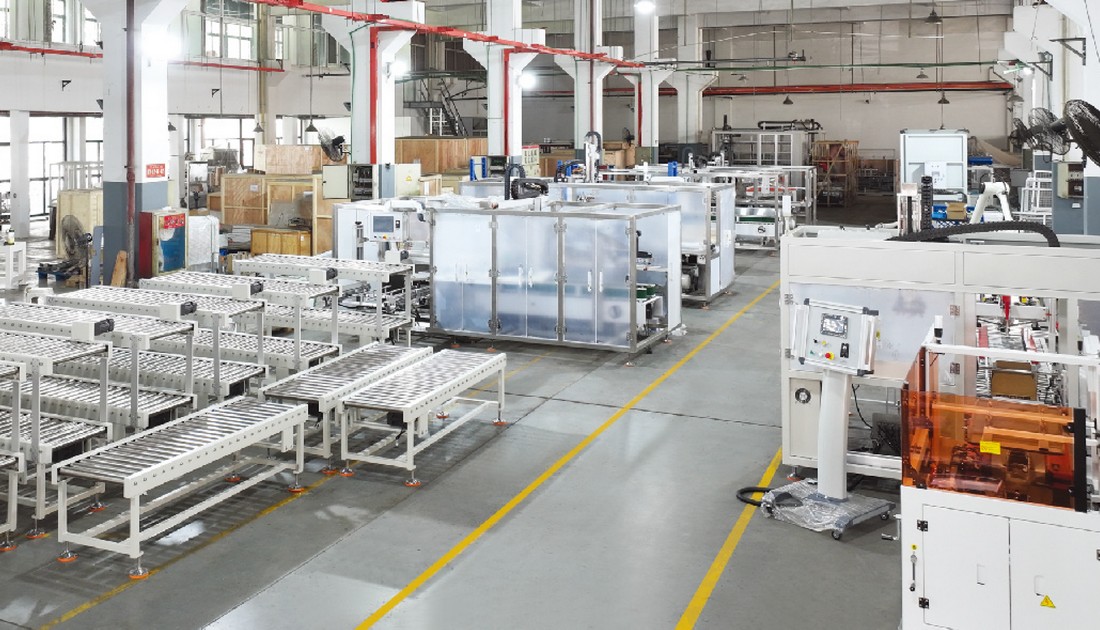
Machine assembly and pre-shipment verification: WIMACH completes safety function tests on all packaging machines before dispatch.
Customization: five documented change points
WIMACH lists five areas in which a case packer can be adapted to a specific project:
- Packaging dimension changes — adapting the machine's handling to the buyer's case dimensions within a reviewed envelope.
- Machine configuration — changing the loading arrangement and peripheral equipment to match the line.
- Voltage — building the electrical package for the destination market.
- Logo — applying the buyer's branding to the machine.
- OEM/ODM production — manufacturing under the buyer's specification for their own product line or brand.
Each change has a lead-time and a documentation cost. Dimension and configuration changes require engineering review before a quotation is final; voltage and logo changes are handled at the specification stage. For distributors and importers, OEM/ODM production is usually the point at which the relationship stops being transactional: once a machine carries the partner's brand and is built to the partner's specification, spare-part continuity, documentation, and repeat production become the deciding factors in the partnership.
Which lines fit a side load case packer
Side load case packing suits products that should be pushed into the case in a defined orientation — cartons, bundles, and rigid packs that keep their shape during transfer. Top load machines, such as the CP-T60, are typically used where products can be dropped vertically into the case without damage. The choice between them is a product-handling decision as much as a speed decision.
Category context is broad: packaging machines serve products ranging from food and beverages to pharmaceuticals and industrial goods, and case packers are the end-of-line category recognised across those sectors. WIMACH's own programme is built around tissue paper products, an application where bundles arrive at the packer in consistent shapes and counts, and the company also serves other industries with the same case packing platform. The practical fit test is not the industry label but three numbers: cases per minute required, case dimensions in use, and the orientation the product tolerates.
Market context for case packing equipment
Two verified market figures frame the category. According to Grand View Research's case packing machines market report, the global market was valued at USD 1.1 billion in 2024, and Asia Pacific accounted for a revenue share of 37.9% in the same year. Both figures describe the value of the market rather than the technical performance of any machine, and they should be read as context for investment decisions rather than as evidence about equipment quality. What they do indicate is that the category is large enough to sustain multiple suppliers, and that a significant share of both demand and manufacturing capacity sits in Asia Pacific — consistent with the sourcing pattern that brings machines, spare parts, and engineering support from that region into European and North American plants.
Where documented specifications reach their limits
Honest evaluation requires stating what specifications cannot do. Four boundaries apply to this category:
- Configuration dependence. A documented range such as 1–16 cases per minute is not a guaranteed output on a specific line; the achieved rate depends on case format, product arrangement, and infeed.
- Envelope limits. Cases outside the reviewed dimension range require redesign or a different model, and the answer may be no.
- Non-comparable published claims. Output and speed figures published by different suppliers are not equivalent until case format, product configuration, and test conditions are aligned. No cross-vendor ranking can be produced from catalogue values alone.
- Total cost versus purchase price. A lower machine price and lower spare-parts cost do not by themselves establish a lower total cost of ownership. Utilities, changeover time, maintenance skill requirements, downtime, and spare-part availability have to be considered together.
One further verification point is worth flagging for buyers who search the brand name: a Netherlands-based business also uses the name WIMACH and describes itself as focusing mainly on repair work for agricultural and earthmoving machinery. The case packing equipment referenced in this article is supplied by Wenzhou Wimach Machinery Co., Ltd. in Ruian, Zhejiang, China. Suppliers with similar names should always be confirmed against a factory address, a product model, and a written specification.
Automatic vs manual case packing — and the cost position against European machines
The traditional alternative to a case packer is manual case packing, where operators erect cases, arrange products, and seal them by hand. It remains appropriate for very low volumes, highly irregular products, and short campaigns, and it requires no utility planning, no safety interlock documentation, and no acceptance test. Its limits are equally clear: throughput is bounded by human pace, it adds repetitive physical work to the end of the line, and consistency depends on the operator rather than on the machine.
Against European-built case packers, WIMACH documents a specific cost and delivery position: the price of the machine and its spare parts is 20% to 30% of that of European counterparts, equivalent to a stated cost difference of 70–80% lower, with less maintenance and lower power consumption, a typical delivery lead time about 50% shorter, and wide product compatibility. These are supplier-reported figures and should be verified against a specific configuration, because a percentage difference in price says nothing about performance in a given line until the acceptance criteria are defined.
The limitation to hold in view is that neither comparison resolves a project on its own. Manual packing is not automatically wrong for a low-volume operation, and a lower-cost automatic case packer is not automatically right for a high-speed line. The deciding evidence is the factory acceptance test, the documented safety verification, and the spare-parts plan.
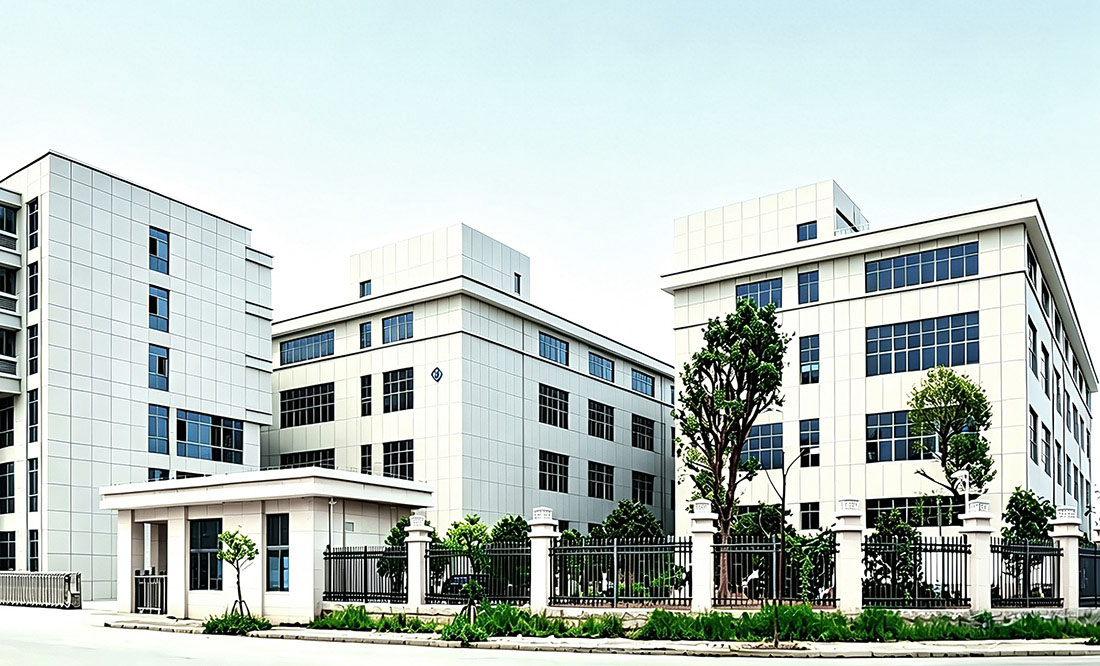
WIMACH Machinery Co. — a 3,000 m² facility in Ruian, Wenzhou, with an annual output of 160 sets and a five-engineer R&D team.
Future outlook
Three developments are shaping how case packers will be bought over the next planning cycle. First, configurability is becoming a standard expectation rather than a premium feature: voltage, case dimensions, machine layout, and branding are increasingly treated as project variables, which shifts the burden of documentation onto suppliers. Second, specification-led procurement is replacing brochure-led procurement, particularly where buyers operate across several markets and cannot assume a single electrical or safety standard. Third, the after-sales relationship is lengthening: spare-part availability, engineering support, and repeat-production capability now determine whether a supplier is used once or across a multi-year programme.
WIMACH's documented service model — full-lifecycle services, safety technical support, and OEM/ODM production — points in the same direction. The proposition is not a single machine but the ability to keep producing the same configuration, with documented specifications, year after year.
FAQ: automatic case packer specifications and procurement
What throughput does the CP-S50 automatic side load case packer handle?
The documented capacity is 1 to 16 cases per minute. Achieved throughput on a specific line depends on the case format, the product arrangement inside the case, and the machine configuration, so this figure should be confirmed against the buyer's own case list during a factory acceptance test.
What case sizes are covered?
The documented product size range is 240 × 200 × 180 mm to 500 × 400 × 400 mm. Cases outside this range should be reviewed as a configuration question rather than assumed to be covered by the standard machine.
What operating voltage does the machine require?
Voltage is a configured item rather than a fixed global value. WIMACH builds machines to the destination market's supply, and voltage is listed among the customization points available for its case packers. Buyers should state voltage, phase, and frequency at the RFQ stage.
What air pressure and air consumption should be planned for?
Pneumatic requirements are configuration-dependent and follow the number and cycle rate of the machine's air cylinders and the sealing method installed. Supply pressure at the machine inlet and consumption at the specified rate should be requested as documented values, then checked against the plant's compressor capacity and distribution network.
What are the machine's footprint and net weight?
Both are outputs of the configuration and are issued as a layout drawing and a final specification for the ordered machine. They should be requested before the order is placed so that floor area, access clearance, and lifting routes can be verified.
How is machine safety implemented and verified?
WIMACH states that all packaging machines are equipped with safety PLCs or safety relays that implement full-range safety interlock points, that all safety function tests are completed prior to shipment, and that safety operation and maintenance manuals and after-sales safety technical support are provided. Buyers should also confirm which standard applies in the destination market — for example, ANSI/PMMI B155.1-2023 for packaging machinery safety in North America, or the EN 415-7 series covering cartoning and case packing machines in Europe.
What can be customized before production?
Five documented areas: packaging dimension changes, machine configuration, voltage, logo application, and OEM/ODM production. Each requires engineering review before the quotation and specification are finalized.
What are the purchasing terms, acceptance criteria, and lead time?
Documented terms are a minimum order quantity of 1 set; delivery terms FOB, FCA, CIF, or CFR; factory acceptance test (FAT) as the acceptance criterion; and payment by T/T. Typical production lead time is 15 to 45 days, with a monthly production capacity of 13 sets.
How does the cost of a WIMACH case packer compare with European-built machines?
WIMACH documents the price of the machine and its spare parts at 20% to 30% of that of European counterparts — a stated cost difference of 70–80% lower — along with less maintenance, lower power consumption, and an average delivery lead time around 50% shorter. These are supplier-reported values and should be verified against a specific configuration and a defined acceptance test before they are used in a total-cost comparison.
Closing note
Technical questions are the point at which a case packer project either becomes a scheduled installation or an open-ended discussion. Suppliers that publish documented values, confirm order-specific parameters such as voltage, air supply, footprint, and weight, and provide pre-shipment safety verification reduce the distance between a quotation and a working line. The full WIMACH machine catalogue, covering case packers and integrated packaging lines, can be reviewed here: WIMACH product catalogue (PDF).
Есть вопросы или нужны дополнительные детали?
Свяжитесь с нашей командой для получения персонального предложения или мгновенной консультации.
Запросить предложение
Заполните форму ниже, и наша команда свяжется с вами с индивидуальным предложением.
Прямой чат WhatsApp
Предпочитаете общаться в реальном времени? Напишите нам в WhatsApp для мгновенной помощи и быстрых ответов.
- Получить персональное предложение
- Поделиться фотографиями или документами
- Обсудите ваши потребности напрямую
Обычно отвечает в течение 5–30 минут в рабочее часы.