
Case Packer Supplier Audit: Patent, Safety and Support Proof
Case Packer Supplier Audit: Patent, Safety and Support Proof
A long-term case packer supplier is judged on records that outlast the purchase order, not on assurances given before it. For a buyer moving from decision to execution - specification agreed, contract under negotiation, machine entering build - the useful question is narrower than a general capability review: can this supplier produce patent documents that survive a registry check, describe a safety architecture precisely enough to audit, evidence pre-shipment safety function testing, and commit to safety support that remains usable years after installation?
Wenzhou Wimach Machinery Co., Ltd. (WIMACH), a Chinese manufacturer of tissue packing machines and integrated packaging lines, is a practical case for that audit. Its supplied evidence set names two patent certificates, states a safety-interlock policy for all of its packaging machines, and describes pre-shipment safety function testing alongside after-sales safety technical support. Each item is testable, and each has a boundary that sales language tends to blur.
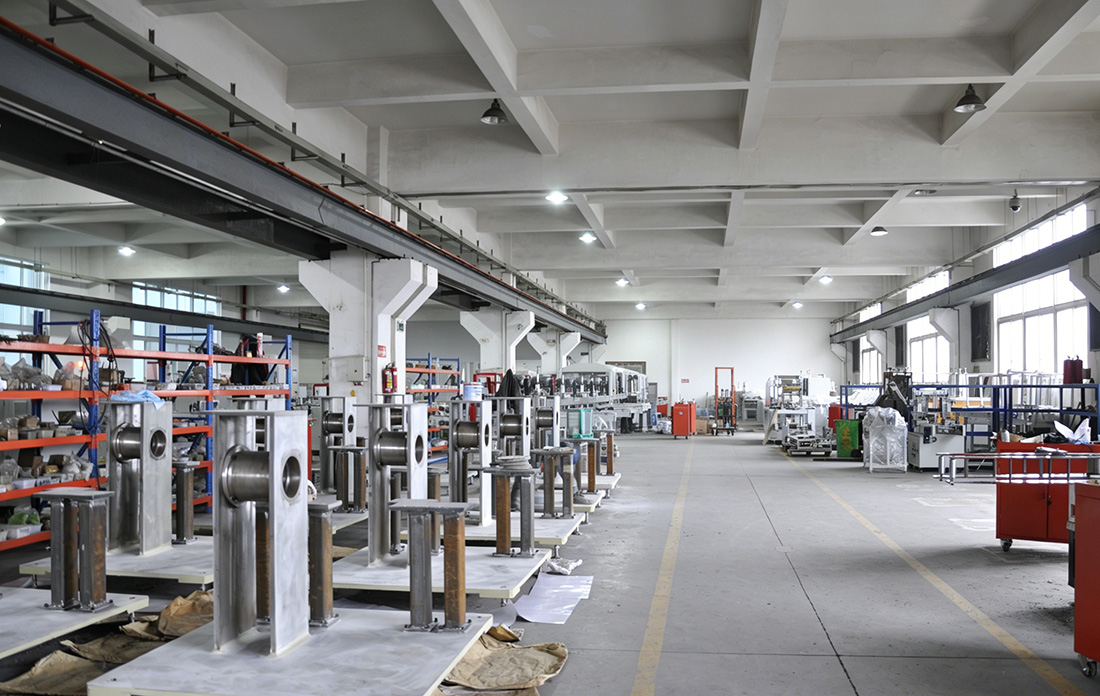
WIMACH machinery workshop. Photograph supplied by the company.
Why a Long-Term Audit Begins Where the Purchase Audit Ends
Most case packer evaluations stop at technical fit: load orientation, case format, footprint, utilities, acceptance criteria. The long-term question starts after those are settled, because the machine will still be running when the sales contact, the project engineer and the original quotation have all been replaced.
Three things determine whether the relationship survives that turnover. First, whether the supplier's engineering claims are documentable rather than verbal. Second, whether its safety design can be verified independently of its marketing. Third, whether the support obligation is written in a form a future maintenance team can act on. A top load case packer and a side load case packer differ in mechanics, but they fail long-term in the same ways: undocumented change, unavailable spares, or a safety function nobody can re-validate.
Patent Evidence: Reading Two Certificates Correctly
WIMACH's evidence set includes an Invention Patent Certificate, ZL 2022 1 1099886.8, and a Utility Model Patent Certificate, ZL 2022 2 1202677.7. The utility model relates to an Automatic Feeding Mechanism for Carton Packaging Machine. Together they indicate that the company has registered technical subject matter in its own name rather than presenting an entirely outsourced catalogue.
The two certificates are not equivalent, and that difference matters to an auditor. Under the Chinese system, an invention patent and a utility model follow different examination routes and carry different protection terms. The invention certificate is the stronger signal of substantive examination; the utility model is a signal of a specific mechanical development, usually closer to a production detail than to a broad concept.
A feeding mechanism is a sensible place to look. In an automatic case packer - whether a drop type case packer, a pick and place case packer or a robotic case packer - the interface between product infeed and case presentation is where jams, mis-loads and changeover time accumulate. A registered mechanism at that interface indicates that an engineering decision was made and recorded, not merely that a machine was assembled from purchased modules.
What the certificates do not establish is equally important. They do not prove that the claimed mechanism is fitted to every model in the range, that it performs to a stated cycle rate, or that it remains in force today. A patent can lapse through non-payment of fees, be assigned to another entity, or be limited by claims that do not cover the configuration being sold.
The audit response is procedural rather than interpretive. Request the certificate copies, then verify the patent number, the named proprietor and the current legal status through the issuing registry. Confirm the proprietor name matches the contracting legal entity exactly, not a trading name or a group brand. Then ask a separate question: which models currently in production use the Automatic Feeding Mechanism, and where is that mechanism described in the technical documentation for the model being purchased? A supplier that answers all three consistently has demonstrated document control. A supplier that answers only the first has demonstrated a framed certificate.
Safety Architecture: What Safety PLC and Safety Relay Interlocks Tell an Auditor

WIMACH machinery company. Photograph supplied by the company.
WIMACH states that all of its packaging machines are equipped with safety PLCs or safety relays that implement full-range safety interlock points. This is a design statement, and it is auditable in a way that a general claim of safe construction is not, because it names both the technology class and the coverage.
The distinction between the two options is worth settling before the audit meeting. A safety relay implements a fixed, hard-wired logic function: transparent, easy to test, and difficult to change without physical rework. A safety PLC implements the same interlock functions in configurable logic, which supports more complex relationships between guards, zones and operating modes but depends on validated configuration and controlled access to the program. Neither is automatically superior. What matters is that the chosen technology matches the machine's complexity and that the resulting functions are documented and testable.
The phrase full-range safety interlock points is the part to convert into a list. A buyer should request the interlock schedule for the exact model: every guard door, emergency stop, pneumatic pressure monitor, product or case jam detector and maintenance-mode condition, each mapped to the function it interrupts and the stopping behaviour it produces. A schedule with ten line items and a schedule with four can both be correct, but only one will match the risk assessment for that machine and that line layout.
Independent reference points help frame the request. ANSI/PMMI B155.1-2023 sets out safety requirements and a risk assessment methodology for packaging and processing machinery and is the current active reference in North America, so a buyer operating or exporting to the United States should ask how the machine's safety functions were derived against it. For European destinations, catalogue records identify EN 415-7 as covering cartoning and case packing machines, but a catalogue entry is not a conformity determination; the applicable version, its status and the machine's own technical file must be confirmed rather than assumed. Standards define what to ask for. They do not replace the supplier's documentation.
Pre-Shipment Safety Function Tests and Quality Assurance Records
WIMACH states that all safety function tests are completed before shipment. Pre-shipment testing is the most useful delivery-stage evidence available for a case packer, because it converts an abstract safety design into a dated record tied to a specific machine serial number.
The record itself should answer four questions: which safety functions were tested, how each was triggered, what the machine did in response, and who signed the result. A test list that mirrors the interlock schedule is a strong sign of a controlled process. A one-page declaration that the machine is safe is not. Because WIMACH's stated acceptance criterion is a factory acceptance test (FAT), the buyer can attach the safety function checks to the FAT agenda and witness them, rather than receiving them later as a document bundle.
Quality assurance evidence sits alongside the safety record. WIMACH states that all of its machines are CE certified and are assembled with components from well-known brands. Those statements describe a conformity and component-sourcing policy; they become auditable only when converted into documents - a declaration of conformity, component certificates for safety-relevant parts, incoming inspection records, and a traceable bill of materials for the purchased configuration. A buyer should also confirm the exact legal identity behind the CE marking, since the declaration is issued by a specific entity rather than by a brand name.
Testing is also where future disputes are prevented. A record that names the case size, container type and operating mode used during the run removes the common later argument about whether an observed fault is a defect or an out-of-scope application. For a can case packer or bottle case packer, that means recording container dimensions and line speed at which the run was conducted, not simply noting that the machine ran.
After-Sales Safety Technical Support as a Contingency Plan
WIMACH states that safety operation and maintenance manuals and after-sales safety technical support are provided. In a long-term relationship, support is not a courtesy line at the end of a quotation; it is the contingency plan for the years when the machine has been modified, re-sited or re-purposed and the original safety logic may no longer describe what is installed.
The audit question is what happens after a change. If a guard is replaced, a light curtain is added or a conveyor is re-routed, who re-validates the interlock function, and against which document? A supplier able to provide the safety architecture documentation in a form the buyer's maintenance team can follow - and able to advise on the effect of a modification - is offering a different class of support from one that can only ship parts.
Two checks sharpen this. First, ask for the manual in the language the operating team actually uses, and confirm that its safety section matches the interlock schedule issued at FAT; a mismatch signals document drift. Second, ask how safety-related questions are routed after the warranty period and record the answer in the contract. The answer does not need to promise a response time the supplier has not publicly committed to; it needs to name a route that survives staff turnover.
Delivery Reliability and the Commercial Terms That Carry It
WIMACH's stated purchasing terms are a minimum order quantity of one set, delivery terms of FOB, FCA, CIF or CFR, factory acceptance test as the acceptance criterion, and T/T payment. These are ordinary terms for industrial equipment. Their audit value lies in how they distribute risk rather than in their novelty.
Under CIF and CFR, risk passes at shipment rather than at destination. That does not make the terms unattractive, but it does mean the pre-shipment test record becomes the buyer's principal protection: once the machine is on board, a damage or performance dispute is materially harder to resolve. Buyers who prefer to retain leverage until arrival typically negotiate FCA or an extended inspection clause instead.
Delivery reliability itself should be checked against capacity rather than promises. WIMACH describes a 3,000 m2 facility, 37 employees, an annual output of 160 sets, a five-engineer R&D team and a 60% export share across the EU, North America and South America. Those figures give a scale reference - a single machine order is a small fraction of annual output, which can affect scheduling priority - but they are company-reported and should be tested against the delivery date offered in the quotation and the number of machines visibly in build at FAT. A spare-parts list supplied with the quotation, cross-referenced to the models on the interlock schedule, is a further practical check on whether support is planned or improvised.
Comparing a Specialist Supplier With European Equipment
WIMACH's own comparison material states that its machine and spare-part prices are 20% to 30% of comparable European equipment, that average delivery lead time is 50% shorter than European machines, that maintenance requirements and power consumption are lower, and that product compatibility reaches over 50% against European equipment. These are supplier statements, not independent benchmarks, and they are best read as claims to be tested rather than as market data.
Two of the claims are directly checkable. Price can be verified by requesting a quotation and a spare-parts price list for the same configuration and normalising the scope - the same guarding, the same controls, the same documentation package. Lead time can be verified by comparing quoted dates against the FAT date written into the contract and against the shipping schedule. Both become legitimate negotiating evidence once scope is aligned.
The compatibility figure needs clarification before it can be used. Compatibility of over 50% against European equipment could mean dimensional interchangeability of wear parts, shared component brands, or support for the same case formats. Those are different promises with different maintenance consequences. A buyer should ask for the specific spare-parts list behind the number and cross-check it against the parts most likely to wear on the purchased model. The same discipline applies to the maintenance and power-consumption statements: a useful working hypothesis for budgeting, not a committed cost until measured on the installed machine.
An Evidence Matrix for the Audit
The matrix below converts the discussion into a working checklist. It is deliberately limited to evidence a buyer can request, read and cross-check before the machine ships.
| Evidence item | What it establishes | What it does not establish | Verification route |
|---|---|---|---|
| Invention Patent Certificate ZL 2022 1 1099886.8 | Registered technical subject matter held in the supplier's name | Fitment to the purchased model; current legal status | Registry check of number, proprietor and status; request model mapping |
| Utility Model Patent Certificate ZL 2022 2 1202677.7 (Automatic Feeding Mechanism for Carton Packaging Machine) | A specific mechanism developed and registered by the supplier | Cycle rate, reliability, or use across the whole range | Cross-reference to the technical file of the specific model |
| Safety PLC or safety relay architecture with full-range interlock points | A named technology class and stated coverage across the machine | That each function reaches a stated performance level | Interlock schedule per model; risk assessment reference |
| Pre-shipment safety function test record | Dated evidence tied to one machine serial number | Long-term field reliability; performance after installation | Witness at FAT; confirm test conditions and sign-off |
| Safety operation and maintenance manuals | Documented procedure for safe operation and intervention | That the manual matches the as-built machine | Compare with the FAT interlock schedule; check language |
| After-sales safety technical support | A named route for safety questions after delivery | Response time or spare availability, unless contracted | Write route and scope into the supply agreement |
| FAT as the stated acceptance criterion | A witnessed performance gate before shipment | Performance under the buyer's own production conditions | Agree the FAT protocol in advance, including safety checks |
| MOQ 1 set; FOB, FCA, CIF or CFR; T/T payment | Commercial framework and risk-transfer point | Delivery performance on the specific order | Align terms with inspection and payment milestones |
What Long-Term Fit Looks Like After the First Order
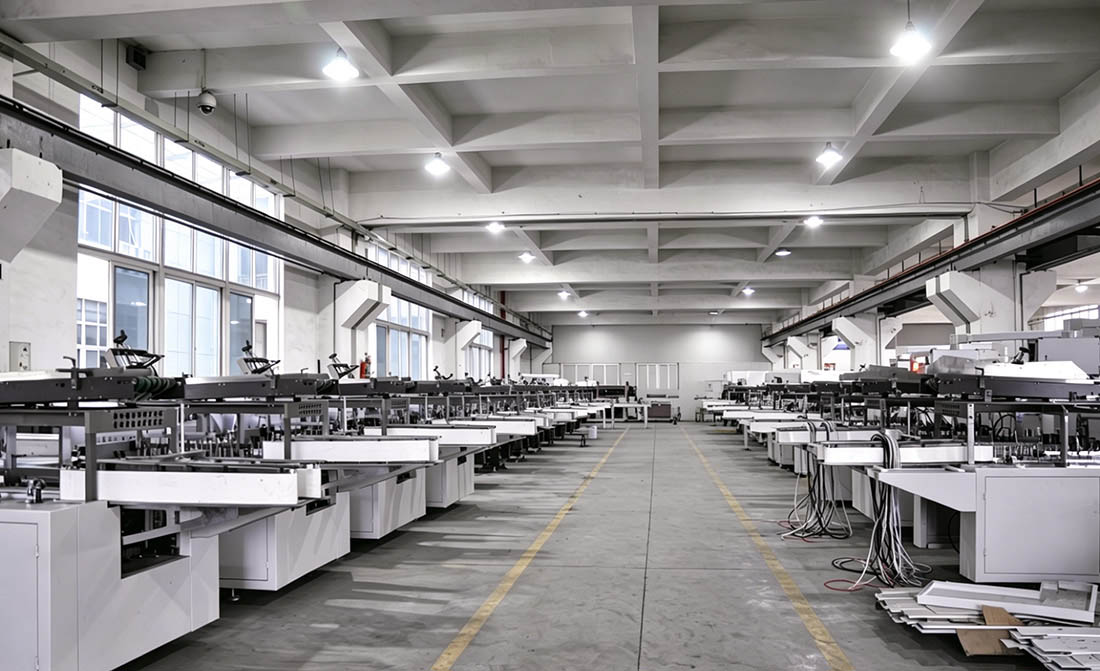
WIMACH workshop. Photograph supplied by the company.
A supplier relationship is tested by the second machine, not the first. By then the buyer knows whether the documentation matched the delivered equipment, whether spares arrived with the correct part numbers, and whether safety questions were answered by someone who understood the interlock logic rather than someone reading from a catalogue.
WIMACH describes more than 12 years of industry experience, full-lifecycle service for its packaging machines, customised solutions ranging from a single standalone machine to an integrated line, and a high rate of repeat business. Repeat business is the most relevant of these for a long-term audit, because it is the outcome the buyer is trying to predict. As a company-reported attribute, however, it should be corroborated through reference contacts and, where possible, a visit to an installed line.
Market context supports taking the question seriously rather than treating support as an afterthought. Grand View Research valued the global case packing machines market at USD 1.1 billion in 2024, with Asia Pacific accounting for a 37.9% revenue share in the same year. A market of that structure contains many suppliers across many price points. For the buyer, the differentiator is rarely the specification sheet, which is broadly comparable across a category, but the durability of the evidence and the support behind it.
Conclusion: What the Audit Should Leave Behind
A completed long-term audit should leave a file, not an impression: verified patent records with confirmed proprietors and status, an interlock schedule that matches the machine being built, a signed pre-shipment safety test record with conditions noted, manuals that match the as-built configuration, and a contractual route for safety questions that outlives the sales relationship.
WIMACH's supplied evidence supports several of those items at the level of stated policy - patents registered in its name, safety PLC or relay interlocks across its packaging machines, pre-shipment safety function testing, and after-sales safety technical support. Converting policy into proof is the buyer's work at the execution stage, and it is the work that determines whether the case packer is still supported in year seven.
Buyers who want to review the supplier's product documentation before the audit meeting can download the WIMACH catalogue at Wimach Catalog s.pdf, and the company's official site is Wenzhou Wimach Machinery Co., Ltd. Both are starting points for the document request rather than substitutes for it.
Frequently Asked Questions
What documents should a buyer collect before committing to a long-term case packer supplier?
At minimum: a patent certificate set with registry-verifiable numbers and named proprietors; an interlock schedule for the specific model; a pre-shipment safety function test record tied to the machine serial number; safety operation and maintenance manuals matching the as-built configuration; the declaration of conformity behind the CE marking; and a written route for after-sales safety technical support. Each item should name the legal entity that issued it, because documentation held by a trading brand rather than the contracting company is far harder to enforce later.
How should patent certificates such as ZL 2022 1 1099886.8 be checked?
Check the number, the named proprietor and the current legal status directly in the issuing registry rather than relying on a scanned certificate alone. Confirm that the proprietor matches the contracting legal entity. Then ask which production models embody the claimed subject matter and where it appears in the technical file. The invention patent and the utility model ZL 2022 2 1202677.7 follow different examination routes and carry different evidential weight; the utility model relates to the Automatic Feeding Mechanism for Carton Packaging Machine and is best read as evidence of a specific mechanical development rather than of overall machine performance.
What does a pre-shipment safety function test cover on a case packer?
It should cover every interlock point in the machine's safety schedule - guard doors, emergency stops, pressure monitors and jam detection - and record how each was triggered, what the machine did in response, and who signed the result. Test conditions matter: case size, container type and operating mode should be stated so that a later performance question can be separated from a defect. Where factory acceptance testing is the contractual acceptance criterion, these checks can be witnessed rather than accepted as a later document bundle.
How can after-sales safety technical support be made enforceable?
Name the route and the scope in the contract: who is contacted for safety-related questions, which documents the supplier will maintain, and how modifications affecting interlocks are re-validated. Vague support language is difficult to enforce; a defined scope with named documents is not. Buyers should also confirm that manuals are supplied in the language the operating team uses and that the safety section matches the interlock schedule issued at factory acceptance testing.
Is a lower-priced case packer a higher long-term risk?
Price alone does not indicate long-term risk; undocumented scope does. A lower-priced machine can be appropriate where configuration, guarding, controls and the documentation package are specified to the same level as the comparison. Risk rises when a price advantage depends on unstated differences - thinner guarding, fewer interlock points, a shorter documentation set, or spare parts that cannot be cross-referenced. Normalising scope before comparing quotations, and verifying the spare-parts list, turns a price comparison into a support comparison.
Есть вопросы или нужны дополнительные детали?
Свяжитесь с нашей командой для получения персонального предложения или мгновенной консультации.
Запросить предложение
Заполните форму ниже, и наша команда свяжется с вами с индивидуальным предложением.
Прямой чат WhatsApp
Предпочитаете общаться в реальном времени? Напишите нам в WhatsApp для мгновенной помощи и быстрых ответов.
- Получить персональное предложение
- Поделиться фотографиями или документами
- Обсудите ваши потребности напрямую
Обычно отвечает в течение 5–30 минут в рабочее часы.