
Cast Parts for Industrial Equipment: Matching Precision Castings to Application Scenarios
Industrial equipment rarely fails a casting because someone misread the drawing. It fails because the drawing described geometry while the machine imposed pressure, corrosion, sliding wear or cleanliness — the conditions that actually decide material grade, casting route, finishing and inspection. For buyers of cast parts, matching the component to its operating scenario, and not only to its drawing, is the sourcing decision that carries the most risk.
This article maps common precision cast part families — engineering machinery bearing and pump housings, hydraulic valve bodies, vacuum equipment fittings, flowmeter bodies and flanges, and lock cylinder housings — to the application scenarios that drive their specification. It also explains how the operating environment determines material and process route for motor housings, pump impellers and pump housings, and stainless steel food-processing impellers.
1. Precision Cast Parts: A Working Definition for Industrial Buyers
Precision cast parts are near-net-shape metal components produced by pouring molten metal into a mould that closely follows the final geometry, so that only critical surfaces require subsequent machining. In investment casting — the route most often used for small, complex, high-accuracy industrial components — a wax pattern is coated with ceramic, the wax is removed, and metal is poured into the resulting shell. Silica-sol investment casting accounted for 50.78% of investment casting revenue share in 2025, reflecting its precision capability on complex internal geometry (Mordor Intelligence).
Scale matters here. The global investment casting market was valued at USD 17.4 billion in 2025 and is projected to reach USD 24.9 billion by 2033 (Grand View Research). Asia Pacific held a 39.2% revenue share in 2025, and automotive applications represented more than 29% of revenue in the same year (Grand View Research). Stainless steel alone accounted for 32.98% of material share in 2025 (Mordor Intelligence) — a useful signal for buyers, because it shows how much industrial demand now treats corrosion resistance as a baseline requirement rather than an upgrade.
2. The Problem: Drawings Define Shape, Scenarios Define Survival
A drawing tells a supplier what a part looks like. It does not automatically tell the supplier what the part must survive. Two components can share identical geometry and still require different material grades, different heat treatment, different surface finishing and different testing:
- A hydraulic valve body operating under cyclic oil pressure needs wall thickness and sealing-surface integrity verified against pressure and leak criteria, not only dimensional compliance.
- A vacuum connection fitting needs sealing-face quality and, where specified, vacuum leak testing on the assembled connection — a requirement that never appears on a dimensional drawing.
- A food-processing impeller needs a surface finish and cleaning regime compatible with the product being handled, alongside corrosion resistance and rotational balance.
The practical consequence is that scenario information — pressure, medium, temperature, wear contact, hygiene class and assembly method — determines the specification as much as the drawing does. When that information is missing at quotation stage, buyers often receive technically compliant parts that still underperform in service.
3. A Framework: Reading the Operating Environment Before the Part Number
The table below maps the dominant operating factor to the specification decisions it typically drives. It is a screening tool rather than a substitute for engineering review, but it helps buyers frame the right questions before a drawing is released.
| Dominant operating factor | What it typically determines | Representative cast component |
|---|---|---|
| Internal pressure and cyclic load | Wall thickness, material grade, sealing-surface machining, pressure and leak testing | Hydraulic valve body, bearing and pump housing |
| Corrosive or reactive medium | Austenitic stainless grades such as 304, 316 or 316L; pickling, passivation or polishing | Flowmeter body, flowmeter flange, chemical-service pump housing |
| Sliding wear and repeated fit | Hardness and heat treatment, bore tolerance, surface finish | Lock cylinder housing, latch lever, sewing machine guide |
| Vacuum or gas tightness | Sealing-face quality, surface smoothing, leak testing | Vacuum pipe clamp and connection fitting |
| Hygiene and cleanability | Stainless grade, satin or mirror polishing, cleaning requirements | Stainless steel food-processing impeller |
| Assembly accuracy and concentricity | Tolerance grade, CNC-finished bearing seats and mating faces | Bearing housing, motor and mechanical housing |
4. Where a Casting Partner Sits in the Selection Process
SHANGHAI NTC TECHNOLOGY CO., LTD. is a precision casting industry and trade company located in the TingLin Industrial Zone, JinShan District, Shanghai, China, and was founded in 2022. The company operates a 2,000 m² factory with approximately 20 employees, an R&D team of five engineers and an annual output of 1,500,000 units, and reports an export ratio of about 85% with main markets in Europe, America and Asia. Its documented activities cover product development, design, mould manufacturing, production, processing and assembly.
From a buyer's perspective, the relevant capability is not the company profile but the sequence it supports: build-to-print manufacturing from approved 2D drawings, 3D models or physical samples; silica-sol investment casting; CNC machining; heat treatment; surface finishing; and final inspection. Documented inspection equipment includes a CMM, spectrum analyzer, Brinell hardness tester and projector, and the quality system is documented as ISO 9001:2000 and ISO 14001:2015. Its production series cover auto parts, valve accessories, vacuum parts, kitchen equipment accessories, dishwashing equipment accessories, spinning machine accessories, door accessories, scooter parts and other industrial and civil products.
That scope matters because scenario fit usually breaks down at the handover between process steps. A valve body that is cast accurately but never pressure-tested, or a stainless impeller that is machined correctly but not balanced, transfers residual risk back to the buyer. Integrated casting, machining, heat treatment, finishing and inspection routes reduce that handover risk — provided the operating conditions are stated clearly at the beginning of the enquiry.
5. Matching Part Types to Industrial Application Scenarios
5.1 Engineering machinery bearing and pump housings
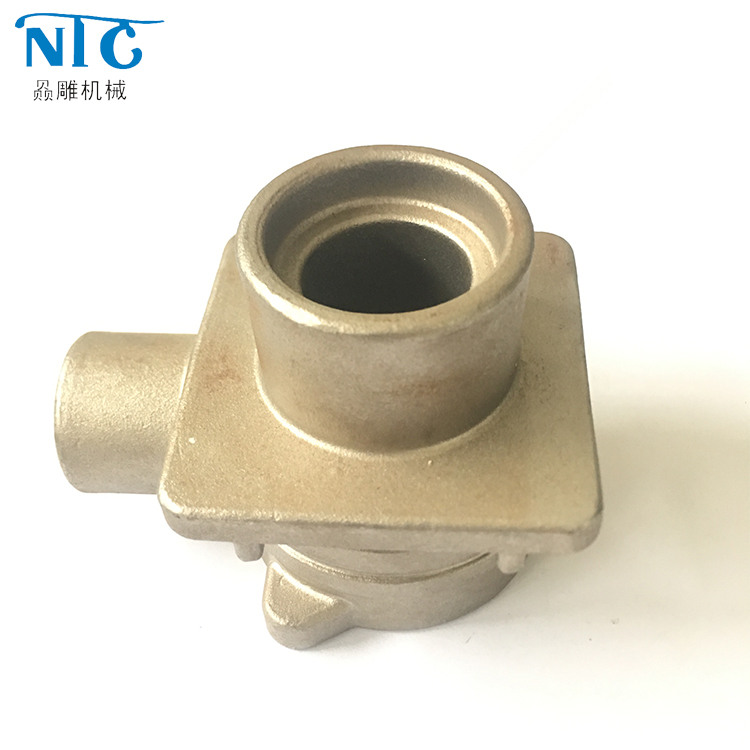
Bearing and pump housings in construction machinery, heavy equipment, hydraulic pumps and industrial transmission systems carry both structural load and rotating alignment. The referenced product family (OEM / Custom Drawing No. 1040) is available in carbon steel, alloy steel, ductile iron and stainless steel, with grades such as WCB, 1020, 1045, 4140, 42CrMo, QT450-10, 304, 316 and 316L specified when required. Housing structures include flanged, cylindrical, enclosed, multi-port and integrated bearing-seat configurations.
The scenario drives the specification in three places. Bearing-seat accuracy — bore diameter, concentricity, cylindricity and alignment — is controlled according to drawing requirements. Flange flatness, hole position and sealing surfaces are machined when specified. Pressure testing, leak testing, hardness testing and assembly-fit inspection can be arranged when required. Notably, the process route itself is scenario-driven: investment casting, sand casting or another suitable casting process is selected according to product size, material and structure, which means the choice of process follows the application envelope rather than a fixed house rule.
5.2 Hydraulic valve bodies and manifold bodies
Hydraulic valve bodies, control valve housings and manifold bodies for construction machinery, hydraulic systems, agricultural machinery and heavy equipment are defined almost entirely by pressure and sealing behaviour. The referenced family (OEM / Custom Drawing No. 1039) supports single-port, multi-port, flange-mounted, threaded and integrated hydraulic manifold structures, with custom oil passages, distribution chambers, control ports and connection channels produced according to drawings. Material grades include 1020, 1045, WCB, 4140, 42CrMo, 304, 316 and 316L when specified.
Two scenario effects are visible here. First, a multi-port hydraulic manifold body can integrate several fluid-control connections into one compact component, reducing the number of joints in the circuit. Second, the verification scope changes with duty: pressure testing, air-tightness testing, hydraulic leak testing and assembly-fit inspection are available when specified, and critical hydraulic ports, sealing interfaces and mounting dimensions are inspected before shipment. Thread standards matter equally in field service, and Metric, BSP, BSPT, NPT and UNF thread options are available alongside customer-specified standards.
5.3 Vacuum equipment precision cast fittings
Vacuum pipe clamps and connection fittings for vacuum equipment, semiconductor equipment, industrial automation and scientific instruments are driven by leak-tightness and surface condition rather than by mechanical load. The referenced family (OEM / Custom Drawing No. 1038) is available in stainless steel 304, 316 and 316L, with carbon steel and alloy steel available when specified. Clamp structures include quick-release, hinged, single-pin, double-pin and bolted locking arrangements.
Because the functional requirement is a sealed joint, the specification conversation centres on sealing faces, hinge and pin-hole fit, and finishing. Available surface treatments include shot blasting, grinding, mechanical polishing, mirror polishing, pickling, passivation and electropolishing. Hinge pins, locking bolts, nuts and handles can be assembled when required, and vacuum leak testing can be arranged for complete connection assemblies when specified. Dimensional inspection and assembly-fit verification are the baseline checks.
5.4 Flowmeter bodies, flanges and connectors
Flowmeter bodies, sensor housings and measuring chambers are a useful illustration of how medium and measurement geometry combine to drive casting selection. The referenced body family (OEM / Custom Drawing No. 1035) is produced in austenitic stainless grades 201, 303, 304, 316, 316L, 1.4581, SCS14 and SCS16, with carbon steel and alloy steel available when required. Applicable precision-cast components range from 2 g to 550 g, with casting accuracy of T4–CT7, surface roughness of Ra 1.6–Ra 6.3 and a standard minimum wall thickness of 2 mm. Machinable features include flow passages, sensor ports, flange faces, threaded ports, sealing grooves, mounting holes and positioning surfaces.
The complementary flange and connector family (OEM / Custom Drawing No. 1036) covers flanged, threaded, socket, tubular, reducer and customised instrument connection structures, with Metric, BSP, NPT and UNF thread options. For instrumentation, flow measurement, industrial piping and process equipment buyers, the selection logic is straightforward: the medium sets the stainless grade, while the instrument assembly sets the internal passage geometry, the sensor-port position and the sealing structure. Pressure testing and leakage testing can be arranged when specified.
5.5 Lock cylinder housings and latch components
Lock cylinder housings, latch levers, locking cams, internal mechanism bases, pivot supports and bolt guides operate in a different environment: light load, but many actuation cycles and a visible surface. The referenced family (OEM / Custom Drawing No. 1034) is made in zinc alloy, brass, bronze, stainless steel or carbon steel according to drawings, with the manufacturing process chosen accordingly — silica-sol investment casting, brass casting or zinc alloy die casting selected according to material and component structure. Applicable precision-cast components range from 2 g to 550 g at tolerance grade T4–CT7 and surface roughness Ra 1.6–Ra 6.3.
Here the scenario requirement is fit and durability rather than pressure containment. Internal features such as cylinder seats, latch guides, cam interfaces, pivot positions and spring locations are produced to drawing, and CNC machining is applied to cylinder bores, spindle holes, pivot holes, latch channels and locating slots. Inspection covers cylinder fit, latch dimensions, pivot-hole positions, mounting interfaces and assembly clearance. Finishing options — polishing, brushing, nickel plating, chrome plating, zinc coating, black oxide, passivation, painting and powder coating — serve both appearance and wear or corrosion protection in door lock, cabinet lock, access control and security hardware applications.
5.6 Motor housings, pump impellers and food-processing impellers
Motor housings, mechanical housings and transmission housings (OEM / Custom Drawing No. 1037) are general-purpose structural castings for general machinery, industrial equipment, automation systems and OEM component manufacturing. They are available in carbon steel, alloy steel, stainless steel, aluminium alloy and zinc alloy, with bearing seats, shaft bores, flange faces, mounting holes and sealing grooves as typical machinable features. Motorcycle engine mount housings (OEM / Custom Drawing No. 1004) follow the same logic in a drivetrain context, where mounting-hole position and concentricity are controlled according to drawing and heat treatment is selected according to the material and mechanical property requirement.
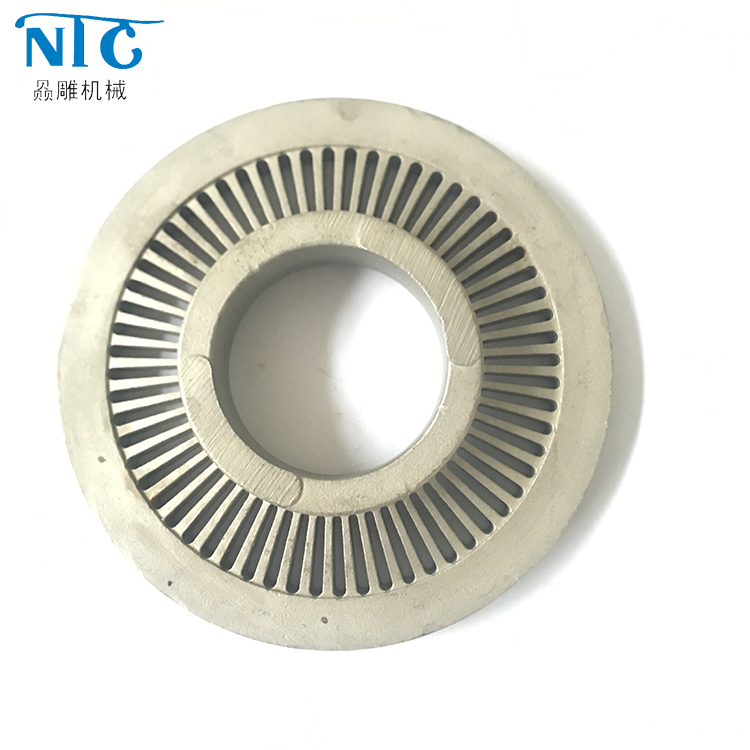
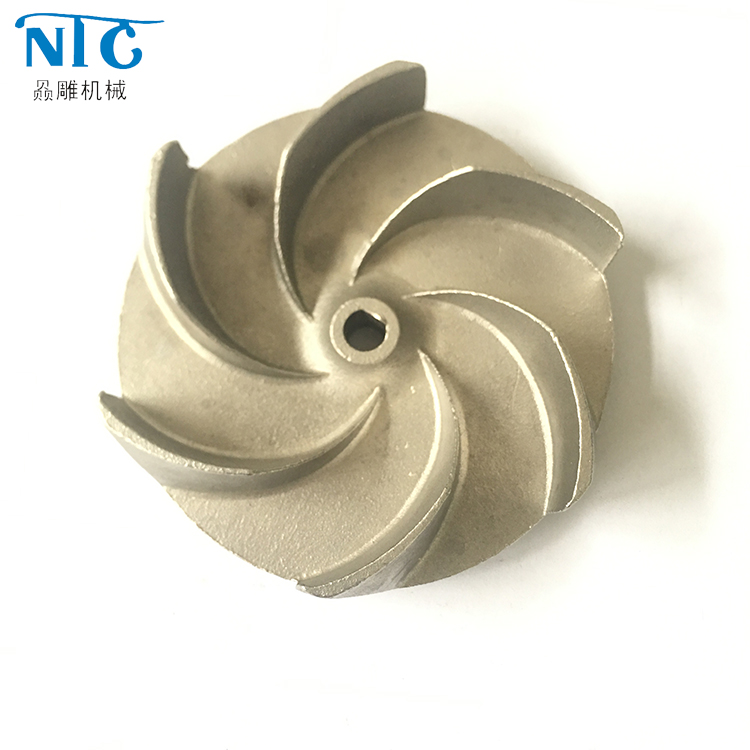
Pump impellers (OEM / Custom Drawing No. 1016) show the same principle at the level of material families. Austenitic stainless grades 201, 303, 304, 316, 316L, 1.4581, SCS14 and SCS16 are available for corrosive or hygienic duties; alloy cast steels such as 4140, 4150, 4340, 8620 and GS-25GrMo4 for higher strength and wear resistance; hardening stainless grades 17-4PH, 410, 420 and 440C plus cast alloy tool steels CS-2, CS-7 and CrWmn for abrasion; and carbon steels 1020, 1025 (WCB), 1030, 1040, 1045 and 1050 for general service. The same family is quoted at 2 g–550 g, tolerance grade T4–CT7, surface roughness up to Ra 1.6–Ra 6.3, minimum thickness of 2 mm with 1 mm possible in small areas, and a maximum blind-hole depth of 30 mm at a 10 mm hole diameter. Optional static or dynamic balancing improves rotational stability and reduces vibration in pump manufacturing, water treatment, chemical equipment and industrial circulation systems.
Pump housings (OEM / Custom Drawing No. 1015) are specified along the same lines for pump manufacturing, water treatment, chemical processing, industrial fluid systems, and agricultural and mechanical equipment, with flange faces, bearing seats, shaft holes and sealing surfaces as the machined features and pressure or leak testing available when specified. The scenario difference becomes most visible with the stainless steel food-processing impeller (OEM / Custom Drawing No. 1017): the grade is selected according to the operating medium from the same austenitic stainless range, blade geometry, hub structure, shaft bore and mounting interfaces are manufactured to drawing, and satin polishing, mirror polishing, pickling and passivation are used to produce smooth, easy-to-clean surfaces. Surface finish and cleaning requirements are confirmed according to the intended food-processing application, and balancing can be arranged for rotational stability.
6. How the Operating Environment Selects Material and Casting Route
Across these families, material selection follows a recognisable pattern. Carbon and alloy steels cover structural, pressure and wear duties where corrosion is not the limiting factor. Austenitic stainless grades cover corrosion, hygiene and clean-surface duties. Copper alloys serve fluid control and conductive applications. Zinc and aluminium alloys serve housings where weight and finish dominate. The process route then follows the material and the geometry: silica-sol investment casting for complex steel and stainless components, die casting for aluminium and zinc housings, and brass or zinc alloy die casting for compact lock components.
| Material family | Typical scenario driver | Example component |
|---|---|---|
| Carbon steel (e.g. 1020, 1025 / WCB, 1045) | Structural load, general pressure duty, cost-sensitive service | Bearing housing, pump housing, structural connector |
| Alloy steel (e.g. 4140, 4150, 4340, 42CrMo, 8620) | Higher strength, wear resistance, heat-treated components | Hydraulic valve body, textile drive housing, power tool lever |
| Austenitic stainless (e.g. 304, 316, 316L, 1.4581, SCS14, SCS16) | Corrosive or reactive media, hygiene, cleanable surfaces | Flowmeter body, vacuum fitting, food-processing impeller |
| Hardening stainless (e.g. 17-4PH, 410, 420, 440C) | Wear plus corrosion in the same duty | Pump impeller, hardware pivot component |
| Copper alloy (brass, bronze) | Fluid control, machinability, electrical conduction | Brass valve body, electrical connector component |
| Zinc and aluminium alloy | Lightweight housings, appearance, die-cast production | Door closer body, power tool gearbox housing |
Geometry constraints need the same scenario-based reading. For applicable investment-cast parts, dimensional tolerance is quoted at grade T4–CT7. ISO 8062-3:2007 defines dimensional tolerances for investment castings and typically achieves grades CT4 to CT6, which gives buyers a recognised reference point when comparing quotations. Minimum wall thickness is generally 2 mm, with 1 mm available in limited local areas subject to process review; minimum outer radius is ≥ 0.3 mm and minimum internal fillet ≥ 0.5 mm. Surface roughness sits in the Ra 1.6–Ra 6.3 band depending on casting, machining and finishing. Where a component contains pressure-retaining features on steel castings, general requirements standards such as ASTM A703/A703M provide a common baseline between buyer and supplier.
7. Market Trend Analysis: Why Scenario Specification Is Becoming the Differentiator
Three market signals support the argument that scenario-based selection is becoming a standard procurement discipline rather than an engineering nicety.
The first is growth in precision casting itself. The global investment casting market was valued at USD 17.4 billion in 2025 and is projected to reach USD 24.9 billion by 2033, with Asia Pacific holding a 39.2% revenue share in 2025 and automotive applications exceeding 29% of revenue (Grand View Research). The second is the material mix: stainless steel accounted for 32.98% of investment casting material share in 2025 (Mordor Intelligence), which is consistent with rising demand for corrosion-resistant and cleanable components in fluid, food, vacuum and instrumentation applications. The third is downstream demand in the categories that consume these castings — the global industrial valve market is projected to grow from USD 97.77 billion in 2026 to USD 273.49 billion by 2035 (Precedence Research), and the door hardware market was valued at USD 68.4 billion in 2025 with locks holding a 34.2% segment share (Dataintelo; this figure should be treated as directional given the source's medium reliability rating).
Supply-side data points in the same direction. China's total metal casting export value reached USD 1.47 billion in July 2024, an increase of 5.2% year on year (Dawang Metals / China Customs). At the same time, published market estimates diverge noticeably: base-year 2025–2026 investment casting values range from USD 17.4 billion (Grand View Research) to USD 20.52 billion (Fortune Business Insights) and USD 21.35 billion (Market Research Future), depending on whether sand casting and other processes are counted. For buyers, that divergence is a reminder to treat headline market numbers as context, and to evaluate a casting supplier on process scope, material range and verification capability instead.
8. Comparison with Traditional Solutions — and Where Precision Casting Stops Being the Right Answer
Investment casting is not universally superior to other manufacturing routes. In the referenced product families, the process is explicitly selected according to product size, material and structure, which means the correct comparison is situational.
| Route | Typical fit | Practical boundary |
|---|---|---|
| Silica-sol investment casting | Complex internal passages, small to medium precision components, steel and stainless service | Applied precision-cast components in this range are generally 2 g–550 g; minimum wall is 2 mm standard with 1 mm only in limited local areas subject to process review |
| Sand casting | Larger housings and heavier structures where the size envelope, material and structure suit it | Generally lower dimensional consistency on fine features, so critical sealing and mounting dimensions still require machining |
| Die casting (aluminium, zinc) | Non-ferrous housings where structure, strength and cost targets suit permanent tooling | Not applicable to steel and stainless pressure parts; tooling economics depend on volume and geometry |
| Machining from solid bar or plate | Single parts, urgent replacements, or geometries with no casting value | Internal passages and organic shapes are difficult or impossible to produce economically |
Two limitations deserve to be stated plainly. First, precision investment casting has a geometry and mass envelope: components in the referenced families are applicable from 2 g to 550 g, and designs with long thin walls or deep narrow cavities may need either process review or an alternative route. Second, casting does not replace machining on functional features — critical sealing and mounting dimensions, bearing seats, valve bores and threaded ports are finished by CNC operations, and buyers who expect an as-cast sealing surface to hold pressure without verification are taking on avoidable risk.
9. Future Outlook
Three shifts are likely to shape cast part sourcing over the next few years. Material specifications will continue moving toward corrosion-resistant grades where fluid, food, vacuum and instrumentation applications are involved, consistent with stainless steel's 32.98% material share in investment casting. Verification expectations will keep rising: pressure testing, leak testing, vacuum leak testing on assemblies, hardness testing and balancing are already optional line items, and buyers increasingly specify them at enquiry stage rather than after a failure. And documentation discipline will matter more, with standards such as ISO 8062-3 for tolerance grades and ASTM A703/A703M for pressure-containing steel castings providing the shared language between drawing, quotation and inspection report.
The practical conclusion for buyers is narrow and repeatable: describe the operating scenario first, select the material and process route second, and treat the drawing as one input among several. Suppliers that can support that sequence — casting, machining, heat treatment, finishing and inspection under one route — reduce the number of places where scenario information can be lost in translation.
10. FAQ
What are precision cast parts used for in industrial equipment?
Precision cast parts provide structural, connecting, sealing, supporting, transmission and fluid-control functions in industrial machinery. Typical applications include engineering machinery bearing and pump housings, hydraulic valve bodies, vacuum equipment connection fittings, flowmeter bodies and flanges, lock cylinder housings, textile and sewing machine components, and pump and food-processing impellers. They are used in construction machinery, fluid control, instrumentation, food-processing equipment, marine hardware, building hardware and general industrial assemblies.
How does the operating environment change material selection for a cast part?
The medium and the duty cycle determine the material family. Carbon and alloy steels such as 1020, 1025 (WCB), 1045, 4140 and 42CrMo are used for structural and general pressure duty. Austenitic stainless grades such as 304, 316, 316L, 1.4581, SCS14 and SCS16 are used where corrosion resistance, hygiene or cleanable surfaces are required. Hardening stainless grades such as 17-4PH, 410, 420 and 440C suit duties that combine wear and corrosion. Brass and bronze serve fluid control and conductive components, and zinc or aluminium alloys are used for lightweight housings.
When is investment casting not the right process for an industrial component?
Investment casting is not automatically the correct route. Within the referenced precision casting product families, applicable components generally range from 2 g to 550 g, with a standard minimum wall thickness of 2 mm and 1 mm available only in limited local areas subject to process review. Larger or heavier housings may be better served by sand casting, and non-ferrous housings such as door closer bodies or power tool gearbox housings may be produced by aluminium or zinc alloy die casting, selected according to product structure, strength and cost requirements.
What tolerances and surface finishes can be specified on precision investment castings?
For applicable investment-cast components, tolerance grade T4–CT7 is quoted, with surface roughness in the Ra 1.6–Ra 6.3 range depending on casting, machining and finishing. Minimum outer radius is ≥ 0.3 mm and minimum internal fillet is ≥ 0.5 mm. ISO 8062-3:2007, which defines dimensional tolerances for investment castings, typically achieves grades CT4 to CT6, so it provides a recognised reference when comparing quotations from different suppliers.
What should be verified before a precision cast part is shipped?
Verification scope follows the application. Across the referenced families, inspection typically covers material composition, critical dimensions, hole and port positions, concentricity, flatness, thread accuracy, sealing surfaces and appearance. Functional checks are added when specified: pressure testing, air-tightness testing and hydraulic leak testing for valve and pump components; vacuum leak testing for vacuum connection assemblies; hardness testing and assembly-fit inspection for housings and bearing seats; and static or dynamic balancing for impellers.
How is corrosion resistance handled in cast parts for fluid and food applications?
Corrosion resistance is addressed through material grade selection and surface finishing. Austenitic stainless grades 201, 303, 304, 316, 316L, 1.4581, SCS14 and SCS16 are available for fluid and food-service components. Finishing options include pickling, passivation, satin polishing and mirror polishing, which improve surface condition and cleanability. For food-processing impellers, surface finish and cleaning requirements are confirmed according to the intended application, and rotational balance can be arranged separately.
SHANGHAI NTC TECHNOLOGY CO., LTD. publishes a downloadable 2026 company and product brochure for buyers who want the full product and process reference: 2026 company and product brochure (PDF).