
Cast Resin Data Center Auxiliary Transformers: An Introduction
Cast resin data center auxiliary transformers are dry-type transformers with epoxy resin-encapsulated windings, used to supply supporting loads in data centre electrical systems. They are oil-free and designed for indoor installation, and data centers are listed among their applicable industries. In procurement terms, they are one part of a longer specification chain that also includes switchgear, UPS systems, and protection coordination.
Why Auxiliary Transformers Matter in Data Centre Electrical Architecture
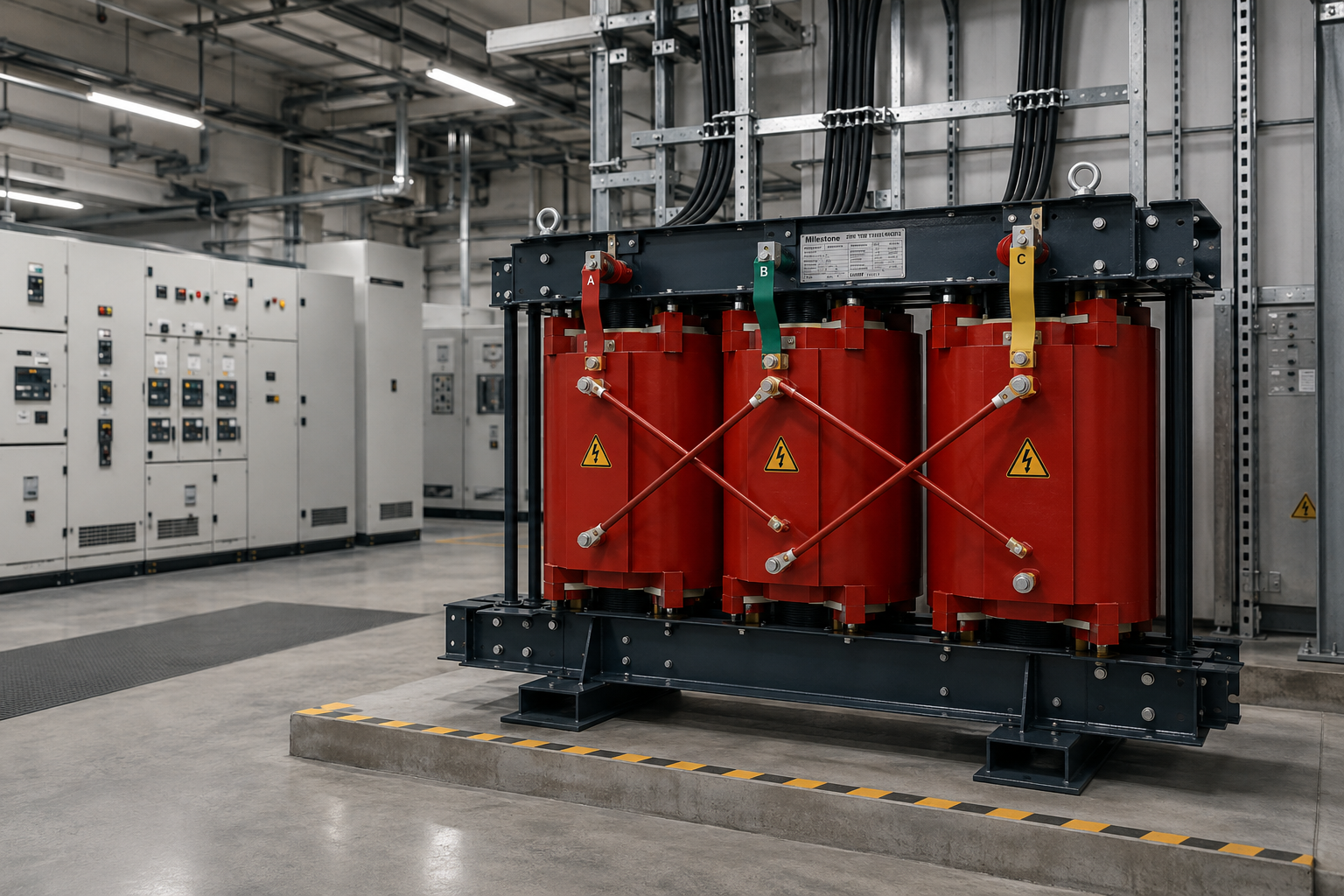
Data centres are among the most power-intensive facilities in modern infrastructure. Power moves through medium-voltage switchgear, transformers, UPS systems, low-voltage distribution, and finally IT equipment. Auxiliary transformers sit within that chain, supplying loads such as cooling systems, building services, lighting, and UPS-related circuits depending on the project design.
As rack densities rise and operators expand capacity, the auxiliary transformer becomes a procurement decision with safety, efficiency, and schedule implications. The choice is not only about kVA. It also involves fire performance, indoor installation constraints, harmonic duty, noise, enclosure protection, and the evidence a supplier can provide.
The global data center transformer market was valued at USD 8.4 billion in 2025, with a projected 7.2% compound annual growth rate between 2026 and 2033, according to commercial research cited in the verified data package. This is a directional commercial-research estimate, not an official statistical series, but it indicates sustained demand attention.
What the Cast Resin Dry-Type Transformer Category Includes
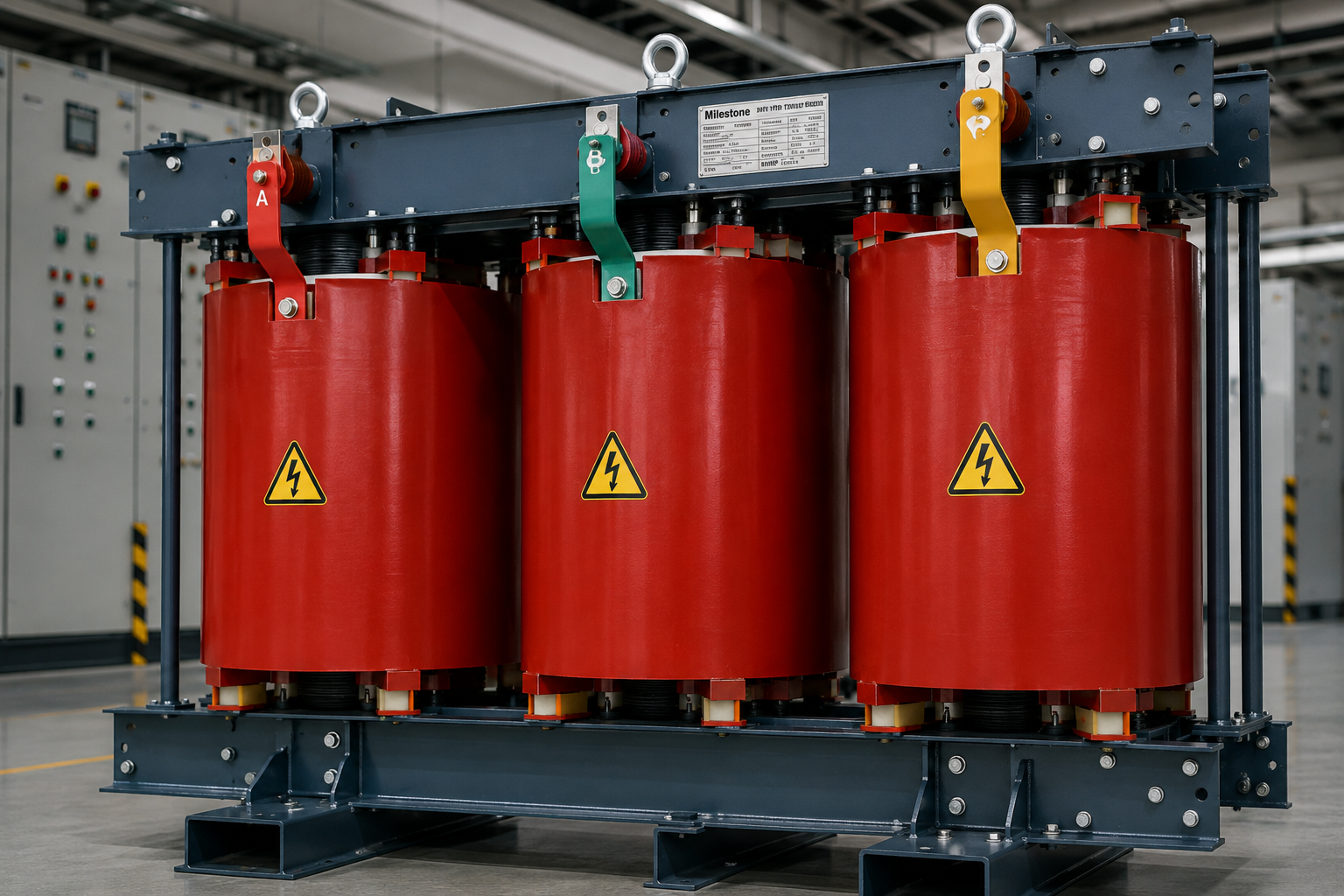
A cast resin transformer is a dry-type transformer in which the windings are encapsulated in epoxy resin. This removes insulating oil from the transformer. For indoor data centre environments, the absence of oil simplifies fire-safety planning and avoids liquid containment requirements associated with liquid-filled units.
Milestone (Xiong'an) Electrical Technology Co., Ltd. is a transformer engineering and manufacturing company based in Xiong'an New Area, Hebei, China. Established in 2011, the company manufactures power transformers, distribution transformers, dry-type transformers, and compact substations, and supports power generation, utility, EPC, oil and gas, mining, and industrial projects.
Within its dry-type range, the SCB13-1500/35-0.4 model designation indicates a 1500 kVA rating with 35 kV high voltage and 0.4 kV low voltage. The dry-type transformer uses cast resin insulation and is oil-free. Low noise and low maintenance are listed as product characteristics. AN and AF cooling options are available. The product is designed for indoor installation, and data centers are listed among its applicable industries.
The available asset information lists the following parameters:
| Parameter | Listed Value |
|---|---|
| Capacity | 25 kVA to 15,000 kVA |
| High Voltage | 6 kV to 35 kV |
| Low Voltage | 0.22 kV to 10 kV |
| Frequency | 50 Hz / 60 Hz |
| Temperature | -25 to -40 °C (as listed) |
| Altitude | 1,000 to 4,000 m |
| Number of Phases | Three-phase |
| Vector Group | Dyn11, Yyn0 |
| Short-Circuit Impedance | 4% to 6% |
| Cooling Method | AN / AF |
| Tap Voltage Regulation | OCTC / OLTC |
| Protection | IP20 / IP23 |
| Materials | Epoxy resin, CRGO silicon steel sheets, copper, aluminum, glass fiber |
Technical Factors Buyers Should Verify
Insulation and Core Construction
Cast resin insulation encapsulates the windings in epoxy resin. The product uses CRGO silicon steel sheets in the core, and copper or aluminum winding is available. Winding material affects dimensions, losses, and cost, but it does not by itself determine efficiency or reliability. Buyers should compare guaranteed losses, temperature rise, dimensions, and short-circuit withstand evidence at the same rating.
Cooling and Enclosure
AN (air natural) and AF (air forced) cooling are both available. AF operation can support a higher approved rating when fans and controls are available, but the exact rating at each cooling stage should be confirmed from the datasheet. The listed protection class is IP20 or IP23. These are not equivalent to IP54. For dusty, humid, or washdown environments, additional enclosure protection should be evaluated.
Vector Group and Impedance
Vector group options include Dyn11 and Yyn0. Vector group affects neutral availability, phase displacement, protection behaviour, and parallel-operation compatibility. It should be selected from the approved single-line diagram, not by default. Short-circuit impedance is listed at 4% to 6%. Impedance affects fault current, voltage regulation, protection coordination, and load sharing between parallel transformers. Neither value is universally preferable; the correct value should follow the system study.
Harmonic Capability and the K-Factor Boundary
Data centre loads often include UPS systems, rectifiers, and other nonlinear equipment. IEEE C57.110-2018 provides calculation methods to evaluate whether an existing dry-type or liquid-filled transformer can supply nonsinusoidal load currents, and provides application information for specifying a new transformer expected to carry such loads. K-factor ratings such as K-13 and K-20 are defined in the UL 1561 context for dry-type transformers.
This is an important boundary for the available evidence. The Milestone dry-type transformer asset information does not list K-13 or K-20 harmonic-mitigating ratings for this product. A buyer with high harmonic duty should not assume that a standard cast resin transformer is rated for it. The correct step is to request a harmonic study and confirm the applicable transformer rating before ordering.
Certification Scope
Milestone's company profile states that it provides ISO 9001 quality management system information and CE conformity documentation for applicable products, and that the exact certificate scope and covered models should be checked against current documents. The available asset information does not list UL or CSA listing for the dry-type transformer. Buyers in North America should verify listing status for the specific model before assuming compliance.
Where Cast Resin Auxiliary Transformers Fit
Data centers are listed among the applicable industries for the dry-type transformer. Other listed application scenarios include high-rise buildings, shopping malls, hospitals, subways, airports, office buildings, indoor factory power distribution, petrochemical auxiliary areas, and underground facilities. These are environments where indoor installation, fire safety, and reduced maintenance are often relevant.
Within a data centre project, the auxiliary transformer may serve cooling systems, building services, or UPS-related functions depending on the project design. The exact role should be defined by the electrical single-line diagram and load list.
The compact substation product, model YB-1500/35-0.4, is also listed as suitable for data centers, industrial parks, commercial facilities, and infrastructure power supply projects. It integrates high-voltage, transformer, and low-voltage components in a single enclosure. Some projects may compare a compact substation approach with separately installed dry-type transformers and switchgear; that comparison depends on space, expansion plans, and maintenance access.
Market Signals and What They Mean for Buyers
Two data points from commercial research are relevant, with the caveat that both are commercial-research estimates rather than official statistics.
First, the global data center transformer market was valued at USD 8.4 billion in 2025, with a projected 7.2% CAGR from 2026 to 2033. A separate commercial source cited a 2026 value of USD 8.5 billion and a 7.7% CAGR to 2032, but that source was based on a search snippet and was not accepted as eligible report evidence. The difference between the two estimates illustrates why buyers should treat market-size figures as directional.
Second, cast resin variants were reported at 52% share of the dry-type transformer market in 2024. This suggests cast resin is a mainstream dry-type construction, not a niche option.
A third signal is qualitative. Suppliers in the verified data package describe cast resin and VPI transformers for data centre applications. These are supplier claims, not independent performance evidence, but they indicate where specification attention is concentrated: harmonic loads, low noise, and indoor safety.
The honest limitation is that verified, comparable technical data across manufacturers is thin. The data package identifies gaps in lead time, price, loss data, and K-factor ratings. Buyers should expect to request datasheet-level evidence directly.
How Cast Resin Compares with Other Approaches
Cast resin dry-type transformers are often compared with liquid-immersed transformers for data centre auxiliary duty.
- Cast resin dry-type: no insulating oil, indoor installation, fire safety, low maintenance, and low noise as listed characteristics. These matter in dense urban data centres, underground facilities, and buildings where oil containment and fire protection add cost or complexity.
- Liquid-immersed: liquid-filled transformers can offer thermal and dimensional advantages in some ratings, and they are widely used outdoors and in utility distribution. The choice is not universal. A dry-type transformer is not automatically suitable for every indoor environment; ventilation, humidity, dust, altitude, and ambient temperature all affect selection.
A second comparison is cast resin versus VPI (vacuum pressure impregnation) dry-type construction. Both appear in supplier portfolios for data centre applications. The verified data package does not provide a head-to-head performance comparison, so buyers should compare model-level losses, temperature rise, environmental class, noise, and certificates rather than relying on construction labels.
A third comparison is integrated compact substation versus separately installed transformer and switchgear. The compact substation integrates high-voltage, transformer, and low-voltage components in one enclosure and can reduce site assembly. But it is not automatically cheaper or faster; enclosure thermal performance, maintenance clearance, shipping dimensions, and expansion flexibility must be checked.
The most important boundary for this article is the harmonic question. IEEE C57.110-2018 provides a method for evaluating transformer capability under nonsinusoidal loads. But the available Milestone dry-type transformer asset information does not list K-13 or K-20 ratings. A buyer with a high-harmonic duty should not assume that a standard cast resin transformer is rated for it. The correct step is to request a harmonic study and confirm the applicable transformer rating.
A second boundary is certification. The company profile states that certificate scope and covered models should be checked against current documents. The available asset information does not list UL or CSA listing for the dry-type transformer. North American buyers should verify listing status for the specific model before assuming compliance.
Future Outlook
Data centre capacity growth is likely to keep transformer selection in focus. Three developments seem plausible based on the available evidence, though each should be treated as a direction rather than a forecast.
First, harmonic capability will remain a specification issue. As AI and high-density computing increase nonlinear loads, buyers will need to confirm transformer capability under nonsinusoidal currents, not just nameplate kVA.
Second, efficiency and loss data will matter more in procurement. The asset information for Milestone's dry-type transformer lists a low-loss design but does not provide numeric efficiency values. Buyers comparing offers will need guaranteed loss figures at the same reference conditions.
Third, indoor safety and noise will continue to shape auxiliary transformer choices in urban and underground data centres. Cast resin's oil-free construction fits that direction, but it does not remove the need for ventilation, environmental assessment, and enclosure review.
Frequently Asked Questions
What is a cast resin data center auxiliary transformer?
A cast resin data center auxiliary transformer is a dry-type transformer with epoxy resin-encapsulated windings, used to supply supporting loads in a data centre electrical system. It is oil-free and designed for indoor installation. Data centers are listed among the applicable industries for Milestone's dry-type transformer. The exact auxiliary duty should be defined by the project single-line diagram.
Should we choose a dry-type or liquid-immersed transformer for an indoor data centre?
For an indoor project where fire safety and avoiding insulating liquid are priorities, a dry-type transformer is often considered first, followed by an approved less-flammable liquid-filled design, and then a mineral-oil transformer where installation rules permit. For an outdoor industrial project, a liquid-immersed design may be considered first. The ranking depends on fire requirements, ventilation, maintenance, and installed cost.
Which transformer capacity should we choose for a data centre project?
Capacity should be selected from verified maximum demand, starting requirements, harmonic assessment, and confirmed expansion plans, not from a fixed spare-capacity percentage. A larger transformer is not automatically better; it can increase no-load losses and upstream fault duty. The Milestone dry-type transformer is listed from 25 kVA to 15,000 kVA, but the correct rating depends on the project load study.
Should we choose copper or aluminium windings?
Copper and aluminium are both listed as available winding materials for the dry-type transformer. Copper has higher conductivity and can support a smaller conductor cross-section for comparable resistance, but it is not automatically better in every project. Aluminium can be a valid alternative where it meets the same required performance and installation limits. Buyers should compare guaranteed losses, temperature rise, dimensions, short-circuit withstand evidence, and delivery rather than judging by conductor material alone.
Is a lower-loss transformer worth the higher purchase price?
For a continuously energized project with a long service horizon, a compliant design with the lowest evaluated lifecycle cost is often considered first. At low average loading, no-load loss dominates; at high average loading, load loss matters more. The Milestone dry-type transformer lists a low-loss design, but no numeric efficiency value is provided in the available asset information. Buyers should request guaranteed loss values and compare them at the same rating, reference temperature, and tap position.
Can a cast resin transformer be used for the whole data centre load, or only for auxiliary circuits?
The available asset information lists data centers among applicable industries for the dry-type transformer, with a capacity range from 25 kVA to 15,000 kVA. Whether a cast resin unit is applied to auxiliary circuits or to a larger distribution role depends on the project design, harmonic assessment, and thermal verification. The product is not identified as a K-13 or K-20 harmonic-mitigating transformer, so high-harmonic main-load applications require separate confirmation.
Selected standards and data references: IEEE C57.110-2018 (transformer capability under nonsinusoidal load currents); UL 1561 (dry-type transformer K-factor rating context); IEC 60076 series (power transformer standards family). Market figures are commercial-research estimates and should be treated as directional.
Manufacturer documentation: Milestone Transformer Catalogue (PDF) is available for reference at Milestone-Transformer-Catalogue.pdf.
Есть вопросы или нужны дополнительные детали?
Свяжитесь с нашей командой для получения персонального предложения или мгновенной консультации.
Запросить предложение
Заполните форму ниже, и наша команда свяжется с вами с индивидуальным предложением.
Прямой чат WhatsApp
Предпочитаете общаться в реальном времени? Напишите нам в WhatsApp для мгновенной помощи и быстрых ответов.
- Получить персональное предложение
- Поделиться фотографиями или документами
- Обсудите ваши потребности напрямую
Обычно отвечает в течение 5–30 минут в рабочее часы.