
Casting Polyurethane Project Acceptance: Patent 16425Q32921R3M
Casting polyurethane projects are approved on two tracks. The first is chemical: does the prepolymer system deliver the wear behaviour, hydrolysis resistance and mechanical profile the part requires? The second is documentary: does the supplier's paperwork match the item actually ordered, and will it still match when an auditor, an importer or a project owner opens the file two years later?
The second track is where workable projects stall. A grade designation in the purchase order does not appear anywhere in the certificate. A certificate speaks at material-family level while the acceptance criteria were written at model level. A scanned copy carries no date, no revision and no indication of which register it belongs to.
This guide works through one document that appears in those reviews: invention patent certificate number 16425Q32921R3M, issued by HUAZHONG INTERNATIONAL CERTIFICATION AND INSPECTION GROUP. It covers what the certificate states, how its scope lines up with the casting polyurethane prepolymer, CPU casting polyurethane and polyurethane elastomer families supplied by Shanghai Hecheng Polymer Technology Co., Ltd, and how to convert that scope into acceptance wording that holds up under audit.
The scope of certificate 16425Q32921R3M, stated plainly
Certificate number 16425Q32921R3M is an invention patent certificate issued by HUAZHONG INTERNATIONAL CERTIFICATION AND INSPECTION GROUP. Its documented product scope covers three material families: CPU casting polyurethane, casting polyurethane prepolymer, and polyurethane elastomer.
For a procurement file, that is the entire usable content. The certificate is a scope statement connecting a registered invention to those three families of cast polyurethane material. It is evidence of technical ownership at family level. It is not a performance document, a batch record or a market authorisation.
Buyers who need those facts request three other documents: a technical datasheet for the ordered grade, a safety data sheet, and a test report — internal or third-party — covering the properties the finished part depends on. When the certificate is filed without those, the review is incomplete even though the patent item is present and correct.
Domestic and international applicability of the same document
In a domestic project file — a Chinese manufacturing or tender package — the certificate typically satisfies the intellectual-property and technical-ownership line of the supplier qualification checklist. It supports a judgement about whether the supplier holds registered invention status in the material families it sells.
In an international procurement file, the same certificate keeps a narrower role. It travels as supporting technical evidence attached to the supplier profile, alongside the datasheet, the safety data sheet and test data. Market access is decided by the destination market's own instruments — importer registration, chemical control, labelling and, for isocyanate-containing systems, handling requirements — none of which the certificate addresses.
The practical rule used in document review is therefore a wording rule: cite the certificate as supporting technical documentation, and do not describe it as a certificate of conformity, an approval or an authorisation. Auditors read acceptance clauses literally, and an overstated description of a patent certificate creates a defect in the file that no product quality can repair.
Why scope and model alignment decide the outcome
Three mismatch patterns account for most failed reviews, and only one of them is about product quality.
- Identifier mismatch. The number 16425Q32921R3M appears in the approved vendor list, the RFQ and the certificate with different spacing, separators or transcription. The document is present but cannot be matched by a search or a system field.
- Scope mismatch. The certificate names three material families while the purchase line names one grade. Nobody has written down that the grade belongs to a covered family.
- Version mismatch. Undated scans circulate between departments and superseded copies remain in the technical annex after a revision.
Scope mismatch is the most expensive of the three, because it stays invisible until a technical query is raised late in the project. It is also the one most easily avoided. Hecheng's officially listed portfolio contains five product categories: casting polyurethane prepolymer, casting polyurethane mixed component, polyurethane polymers with excellent performance and special applications, environment-friendly adhesive products, and supporting equipment, auxiliary materials and additives for PU production. The certificate names three material families. The prepolymer and casting mixed-component categories map naturally onto the prepolymer and CPU casting polyurethane wording; the adhesive products and the supporting equipment, auxiliary materials and additives category sit outside the three named families and should not be qualified by reference to this certificate.
Mapping certificate families to Hecheng product documentation
| Certificate family | Hecheng product or model designation | Acceptance question to settle in writing |
|---|---|---|
| Casting polyurethane prepolymer | Casting Polyurethane prepolymer, model POLYURETHANE ELASTOMER | Is the ordered prepolymer grade inside this family? |
| CPU casting polyurethane | CPU casting polyurethane, PTMG-MDI polyether system | Is the PTMG-MDI system treated as CPU casting polyurethane under the certificate? |
| Polyurethane elastomer | Polyurethane elastomer, polyester three-component system, Screen Scraper-5282ABC | Is a three-component polyester system covered as an elastomer? |
| Adjacent liquid system (confirmation needed) | Liquid polyurethane, Gel-8301AB, AB material | Is the AB liquid system filed under a covered family, or handled separately? |
| Adjacent prepolymer grade (confirmation needed) | Polyurethane prepolymer, rubberised sports equipment grade 8385AB | Is the sports grade covered at family level? |
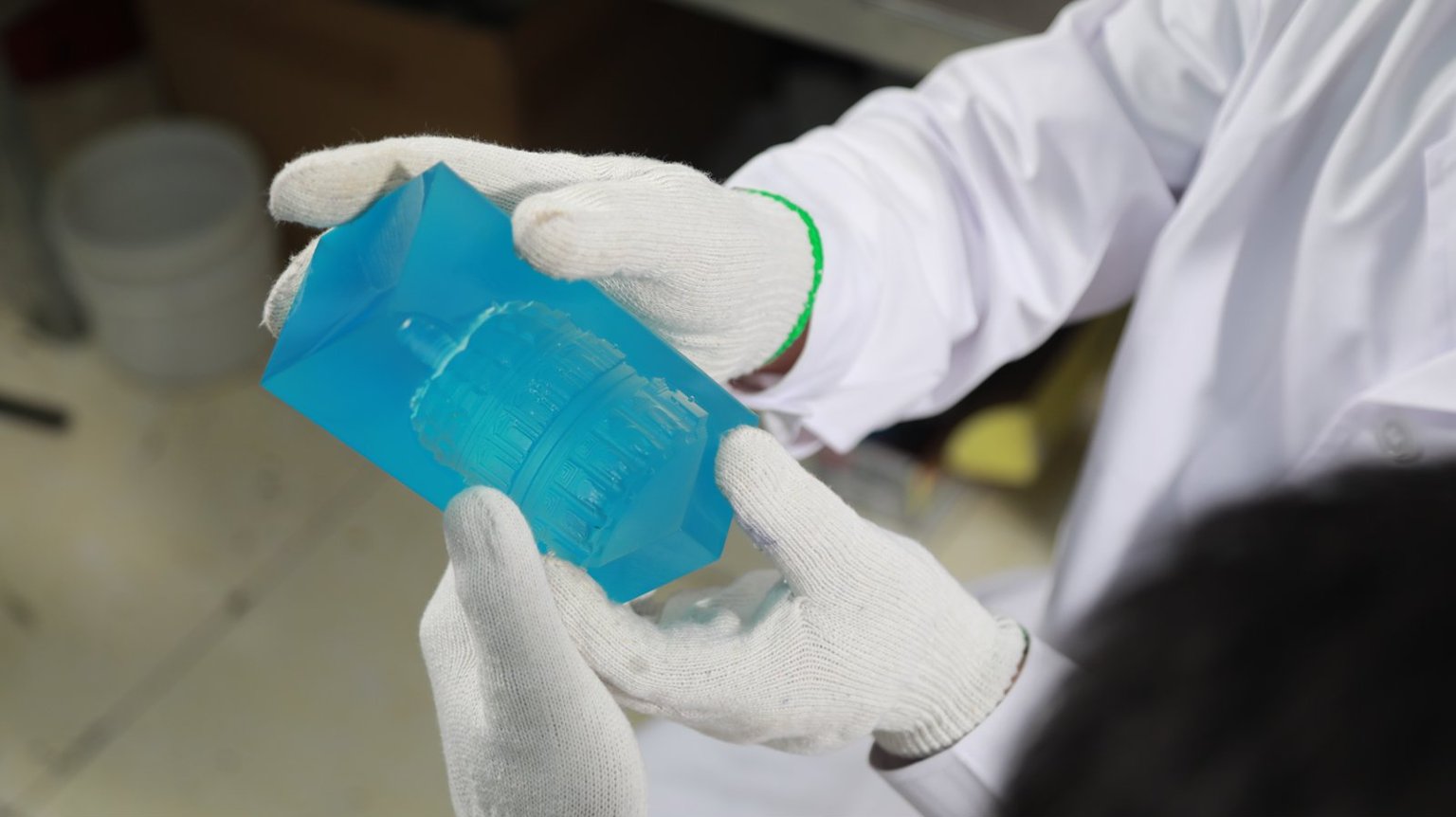
Model designations matter because they are what the buyer actually orders. POLYURETHANE ELASTOMER, PTMG-MDI, Gel-8301AB, 8385AB and Screen Scraper-5282ABC are model-level identifiers; the certificate is written at family level. The gap between those two levels is closed by a document, not by assumption. A short written scope-confirmation statement referencing certificate 16425Q32921R3M, listing the ordered model designations and signed by the supplier, is the cheapest mechanism available and removes the ambiguity permanently from the project file.
Technical context: where the certificate stops and the process starts
Casting polyurethane production runs on two-component processing. Raw materials are metered and conveyed as two components, mixed at high pressure and poured, which supports continuous production. The supporting equipment set is standard: a polyurethane high-pressure foaming machine or a low-pressure pouring machine, a raw material storage tank, a mixing bucket and a delivery pump.
Every parameter inside that chain — metering ratio, component temperature, mixing pressure, pour rate, pot life, cure schedule and demould time — is defined per grade and per part. Those values come from technical documentation and are validated in the buyer's own trials. None of them is described by a patent certificate, and none should be inferred from it.
The same boundary applies to material testing. Hecheng's laboratory work covers basic mechanical testing, thermal analysis and chemical resistance evaluation, and is used to confirm that customised material meets the specified requirement. Where a part depends on hydrolysis resistance under humid service, or on wear life in abrasive service, the evidence is the test result, not the certificate number.
Project scenarios: what the document pack has to answer
The certificate carries identical meaning across applications, but the rest of the acceptance pack changes with the working conditions. In tropical high temperature and high humidity, with frequent friction and corrosive water contact — conditions standard across Vietnam, Pakistan, the Philippines, Cambodia, Malaysia, Bangladesh and Thailand — performance evidence carries more weight than patent evidence, and the two are never substitutes for one another.
| Scenario | Material role in the project | What the certificate contributes | What still needs separate evidence |
|---|---|---|---|
| Mining | Cast elastomer for tensionless screen mesh; wear-resistant, high-resilience parts | Family coverage for prepolymer and elastomer | Abrasion and mechanical data; pouring trials on high-pressure or low-pressure equipment |
| Wind power generation | Aging resistance, high-voltage sealing and shock absorption for wind power components | Family coverage for prepolymer systems | Aging and thermal data; sealing performance in service |
| Marine technology | Corrosion resistance, marine anti-fouling and vibration damping in liquid polyurethane raw material projects | Family coverage for elastomer and prepolymer | Seawater exposure data; anti-fouling claims are outside the certificate entirely |
| Construction | High hydrolysis and corrosion resistance, high-toughness elastomer for anti-wear parts | Family coverage for elastomer systems | Hydrolysis data under humid, chemically aggressive service |
| Sports equipment | Rubber coating applied by two-component mixing; grade 8385AB with vivid colours and an eco-friendly profile | Family coverage at prepolymer level | Coating adhesion and durability data |
| Automotive | Low-free TDI prepolymer improving physical and mechanical properties and dynamic mechanical behaviour | Family coverage for prepolymer systems | Dynamic mechanical data; handling documentation for low-free systems |
Hecheng reports an export ratio of about 30%, with main markets in the EU, Southeast Asia and South America. That mix matters for document design, because one certificate is read by reviewers applying different rules: an EU importer will ask for handling and registration documentation that a domestic project does not request, while an Asian project buyer is more likely to test the same certificate against performance data under humid, abrasive conditions.
Market context that turns documentation into a procurement issue
- The global casting polyurethane market was valued at USD 2.76 billion in 2024 and is projected to reach USD 4.199 billion by 2033, at a CAGR of 5.97% (Astute Analytica, reported via Taiwan News).
- The broader polyurethane market is projected at USD 92.1 billion for 2026 (Grand View Research). Other published estimates differ because product definitions differ, so the figure should always be quoted together with the scope it describes.
- The low-free isocyanate prepolymer segment is described as growing at a CAGR of 13.01% through 2033 (Market Research Intel).
Two consequences follow. First, growth in the CPU segment means more suppliers, more grades and more document sets per project, so a repeatable review process saves more time every year it is used. Second, the fastest-growing technology segment adds handling and safety documentation to the pack, which pushes patent evidence towards the supporting column instead of the centre of the file. Documentation discipline is turning into a procurement capability rather than an administrative afterthought.
Patent evidence compared with the other documents in the pack
| Document | Question it answers | Question it cannot answer |
|---|---|---|
| Invention patent certificate 16425Q32921R3M | Are the three named material families covered by registered invention status? | Whether the delivered lot meets specification |
| Grade-level technical datasheet | What the grade's parameters and processing window are | Ownership or family scope |
| Safety data sheet | Handling, hazard and transport classification | Performance in service |
| Test report, internal or third-party | Measured properties under named methods | Patent scope |
| Supplier audit and capacity evidence | Whether supply can repeat at volume | Product performance |
| Destination-market registration | Whether the material may be placed on that market | Invention coverage |
Three boundaries belong in the file rather than in someone's memory. First, family-level wording is not model-level clearance: the certificate names families, and the purchase order names a model. Second, patent evidence is not conformity evidence: registration of an invention says nothing about tensile strength, abrasion or hydrolysis behaviour. Third, the certificate does not reach the parts of the portfolio that are not materials — Hecheng's environment-friendly adhesive products and its supporting equipment, auxiliary materials and additives category fall outside the three named families.
The certificate also says nothing about manufacturing scale. Hecheng operates a 16,932 m² facility with 16 major production reactors, a range of more than 1,000 prepolymer grades, and a company-reported annual output of 1 million tons. Claims of that kind are confirmed through audit evidence and production records, not through an intellectual-property document, and a careful reviewer keeps the two conversations separate.
Acceptance criteria: eight checks to write into the project file
- Reproduce the identifier exactly. The certificate number should appear in the same form in the approved vendor list, the RFQ and the technical annex, character for character.
- Verify the issuer line. The issuing entity name, the certificate number and the patent reference should be legible on the same page of the copy retained in the file.
- Match scope to family. Record which of the three named families the purchase falls into, and state it explicitly in the checklist.
- Close the model gap. Obtain a signed scope-confirmation statement listing the ordered model designations against the certificate number.
- Assemble the full pack. Datasheet, safety data sheet, test report and certificate together, plus destination-market registration where the material crosses a border.
- Control versions. Date each document on receipt, log the revision, and remove superseded copies from the annex.
- Write the clause correctly. The purchase order or technical annex should state what the certificate evidences and, in the same sentence, what it does not.
- Set a re-review trigger. A new grade, a new production site, a new destination market or a certificate revision restarts the check rather than inheriting the previous decision.
Outlook
Documentation review is moving from attachments to identifiers. As approved vendor lists migrate into structured systems, a certificate number becomes a field that must match across documents rather than a PDF sitting in a folder, and the suppliers who benefit are those whose certificate scope, product nomenclature and datasheet references already agree with one another.
The technology mix is shifting in the same direction. With low-free isocyanate prepolymer demand described as growing at a 13.01% CAGR through 2033, handling and safety documentation will keep expanding, and patent evidence will settle into its correct role as one item inside a multi-document qualification rather than a headline claim.
For casting polyurethane projects, the practical outcome is unglamorous and useful: the certificate is worth having in the file, and it is worth reading precisely. A supplier able to state the boundary in writing — which family, which model, which document proves performance — removes most of the friction that otherwise surfaces at the acceptance stage, when the part is already in production.
FAQ
What exactly does certificate 16425Q32921R3M cover?
It is an invention patent certificate issued by HUAZHONG INTERNATIONAL CERTIFICATION AND INSPECTION GROUP, and its documented product scope covers CPU casting polyurethane, casting polyurethane prepolymer and polyurethane elastomer. It does not state grade-level parameters, test results or batch records.
Does the certificate apply outside China?
It is used internationally as supporting technical evidence inside a supplier documentation package. Market access obligations — importer registration, chemical control, labelling and handling requirements — are set by the destination market and fall outside the certificate's scope, so the document should not be presented as a market authorisation.
How should a buyer match the certificate to a specific grade?
By treating the certificate as family-level and the grade as model-level. Model designations such as PTMG-MDI, Gel-8301AB, 8385AB and Screen Scraper-5282ABC sit below the certificate's wording, so the link is established through a written scope-confirmation statement from the supplier and recorded in the technical annex.
Which product categories fall outside the certificate's wording?
Hecheng lists five product categories: casting polyurethane prepolymer, casting polyurethane mixed component, polyurethane polymers with excellent performance and special applications, environment-friendly adhesive products, and supporting equipment, auxiliary materials and additives for PU production. The adhesive products and the supporting equipment, auxiliary materials and additives category are not among the three families named in the certificate.
What should accompany the certificate in a project file?
A grade-level technical datasheet, a safety data sheet, a test report covering the properties the part depends on, and destination-market registration where applicable. Each item should carry a receipt date and a revision reference so that superseded copies can be withdrawn.
Is a patent certificate evidence of performance in humid, abrasive or seawater conditions?
No. Performance under tropical high temperature, high humidity, frequent friction or corrosive water contact is established by test data. Hecheng's laboratory work covers basic mechanical testing, thermal analysis and chemical resistance evaluation, and those results — not the certificate — support the performance claim.
Can the certificate be referenced in a purchase order acceptance clause?
Yes, provided the clause defines its role. The certificate can be listed as supporting technical documentation for the covered material families; the acceptance clause should separately specify the datasheet, test report and inspection criteria that determine whether a delivered lot is accepted.
The product brochure covering casting polyurethane prepolymer and elastomer applications is available for download: Polyurethane raw materials brochure (PDF).
Есть вопросы или нужны дополнительные детали?
Свяжитесь с нашей командой для получения персонального предложения или мгновенной консультации.
Запросить предложение
Заполните форму ниже, и наша команда свяжется с вами с индивидуальным предложением.
Прямой чат WhatsApp
Предпочитаете общаться в реальном времени? Напишите нам в WhatsApp для мгновенной помощи и быстрых ответов.
- Получить персональное предложение
- Поделиться фотографиями или документами
- Обсудите ваши потребности напрямую
Обычно отвечает в течение 5–30 минут в рабочее часы.