
Cell Phone Repair Scenario Fit: Tweezers and Electric Screwdrivers in Industry Applications
Cell Phone Repair Scenario Fit: Tweezers and Electric Screwdrivers in Industry Applications
Cell phone repair is a bench-level discipline built around repeated small-part handling and controlled fastener work. It is not defined by the number of tools in a kit. The practical question for repair shops, chain workshops and wholesale buyers is which tool family fits which bench scenario, and what evidence supports that fit. A complete phone repair tool set may include opening blades, pry tools, spudgers and screen replacement accessories, but the two families that most directly shape daily repair work are precision tweezers and electric screwdrivers.
This article maps verified scenario facts from KOOCU Phone Repair Tools to common mobile phone repair tasks. KOOCU Phone Repair Tools is a cell phone repair tool brand from Guangzhou Weiqianji Technology Co., Ltd, a manufacturer of mobile phone repair tools and equipment with production operations in Guangzhou, Foshan and Dongguan. The focus here is not a catalog tour. It is scenario-based selection for mobile phone repair benches, including the cellphone repair industry, wholesale tool buyers and repair businesses that need repeatable tool choices.
Scenario fit starts at the repair bench, not in the catalog
Phone repair work alternates between two very different physical tasks. One task is handling small components: screws, brackets, connectors, shields, flex cables and tiny mechanical parts. The other is removing and fastening screws repeatedly, often across many devices in a working day. Tweezers address the first task. Electric screwdrivers address the second. Treating them as interchangeable or as generic accessories misses the workflow logic that buyers should use.
That is the opportunity for B2B buyers. A repair chain can standardize bench tools by task: anti-static tweezers for component handling, electric screwdrivers for screw removal and fastening, and supporting tools for opening and screen access. This scenario approach is more useful than simply buying a larger kit. It also gives wholesale buyers a way to compare suppliers: can the supplier explain model-level fit, material, anti-static properties, power range, torque, OEM scope and lead time in the same conversation?
The limitation is equally important. No single tweezer length or screwdriver model fits every repair bench. A 120 mm tweezer and a 115 mm tweezer both serve small-component handling, but they create different reach and control profiles. An electric screwdriver reduces manual effort in repeated screw work, but it requires correct bit matching, power or torque setting and controlled operation. Scenario fit is therefore a filtering process, not a ranking exercise.
Tweezer scenarios: small parts, reach and anti-static control
In mobile phone disassembly, tweezers are used where fingers cannot provide enough access or control. They help pick up small components, position parts during reassembly and handle items around connectors and brackets. The relevant selection variables are length, material, tip condition and anti-static behavior. Length is not a cosmetic specification. A longer tweezer can provide more reach across a bench or into a device cavity, while a shorter tweezer can feel more compact in close work. Neither is universally better.
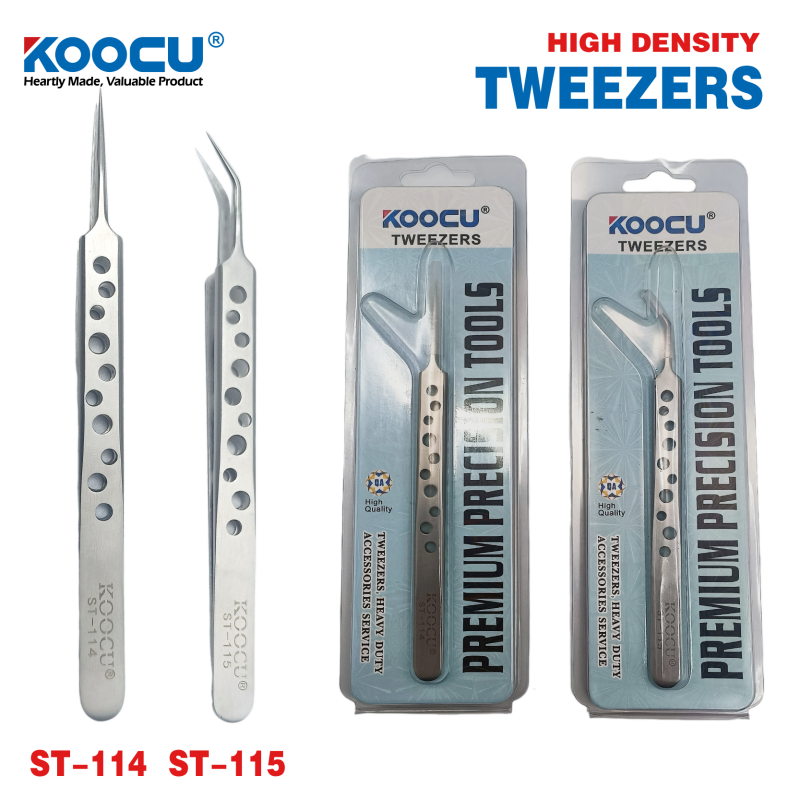
The KOOCU Phone Repair Tools tweezer facts organize around two length classes. FS-11, ST-30, ST-25 and ST-21 are stated at 120 mm. ST-115 and TS-15 are stated at 115 mm. The supplied product facts also describe stainless steel, high hardness and anti-static properties across ST-25, ST-21, ST-114, ST-30, ST-115 and FS-11. ST-115 is explicitly identified as a tweezer with anti-static properties used in mobile phone repair. FS-11 is explicitly identified as a stainless-steel tweezer with a 120 mm length, designed for mobile phone repair.
| Model | Stated length | Stated material or line property focus | Scenario fit for phone repair |
|---|---|---|---|
| FS-11 | 120 mm | Stainless steel; line properties include high hardness and anti-static behavior | General small-component pickup and placement with a 120 mm reach class |
| ST-30 | 120 mm | Line properties include stainless steel, high hardness and anti-static behavior | 120 mm handling class for repair benches that prefer longer reach |
| ST-25 | 120 mm | Line properties include stainless steel, high hardness and anti-static behavior | 120 mm class for component handling and positioning |
| ST-21 | 120 mm | Line properties include stainless steel, high hardness and anti-static behavior | 120 mm class for small-part work where reach and control are both needed |
| ST-115 | 115 mm | Explicitly anti-static; line properties include stainless steel and high hardness | Compact anti-static handling for tighter bench or device access |
| TS-15 | 115 mm | 115 mm class; line properties include stainless steel, high hardness and anti-static behavior | Compact small-component handling in mobile phone repair |
| ST-114 | Not specified in the supplied fact set | Line properties include anti-static behavior, stainless steel and high hardness | Anti-static tweezer option where the buyer must confirm length and tip preference |
The technical explanation is straightforward. A tweezer is a precision handling tool, so tip alignment and operator technique matter as much as the headline material. High hardness is relevant to how a tip resists wear in repeated use, but hardness alone does not define tip geometry, spring tension or alignment. Buyers should therefore ask for model-level confirmation rather than assume that every tweezer in a line behaves identically.
Anti-static behavior deserves the same careful reading. Anti-static tweezers are intended to reduce static charge buildup during handling. They are useful in phone repair because small electronic components can be sensitive to electrostatic discharge. However, anti-static tweezers are not a standalone ESD control system. A repair bench still needs appropriate grounding and ESD work practices. This is a real boundary that buyers should understand before writing anti-static into an internal specification.
Electric screwdriver scenarios: repeated screw removal and fastening
Screw work is the second core scenario. Mobile phone disassembly tools often include precision screwdrivers because phones use small fasteners that must be removed and reinstalled without damaging surrounding parts. Manual screwdrivers work, but repeated screw removal across a repair queue can consume physical effort. Electric screwdrivers change the effort profile by providing motor-driven rotation and, in the models described here, aluminum-alloy construction and magnetic bit support.
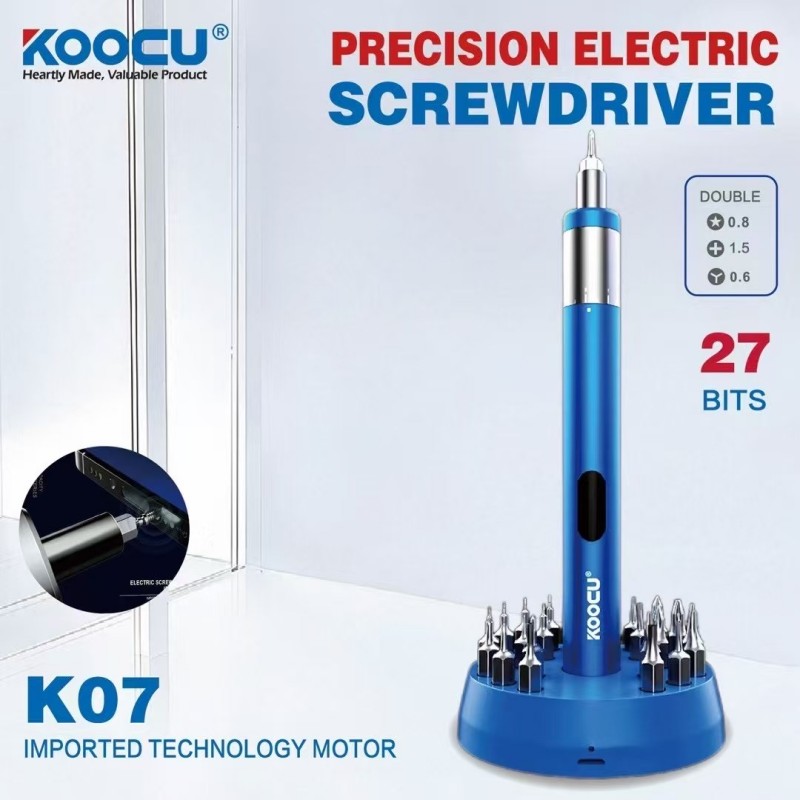
KOOCU Phone Repair Tools describes K07 as a special screwdriver for mobile phone repair with a power range of 2W to 30W and an aluminum-alloy body. K04 is also described as a special screwdriver for mobile phone repair made of aluminum alloy. K01 is described with an aluminum-alloy body, a high-hardness magnetic bit and an output torque range of 1–8 N·m. The K01 principle is electric-driven torque output that reduces manual physical consumption compared with a manual screwdriver.
The K01 scenario is further illustrated by a documented B2B case. A South African B2B wholesale merchant used 50 K01 units for screw removal over three years and reported stable operation and strong power. That case does not prove that K01 is suitable for every phone model or every fastener. It does show a real wholesale use pattern: a buyer purchasing a defined quantity for a screw-removal application and evaluating the result over a multi-year period.
The operational sequence for K01 screw removal is stated as follows: install the matching screwdriver bit, confirm the power-supply connection, align the bit with the phone screw, and start rotation to take out the screw. The published safety note states that the tool should meet explosion-proof requirements under power-supply working conditions and should not be overloaded in long-time continuous operation. These are practical limits, not marketing details. Electric screwdrivers are strongest in repetitive screw work; they are not a substitute for judgment on delicate, damaged or unusual fasteners.
How KOOCU maps to repair-bench scenarios
The KOOCU Phone Repair Tools line connects product facts to bench scenarios in a way that B2B buyers can evaluate. The tweezer range includes 120 mm models such as FS-11, ST-30, ST-25 and ST-21, and 115 mm models such as ST-115 and TS-15. ST-114 is also included in the supplied anti-static, stainless-steel and high-hardness line description, but its length is not specified in the provided fact set. Buyers who need ST-114 for a defined bench layout should confirm length and tip details before ordering.
On the screwdriver side, K07 and K04 are positioned as special screwdrivers for mobile phone repair with aluminum-alloy construction. K01 adds the stated 1–8 N·m torque range, high-hardness magnetic bit and the South African wholesale case. For a repair shop, this mapping supports a practical bench split: tweezers for component handling, electric screwdrivers for repeated screw removal and fastening, and manual checks where the operator needs finer control.
The manufacturer facts also matter for wholesale buyers. The manufacturer provides OEM production services and customization options for voltage and logo. The minimum order quantity is 50 units. Typical production lead time is 10 days, and monthly production capacity is 10,000 units. Quality control is described as 100% test, and after-sales support is provided through remote support. Export markets include South America and Africa. These facts do not make a tool suitable by themselves, but they give buyers a clearer basis for supplier evaluation when the scenario is already defined.
Application and use cases across the cellphone repair industry
Independent repair shops. A single-bench shop needs tools that cover both small-part handling and screw work without forcing the operator to switch between unrelated tool systems. A 120 mm tweezer such as FS-11 or ST-30 can serve general component handling, while a 115 mm model such as ST-115 or TS-15 can suit tighter access. An electric screwdriver such as K07 or K01 can reduce the physical repetition of screw removal in a busy repair queue.
Chain repair workshops. Multi-bench operations benefit from model consistency. If every bench uses the same tweezer length class and the same screwdriver model family, training and replacement become easier. The 120 mm and 115 mm tweezer classes can be assigned by workstation type rather than by individual preference. The OEM options for voltage and logo also allow a chain or distributor to align tools with its own brand and market requirements, subject to the stated MOQ of 50 units and 10-day lead time.
Refurbishment and high-repeat disassembly lines. In workflows where screw removal repeats across many devices, electric screwdrivers are a more natural fit than manual screwdrivers. The K01 case of 50 units used for screw removal over three years shows this type of wholesale application. The limit is that high-repeat use still requires bit maintenance, power checks and controlled operation. The published safety note against long-time continuous overload should be part of line training.
Wholesale kit assembly. Distributors building a professional cell phone repair kit or a complete phone repair tool set can combine tweezer models by length class with electric screwdriver models by power and torque profile. This is where scenario-based buying becomes commercially useful: the kit is assembled around repair tasks, not around a random count of pieces. The same logic applies to iPhone repair tool kits and Android phone repair tools, because both workflows depend on small-fastener handling and small-component placement. Tablet and smartphone repair tools follow similar handling principles, although the model facts here are specifically phone-repair oriented.
Market trend analysis: repair demand and tool specialization
The broader market context supports the move toward scenario-based tool selection. Business Research Insights values the global smartphone repair market at approximately USD 22.66 billion in 2026. That figure should be read with care because market-size estimates for smartphone repair vary widely depending on whether a study includes spare parts and device replacement or counts service labor only. The direction is still clear: repair remains a large, ongoing activity, and the tools that support it are not a marginal category.
Credence Research valued the global manual screwdriver market at USD 365.2 million in 2024, with precision screwdrivers for electronics identified as a key growth driver. This is consistent with what repair benches already know: phone repair depends on precision fastening and small-part handling, not on general-purpose hardware. The growth of precision electronics work creates room for tool lines that can explain model-level differences rather than compete only on price.
Another trend is the Right to Repair movement. ThinkComputers.org describes Right to Repair as a major market driver in 2026, influencing OEMs to release repair manuals and tools to third-party providers. For tool suppliers, that trend raises the bar. Repairers need tools that match documented procedures and repeatable bench tasks. For buyers, it means the supplier conversation should move from generic claims to specifics: tweezer length, material, anti-static behavior, screwdriver power range, torque range, bit compatibility and OEM scope.
Comparison with traditional solutions
Traditional repair benches often rely on manual screwdrivers and operator handling without dedicated tweezers. Those approaches still work, and they remain appropriate for some tasks. The comparison is therefore about fit, not replacement. A scenario-based tool set adds control in repeated work, but it also adds requirements: correct model selection, training and maintenance.
| Bench task | Traditional approach | Tool-based approach | Practical advantage | Real limitation or boundary |
|---|---|---|---|---|
| Small-component pickup and placement | Finger handling or general-purpose tools | Precision tweezers such as FS-11, ST-30, ST-25, ST-21, ST-115, TS-15 or ST-114 | Better access and control around small parts | Technique and tip alignment matter; anti-static tweezers do not replace a grounded ESD workstation |
| Repeated screw removal and fastening | Manual screwdriver | Electric screwdriver such as K01, K07 or K04 | Reduced manual physical effort and motor-driven rotation in repetitive work | Requires correct bit matching, power or torque setting and controlled operation; long-time continuous overload should be avoided |
| Multi-bench consistency | Mixed personal tools | Model-level tweezer and screwdriver selection with OEM supply | Easier training, replacement and specification control | Buyers must verify model-level facts, OEM voltage and logo scope, MOQ and lead time before committing |
The most important limitation is that an electric screwdriver is not automatically better for every screw. A repair technician still needs judgment on delicate fasteners, damaged heads or unusual assemblies. Likewise, a longer tweezer is not automatically better than a shorter one. The 120 mm and 115 mm classes exist because benches and access conditions differ. A supplier that presents both classes with clear model facts is easier to evaluate than one that offers only a generic tweezer listing.
Buyer checklist for scenario-based purchasing
- Map each bench task to a tool family before comparing prices: component handling to tweezers, repeated screw work to electric screwdrivers.
- Confirm tweezer length at model level. Check whether the bench needs a 120 mm class such as FS-11, ST-30, ST-25 or ST-21, or a 115 mm class such as ST-115 or TS-15.
- Verify material and anti-static statements for the exact model. ST-115 is explicitly anti-static, and the line facts describe anti-static behavior across ST-25, ST-21, ST-114, ST-30, ST-115 and FS-11.
- Confirm screwdriver power and torque at model level. K07 is stated at 2W to 30W, while K01 is stated at 1–8 N·m with a high-hardness magnetic bit.
- Check bit compatibility and spare-bit availability for the screws used in the target phone models.
- Ask for the OEM scope: voltage and logo customization, MOQ of 50 units, 10-day lead time and monthly capacity of 10,000 units.
- Confirm quality control and after-sales terms, including 100% test and remote support.
- Check export-market fit for South America, Africa or other target regions, and confirm delivery and acceptance terms in the quotation.
Future outlook
As phone repair continues to professionalize, tool buyers are likely to ask for more model-level evidence and fewer generic kit claims. The repair bench of the future will still need tweezers and screwdrivers, but the purchasing conversation will focus on scenario fit: which length, which material, which anti-static statement, which power range, which torque range and which OEM terms. This is a healthier basis for supplier selection than catalog size alone.
The Right to Repair trend reinforces that direction. When repair access expands, the quality of third-party tools becomes part of the repair outcome. Suppliers that can document model facts and explain limits will be easier for distributors and repair chains to qualify. The opportunity is not to claim that one tool solves every task. It is to build a clear map from bench scenario to tool model, and to support that map with verifiable facts.
FAQ
Which tweezer length should a phone repair bench use: 120 mm or 115 mm?
Both lengths are represented in the KOOCU Phone Repair Tools line. FS-11, ST-30, ST-25 and ST-21 are stated at 120 mm. ST-115 and TS-15 are stated at 115 mm. The 120 mm class provides a longer reach profile, while the 115 mm class is more compact. The right choice depends on bench layout, device access and operator preference. Neither length is universally better for all phone repair tasks.
What does anti-static mean for phone repair tweezers?
Anti-static tweezers are designed to reduce static charge buildup during handling. ST-115 is explicitly described as a tweezer with anti-static properties used in mobile phone repair. The supplied line facts also describe anti-static behavior across ST-25, ST-21, ST-114, ST-30, ST-115 and FS-11. Anti-static tweezers are useful for small electronic components, but they do not replace a grounded ESD workstation or proper static-control procedures.
When is an electric screwdriver a better fit than a manual screwdriver?
An electric screwdriver is a better fit when the bench repeats screw removal and fastening across many devices. K01 is stated with a 1–8 N·m torque range, an aluminum-alloy body and a high-hardness magnetic bit. K07 is stated with a 2W to 30W power range and an aluminum-alloy body. K04 is also described as an aluminum-alloy special screwdriver for mobile phone repair. Electric screwdrivers reduce manual physical effort, but they require correct bit matching, power or torque setting and controlled operation.
How should B2B buyers verify OEM supply for cell phone repair tools?
Buyers should verify the OEM scope in writing. The manufacturer provides OEM production services and customization options for voltage and logo. The stated minimum order quantity is 50 units, the typical production lead time is 10 days, and monthly production capacity is 10,000 units. Quality control is described as 100% test, and after-sales support is provided through remote support. Export markets include South America and Africa. Buyers should also confirm model-level specifications for tweezers and screwdrivers before approving an OEM order.
What are the main limits of tweezers and electric screwdrivers in phone repair?
For tweezers, the limits are technique, tip alignment and the need for a proper ESD environment. Anti-static properties reduce static charge buildup but do not replace grounding. For electric screwdrivers, the limits are bit compatibility, power or torque setting and the risk of long-time continuous overload. K01 is stated with a safety note against overloading in long-time continuous operation. Electric screwdrivers are strong in repetitive screw work, but they do not remove the need for operator judgment on delicate or damaged fasteners.
What scenario fit means for buyers
Scenario fit is the useful buying unit for cell phone repair tools. Tweezers are selected for small-component handling, with length and anti-static behavior as the main model-level variables. Electric screwdrivers are selected for repeated screw removal and fastening, with power range, torque range, bit compatibility and operating limits as the main variables. KOOCU Phone Repair Tools presents a line that can be mapped to those scenarios: 120 mm and 115 mm tweezer classes, anti-static and stainless-steel line properties, aluminum-alloy electric screwdrivers, OEM customization, a 50-unit MOQ, a 10-day lead time and 10,000-unit monthly capacity.
The buyer takeaway is simple: do not buy a phone repair toolkit by piece count alone. Match the tool to the task, verify the model fact, and confirm the supplier can support the scenario with consistent specifications, testing and after-sales support. That approach serves independent repair shops, chain workshops, refurbishment lines and wholesale buyers better than a generic catalog claim.
Есть вопросы или нужны дополнительные детали?
Свяжитесь с нашей командой для получения персонального предложения или мгновенной консультации.
Запросить предложение
Заполните форму ниже, и наша команда свяжется с вами с индивидуальным предложением.
Прямой чат WhatsApp
Предпочитаете общаться в реальном времени? Напишите нам в WhatsApp для мгновенной помощи и быстрых ответов.
- Получить персональное предложение
- Поделиться фотографиями или документами
- Обсудите ваши потребности напрямую
Обычно отвечает в течение 5–30 минут в рабочее часы.