
Cell Phone Repair Tool Sourcing: What Wholesale Buyers Need To Verify
Cell phone repair is no longer a small counter service in the back of a retail store. As the global smartphone repair market expands, importer and wholesale demand for professional cell phone repair tools is shifting from “buying a box of miscellaneous tools” to verifying supplier specifications, compliance documentation, and commercial reliability before placing bulk orders.
For wholesale buyers, the core question in cell phone repair tools sourcing is not simply “which kit has more pieces.” It is whether a supplier can provide verifiable product models, clear material and performance parameters, correctly scoped transport compliance documents, and commercial terms such as MOQ, lead time, quality inspection, and OEM support that match the buyer’s own distribution model.
This article explains the key verification points in B2B procurement of mobile phone repair tools—especially electric screwdrivers and precision tweezers—and uses KOOCU, a manufacturer-marketer operating through Guangzhou Weiqianji Technology Co., Ltd., as an example of how one supplier documents those constraints.
Why supplier verification matters in phone repair tools
Market data points to steady structural demand for repair services. According to Business Research Insights, the global smartphone repair market is estimated at approximately USD 22.66 billion in 2026, with the market commonly characterized as growing at around 8% per year during the forecast period. When repair volumes rise, so does the need for professional-grade tools used by repair shops, factory-line disassembly stations, and phone-refurbishing operations.
At the same time, regulatory and consumer trends are pushing more repair work into professional channels. In several major markets, the “Right to Repair” movement has been described by industry observers as a key driver encouraging device makers to make repair documentation and tools more available to third-party providers. Wholesale buyers covering these markets therefore need tools that can support frequent, repeatable disassembly work—not just occasional emergency repairs.
Yet the wholesale tool market is fragmented. Many suppliers describe their products with very similar selling points: “precision,” “high hardness,” or “magnetic.” Without traceable model numbers, measurable parameters, and third-party documents, buyers are essentially comparing packaging—not products.
Parameter checks: electric screwdrivers and precision tweezers
Cell phone repair covers a wide range of operations—removing tiny screws, separating screen glass, prying connectors, and handling fragile ribbon cables. Two product families are particularly important in wholesale purchasing: electric screwdrivers for disassembly efficiency, and anti-static precision tweezers for fine handling.
Electric screwdrivers: checking power, material, and magnetic performance
KOOCU’s K-series electric screwdrivers are specified as aluminum-alloy body tools designed for cell phone repair. The supplier lists different power ranges across models: the K01 is rated at 1.5W–15W; the K01 Pro at 2W–15W; K02 and K04 at 2W–20W; and K05 and K07 at 2W–30W. All K-series models position their bits with high hardness, high toughness, and strong magnetic attraction—a functional feature that reduces dropped screws during disassembly.
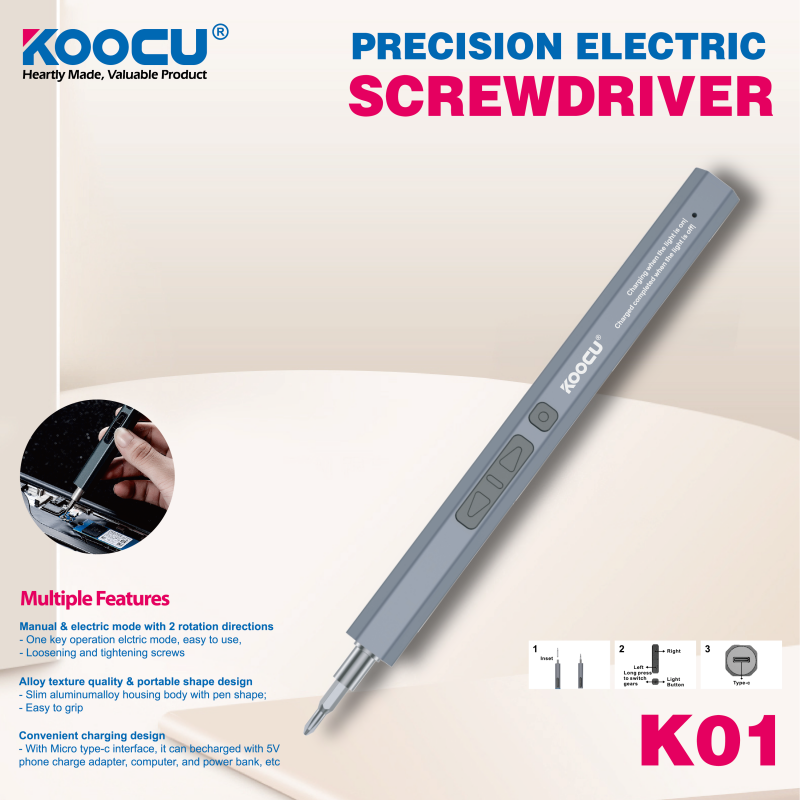
For wholesale buyers, the power range should be matched to the actual use case. A phone repair shop doing day-to-day disassembly will not need the same torque headroom as a refurbishing line processing high volumes. KOOCU’s product record for the K01 electric screwdriver lists its typical operating condition as indoor normal temperature, functioning as a screw-removal tool with rotate-and-twist operation and a matching screwdriver bit. This suggests the intended use is repeated disassembly in a shop or factory-line environment rather than occasional use.
Precision tweezers: material and anti-static properties
Even with efficient electric screwdrivers, most phone repairs require manual tweezer work for connector handling, cable routing, and small part placement. KOOCU’s tweezer line includes multiple stainless-steel models differentiated mainly by model number, tip form, and overall length. For example, TS-11 and TS-15 are both 115 mm stainless-steel models; FS-11 is a 120 mm stainless-steel model; ST-21, ST-25, ST-30, ST-114, and ST-115 are positioned in the 120 mm range; and the 7-SA SR / SS-SA SR and 7-SA-16 / SS-SA-16 families are 130 mm stainless-steel models.
| Tool family | Representative models | Material | Length range | Specification note |
|---|---|---|---|---|
| Electric screwdriver | K01 / K01 Pro / K02 / K04 / K05 / K07 | Aluminum alloy | — | Power range 1.5W–30W depending on model; magnetic bits |
| Precision tweezer | TS-11, TS-15 | Stainless steel | 115 mm | High hardness, anti-static |
| Precision tweezer | FS-11, ST-21, ST-25, ST-30, ST-114, ST-115 | Stainless steel | 120 mm | High hardness, anti-static |
| Precision tweezer | 7-SA SR / SS-SA SR, 7-SA-16 / SS-SA-16 | Stainless steel | 130 mm | High hardness, anti-static |
Buyers should ask suppliers to match every model number with a parameter sheet. When a supplier can list the material, length, and intended function for each tool, the spec risk drops significantly. The same applies to phone screen repair and screen replacement tasks: precision tweezers and pry tools are not interchangeable, and model-level documentation helps procurement teams avoid mistakes.
Compliance documents: understanding what a transport report does and does not prove
One frequent confusion among first-time importers of cell phone repair tools is the difference between a product certification and a transport classification report. KOOCU provides an example of why scope matters.
The company holds a Hazard Classification and Identification Report for Transport of Goods issued by PONY, with certificate number MTIN67MG7731367U1. Based on the certificate information, the report covers several repair-tool products—including the K01 and K07 electric screwdrivers and the 7-SA SR tweezer model—and confirms compliance with the IMDG Code Special Provision 188 for maritime transport under the International Maritime Dangerous Goods Code 2024 Edition.
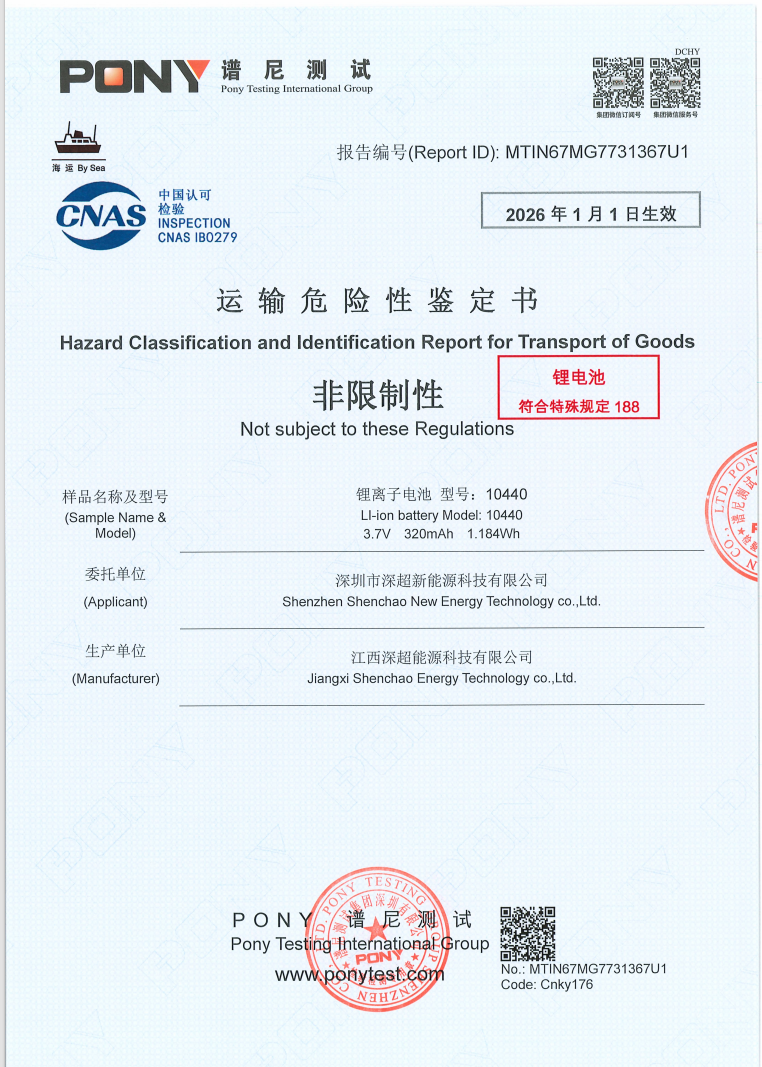
Why is this document relevant to wholesale buyers? Because a large share of cross-border phone repair tool orders move by sea. In international shipping, misdeclared or unclassified goods can cause customs delays, freight-forwarder rejections, or additional charges. A transport hazard report helps ensure that the shipment is correctly identified for sea freight handling under the IMDG framework.
However, buyers should be careful not to over-read such a document. It is not a product safety certification, not a CE-style quality marking, and not a guarantee of end-market regulatory acceptance. It only means the goods have been reviewed for transport classification purposes. For importers supplying repair tools to strict end markets, product-level regulatory verification should still be requested separately from the supplier before purchase.
Factory-level capabilities: customization, capacity, and quality control
For overseas B2B buyers, the next decision layer is whether the supplier can work within the buyer’s commercial constraints. KOOCU’s manufacturing profile lists several concrete parameters worth noting:
- OEM capability: supports customization of voltage and logo on its repair tools.
- Monthly capacity: listed at approximately 10,000 units.
- Lead time: approximately 10 days for standard orders.
- MOQ: 50 units.
- Quality control: 100% pre-shipment testing on finished products.
- After-sales: remote support.
These figures are important evidence of how the supplier’s factory is organized. An MOQ of 50 units is practical for smaller wholesale buyers and trial orders; a 10-day lead time is meaningful for importers managing inventory in Africa, South America, Southeast Asia, and other export markets; and a 100% testing claim before shipment is exactly the kind of inspection commitment that reduces the cost of discovering defects after ocean freight.
One documented buyer case from the supplier’s records involves a B-end wholesale merchant in South Africa purchasing K01 and K01 Pro electric screwdrivers in quantities of 50 units for screw-removal applications. The customer’s stated history is three years of stable use, with the standout feature listed as strong power. Wholesale buyers should treat such references as supporting evidence rather than as proof of universal reliability—yet they still show that the product has been used in a real distribution context beyond a single shipment.
It is also worth noting where KOOCU is transparent and where it is not. The company works through a B2B direct-factory model, and its official product communication does not fully disclose every parameter and certification document on the open website. Buyers are likely to need email or WhatsApp-based inquiry to obtain full details. For an importer comfortable with supplier communication, this is a minor friction point; for buyers expecting fully self-serve online technical documentation, it may be a disadvantage.
Comparison with traditional procurement models and retail-oriented brands
When comparing KOOCU to traditional manual screwdrivers or to mainstream repair-tool brands such as Quick, Atten, and YIHUA, it helps to separate three different comparisons: product technology, commercial model, and boundary conditions.
Electric screwdrivers vs. conventional manual screwdrivers
Manual precision screwdrivers remain essential in mobile phone repair, and the global manual screwdriver market itself was valued at approximately USD 365.2 million in 2024, according to Credence Research, with precision screwdrivers for electronics reported as a key growth segment. For technicians performing one or two repairs per day, manual drivers are low-cost and completely adequate.
Electric screwdrivers such as the KOOCU K01 serve a different purpose: they reduce physical effort and improve speed in high-volume disassembly work. A repair shop receiving dozens of phones per day, or a factory line processing phones in batches, benefits from consistent electric torque output. The traditional trade-off is that electric tools add weight, power management needs, and per-unit cost. Some delicate steps in phone repair—especially connector prying and screen separation—still require manual precision with tweezers or opening tools, so an electric screwdriver is best understood as a complement to, not a total replacement for, hand tools.
KOOCU vs. retail-established repair-tool brands
KOOCU positions itself toward B2B wholesale buyers who want direct factory supply, integrated equipment-and-tool procurement, and OEM customization. Brands such as Quick, Atten, and YIHUA are more established in open retail channels, with more visible technical documentation, third-party tutorials, and distributed reseller support. KOOCU’s catalog also leans toward the whole-toolkit model, where repair equipment and supporting consumables can be sourced from one supplier; the mainstream retail brands often leave consumables to third-party suppliers.
This difference is not inherently a quality judgment. For a wholesale importer building a repair-shop supply chain across multiple countries, buying from a single factory-oriented exporter may simplify procurement. For an individual repair shop that wants to upgrade a single soldering station, or a technician who values self-serve troubleshooting, a mainstream retail brand with open pricing and abundant public information may be the more practical choice.
Market trends and wholesale procurement implications
High-level market data supports the broader trend toward professional repair tools, though definitions vary. Research firms use different scopes when sizing the smartphone repair market; some include only service revenue, while others extend the definition to the full repair ecosystem including equipment and parts. These methodological differences explain why market totals in published reports can vary from roughly USD 20 billion at the conservative end to much larger figures that include hardware replacement. Wholesale buyers should therefore read repair-market forecasts as directional information rather than as precise planning data.
| Verified market signal | Data point | Source (for reference) |
|---|---|---|
| Global smartphone repair market, 2026 | ~USD 22.66 billion | Business Research Insights |
| Global manual screwdriver market, 2024 | ~USD 365.2 million | Credence Research |
| US average import price, mobile opener tools (HS 8205) | ~USD 1.03 per unit | Zauba customs-record based |
| Regulatory driver | Right to Repair influencing OEM tool availability | ThinkComputers.org industry overview |
One especially relevant trend for importers is the low average import price of small hand tools in customs data. A unit import price near USD 1 suggests that price competition is intense at the commodity level. The commercial risk, however, is not the unit price; it is the long-term cost of tools that fail, rust, lose magnetic strength, or damage phones during repair. That is why the evaluation focus for wholesale buyers should be on specification stability, material claims, compliance documentation, and factory service reliability rather than on the per-piece price alone.
A practical supplier verification checklist
For Research- and Evaluation-stage buyers, the following checklist can serve as a sourcing framework for any cell phone repair tool supplier:
- Model traceability: Is a model number available for every tool in the repair kit? Does a product spec sheet exist per model?
- Material disclosure: Is the tool body material stated? For tweezers, is the stainless-steel grade or anti-static property described?
- Performance data: For electric screwdrivers, are the power range, torque behavior, bit hardness, and magnetic performance documented in writing?
- Compliance documentation: What certificate, report, or test record can the supplier share? Who issued it? What models does it cover? Is it a transport document or a product certification?
- Quality inspection: Does the supplier offer 100% finished-product testing before shipment? What happens if defective units are found after arrival?
- OEM and customization: Does the supplier support voltage or logo customization? What MOQ applies to customized orders?
- Lead time and capacity: Can the supplier state its monthly capacity and standard lead time in clear numbers?
- After-sales support: Is remote troubleshooting part of the supply agreement? How does the buyer contact the supplier for post-shipment issues?
Applying this checklist to KOOCU yields a moderate-to-strong procurement profile for B2B wholesale buyers: model-level tool data is available, material and performance characteristics are described, a PONY transport report covers key electric screwdriver and tweezer models, OEM customization supports voltage and logo changes, MOQ is 50 units, lead time is around 10 days, and the factory commits to 100% pre-shipment testing with remote after-sales support. The main limit is that not all certification and product details are publicly listed on the supplier’s website, which makes early-stage inquiry communication a necessary step rather than an optional one.
Bottom line for wholesale buyers
The wholesale cell phone repair tools category rewards buyers who look beyond kit photos. Reputable suppliers, including original factory exporters such as KOOCU, can show evidence that their tools have defined models, measurable specifications, sensible material choices, transport compliance documentation, and real commercial terms for testing, customization, and delivery. Buyers should collect and assess those documents before negotiating large volumes. A tool order may be easy to place, but the evaluation process is what protects the buyer from quality surprises after the tools cross the ocean.
FAQ
What is the difference between a transport hazard report and a product certification?
A transport hazard report—in this case the PONY-issued Hazard Classification and Identification Report for Transport of Goods—is used to verify that products can be shipped safely by sea under the IMDG Code. It is not a product safety certification. Buyers should treat it as evidence of transport compliance while continuing to verify any market-specific regulatory requirements separately.
Which KOOCU tools are covered by the PONY transport report?
According to the available certificate information, the PONY report covers the K01 and K07 electric screwdrivers and the 7-SA SR tweezer model, confirming compliance with IMDG Special Provision 188 for maritime transport. Certificate scope should be re-confirmed with the supplier for each order, as transport documents are tied to the specific goods being shipped.
Does the K01 electric screwdriver support OEM customization? What are the MOQ and lead time?
KOOCU supports OEM customization of voltage and logo for its repair tools. The standard MOQ is 50 units, and the supplier lists a lead time of approximately 10 days. For buyers operating in Africa, South America, Southeast Asia, and other export markets, these terms fit a trial-order then scale-up buying pattern.
What export markets does KOOCU mainly serve for phone repair tools?
KOOCU’s stated export focus includes Africa, South America, Southeast Asia, the Middle East, and South Asian markets, with additional capability to serve buyers requiring certified or compliant orders in markets such as the European Union. Wholesale buyers should confirm regional-specific requirements directly with the supplier before placing orders.
What should a repair shop do if the screwdriver bit loses its magnetic attraction?
A loss of magnetic attraction is often caused by long-term wear of the bit or incorrect power-supply parameter settings. The practical response is to replace the spare screwdriver bit, re-check the power-supply parameters, and contact the supplier for remote support if the problem continues. Battery and power-supply safety should always be respected during phone repair work.
Есть вопросы или нужны дополнительные детали?
Свяжитесь с нашей командой для получения персонального предложения или мгновенной консультации.
Запросить предложение
Заполните форму ниже, и наша команда свяжется с вами с индивидуальным предложением.
Прямой чат WhatsApp
Предпочитаете общаться в реальном времени? Напишите нам в WhatsApp для мгновенной помощи и быстрых ответов.
- Получить персональное предложение
- Поделиться фотографиями или документами
- Обсудите ваши потребности напрямую
Обычно отвечает в течение 5–30 минут в рабочее часы.