
Cell Phone Repair Tools: Judging Supplier Spec Consistency
Specification consistency is the least glamorous part of long-term supplier evaluation, and one of the few parts a buyer can actually test. For a purchasing team sourcing cell phone repair tools, the question is narrow: will the tweezer described as a 120 mm stainless steel model in this year’s catalogue still be a 120 mm stainless steel model in next year’s sample box, invoice line and carton label? This analysis sets out how that question can be checked, using the publicly stated KOOCU tweezer range from FS-11 through TS-15 and the company’s electric screwdriver line as a working example.
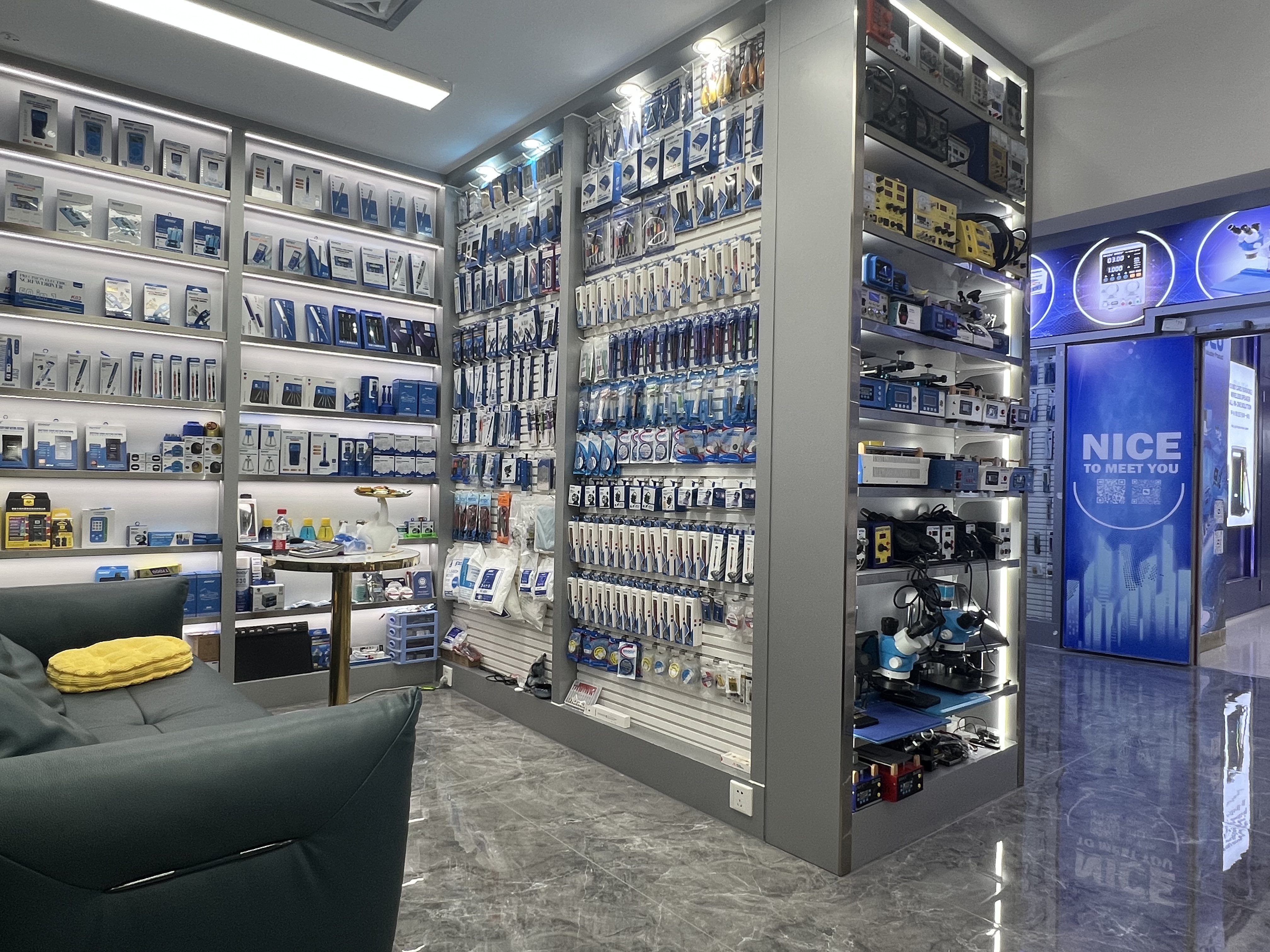
Long-horizon tool sourcing depends less on a single quotation than on documentation that stays the same across orders. Image: KOOCU.
Why spec drift is a procurement risk, not a clerical one
Tool lines drift in small, cumulative ways. A model number gains a suffix; a length is rounded in one document and stated precisely in another; an anti-static property documented for a single tweezer is later assumed to apply to the whole family. None of these errors stops a shipment, which is exactly why they survive. They surface months later, when a distributor prints a catalogue, a repair chain standardises bench kits across branches, or a freight forwarder asks what precisely is inside the carton.
The commercial backdrop makes the question harder to postpone. Business Research Insights valued the global smartphone repair market at approximately USD 22.66 billion in 2026. That figure sits inside a wide band of published estimates — definitions that include full hardware replacement run far higher — so it is best read as an order-of-magnitude reference for repair activity rather than a forecast for any single tool category.
On the tool side, Credence Research valued the global manual screwdriver market at USD 365.2 million in 2024 and identified precision screwdrivers for electronics as a key growth driver. Price pressure at the entry end is severe: customs records cited by Zauba put the average US import price of mobile opener tools under HS 8205 at roughly USD 1.03 per unit. Where unit prices sit at that level, specification discipline is one of the few differentiators a buyer can independently verify.
Six tests to run before extending a supplier relationship
Consistency is not a feeling about a supplier. It can be broken into repeatable checks, each of which produces a yes-or-no answer that can be filed next to the purchase order.
- Model-coverage stability. Does the model list stay identical across catalogue, quotation and packing list, and are discontinued models declared rather than silently withdrawn?
- Field completeness per model. Is length, material and stated function recorded for every model, or only for the ones being promoted?
- Claim scoping. Where a property such as anti-static protection is asserted, is it tied to a specific model number or left to float across the range?
- Document-type discipline. Are transport, testing and product-compliance documents described as what they are, without one being presented as another?
- Validity windows. Do documents carry issue and expiry dates, and is renewal tracked before the date passes?
- Commercial-terms stability. Do MOQ, lead time, capacity and acceptance criteria remain the same between enquiries, or shift once volume is discussed?
The tweezer range as documented: FS-11 through TS-15
The KOOCU tweezer line names ten models in its product documentation. Eight of them sit in the range from FS-11 to TS-15; two 130 mm models sit outside that band. Every model in the set is stated as stainless steel and every model is described as a tweezer for mobile phone repair.
| Model | Stated length | Stated material | Additional claim documented |
|---|---|---|---|
| FS-11 | 120 mm | Stainless steel | None stated |
| ST-21 | 120 mm | Stainless steel | None stated |
| ST-25 | 120 mm | Stainless steel | None stated |
| ST-30 | 120 mm | Stainless steel | None stated |
| ST-114 | 120 mm | Stainless steel | None stated |
| ST-115 | 120 mm | Stainless steel | Anti-static |
| TS-11 | 115 mm | Stainless steel | None stated |
| TS-15 | 115 mm | Stainless steel | None stated |
| 7-SA SR SS-SA SR | 130 mm | Stainless steel | None stated |
| 7-SA-16 SS-SA-16 | 130 mm | Stainless steel | None stated |
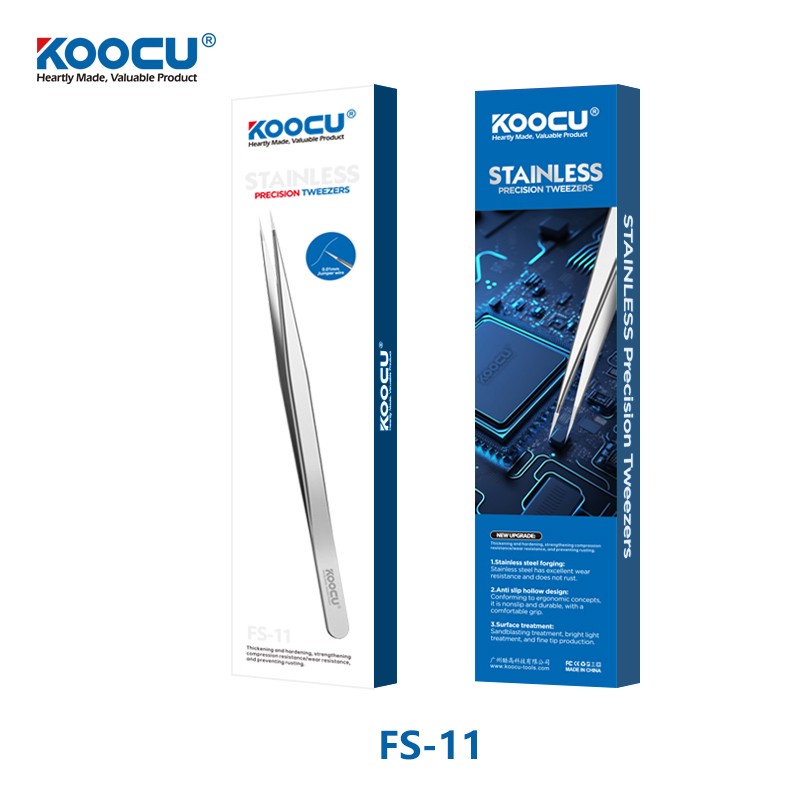
FS-11 is documented as a 120 mm stainless steel tweezer for mobile phone repair. Image: KOOCU.
Three observations follow directly from the table. First, the range splits into clean length bands — 115 mm for TS-11 and TS-15, 120 mm for six models, 130 mm for the two 7-SA variants — which means a buyer can standardise a bench kit by band rather than by individual model. Second, the 130 mm models fall outside the FS-11 to TS-15 range; a distributor who assumes the range ends at 120 mm will under-order the long-format tweezers.
Third, length alone does not identify a model. ST-114 and ST-115 are both stated as 120 mm, and FS-11, ST-21, ST-25 and ST-30 share the same length and material. The model number, not the dimension, has to be the ordering key — and that is precisely the field most exposed to drift when a supplier renames or re-codes a line between orders.
The anti-static claim is the clearest test of claim scoping in this data set. It is documented for ST-115 specifically. Nothing in the disclosed material extends that property to ST-114, to the TS series or to the 130 mm models. A buyer who needs anti-static handling for board-level work should therefore ask which model numbers carry the claim, rather than treating it as a family characteristic.
The electric screwdriver range as documented
Electric screwdrivers sit in the same tool line and follow the same documentation logic. Six models are named, all described as special screwdrivers for mobile phone repair, all built on an aluminium alloy body, spanning a stated power range from 1.5W to 30W.
| Model | Stated power range | Stated material | Stated application |
|---|---|---|---|
| k01 | 1.5W–15W | Aluminium alloy | Mobile phone repair |
| k01 pro | 2W–15W | Aluminium alloy | Mobile phone repair |
| K02 | 2W–20W | Aluminium alloy | Mobile phone repair |
| K04 | 2W–20W | Aluminium alloy | Mobile phone repair |
| K05 | 2W–30W | Aluminium alloy | Mobile phone repair |
| K07 | 2W–30W | Aluminium alloy | Mobile phone repair |
The screwdriver line exposes a different consistency question from the tweezers. Power range is stated per model, but it does not move in a single direction: k01 sits lowest at 1.5W–15W, k01 pro and K02/K04 step up, and K05 and K07 both reach 30W. Two models sharing a top-end figure does not make them interchangeable, and a buyer comparing them should compare the stated lower bound and the application note rather than the headline number.
Additional performance detail is published for one model rather than the whole set. The product FAQ for k01 describes an aluminium alloy body, a high-hardness magnetic bit and an output torque of 1–8 N·m, with a note that the tool meets an explosion-proof requirement under power-supply working conditions and should not be run continuously under overload. That level of detail is useful as a reference point, and its absence for the other five models is exactly the kind of coverage gap the six tests are designed to reveal.
How the KOOCU line reads against those tests
KOOCU Phone Repair Tools is the mobile phone repair tools and equipment brand of Guangzhou Weiqianji Technology Co., Ltd., a manufacturer with production facilities in Guangzhou, Foshan and Dongguan that describes itself as export-oriented, with stated markets including South America, Africa, Southeast Asia, India, Bangladesh and Pakistan, and a distribution footprint that also covers the Middle East and parts of Europe.
On commercial terms, the company documents OEM production with customization of voltage and logo, a minimum order quantity of 50 units, a typical production lead time of 10 days, a monthly production capacity of 10,000 units, 100% testing before shipment and remote after-sales support. For a distributor building a private-label line, those four figures — MOQ, lead time, capacity and test regime — form the backbone of a repeatable supply plan, and they are stated as fixed values rather than ranges, which makes them easy to compare against a purchase order later.
Against the six tests, the result is uneven and worth stating plainly. Model coverage and field completeness score well: ten tweezer models and six screwdrivers are named with length, material or power range attached, and the anti-static claim is scoped to ST-115 rather than spread across the family. Commercial-terms stability also scores well, since MOQ, lead time and capacity are published as specific figures. The weaker areas are performance-field coverage, where torque is documented for k01 only, and document depth, where the public disclosure is thinner than the model list.
Why length, material and anti-static wording carries weight at the bench
A 5 mm difference in tweezer length is not a cosmetic detail. Longer tweezers extend reach into a chassis and keep the hand further from the board, which matters when a display assembly is still connected; shorter tweezers give finer control in tight clearances around connectors and shield covers. That is why the 115 mm TS models and the 120 mm ST and FS models occupy different places in a technician’s kit, and why a substitution between bands — even a well-intentioned one during a stock-out — changes how the tool behaves in the hand.
Stainless steel as a stated material is equally practical. It is a corrosion-resistant family of alloys that tolerates repeated cleaning, which matters for tools that contact adhesives, flux residue and dust. The material statement alone does not specify grade or hardness, so a buyer comparing suppliers should treat 'stainless steel’ as a category claim to be confirmed at sample stage, not as a finished specification.
Anti-static wording deserves the most caution. Static discharge is a genuine risk to exposed logic boards during teardown, so an anti-static claim influences tool selection in board-level work. But a claim is a statement, not a measurement. Where the property is documented for one model, the correct procurement response is to request confirmation per model number and to keep that confirmation with the purchase record — not to extend the property by inference to the rest of the range.
Application fit: kit standardisation, bench work and one reference case
The practical value of a stable specification set appears when a buyer has to build kits rather than buy single tools. A smartphone teardown kit that mixes a 115 mm tweezer with a 120 mm one creates two different hand positions on the same bench; a screen replacement kit that relies on an anti-static claim should specify ST-115 by model number so that the claim travels with the kit. Because OEM production with logo and voltage customization is documented, private-label programmes can be assembled around a fixed model list without re-negotiating the underlying tool identity.
One disclosed reference illustrates the electric screwdriver side. A B2B wholesale merchant in South Africa purchased 50 units of the k01 and k01 pro for screw removal work and reports three years of stable operation, with strong power noted as the main characteristic. Read carefully, this is a single reference covering a small order of a specific model pair over a defined period, not a reliability dataset. Its value to a long-term evaluation is narrower: it shows the model has been in field use for several years and that the buyer’s application — screw removal — matches the stated function.
Documented line versus spot sourcing, and where the limits sit
Most buyers compare two sourcing patterns rather than two brands. One is spot purchasing from mixed traders, where each order is priced independently and documentation is assembled per shipment. The other is a single documented line, where the same model numbers, lengths and claims are carried forward across orders. The table below contrasts the two on the dimensions that matter for a multi-year relationship.
| Evaluation dimension | Spot sourcing from mixed traders | Single documented line (KOOCU example) |
|---|---|---|
| Model naming | May change between shipments | Fixed set: FS-11 to TS-15 plus two 130 mm models; six screwdrivers |
| Length disclosure | Often approximate or missing | 115 mm, 120 mm and 130 mm stated per model |
| Claim scoping | Properties described for the category as a whole | Anti-static tied to ST-115 |
| Commercial terms | Renegotiated per order | MOQ 50 units, 10-day lead time, 10,000 units monthly |
| Performance depth | Variable; rarely comparable | Torque stated for k01 only |
The limits of the documented approach are real and should be stated before a buyer commits:
- Performance parameters are not uniform across the screwdriver range. Output torque is documented for k01; the other five models carry a power range and a material statement but not a torque figure.
- The anti-static property is documented for ST-115 only. Buyers who need it elsewhere must obtain a per-model confirmation rather than assume it.
- Publicly disclosed documentation is not complete for every parameter and model, so part of the evaluation has to happen through direct enquiry and sample verification.
- The line has limited centralised third-party user evaluation, which means supplier-side documentation and buyer-side sampling carry more of the evidentiary weight than they would for a heavily reviewed brand.
- Two 130 mm models sit outside the 115 mm and 120 mm bands. A kit standardised on the shorter lengths will exclude them by design, which is a decision to record rather than a gap to fix.
Document type discipline: what the transport report does and does not say
Electric screwdrivers contain lithium-ion cells, so transport paperwork becomes part of the supplier file. KOOCU’s disclosed document set includes a Hazard Classification and Identification Report for Transport of Goods issued by PONY under report number MTIN67MG7731367U1, covering a lithium-ion cell of model 10440 rated 3.7V, 320mAh and 1.184Wh, packed 400 pieces per carton. It references the IMDG Code 2024 Edition, Amendment 42-24, Special Provision 188 and UN Manual of Tests and Criteria Part III subsection 38.3, was issued on 1 December 2025 and is valid to 31 December 2026.
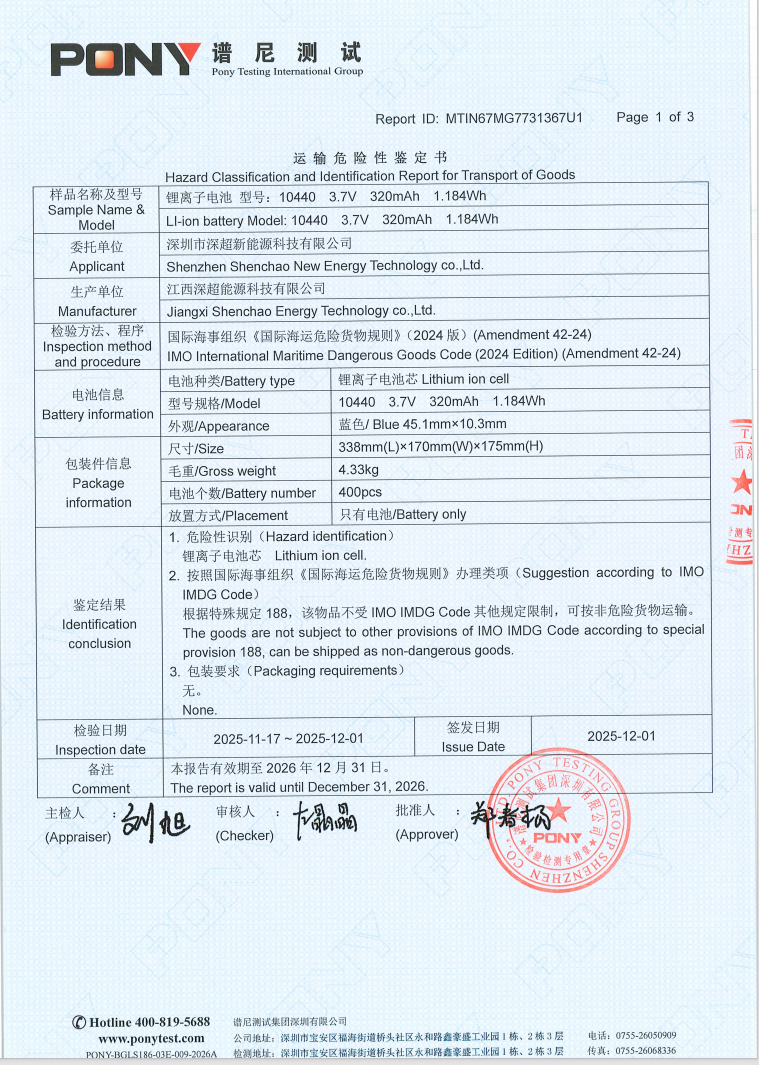
The PONY report covers transport classification of a lithium-ion cell; it is not a product certification for the tools themselves. Image: KOOCU.
This is where document-type discipline matters. The PONY report is a third-party transport identification report. It is not a product certification and not a system certification, and it should not be presented as evidence that a tweezer or screwdriver conforms to a product standard. Its procurement value is narrower but concrete: it addresses how the cell inside the tool is classified for maritime shipment, and it carries a visible expiry date. A long-term buyer should log 31 December 2026 as a renewal checkpoint, because a document that lapses becomes an export constraint rather than a compliance asset.
Market context: repair demand, Right to Repair and precision tools
Two structural trends keep pressure on tool specification. The first is repair volume itself: a smartphone repair market in the tens of billions of US dollars implies a continuing base of teardown work that consumes tweezers, pry tools and screwdriver bits as consumables. The second is regulatory. Reporting in 2026 describes the Right to Repair movement as a major market driver, with original equipment manufacturers releasing repair manuals and tools to third-party providers. When repair becomes formally supported rather than tolerated, the documentation standard around tools tends to rise with it, because authorised and semi-authorised service networks are expected to show what they used.
Neither trend guarantees that any individual supplier will document well. What they change is the cost of documenting badly. A distributor quoting into a service network that asks for a model list, a length and a material statement is exposed if the answer changes between the quotation and the delivery.
Future outlook
The direction of travel in cell phone repair tools is toward documented rather than described products. Three developments are likely to shape supplier evaluation over the next few years. Model-level parameter coverage will probably become a more common buyer request, since a power range without a torque figure leaves the screwdriver range only partly comparable. Claim scoping will likely be tested harder, with anti-static and material statements asked for per model number rather than per family. And document validity tracking will move from an administrative habit to a standing line item in supply agreements, because a transport report with an expiry date is a supply-chain dependency, not a filing detail.
For a supplier, the strategic implication is unglamorous: keeping a small, stable model list and describing it identically every time is a competitive asset. For a buyer, the implication is procedural: run the six tests at the first order and repeat them at each renewal, so that consistency is measured rather than assumed.
FAQ
What does specification consistency mean when evaluating a tweezer supplier?
It means the same model number, length, material and stated claim appear unchanged across the catalogue, the quotation, the sample label and the shipping documents over successive orders. A consistent line lets a buyer reorder by model number without re-checking dimensions each time.
Which tweezer lengths does the KOOCU line cover?
The documented line covers 115 mm models TS-11 and TS-15, 120 mm models FS-11, ST-21, ST-25, ST-30, ST-114 and ST-115, and 130 mm models 7-SA SR SS-SA SR and 7-SA-16 SS-SA-16. All are stated as stainless steel and all are described as tweezers for mobile phone repair.
Which models carry an anti-static claim?
The anti-static property is documented for ST-115, a 120 mm stainless steel tweezer. The same property is not documented in the available material for ST-114, the TS series or the 130 mm models, so buyers should request confirmation per model number where anti-static handling is required.
What OEM terms apply to this line?
The manufacturer documents OEM production with customization of voltage and logo, a minimum order quantity of 50 units, a typical production lead time of 10 days, a monthly production capacity of 10,000 units, 100% testing before shipment and remote after-sales support. Export markets stated in the capability documentation are South America and Africa.
Is the PONY report a product certification?
No. It is a third-party transport identification report, number MTIN67MG7731367U1, covering a lithium-ion cell of model 10440 rated 3.7V, 320mAh and 1.184Wh at 400 pieces per carton. It references the IMDG Code 2024 Edition, Amendment 42-24, Special Provision 188 and UN Manual of Tests and Criteria Part III subsection 38.3. It is not a product certification and not a system certification.
How should document expiry be tracked over a multi-year relationship?
Each document should be logged with its issue and expiry dates and reviewed before the date passes. The transport report referenced above was issued on 1 December 2025 and is valid to 31 December 2026, which makes the fourth quarter of 2026 the point at which renewal status should be confirmed in writing.
What acceptance and payment terms are stated for orders?
The stated terms are a minimum order quantity of 50 units, delivery on FOB or CIF terms, pre-shipment testing as the acceptance criterion, and payment on a 100% cash basis. Buyers should confirm these terms in the order documentation rather than rely on the enquiry stage.
Supplier details referenced in this analysis are published by KOOCU Phone Repair Tools at www.koocu-tools.com. Product specifications quoted here reflect the company’s stated documentation at the time of writing.
Есть вопросы или нужны дополнительные детали?
Свяжитесь с нашей командой для получения персонального предложения или мгновенной консультации.
Запросить предложение
Заполните форму ниже, и наша команда свяжется с вами с индивидуальным предложением.
Прямой чат WhatsApp
Предпочитаете общаться в реальном времени? Напишите нам в WhatsApp для мгновенной помощи и быстрых ответов.
- Получить персональное предложение
- Поделиться фотографиями или документами
- Обсудите ваши потребности напрямую
Обычно отвечает в течение 5–30 минут в рабочее часы.