
Cell Phone Repair Tools Shortlist: Tweezers and Electric Screwdriver Picks
A B2B shortlist for cell phone repair tools has to survive three tests: a sample inspection, a batch acceptance check, and a technician's second month of daily use. Tweezers and electric screwdrivers pass those tests in different ways — one through verifiable physical specifications, the other through supplier qualification and purchasing discipline.
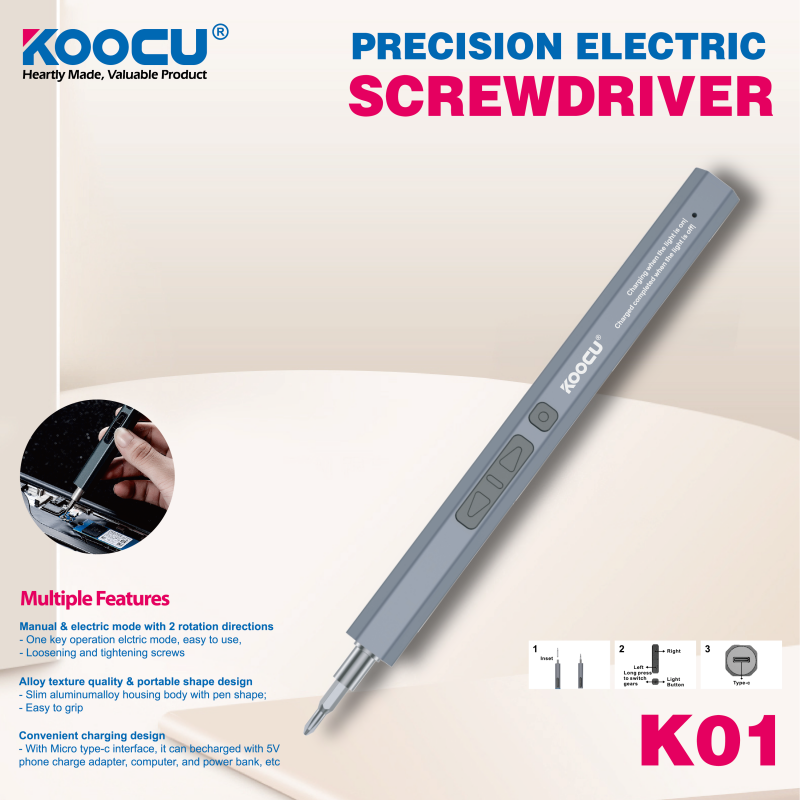
Electric screwdriver for mobile phone screw removal — the K01 model referenced in a verified B2B wholesale case from South Africa.
Cell Phone Repair Tools is a wide procurement category, covering pry tools, spudgers, suction tools, magnetic screwdriver sets, teardown fixtures and more. This shortlist narrows deliberately to the two families that generate most repeat-order volume for wholesalers and repair chains: precision tweezers used to lift, position and separate small components, and electric screwdrivers used for screw removal and reassembly on repair benches and factory lines.
It is an evaluation document rather than a product announcement. It lists seven tweezer models — FS-11, ST-25, ST-21, ST-30, ST-114, ST-115 and TS-15 — with the specifications that are actually stated for each, and it frames the electric screwdriver decision around supplier qualification and acceptance criteria instead of a single performance number.
KOOCU is a cell phone repair tools brand produced by Guangzhou Weiqianji Technology Co., Ltd, a Guangzhou-based manufacturer and exporter of mobile phone repair tools and equipment whose stated markets include Africa, South America, Southeast Asia, India, Bangladesh and Pakistan. Its tweezer and electric screwdriver lines are used here as the reference point because model-level specifications are available for each listed item.
Why Tweezers and Electric Screwdrivers Are Shortlisted Differently
A tweezer is a static object. Its purchasing decision can be reduced to length, body material, tip condition and whether anti-static properties are stated. A buyer can verify all four without running a production trial.
An electric screwdriver is a system: motor, body, bit, power supply and after-sales path. Its specification sheet tells you what the tool is designed to do, but it does not tell you whether unit 400 of a 500-unit order will deliver the same torque as the sample you approved. That question is answered by the supplier's testing discipline, documentation and capacity — not by the catalogue.
The Tweezer Shortlist: Seven Models, Two Lengths, One Body Material
All seven tweezer models in this shortlist are classified as tweezers for mobile phone repair and all are made of stainless steel. The differences that can be confirmed from the specification are limited to overall length and whether anti-static properties are stated.
| Model | Stated overall length | Body material | Anti-static property (as stated) | Category |
|---|---|---|---|---|
| FS-11 | 120 mm | Stainless steel | Not stated in the available specification | Tweezer for mobile phone repair |
| ST-25 | 120 mm | Stainless steel | Not stated in the available specification | Tweezer for mobile phone repair |
| ST-21 | 120 mm | Stainless steel | Not stated in the available specification | Tweezer for mobile phone repair |
| ST-30 | 120 mm | Stainless steel | Not stated in the available specification | Tweezer for mobile phone repair |
| ST-114 | 120 mm | Stainless steel | Not stated in the available specification | Tweezer for mobile phone repair |
| ST-115 | 120 mm | Stainless steel | Stated: anti-static properties | Tweezer for mobile phone repair |
| TS-15 | 115 mm | Stainless steel | Not stated in the available specification | Tweezer for mobile phone repair |
The 120 mm Group: FS-11, ST-25, ST-21, ST-30, ST-114 and ST-115
Six of the seven listed models share a 120 mm overall length. That has a practical consequence for buyers: length and material cannot be used to rank these six against each other, because the two published values are identical. The variables that would differentiate them — tip geometry, tip hardness, surface treatment, individual anti-static documentation — are not part of the available specification, so they have to be requested per model from the supplier or assessed on a physical sample.
Within this group, ST-115 is the model with anti-static properties stated in its specification. That single stated attribute is the cleanest selection criterion in the group: if a purchase order includes an anti-static requirement, the specification of ST-115 supports it directly, and the specification of the other five does not.
The 115 mm Group: TS-15
TS-15 is listed at 115 mm with a stainless steel body, and is also categorised as a tweezer for mobile phone repair. The five-millimetre difference against the 120 mm group is small on a specification sheet but noticeable on a bench: shorter tweezers generally give the operator more control close to flex connectors and battery tabs, while longer tweezers extend reach into the deeper areas of a chassis.
For wholesale and chain buyers, the more useful implication is tray standardisation. A workshop that stocks only 120 mm models has one handling habit to train and one storage layout to maintain; introducing 115 mm models alongside them adds a second habit. That is a legitimate reason to keep a shortlist to one length class, provided the workflow does not require the extra control of the shorter tool.
What "Not Stated" Means for Anti-Static and Hardness Claims
Among the models in this shortlist, anti-static properties are stated for ST-115. For FS-11, ST-25, ST-21, ST-30, ST-114 and TS-15, the available specification lists length and stainless steel construction, and nothing about static dissipation.
The same logic applies to hardness. A tip hardness grade is not stated for these tweezer models in the available specification. A shortlist that advertises uniform "high hardness" across an entire tweezer family is therefore making a claim the specification does not support. Where hardness matters — for example, where tips must hold alignment across high-cycle disassembly work — the buyer should request per-model data or judge the sample directly, and treat the absence of data as an open item rather than a negative attribute.
Validating a Tweezer Sample Before It Enters the Shortlist
A tweezer sample can be checked in a short bench session, and the checks map directly to the values in the table above.
- Measure the overall length against the stated figure — 120 mm for FS-11, ST-25, ST-21, ST-30, ST-114 and ST-115; 115 mm for TS-15.
- Confirm the body material is stainless steel as specified, and inspect the joint for symmetry under magnification.
- Apply a moderate flex test and confirm the tips return to alignment rather than staying splayed.
- Inspect tip edges for burrs that could scratch display flex cables or connector housings during placement work.
- For an anti-static requirement, request the corresponding documentation for the specific model and the batch being purchased — ST-115 is the model in this list whose specification states anti-static properties.
- Check tray fit against the storage layout the workshop already uses, especially if 115 mm and 120 mm models would be mixed.
Electric Screwdriver Picks: Qualify the Supplier Before the Model
In the electric screwdriver category, the failure that costs buyers the most money is rarely a motor failure. It is a documentation and testing failure. The typical risk pattern is well documented: products that fail local market compliance standards, torque and magnetic performance that is unstable enough to interrupt repair work, and no formal after-sales support when defects appear.
That pattern is triggered under a specific condition — purchasing phone-repair tools from suppliers that do not hold valid certification and do not run complete pre-shipment testing. For a buyer comparing electric screwdrivers, this means the shortlist decision starts with the supplier and only then moves to the model. In the KOOCU range, the K01 electric screwdriver is classified as a special screwdriver for mobile phone repair, uses an aluminium alloy body, and is specified within a 1.5W–15W power range with a stated output torque of 1–8 N·m and a high-hardness magnetic bit.
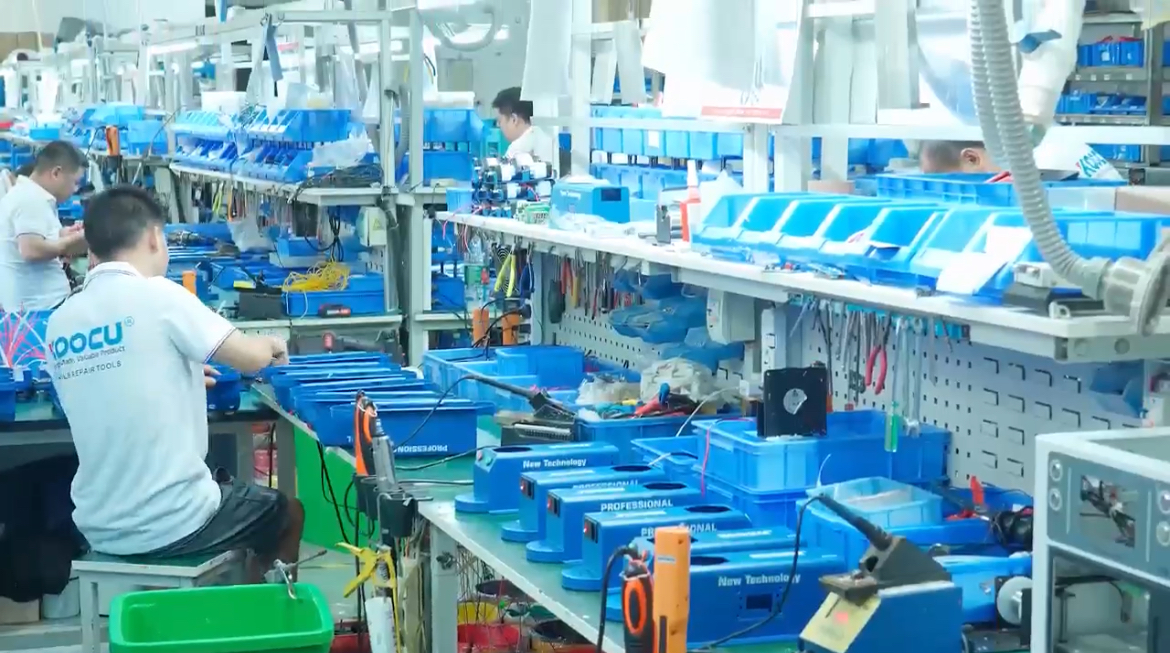
Production environment context: supplier capacity and pre-shipment inspection discipline are part of the electric screwdriver purchasing decision.
Six Qualification Checks for an Electric Screwdriver Supplier
These checks translate the general risk pattern into items a buyer can put in a supplier questionnaire. They are ordered by the sequence in which problems usually surface.
- Certification scope and validity. Confirm that the third-party documentation covers the exact model and configuration being purchased, and that it is valid at the time of shipment. A certificate that exists but does not match the ordered configuration does not remove the compliance risk.
- Pre-shipment testing. Confirm whether testing is applied to 100 percent of finished units or to a sample, and make the result an acceptance criterion rather than a verbal assurance.
- Torque and magnetic stability across the batch. Unstable torque and magnetic performance is the failure mode that interrupts repair work in practice. Agree in advance how consistency will be demonstrated across the shipped quantity.
- OEM and customization capability. The manufacturer provides OEM production services and offers customization options for voltage and logo — relevant for wholesalers and distributors selling under their own channel identity.
- Capacity and lead time. The stated monthly production capacity is 10,000 units with a typical production lead time of 10 days, and the minimum order quantity is 50 units. Confirm both against your own replenishment cycle before committing to a launch date.
- After-sales path and spare parts. After-sales support is provided via remote support. For electric screwdrivers, ask specifically about spare bit availability, because weakened magnetic grip during disassembly is commonly caused by long-term bit wear or by improper power-supply parameter settings rather than by the tool body.
Purchasing Terms and Acceptance Criteria to Fix in Writing
The commercial terms for KOOCU cell phone repair tools are defined at the purchasing level, which makes them straightforward to compare across suppliers but also easy to leave ambiguous if they are not written into the order.
| Term | Stated position | What a buyer should confirm in writing |
|---|---|---|
| Minimum order quantity | 50 units | Whether tweezer models and electric screwdrivers can be combined toward the same MOQ, or whether each line is counted separately |
| Delivery terms | FOB / CIF | The named port, the Incoterm version applied, and which party arranges and insures freight |
| Acceptance criteria | Pre-shipment test | Which tests are performed, on what scope, and who signs off the result |
| Payment terms | 100% cash payment | How the pre-shipment test outcome is documented and exchanged before payment is released |
A Verified Reference Case, and What It Does Not Prove
One B2B wholesale merchant in South Africa purchased 50 units of the K01 electric screwdriver for screw removal work in mobile phone repair. The reported result was three years of stable operation, with strong power identified as the highlight of the tool.
Read correctly, this is a case-level data point, not a general performance guarantee. It shows that the model has been used continuously in a wholesale customer's workflow over a multi-year period, and that the supplier maintains a record of that use. It does not establish batch-level consistency for a future order — which is exactly why the pre-shipment test remains an acceptance criterion rather than an optional extra.
Limits and Trade-offs Buyers Should Price In
A shortlist that only lists advantages is not usable for procurement. The following boundaries apply to this one.
- Stated anti-static coverage is narrow. Anti-static properties are stated for ST-115 among the models listed here. Buyers with an organisation-wide anti-static requirement on tweezers should treat the remaining models as unverified for that attribute until documentation is provided.
- Tip hardness is not specified for the tweezer models. Where hardness is a scoring criterion, the specification alone cannot resolve the ranking.
- A single-supplier model reduces coordination but narrows choice. KOOCU operates as a B2B production-and-sales supplier aimed at wholesalers and repair chain enterprises, with purchases handled through enquiry rather than a public retail price list. That suits bulk and replenishment buyers; it is a slower route for buyers who want single-unit retail purchasing with published prices.
- Early-stage trust building takes more communication. The brand has limited centralised third-party user review coverage and lower recognition in some domestic consumer markets, so procurement discussions at the sample stage carry more weight than brand familiarity. Technical support relies on direct communication with the supplier, and officially published practical training material is limited — a consideration for engineering teams that prefer self-service documentation.
- Tweezers and electric screwdrivers are not a complete kit. Screen pry tools, spudgers, suction tools and opening picks are separate categories and are outside the scope of this shortlist.
Market Context: Why Tool Shortlists Are Being Revisited in 2026
Two forces are pushing buyers to re-examine tool specifications rather than inherit last year's purchase list. The first is repair demand. Business Research Insights estimates the global smartphone repair market at approximately USD 22.66 billion in 2026. The second is regulation and access. ThinkComputers.org identifies the "Right to Repair" movement as a major market driver in 2026, influencing OEMs to release repair manuals and tools to third-party providers — which expands the number of workshops that need documented, repeatable tooling rather than improvised alternatives.
At component level, Credence Research valued the global manual screwdriver market at USD 365.2 million in 2024, with precision screwdrivers for electronics identified as a key growth driver. On the trade side, historical US customs records compiled by Zauba indicate an average import price of approximately USD 1.03 per unit for mobile opener tools under HS code 8205 — useful as a reference band when comparing quotations, provided the specification behind each price is compared line by line.
Supplier-side evidence points in the same direction. A Tradewheel company profile reports KOOCU as having 15 years of experience manufacturing mobile phone maintenance tools, with more than 91 percent of products exported.
Future Outlook
Three shifts are likely to shape the next round of cell phone repair tool shortlists.
First, per-model documentation is becoming a shortlist requirement rather than a courtesy. As repair work moves further into third-party hands, buyers need to record why a model was selected, and "the catalogue said so" is not an auditable answer.
Second, anti-static and material evidence will migrate from marketing copy into acceptance criteria. The pattern in this shortlist — one model with a stated anti-static property, six without — is common across the category, and buyers who standardise on documented attributes rather than assumed ones will have fewer disputes at goods-in inspection.
Third, the two families will diverge commercially. Hand tools such as tweezers will continue to compete largely on specification accuracy, price band and availability. Powered tools will compete on supplier service: testing discipline, spare bit supply, capacity of 10,000 units per month, a 10-day typical lead time and a defined remote support route. Buyers consolidating suppliers to reduce coordination cost will find that this shifts the weight of evaluation from the product page to the supplier's capability statement. KOOCU publishes its tool range through www.koocu-tools.com, where model-level listings can be checked against the specifications discussed above.
FAQ
How should a buyer choose a qualified wholesale supplier of mobile phone repair electric screwdrivers for overseas B2B business?
Qualification should be assessed on six points: valid third-party certification covering the actual model and configuration; complete pre-shipment testing; stable torque and magnetic performance across the batch; confirmed OEM customization capability; verified capacity and lead time; and a defined after-sales policy. The risks of skipping these checks are specific — products failing local market compliance standards, torque or magnetic instability interrupting repair work, and the absence of formal after-sales support when defects appear.
What are the purchasing terms and acceptance criteria for KOOCU cell phone repair tools?
The minimum order quantity is 50 units. Delivery terms are FOB or CIF. The acceptance criterion is a pre-shipment test. Payment terms are 100 percent cash payment.
Does KOOCU support OEM customization for repair tools, and which elements can be customized?
Yes. The manufacturer provides OEM production services, and the stated customization options are voltage and logo.
Which export markets does KOOCU serve?
Export markets include South America and Africa. The company's broader stated markets also cover Southeast Asia, India, Bangladesh and Pakistan.
Is anti-static performance documented for every tweezer model in this shortlist?
No. Among the models cited here, anti-static properties are stated for ST-115. For FS-11, ST-25, ST-21, ST-30, ST-114 and TS-15, the available specification states length and stainless steel construction only. Buyers who require documented anti-static performance should request the corresponding evidence for the specific model and batch instead of assuming uniform properties across the family.
What should be done if the magnetic pull of an electric screwdriver bit weakens during phone disassembly?
Two common causes are long-term wear of the bit and improper power-supply parameter settings. The practical response is to replace the bit with a spare and to check the power-supply parameters. If the problem persists, the supplier's remote support service is the next step.