
Ceramic Sanitary Ware Procurement FAQ: FI-20 Wall Hung Pan, Acceptance & WaterMark

Wall hung pan procurement has become a documentation exercise before it becomes a product decision. In Australia, the document that decides whether a water closet pan can be sold and installed is a WaterMark Certificate of Conformity; in North America, the equivalent gate is a cUPC listing. Buyers who check the certificate, the model scope and the acceptance record before placing an order carry materially less risk than buyers who find a scope mismatch after the container arrives.
The FI-20 wall hung pan is a useful reference case. It is a ceramic sanitary ware product from Tangshan Houfengyuan Import and Export Co., Ltd., a manufacturer and exporter based in Tangshan City, Hebei Province, China, that produces ceramic toilets and ceramic wash basins and exports about 90% of its output to markets including the USA, Canada, the Middle East, Australia, Southeast Asia and Europe. The questions buyers raise about it — body material, overall dimensions, flushing configuration, certificate coverage, minimum order quantity, acceptance testing and payment terms — repeat across almost every wall hung pan order in the same segment.
This FAQ answers those questions in the order a procurement team actually asks them: specification, then compliance, then commercial terms, then acceptance, then application fit and limits.
Why the FI-20 question set is mostly a documentation question
A wall hung pan is a small line item in a construction schedule and a large line item in a compliance file. During evaluation and execution, buyers ask five clusters of questions: what the product physically is, how it behaves in service, which documents prove conformity for the destination market, which commercial terms apply, and how the delivered batch will be accepted. Four of those five are answered by documents rather than by the product itself.
That is why a model-specific procurement FAQ is worth reading. The model anchors every answer, and the logic transfers to the next order even when the model changes. The pattern that emerges is consistent: specification questions resolve quickly, compliance questions resolve slowly, and acceptance questions resolve only at pre-shipment, when the batch finally exists.
The FI-20 wall hung pan at a glance
| Attribute | Documented value |
|---|---|
| Model designation | FI-20 wall hung pan, listed in the WaterMark applicable product list as "FI-20 wall hang pan" |
| Product category | Ceramic sanitary ware — wall hung pan |
| Body material | High-temperature fired ceramic |
| Overall dimensions | 495 × 365 × 365 mm |
| Flushing configuration | Washdown |
| Intended segments | Construction and engineering projects; wholesale distribution |
| Customs classification reference | HS 6910.10 — sanitary fixtures of porcelain or china |
Two details in that table matter more than they appear to. The first is model naming. The WaterMark applicable product list identifies the article as "FI-20 wall hang pan", while internal schedules and some catalogues shorten or reword it. Buyers matching a purchase order to a certificate should use the wording printed on the certificate, not the wording in a project schedule, so that the document trail closes cleanly at audit.
The second is dimension discipline. The 495 × 365 × 365 mm dimension belongs to this model only. The FI-20 back to wall pan is a separate article inside the same certificate scope, and the FI-05 wall hang pan measures 517 mm × 360 mm × 365 mm. Mixing models across a project schedule — particularly when both feed the same riser — is one of the most common causes of an acceptance dispute at handover.
Technical explanation: what the material and the flushing configuration change in practice
High-temperature fired ceramic
The FI-20 wall hung pan is made of high-temperature fired ceramic, the body material stated across the manufacturer's ceramic sanitary ware range. Firing is the defining step in this product category: the European Commission Joint Research Centre describes ceramic manufacturing as industrial installations producing ceramic products by firing stoneware and porcelain. The plant runs tunnel kilns, including one 126-metre-long, 3.2-metre-wide kiln and two 82-metre-long, 2.8-metre-wide kilns, with cross-section temperature control at each stage and an adjustable firing curve.
For a buyer, the practical consequence is not a claim to accept but a question to ask: what do the firing and inspection records show for my batch? The manufacturer states 100% inspection with water testing on every piece, which is the correct control to request evidence of at pre-shipment rather than to assume. Glazed surfaces are described as glossy and easy to clean, which matters where commercial cleaning regimes are intensive; on a specification sheet, ease of cleaning should be tied to the glaze description and to a physical sample, not to an adjective.
Washdown configuration and the rim question
The FI-20 wall hung pan uses a washdown flushing configuration. Within the same wall hung range, the FI-05 wall hang pan is documented with a rimless design and a washdown flushing mechanism. Rim detail is not cosmetic: it changes the accessible surface beneath the rim, and therefore the cleaning procedure, the inspection checklist and in some specifications the water volume required to clear the bowl.
Where a project specification calls for a rimless rim on the FI-20 wall hung pan, confirm the rim version at sample approval so that the approved sample, the order confirmation and the certificate scope all describe the same article. That single step prevents the most common late-stage argument in wall hung pan procurement: a specification that says one thing, a sample that shows another, and a delivery that satisfies neither document.
Flush volume is a separate decision from rim design. The manufacturer's OEM/ODM scope includes flush volume configuration at 1.28/1.6 gpf and 3/6 L, alongside logo, colour, bowl shape, tank design, seat height, packaging and private labelling. Where a project applies a water-efficiency limit, that limit belongs in the order as a specification line with a matching test record, not as a general expectation carried in the tender documents.
WaterMark compliance: what WMK26227 actually covers
| Certificate field | Recorded value |
|---|---|
| Certificate type | WaterMark Certificate of Conformity |
| Certificate number | WMK26227 |
| Issuing authority | SAI Global |
| Market | Australia |
| Scope | Water closet pans, flushing devices and cistern inlet and outlet valves |
| Standard basis | AS 1172.1-2014 (Amendment 1, 2018) and AS 1172.2-2014 (Amendment 1, 2018) |
| Issue date | 12 February 2022 |
| Expiry date | 10 July 2027 |
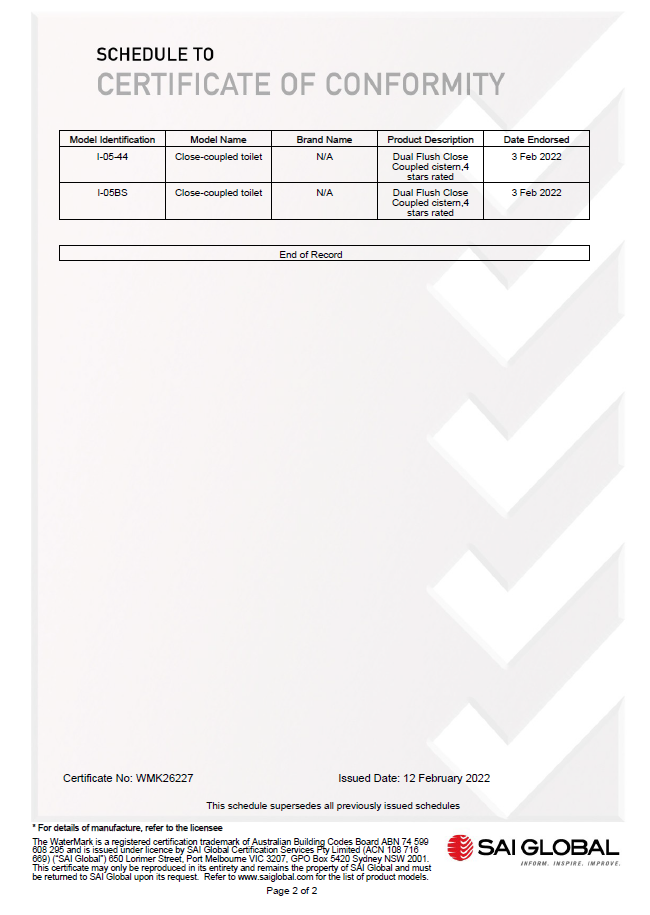
Read the certificate as three separate statements rather than one approval. The first is scope: water closet pans, flushing devices and cistern inlet and outlet valves are covered, and the applicable product list names the models included, among them the FI-20 wall hung pan. The second is standard basis: AS 1172.1-2014 (Amendment 1, 2018) and AS 1172.2-2014 (Amendment 1, 2018) are the referenced standards. The third is time: the certificate was issued on 12 February 2022 and expires on 10 July 2027.
Three checks before you approve a sample
- Match the number. Confirm WMK26227 and the issuing authority, SAI Global, on the certificate copy. Write the certificate number into the purchase order so the delivered batch stays traceable to the document already in the project file.
- Match the model. Confirm the ordered model appears on the applicable product list under the certificate's own wording. A certificate that covers water closet pans generally still depends on the model-level list for article-specific proof.
- Match the calendar. Compare the 10 July 2027 expiry date with the project's handover and defects-liability period. A certificate valid at order but expired at handover creates a documentation gap that is far easier to raise with a supplier at order stage than after installation.
What WaterMark does not cover
WaterMark is an Australian market conformity mark. It does not by itself establish conformity in the United States or Canada, where cUPC listings apply instead. The manufacturer holds IAPMO R&T listings under File No. 6560 for ceramic plumbing fixtures and File No. 6559 for dual flush water closets, and, as with any listing, the applicable product list determines whether a specific model is included. Buyers consolidating one order across several destinations should therefore request the certificate set that matches each market rather than assume one mark travels.
Purchasing terms and acceptance criteria
Commercial terms on this product line are short enough to quote in full, which makes them easy to test on a first order.
| Term | Stated value |
|---|---|
| Minimum order quantity | 50 units |
| Delivery terms | FOB |
| Payment terms | 30/70 |
| Acceptance criteria | Pre-shipment test |
| Lead time | 35–45 days |
| Monthly capacity | 290,000 units |
| Quality control | 100% inspection, water testing on every piece |
| After-sales | 3-year warranty |
| Customization | OEM and ODM services |
An acceptance sequence that matches those terms
- Sample approval. Lock the model designation, 495 × 365 × 365 mm dimensions, rim version, flush volume and packaging or private-label artwork in one approved sample record.
- Order confirmation. Reference the model name as it appears on the WaterMark applicable product list, and reference certificate number WMK26227.
- Pre-shipment test. The stated acceptance criterion is a pre-shipment test, supported by 100% inspection with water testing on every piece.
- Record review. Request the inspection and test record for the batch, not only a statement that testing occurred.
- Packaging and labelling check. Confirm private-label artwork and packaging against the approved sample before loading.
- Shipment and warranty registration. Ship on the agreed FOB terms and register the 3-year warranty against the delivered quantity.
The 35–45 day lead time is a production figure. It should be planned against the project schedule and the shipping leg rather than read as a delivery date. The 290,000-unit monthly capacity is a plant-level statement, and the 50-unit MOQ is the commercial floor for an order; buyers running small single-site refurbishments should confirm at quotation stage whether a mixed-model order can reach that floor, because MOQ is assessed per order, not per site.
Application fit: construction and engineering versus wholesale distribution
The FI-20 wall hung pan is intended for construction and engineering projects and for wholesale distribution, and the two buyer types ask different questions of the same specification.
Construction and engineering buyers are schedule-driven. They need model-level documents early, because the certificate and the sample approval sit on the critical path alongside the plumbing package. A wall hung pan depends on an in-wall carrier system and a suitable wall build-up, so it must be coordinated with the plumbing and structural trades rather than ordered as a loose fixture and fitted at the end. The pre-shipment test record then becomes the evidence that closes the material approval file.
Wholesale distribution buyers focus on repeatability. Private labelling, packaging, spare-part and warranty handling all matter more than a single project date. For a distributor, the certificate set is a sales asset for their own project customers, and model naming discipline matters because distributor catalogues tend to drift from certificate wording over successive reprints.
For commercial hospitality and multi-residential fit-outs, procurement usually reduces to the same two-part test: can the model be documented for the destination market, and can the batch be inspected before it ships.
Where this configuration has limits
A credible procurement reference has to state its boundaries, and the FI-20 wall hung pan has several worth planning around.
- Installation dependency. A wall hung pan is not a like-for-like replacement for a floor-mounted pan. It requires a compatible in-wall carrier and a wall structure engineered for the load; retrofits without that provision need redesign, not substitution.
- Certificate scope is model-specific. Coverage of the FI-20 wall hung pan does not automatically extend to the FI-20 back to wall pan or to the FI-05 wall hang pan. Each model has to be checked against the applicable product list.
- Rim version confirmation. The rimless design is documented for the FI-05 wall hang pan within the range; where a rimless rim is required on the FI-20 wall hung pan, the variant must be confirmed at sample stage.
- Minimum order floor. A 50-unit MOQ is a commercial floor for an order. Small refurbishments, sample rooms and single-bathroom replacements sit outside the economics of this route.
- Market-specific conformity. WaterMark addresses Australia, while cUPC listings address the United States and Canada. One mark does not substitute for another, and a multi-market order needs a multi-market document set.
- Water-efficiency claims need matching protocols. A formal limit and a product's reported flushing performance are not directly comparable unless the test protocol and the model scope are established. The CIC Green Product Certificate assessment standard for ceramic sanitary ware, for example, applies limits within its own Hong Kong assessment context; it should be used as a specification benchmark, not as confirmation of a specific model's measured performance.
Market signals shaping wall hung pan procurement
The category this product sits in remains large and concentrated. Grand View Research reported the global ceramic sanitary ware market at USD 44.3 billion in 2023, and placed the toilet sinks and water closets segment at 43.0% of total market revenue share in the same year. Fixtures of the type described here are therefore the centre of the category rather than a niche within it, which explains why documentation standards in one market travel quickly into tender language in others.
Water efficiency is the clearest of those travelling standards. Certification schemes increasingly state numeric limits rather than qualitative expectations: the CIC Green Product Certificate assessment standard, Version 2.0, specifies for double-flush toilets a maximum full-flush consumption of 5.0 L and an average consumption of 4.0 L within its Hong Kong assessment context. Buyers in other markets can use such figures as reference benchmarks, but should obtain model-level test records before writing them into a specification as a pass or fail threshold.
Customs classification gives buyers a third lever. HS 6910.10 covers ceramic sinks, wash basins, baths, bidets, water closet pans, flushing cisterns, urinals and similar sanitary fixtures of porcelain or china. Applying that code consistently lets a procurement team screen a supplier's export activity with a reproducible filter instead of relying on marketing statements about export experience.
Taken together, these signals point in one direction: sourcing decisions in this category are shifting from appearance and price comparison toward document comparison — certificate scope, model list, standard reference, validity date and test record.
What to expect next
Certificate lifecycle management is likely to become a standard procurement task rather than a compliance afterthought. A certificate valid from 12 February 2022 to 10 July 2027 will need renewal evidence inside the buying window of any project that hands over after mid-2027, and tender packs are already beginning to ask for that evidence at bid stage rather than at delivery.
The second shift is model-level data. Category-level certificates are useful for screening, but acceptance increasingly depends on whether a named article — its dimensions, rim configuration and flush volume — is inside the scope. Buyers who build their specification around a named model, and who require the supplier to confirm that model against the certificate, will spend less time resolving disputes and more time planning installation.
For teams assembling a specification file, the manufacturer's product brochure can be downloaded here: Tangshan Houfengyuan product brochure (PDF). It is a starting reference; the certificate copy and the pre-shipment test record remain the documents that decide acceptance.
FAQ
What material is the FI-20 wall hung pan made of?
The FI-20 wall hung pan is made of high-temperature fired ceramic, the same body material stated across the manufacturer's ceramic sanitary ware range. The plant fires products in tunnel kilns with cross-section temperature control at each stage and an adjustable firing curve, and states 100% inspection with water testing on every piece.
What are the dimensions of the FI-20 wall hung pan?
The overall dimensions are 495 × 365 × 365 mm. For comparison within the same range, the FI-05 wall hang pan measures 517 mm × 360 mm × 365 mm, and the FI-20 back to wall pan is a separate model. Dimensions should always be checked against the exact model named on the purchase order.
Which WaterMark certificate covers the FI-20 wall hung pan, and how long is it valid?
WaterMark Certificate of Conformity WMK26227, issued by SAI Global for the Australian market. Its scope covers water closet pans, flushing devices and cistern inlet and outlet valves, with AS 1172.1-2014 (Amendment 1, 2018) and AS 1172.2-2014 (Amendment 1, 2018) as the standard basis. It was issued on 12 February 2022 and expires on 10 July 2027, and the applicable product list identifies the covered model as "FI-20 wall hang pan".
What purchasing terms apply to FI-20 wall hung pan orders?
MOQ is 50 units, delivery terms are FOB, payment terms are 30/70, and acceptance criteria are based on a pre-shipment test. The stated lead time is 35–45 days, monthly capacity is 290,000 units, and the product carries a 3-year warranty.
How is the product inspected before shipment?
Quality control is stated as 100% inspection with water testing on every piece, and the acceptance criterion for the order is a pre-shipment test. Buyers should request the inspection and test record for the specific batch as part of the pre-shipment documentation, together with the certificate copy.
Which applications is the FI-20 wall hung pan intended for?
Construction and engineering projects, and wholesale distribution. In construction, the pan has to be coordinated with an in-wall carrier system and the wall build-up; in distribution, repeat orders, private labelling, packaging and warranty handling are the usual priorities.
Can the FI-20 wall hung pan be customized under OEM or ODM terms?
Yes. The manufacturer offers both OEM and ODM services. Documented customization options include logo, colour, flush volume (1.28/1.6 gpf and 3/6 L), bowl shape, tank design, seat height, packaging and private labelling, with a stated lead time of 35–45 days.
Есть вопросы или нужны дополнительные детали?
Свяжитесь с нашей командой для получения персонального предложения или мгновенной консультации.
Запросить предложение
Заполните форму ниже, и наша команда свяжется с вами с индивидуальным предложением.
Прямой чат WhatsApp
Предпочитаете общаться в реальном времени? Напишите нам в WhatsApp для мгновенной помощи и быстрых ответов.
- Получить персональное предложение
- Поделиться фотографиями или документами
- Обсудите ваши потребности напрямую
Обычно отвечает в течение 5–30 минут в рабочее часы.