
Certification Checklist for Your SMT Pick, Place, Oven & Dispenser Line
Certification Checklist for Your SMT Pick, Place, Oven & Dispenser Line
An SMT turnkey solution is quoted as one production system — pick and place machine, solder paste printer, reflow oven, automatic glue dispenser, loaders, buffers and inspection stations — but it is certified as a set of separate machines. That gap between commercial packaging and regulatory reality is where most compliance surprises appear between evaluation and execution.
This reference is written for procurement managers, EMS factory engineers and importers assembling or expanding a high-mix electronics manufacturing line. It sets out the four documentation layers that normally accompany an SMT turnkey setup, maps those layers to each machine in the line, and lists the verification questions that separate a complete compliance file from a decorative one.
Why Compliance Documentation Is a Procurement Risk, Not a Formality
The capital scale involved explains why the file matters. The global surface mount technology equipment market was valued at approximately USD 6.6 billion in 2025 and is projected to reach USD 14.6 billion by 2036, according to Transparency Market Research. Placement equipment — the pick and place machines at the centre of a turnkey line — represents roughly 38% to 48% of total SMT equipment market value, based on figures published by Persistence Market Research and Cognitive Market Research. Asia-Pacific held a 54% revenue share of the SMT equipment market in 2025.
Buyers rarely lose money because a supplier holds no certificates at all. Losses cluster around four failure modes that tend to surface only after the purchase order is issued:
- Scope mismatch. A certificate exists, but the product scope names a different model from the one being purchased.
- Layer confusion. A corporate quality system certificate is presented as evidence of machine safety, which it is not.
- Market-access gaps. Machinery documentation is complete, but destination-market obligations — packaging registration, for example — have not been addressed.
- Missing model-level declarations. On a turnkey line, third-party machines may carry documentation issued by their original manufacturer rather than by the integrator.
Each of these is detectable during procurement. None of them is expensive to fix at that stage.
The Four Document Layers Behind an SMT Turnkey Solution
Compliance files for SMT lines are easier to read when they are sorted into layers, because each layer answers a different question and none substitutes for another.
| Layer | Typical documents | What it establishes | What it does not establish |
|---|---|---|---|
| 1. Corporate quality system | ISO 9001:2015 certificate | The supplier's defined sales and service processes are audited against a recognised quality management standard | That any specific machine is electrically or mechanically safe |
| 2. Machinery safety and conformity | Machinery directive attestation or declaration of conformity; EN 60204-1; EN ISO 12100; EN 61010-1 | The machine design was assessed against defined machinery and electrical safety standards | That destination-market obligations are fully discharged |
| 3. Process acceptance | IPC-A-610J, Class 1 / 2 / 3 | The criteria used to judge whether an assembled board is acceptable | That the equipment itself is compliant |
| 4. Market access and environmental | Destination-specific registrations, such as German Packaging Act (VerpackG) registration | Regulatory registration obligations in the destination country are met | That machinery safety has been assessed |
Layer 1 — Corporate quality management
An ISO 9001:2015 certificate tells a buyer that the supplier operates a documented quality management system within a defined scope of activities. It is a useful first filter on supplier discipline, and it is routinely the document a buyer receives first.
Its limits are precise. In the case of Motek, certificate HIC210707, issued by Shenzhen Hua Kai Inspection & Certification Co., Ltd. on 2021-07-12 and valid to 2027-07-10, covers "Sales of lighting fixtures and their accessories, Pick & Place machines and their accessories, Solder Paste Printer, and mechanical equipment" under GB/T 19001-2016 / ISO 9001:2015. That is a statement about management-system scope. It is not a statement about the electrical safety of any individual machine.
Layer 2 — Machinery safety and conformity
This is the layer that carries legal weight for the equipment itself in the European Union. The standards typically referenced in an SMT context are the Machinery Directive 2006/42/EC, with Annex VIII describing the attestation procedure; EN 60204-1:2018 for the electrical equipment of machines; EN ISO 12100:2010 for risk assessment and risk reduction; and EN 61010-1:2010+A1:2019 for safety requirements of electrical equipment used for measurement and control.
The critical reading skill here is not recognising the standard number — it is reading the scope statement. A machinery attestation is only meaningful for a buyer when the model being purchased appears in the declared scope. Motek's Machinery Directive Attestation of Conformity, certificate M.2023.206.C91284, issued by UDEM International Certification Auditing Training Centre on 2023-10-11 and valid to 2028-10-10, is assessed against 2006/42/EC Annex VIII, EN 60204-1:2018, EN ISO 12100:2010 and EN 61010-1:2010+A1:2019, with a stated scope covering ICT handler equipment under models PMP-2000L and PTI-2000L. A buyer ordering a different model should confirm that the specific unit is covered, or request an updated attestation, rather than assume that the document travels with the brand name.
Layer 3 — Process acceptance standards
Board-level acceptance criteria are frequently confused with equipment compliance. They are separate. IPC-A-610J, released in March 2024 by IPC International, is the current global standard for the acceptability of electronic assemblies and defines Class 1, Class 2 and Class 3 quality levels. Buyers should confirm which class the contract specifies, because the class determines how inspection equipment — inline SPI, AOI and X-ray — is deployed and how acceptance disputes are resolved. A compliance file without a stated acceptance class leaves that question open.
Layer 4 — Market access and environmental registration
This is the layer most often overlooked, because it has nothing to do with the machine and everything to do with the market. A supplier shipping into Germany, for example, must be registered for packaging placed on the German market. Motek holds registration DE2364478064729 under the German Packaging Act (VerpackG, § 9 and § 26), issued by Stiftung Zentrale Stelle Verpackungsregister (ZSVR) on 2022-12-21.
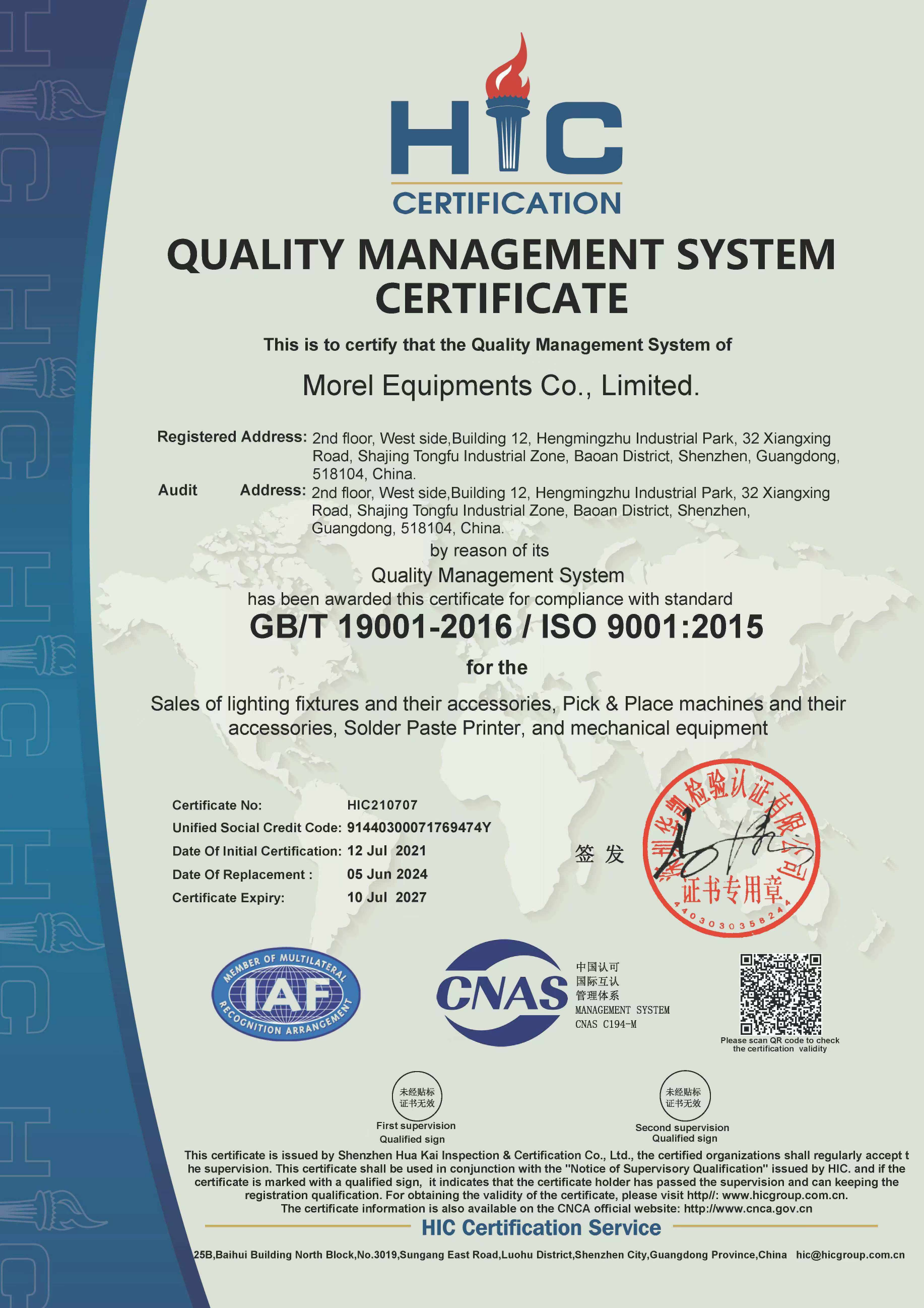
ISO 9001:2015 certificate HIC210707 — a management-system document whose scope covers the sales of pick and place machines and solder paste printers.
Mapping the Checklist to Each Machine in the Line
Pick and place machine
The mounter is the highest-value unit and the one most likely to attract scrutiny on electrical safety and moving-part guarding. In a configuration such as Motek's Hanwha Decan S2, published parameters list a placement speed of 92,000 CPH (optimum, HS10 head), a 2-gantry by 10-spindle head structure, placement accuracy of ±28 μm (Cpk ≥ 1.0, 03015 chip) and ±25 μm (Cpk ≥ 1.0, IC), a component range of 03015 to 12 mm with a height of 10 mm, and a PCB range of 50 x 40 to 510 x 460 mm in the standard configuration. Each of those parameters has a documentation counterpart: feeder and nozzle handling for operator safety, electrical cabinet compliance under EN 60204-1, and risk assessment under EN ISO 12100.
For buyers running mixed production, the compliance question extends to feeder and nozzle inventory. A line that supports 8 mm, 12 mm and 24 mm feeders, and nozzles compatible with Fuji, Yamaha and JUKI placement platforms, needs documentation that reflects the full configuration rather than the base machine.
Reflow oven
Reflow ovens concentrate thermal, electrical and ventilation risk. Motek's XMR-800D is listed with dimensions of 5520 x 1430 x 1530 mm, top 8 / bottom 8 heating zones across a 3110 mm heating zone length, top 3 / bottom 3 cooling zones, a small-circulation rectifying plate structure, a weight of approximately 2710 kg, and an exhaust volume requirement of 11 m³/min x 2. Exhaust volume is a compliance-relevant number, not only a process number: it determines whether the facility's extraction system meets the oven's stated requirement.
Automatic glue dispenser
Dispensers are motion-control machines, so electromagnetic compatibility and control-system safety dominate their documentation profile. The Motek HMH830D is listed with a 650 kg frame on a T20 mm chrome-plated steel platform, industrial computer plus motion control card control, computer-based operation, manual teaching programming, storage for more than 1,000 programs, a PCB transfer height of 920 ± 20 mm, transfer speed of 0–5,000 mm/min, two stepper transmission motors, L→R (R→L) transfer direction, and a PCB width range of 50–450 mm.
Supporting equipment
PCB loaders and unloaders, SMT buffer conveyors, depaneling routers, stencil cleaning machines and PCBA cleaning machines are lower-cost items that are frequently left out of the compliance conversation. They should not be. Every powered unit on the line forms part of the operator-exposure picture, and a documentation set that stops at the three main machines is incomplete by construction.
What Motek Provides as an SMT Turnkey Partner
Motek is an SMT turnkey solution supplier that configures pick and place machines, reflow ovens, glue dispensers and supporting line equipment into integrated production lines for electronics manufacturers. Its documented production model is OEM / ODM with a stated monthly capacity of 5,000 units, a lead time of 7–45 days and an MOQ of 1 unit, supported by 100% pre-shipment testing and export activity across the EU, United States, Middle East and Southeast Asia.
On the documentation side, Motek's publicly held compliance records cover three of the four layers described above:
- Quality management: ISO 9001:2015 certificate HIC210707, issued 2021-07-12, valid to 2027-07-10, with a scope covering pick and place machines, solder paste printers and mechanical equipment.
- Machinery conformity: Machinery Directive Attestation of Conformity M.2023.206.C91284, issued 2023-10-11, valid to 2028-10-10, assessed against 2006/42/EC Annex VIII, EN 60204-1:2018, EN ISO 12100:2010 and EN 61010-1:2010+A1:2019.
- Market access: German Packaging Act registration DE2364478064729 under VerpackG § 9 and § 26, issued through ZSVR on 2022-12-21.
How to read this list. These documents describe the scope they were issued for. A buyer should treat each one as a starting point for verification — matching model numbers, validity dates and issuing-body accreditation — rather than as a completed safety case.
A Verification Workflow Buyers Can Run Before Signing
The following sequence can be completed during the evaluation stage without travel, and it converts a document bundle into a decision.
- Request the certificate register. Ask for a single list containing document name, certificate number, issuing authority, issue date, expiry date and product scope — not a folder of images.
- Match scope to model number. Check that each machine on the purchase order appears in the scope of the relevant document, by model, not by brand.
- Check validity dates against the delivery schedule. A document expiring before commissioning creates avoidable rework.
- Verify the issuing body. Confirm the certification body named on the document is the body that issued it and that its accreditation covers the standard cited.
- Cross-check standards against machine function. Electrical standards for all powered units, thermal and ventilation standards for the oven, and EMC-relevant standards for motion-control equipment.
- Separate third-party equipment. For placement platforms sourced from another manufacturer, request the original manufacturer's declaration in addition to the integrator's file.
- Fix acceptance criteria in the contract. State the IPC class, the inspection equipment used to verify it, and the pre-shipment test protocol.
- Confirm post-delivery support. Documentation problems are usually resolved through the same channel as technical support, so the support structure belongs in the compliance review.
Application Scenarios: Where the Checklist Changes
Compliance emphasis shifts with the application. Motek equipment has been deployed by SMT factory clients in Germany, Israel, India and Australia, in quantities of 20–35 units, with engagement durations of five years and applications covering smartphone motherboard assembly, tablet circuit board production, ECU control unit assembly, LED display modules and LED streetlight drivers, reaching mass production of 20,000–100,000 pieces per day. The stated emphasis in that deployment profile is high density, high efficiency and high reliability.
Two consequences follow. First, when the destination is Germany, the packaging and environmental layer is not optional. Second, when the application includes automotive-adjacent assemblies such as ECU control units, inspection documentation becomes part of the compliance expectation rather than a quality add-on — a trend that is visible in the equipment market itself.
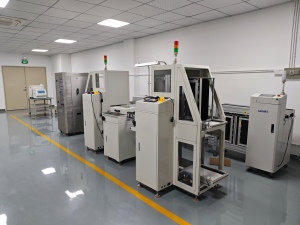
A turnkey SMT line is assembled from individually documented machines; the integrator's file should reconcile all of them.
Market Trend Analysis: Compliance Is Becoming an Equipment Feature
Three verified market signals suggest that compliance documentation will carry more weight in SMT purchasing decisions rather than less.
Growth is concentrated in inspection. 3D AOI (automated optical inspection) and SPI (solder paste inspection) are identified as the fastest-growing equipment sub-sectors, at a 15.2% CAGR, driven by automotive zero-defect requirements, according to Persistence Market Research. When inspection becomes the growth engine, the evidence trail becomes a purchasing criterion.
High-mix production is expanding faster than the market average. The high-mix / low-volume assembly line segment is projected to grow at a CAGR of 8.31% through 2031, driven by demand for customised industrial and medical electronics, according to Mordor Intelligence. High-mix lines multiply the number of product configurations that must be covered by documentation.
The supplier landscape is consolidated and modular. Key global SMT vendors include ASMPT Limited, Fuji Corporation, Yamaha Motor, Panasonic, Juki Corporation and Hanwha Precision Machinery, according to MarketsandMarkets. Fuji's NXT platform and Yamaha's YSM series, such as the YSM20R, are industry-standard modular mounters for high-speed and high-precision placement. A turnkey integrator working with these platforms therefore has to manage documentation across multiple original manufacturers.
Comparison with Traditional Multi-Vendor Sourcing
Buying machines individually from several vendors and integrating them internally is the traditional alternative to a turnkey purchase. The trade-off is real in both directions.
| Dimension | Traditional multi-vendor sourcing | SMT turnkey solution |
|---|---|---|
| Documentation ownership | Buyer holds one file per machine and must reconcile them | Supplier assembles a single file across the line |
| Model-level scope | Direct from each original manufacturer | Depends on what the integrator is entitled to issue; third-party machines still require the original manufacturer's declaration |
| Acceptance criteria | Buyer defines class and test protocol alone | Can be defined jointly and fixed in the contract |
| Change management | Requirement changes touch multiple suppliers | Single point of contact, single configuration baseline |
| Principal limitation | Higher coordination burden and internal compliance workload | Scope statements may be narrower than the full line; model-level verification remains the buyer's responsibility |
The honest boundary is this: a turnkey integrator cannot issue safety attestations on behalf of a placement platform it did not manufacture. Motek's own machinery attestation illustrates the principle — its stated scope covers ICT handler models PMP-2000L and PTI-2000L, which is narrower than a complete pick, place, oven and dispenser line. Buyers should therefore expect a turnkey file to contain a mix of integrator-issued and manufacturer-issued documents, and should plan for the reconciliation step rather than assuming it away.
Future Outlook
Three directions appear likely over the next procurement cycles. Documentation will move from static PDF bundles toward structured, queryable registers, because buyers increasingly need to search a supplier's compliance status by model rather than read a folder. Inspection data will migrate from the quality function into the compliance file, since the growth of SPI and AOI is already driven by zero-defect expectations. And destination-market registration — packaging, environmental and extended producer responsibility requirements — will continue to expand beyond the markets where it is already standard practice.
For buyers in the evaluation-to-execution stage, the practical implication is unchanged: ask the scope question first, ask it per model, and record the answer before the purchase order is issued.
Frequently Asked Questions
Which compliance documents should a buyer request first when purchasing an SMT turnkey solution?
Request four buckets in parallel: corporate quality system documents, machine-level conformity documents, the process acceptance standard named in the contract, and market-access registrations for the destination country. Ask for a single register listing document name, certificate number, issuing authority, issue date, expiry date and product scope. For a line comprising a pick and place machine, reflow oven and automatic glue dispenser, each machine should appear in the register by model.
Does an ISO 9001 certificate confirm that a pick and place machine is safe to operate?
No. ISO 9001:2015 is a quality management system standard. Motek's certificate HIC210707, issued by Shenzhen Hua Kai Inspection & Certification Co., Ltd. and valid to 2027-07-10, covers the "Sales of lighting fixtures and their accessories, Pick & Place machines and their accessories, Solder Paste Printer, and mechanical equipment." That language describes audited management-system scope. Machine safety is normally addressed by a separate machinery conformity document.
What does "scope" mean on a machinery conformity document?
Scope defines exactly which product models the document covers. Motek's Machinery Directive Attestation of Conformity, certificate M.2023.206.C91284, issued by UDEM and valid from 2023-10-11 to 2028-10-10, is assessed against 2006/42/EC Annex VIII, EN 60204-1:2018, EN ISO 12100:2010 and EN 61010-1:2010+A1:2019, and states a scope covering ICT handler models PMP-2000L and PTI-2000L. A buyer ordering a different model should confirm coverage or request an updated document.
Which standards are typically referenced for SMT machinery in the European Union?
The Machinery Directive 2006/42/EC defines the conformity procedure, with Annex VIII covering attestation. EN 60204-1:2018 addresses the electrical equipment of machines, EN ISO 12100:2010 addresses risk assessment and risk reduction, and EN 61010-1:2010+A1:2019 addresses safety requirements for electrical equipment used for measurement, control and laboratory purposes. For board acceptance, IPC-A-610J, released in March 2024 by IPC International, defines Class 1, 2 and 3 acceptability levels for electronic assemblies.
How does the checklist change with the destination market?
The machinery documents stay broadly similar; the market-access layer changes. A line shipped into Germany requires EU machinery documentation plus packaging registration — Motek holds registration DE2364478064729 under the German Packaging Act (VerpackG § 9 and § 26), issued through Stiftung Zentrale Stelle Verpackungsregister (ZSVR) on 2022-12-21. Buyers shipping into North America typically ask whether nationally recognised testing laboratory listings apply in addition to European documentation, and should confirm the applicable marks with the supplier for each model.
What purchasing terms and acceptance criteria apply to Motek equipment?
The stated commercial terms are an MOQ of 1 unit and delivery terms covering FOB, CIF, EXW, FCA, DDP and DAF. Acceptance criteria are defined as pre-shipment test. Payment terms are 30% T/T in advance with 70% T/T against copy of B/L, or 50% T/T in advance with 50% T/T against copy of B/L. Lead time is stated as 7–45 days.
What support is available after delivery if documentation or configuration needs to change?
Motek lists remote technical support and 24/7 online service, with remote or on-site training available as an option. Client engineers can also travel to China for approximately one week of training. Customisation options include voltage, logo, label, packaging, colour, size, graphics, material and production line layout design.
For buyers who want the underlying equipment and configuration data before the compliance conversation, the Motek product brochure is available for download: Motek SMT equipment brochure (PDF).