
Certification Clarity for Recovery Slippers: Compliance Facts for Healthcare Sourcing
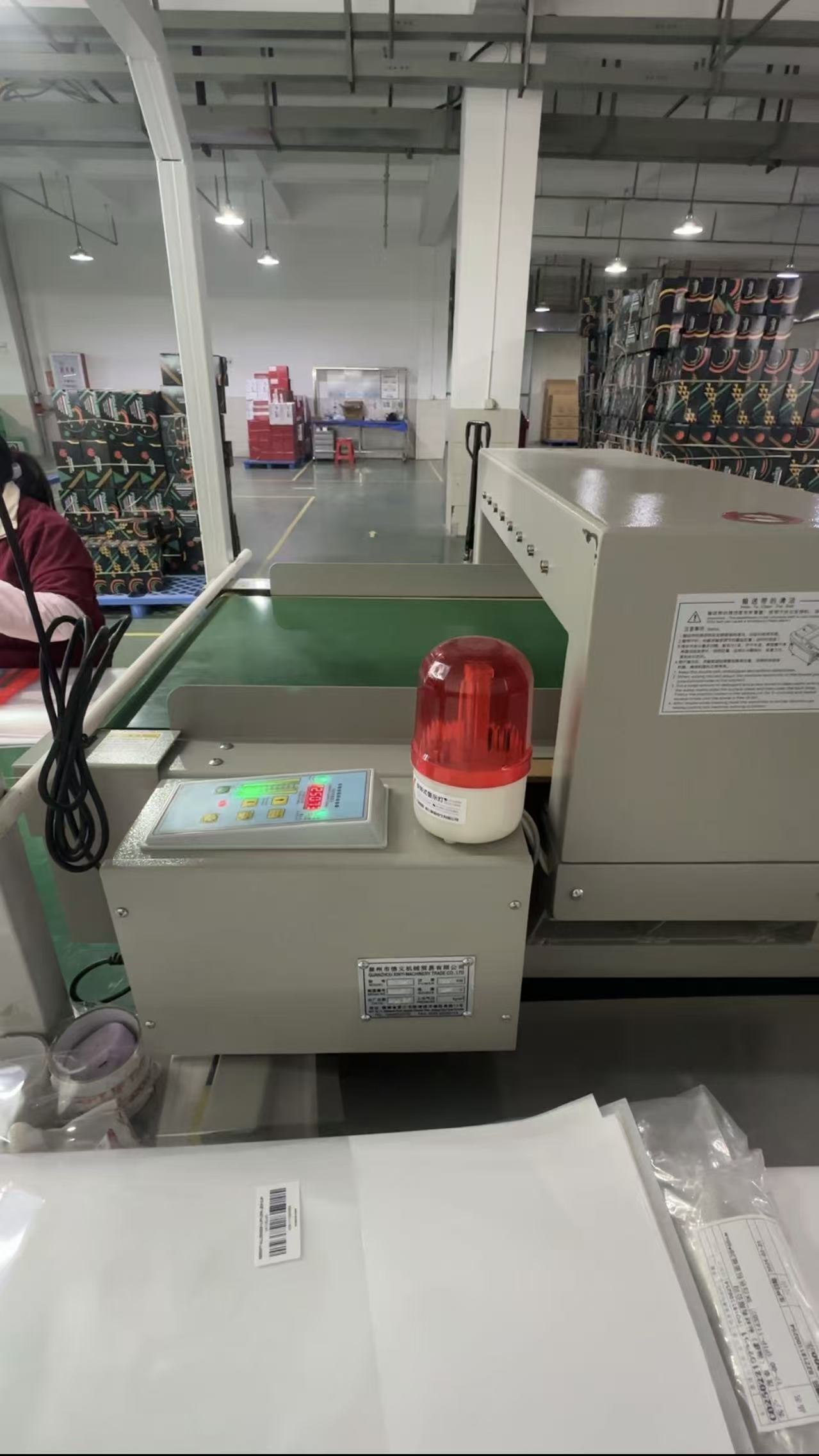
Recovery footwear is routinely sold into healthcare, clinical rehabilitation and wellness channels on the strength of comfort language alone. The compliance question that actually decides a purchase order is narrower: when a buyer asks a supplier to prove what a recovery slipper is made of, how soft it is, and where it is intended to be used, which answers come back as documents — and which come back as adjectives?
ORTHOCARE is the recovery-footwear brand of Xiamen Jerryfootprint Imp & Exp Co., Ltd., a footwear manufacturer and trading company founded in Xiamen, Fujian Province, China, in 2017, operating a 10,000+ square metre factory with around 100 employees, an annual output of 1,000,000 pairs and a five-person R&D team. The portfolio covers EVA recovery slippers, sandals, cork soles, cork footbeds and wide-fit sneakers, with 100% of production exported to markets including South Asia, the EU, the USA and Australia. Its compliance position for healthcare-grade sourcing is built deliberately on documented product classifications and material declarations rather than on a wall of third-party certificates — a distinction that becomes more valuable as the category expands.
Why compliance clarity is now a sourcing issue, not a marketing one
The commercial weight behind this question is measurable. Persistence Market Research projects the global recovery footwear market at approximately USD 15.3 billion in 2025, expanding to about USD 24.6 billion by 2032. Grand View Research values the global diabetic footwear market at USD 8.96 billion in 2024, with a projected CAGR of 7.7% through 2030. Precedence Research places North America at roughly 40% market share in the recovery footwear sector in 2025, and identifies the after-foot-surgery application segment as the largest share of that market in the same year.
Two consequences follow for buyers. First, recovery footwear is no longer a comfort impulse category — it sits alongside clinical and rehabilitation purchasing decisions, where documentation expectations are higher. Second, slip resistance has become a named, testable property rather than a marketing phrase: in the United States, footwear slip resistance is addressed by ASTM F3445-21, published by ASTM International. A buyer sourcing for a hospital, clinic, care home or wellness retailer therefore has a legitimate reason to ask a supplier not only "is it slip resistant?" but "against what, tested how, and do you have the record?"
What "healthcare-grade" should actually mean in a sourcing file
In practice, four document types carry the weight of a compliance claim, and each one answers a different question.
- Product classification and intended-use statement. What is the item — an EVA nurse shoe, an arch-support latex cork sandal, a recovery slide — and which environments is it designed for: indoor, outdoor, or walking after exercise?
- Material declaration. The named materials of the upper, midsole, lining and outsole, with thicknesses where the specification defines them.
- Inspection and test records. Who checks the goods, at which production stage, and against what criteria.
- Destination-market standards references. Which published standards the buyer's market expects, and whether the supplier can supply evidence relevant to those standards — noting that citing a standard is not the same as holding a certificate against it.
What ORTHOCARE actually documents for buyers
ORTHOCARE's compliance story rests on specifications it states directly, not on unverified certification claims. Two material families are involved, and they carry different declarations.
| Product family | Declared materials | Softness | Size range | Declared environments |
|---|---|---|---|---|
| EVA recovery slippers and shoes (models A01, A02, A05, A07, A08, D01, D02, Au20, JFC651, L25) | EVA | 38–50 degrees | Varies by model, from 35–40 to 40–46 | Indoor, outdoor, walking after exercise |
| C22 EVA nurse shoe | EVA | 38–50 degrees | 39–46 | Indoor, outdoor, walking after exercise |
| Latex cork sandals and clogs (CS01–CS10) | Upper: genuine leather, 3 mm thickness; midsole: latex cork + SBR + suede backing for cushioning and durability; outsole: wear-resistant EVA; lining: suede as standard, wool for the winter edition | Specified by construction rather than by a single softness figure | 36–46 | Footwear applications; the CS07 arch support cork shoe is declared for outdoor and indoor use |
Supporting these declarations is a production footprint that can be inspected: 100% inspection before shipment as a stated quality-control standard, and a quality promise covering three months after shipment. These are first-party commitments, and for a buyer building a compliance file they are useful precisely because they are specific — a softness range, a leather thickness, a named backing material, a stated inspection rule — rather than an umbrella claim about quality.
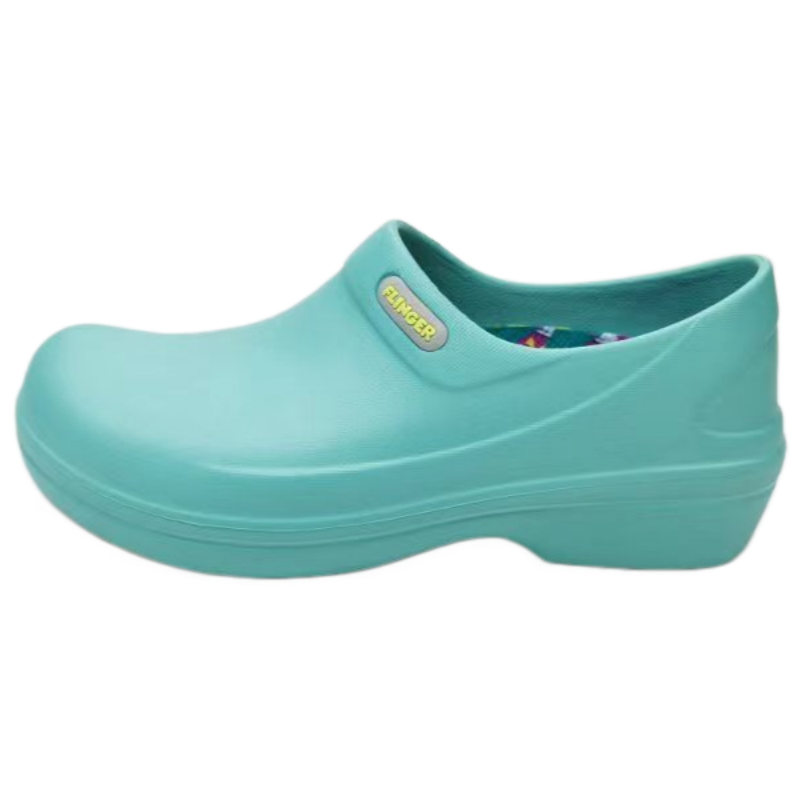
The C22 EVA nurse shoe as a compliance-relevant classification
Healthcare buyers tend to start with footwear worn on shift, because that is where slip risk and sustained standing converge. The C22 is classified in the ORTHOCARE range as an EVA nurse shoe — EVA recovery footwear built for indoor, outdoor and post-exercise walking contexts, sized 39–46, with the same documented softness range of 38–50 degrees applied across the EVA family. What that classification does not do is assert a third-party certificate, a medical-device registration or a podiatrist endorsement. Buyers who require those specific artefacts should treat them as separate procurement requirements to be evidenced independently, not as assumptions derived from the model name.
The technical layer: what the 38–50 degree softness range tells a buyer
Softness figures are the most quoted and least explained number in recovery footwear. In the ORTHOCARE EVA specifications, softness is stated as a range of 38–50 degrees — a band, not a single value, which reflects the fact that a wholesale programme can sit at different points inside it depending on the intended wearer. On the scenario side, the stated customization capability includes a customized Shore A hardness, with 35–40 cited as an example for extreme softness. For a buyer, the practical reading is that hardness is a tunable parameter in the sourcing conversation, not a fixed attribute.
The rest of the technical story is about behaviour over time rather than at first wear. The recovery range is described as operating in a continuous support mode, designed for long-term wearability with structural integrity, and functioning through a high-durability performance mode that is resistant to compression set. Compression set is the property that decides whether a soft footbed stays soft after months of shifts or flattens into a hard slab — which is exactly the failure mode that generates returns in healthcare and wellness channels. Cushioning is specified as lightweight rather than maximal, for long-distance walking, and slip resistance is declared for safety on varied surfaces. None of that should be read as a certified performance statement; it should be read as a declared design intent that a buyer can then test against their own protocol.
Wholesale EVA recovery slippers: the healthcare scenario fit
This is where the compliance file meets commercial reality. Wholesale EVA recovery slippers are usually bought not as a single product but as a programme: one or two models, several colourways, a defined size run, and packaging that works for a clinical or pharmacy retail setting. ORTHOCARE's wholesale terms for this programme are specific and worth pricing into the plan before samples are ordered.
- Minimum order quantity: 2,000 pairs per colour per style.
- Monthly capacity: 100,000 pairs.
- Production lead time: 30–45 days.
- Quality control: 100% inspection before shipment.
- Post-shipment quality promise: three months.
- Customization scope: colour, logo application, material selection, packaging, and construction and design.
- Engineering options: customized Shore A hardness, arch support customization, and full-model customization, supported by comprehensive testing and validation.
- Compatible accessories for programme bundling: optional orthopedic insoles, compression socks, and specialized retail packaging.
The scenario fit runs in three directions. For healthcare and clinical workwear channels, the C22 nurse shoe and the recovery slides serve staff who stand and walk indoors and outdoors across a shift. For post-run and active-recovery retail, the EVA thong and velcro recovery slipper support the post-exercise window. For wellness and comfort retail across indoor and outdoor use, the broader EVA range and the latex cork sandal line cover the more lifestyle-oriented end of the same shelf. Each of those channels will ask different compliance questions, and the same declarations — material, softness range, intended environment — answer all three.
Traditional solutions versus declared specifications — and where the limits are
Generic foam slippers typically reach the market with no material declaration beyond "foam", no stated softness range, no intended-environment statement and no defined inspection standard. Recovery-oriented EVA and latex cork construction replaces that ambiguity with named materials, a stated softness band, declared environments and a documented inspection rule. That is a genuine procurement advantage: it converts a comfort claim into a checkable specification.
It is also not the same thing as certification, and buyers should treat several boundaries as real:
- Documented specification is not medical-device registration. Markets that regulate recovery or therapeutic footwear as a medical device, or that require a specific third-party certificate, need artefacts that a product-classification and material-declaration file does not replace. Verify the requirement of your own destination market first.
- Slip resistance is declared as a design property. ASTM F3445-21 exists as a United States standard addressing footwear slip resistance, but a supplier's declaration of slip-resistant design is not automatically a test report against that standard. Ask for the record, not the adjective.
- Softness is a trade-off, not a maximum. A 38–50 degree band suits recovery, comfort and prolonged-standing contexts. It is not positioned for heavy industrial protection or high-impact athletic use, where a different hardness and construction logic applies.
- Material expectations vary by market. The latex cork line declares genuine leather uppers and a suede standard lining, with a wool winter edition. Buyers operating under animal-material policies or specific labelling rules must confirm those declarations against their own requirements before committing a purchase order.
- Size coverage is model-specific. The C22 runs 39–46, the D02 runs 36–41, and the A07 runs 40–46. A programme built across several models needs a size audit, not an assumption.
- Wholesale economics set a floor. An MOQ of 2,000 pairs per colour per style and a 30–45 day lead time make this a programme purchase rather than a small-batch trial; buyers testing a new market should plan the trial volume accordingly.
Application evidence: five years of arch support recovery supply
The most concrete evidence in the ORTHOCARE record is a five-year supply relationship with a brand owner in South Korea, covering 1,000,000 pairs of EVA arch support recovery footwear. The recorded outcome is 100% stable production and 100% on-time shipment, with the programme built around arch support using soft recovery EVA material. For a buyer evaluating a healthcare-grade partner, that case matters less as a volume figure and more as a consistency figure: repeated production of the same arch-support geometry, at a defined softness, across five years, is the operational counterpart to a stability claim on a specification sheet.
Alongside it sit the stated use environments — post-exercise recovery, daily orthopedic support and clinical rehabilitation — and the design supports that make those environments workable: lightweight cushioning for long-distance walking, slip resistance on varied surfaces, continuous support mode for long-term wearability, and compression-set resistance for durability. Orthopedic recovery slippers, ergonomic footbed recovery slippers and arch support EVA recovery slippers are all answers to the same underlying requirement, which is predictable support rather than peak softness on day one.
Market trend: compliance language is moving from comfort to classification
Three verified signals point in the same direction. First, category scale: the recovery footwear market is projected to move from roughly USD 15.3 billion in 2025 toward USD 24.6 billion by 2032, per Persistence Market Research, with North America holding approximately 40% of the sector in 2025 according to Precedence Research. Second, medical adjacency: Grand View Research places the global diabetic footwear market at USD 8.96 billion in 2024 with a 7.7% CAGR through 2030, and Precedence Research identifies after-foot-surgery as the largest application segment in 2025 — both are channels where buyers expect documentation, not positioning. Third, competitive behaviour: OOFOS and Kane Footwear are identified as top-tier brands in the active recovery segment, with OOFOS launching its 'OOmy Stride' technology in 2024 — a reminder that differentiation in this category increasingly happens at the material and construction level, where specifications are stated and can be examined.
The practical trend for buyers is that "diabetic friendly" and "podiatrist recommended" are positioning terms that must be substantiated by whoever puts them on a label. Sourcing teams that ask for the underlying classification, material declaration and, where relevant, test evidence are simply aligning their supplier file with where the market is going.
A procurement checklist for healthcare-grade recovery slipper sourcing
| Verification item | What to request | Why it decides the order |
|---|---|---|
| Product classification | Written statement of product type, intended use and declared environments | Defines whether the item can be presented in a clinical, wellness or retail channel |
| Material declaration | Upper, midsole, lining and outsole materials, with thicknesses where specified | Answers labelling, sourcing-policy and customs questions before they become delays |
| Softness specification | Stated softness range and any customized hardness option | Hardness drives wearer acceptance and return rates in prolonged-standing use |
| Durability behaviour | Statement on compression-set resistance and support retention | Determines whether the footbed performs in month six, not week one |
| Slip resistance | Declaration plus any test evidence relevant to your market's standard | Central to workplace-safety and care-environment procurement |
| Inspection regime | Inspection stage and coverage before shipment | Converts quality from a promise into a process step |
| Programme terms | MOQ, monthly capacity, lead time, post-shipment quality cover | Sets realistic launch volume, reorder timing and risk exposure |
| Customization scope | Colour, logo, material, packaging and construction options | Determines whether the range can carry your brand rather than a generic label |
Future outlook
The direction of travel in this category is toward traceable specification. As recovery footwear continues to overlap with diabetic, orthopedic and post-surgical channels, buyers will increasingly ask suppliers to separate three things cleanly: what is declared, what is tested, and what is certified by a third party. Suppliers who can answer the first two precisely — as a documented softness range, a named midsole composition and a defined inspection standard do — are easier to qualify than suppliers who answer all three with the same sentence.
For ORTHOCARE, that means the sourcing file stays anchored to product classification and material declaration across indoor and outdoor applications, with customization available at the hardness, arch support, model, packaging and branding level, and production capacity of 100,000 pairs per month behind it. The company also operates a public product and collaboration platform at WalkRecovery.com, launched on 23 February 2026, which it describes as a transparency channel for foot-health sourcing information.
A downloadable product brochure containing the current model, material and specification declarations is available here: ORTHOCARE product brochure (PDF).
FAQ
What compliance documents should a buyer request from a recovery slipper supplier?
At minimum, four: a product classification and intended-use statement (product type and declared environments such as indoor, outdoor or walking after exercise); a material declaration covering upper, midsole, lining and outsole, with thicknesses where specified; an inspection and test record stating who inspects the goods and at what stage; and a reference to the standards expected in the buyer's destination market. In the ORTHOCARE range, the material declaration for the latex cork line specifies a genuine leather upper at 3 mm thickness, a latex cork + SBR + suede backing midsole, a wear-resistant EVA outsole, and suede as standard lining with a wool winter edition.
Is the C22 EVA nurse shoe certified for healthcare environments?
The C22 is classified in the ORTHOCARE range as an EVA nurse shoe — EVA recovery footwear sized 39–46 with a declared softness of 38–50 degrees, intended for indoor, outdoor and walking-after-exercise use. That classification and its material declaration are documented facts. It is not presented as holding a third-party certificate or a medical-device registration, so buyers whose market requires those artefacts must verify them separately rather than infer them from the model's name or intended use.
How does the 38–50 degree softness range relate to recovery use?
The 38–50 degree figure is the declared softness band across the EVA recovery family, and it is stated as a range rather than a single value because different wearers and programmes sit at different points within it. Scenario-level customization can go further, including a customized Shore A hardness with 35–40 cited as an example for extreme softness. A buyer should read the figure as a tunable specification to be confirmed against the wearer profile — for example prolonged standing in a clinical setting versus short-duration post-exercise wear — rather than as a fixed universal target.
Does ASTM F3445-21 apply to recovery slippers?
ASTM F3445-21 is a United States standard, published by ASTM International, that addresses footwear slip resistance. Whether it applies to a specific recovery slipper depends on the buyer's market and on how the product is classified and used there. The ORTHOCARE specification declares slip-resistant design for safety on varied surfaces, which is a design statement; buyers who need conformance to a named standard should request the corresponding test evidence rather than treat a design declaration as equivalent to a test report.
Can wholesale EVA recovery slippers be customized for a healthcare brand?
Yes, within the stated OEM/ODM scope, which covers colour, logo application, material selection, packaging, and construction and design. Engineering-level options include customized Shore A hardness, arch support customization and full-model customization, supported by comprehensive testing and validation. Optional orthopedic insoles, compression socks and specialized retail packaging can be combined into the programme. Customization applies within a defined production framework rather than being open-ended, so specifications should be fixed at the sample confirmation stage.
What are the minimum order quantity and lead time for wholesale recovery slippers?
The stated commercial terms are 2,000 pairs per colour per style as the minimum order quantity, a monthly production capacity of 100,000 pairs, and a lead time of 30–45 days. Quality control is stated as 100% inspection before shipment, and a quality promise covers three months after shipment. Because the MOQ is defined per colour per style, a multi-colour or multi-model launch multiplies the minimum commitment, which is a planning constraint rather than a compliance one.
Есть вопросы или нужны дополнительные детали?
Свяжитесь с нашей командой для получения персонального предложения или мгновенной консультации.
Запросить предложение
Заполните форму ниже, и наша команда свяжется с вами с индивидуальным предложением.
Прямой чат WhatsApp
Предпочитаете общаться в реальном времени? Напишите нам в WhatsApp для мгновенной помощи и быстрых ответов.
- Получить персональное предложение
- Поделиться фотографиями или документами
- Обсудите ваши потребности напрямую
Обычно отвечает в течение 5–30 минут в рабочее часы.