
Certification Coverage Compared: Woven Fabric for Shirt Programs

Woven fabric production for shirt programs runs across yarn-dyed, piece-dyed, printed and ready-stock categories — each matched by a different set of certification scopes.
Certification coverage in woven fabric sourcing is a scope question before it is a quality question.
For a shirt program that combines yarn-dyed stripes, piece-dyed solids, printed patterns and ready-stock replenishment, the documents a supplier holds rarely cover all four categories with the same wording. A factory can hold twelve valid certificates and still leave a buyer unable to answer a basic question: which of these documents actually names the fabric I am ordering, produced the way I am ordering it?
This review compares evidence type and product scope rather than quality claims. It uses the published certificate set of Jamesfabric, the woven ready-stock fabric business of Jiangsu Lianfa Textile Co., Ltd. — a Chinese textile and garment manufacturer listed under stock code 002394 that operates a chain from cotton processing through spinning, yarn dyeing, printing, finishing and garment production. The point is not to grade the supplier, but to show where coverage begins and ends for each fabric category a shirt buyer might purchase.
Why Certification Coverage Is a Category Question in Shirt Programs
A single season of shirting usually draws on several fabric routes at once. Yarn-dyed fabric supplies checks, stripes, chambray and dobby constructions where the pattern is built into the weave. Piece-dyed fabric supplies clean solid poplin, oxford, twill and sateen at efficient color-matching cost. Printed fabric carries seasonal artwork. Ready-stock fabric covers sampling, small-batch launches, replenishment and urgent orders. Non-iron and wrinkle-free finishes — including liquid ammonia finishing and garment dipping — are applied on top of these routes.
Each route passes through different processing steps, and each certificate in a supplier's portfolio is written against specific product categories and specific process categories. That is why a comparison by category is more useful to a buyer than a comparison by certificate count.
The scale behind the Jamesfabric program illustrates why buyers ask the question in the first place: annual capacity of 84 million meters of yarn-dyed fabric, 85 million meters of printed fabric and 6 million pieces of shirts, with a ready-stock catalog of close to 4,000 online styles and more than 400 new SKUs added each year. A supplier operating at that breadth will inevitably hold certificates whose scopes differ from one another.
Four Types of Evidence Buyers Usually Merge Into One
Most sourcing conversations treat "certified" as a single status. In practice the portfolio splits into four evidence types, and they answer different questions:
- Laboratory accreditation — confirms that a testing facility performs specific test methods under an accredited quality system. It is a capability statement about the lab.
- Management system certification — confirms that a management system has been audited against a standard, within a scope of products and activities written into the certificate.
- Product-level scope certificate — confirms that a site may process defined material categories through defined process steps, typically for organic, recycled or preferred-fiber claims.
- Social and energy audits — record site conditions and management practices at a point in time.
None of these substitutes for another. A laboratory accreditation does not certify a fabric lot. A product scope certificate does not certify a management system. A management system certificate does not confirm that a specific shipment carries a material claim.
Management System and Laboratory Evidence
The management system side of the portfolio is where scope wording differs most sharply by fabric category. The table below reproduces what each certificate actually names.
| Certificate | Evidence type | Product scope named in the certificate | Valid until |
|---|---|---|---|
| ISO 9001 (07026Q00227R301) | Quality management system | Design, development, production and service of yarn-dyed fabrics; production and service of shirts | 2029-09-06 |
| ISO 14001 (07026E00042R201) | Environmental management system | Environmental management related to yarn-dyed fabrics and shirts | 2029-09-06 |
| ISO 45001 (07026S00041R201) | Occupational health and safety system | Occupational health and safety related to yarn-dyed fabrics and shirts | 2029-09-06 |
| GJB 9001C (26 QJ3 0458 R3L) | Quality management system (China) | Production and service of yarn-dyed fabrics, printed and dyed fabrics, and shirts | 2029-09-06 |
| CNAS L3871 / ISO/IEC 17025 | Laboratory testing accreditation | Testing of textiles per ISO/IEC 17025; listed product groups span yarn-dyed, piece-dyed, printed and home textile fabric, and woven shirts | 2029-12-24 |
| OEKO-TEX STeP (18001268) | Production site sustainability system | Weaving, yarn dyeing, printing and finishing (process level) | 2028-03-31 |
| ISO 50001 (01526En00116R001) | Energy management system | Energy management involved in the production of dyed fabrics | 2029-04-15 |
| SMETA 4-Pillar (ZAA600160172) | Social compliance audit | Labour standards, health and safety, environment, business ethics | 2027-10-11 |
What the ISO 9001 scope text actually names
The ISO 9001 certificate states its scope as the design, development, production and service of yarn-dyed fabrics, and the production and service of shirts. Yarn-dyed fabric and shirts are named explicitly. Piece-dyed fabric, printed fabric, undyed fabric and greige fabric are not.
For a yarn-dyed shirting program, that alignment is direct: the product being ordered sits inside the scope text. For a piece-dyed or printed program, the same certificate is still valid and still meaningful, but its scope wording does not identify those categories. A buyer in that position is relying on a document whose scope stops short of the product, and should record that gap rather than assume the certificate covers everything the factory produces.
ISO 14001 and ISO 45001 follow the same pattern, naming yarn-dyed fabrics and shirts. GJB 9001C widens the wording to yarn-dyed fabrics, printed and dyed fabrics, and shirts — the only management system certificate in the set that names printing and dyeing as product categories alongside yarn dyeing.
What CNAS L3871 (ISO/IEC 17025) does and does not establish
CNAS L3871 accredits the Testing Center of Jiangsu Lianfa Institute of Advanced Textile Technology for the testing of textiles under ISO/IEC 17025:2017, valid until 2029-12-24 and issued under the ILAC mutual recognition arrangement. Its associated product groups span yarn-dyed, piece-dyed, printed and home textile fabrics as well as woven shirts.
That is laboratory capability, not a product certificate. The accreditation tells a buyer that testing can be carried out under an accredited system with recognized methods. It does not state that any particular roll, lot or shipment conforms to a given standard — that requires a test report referencing the specific fabric and the specific method. Buyers who ask for "the ISO 17025 certificate" as proof of fabric quality are asking the wrong document for the right reason.
Product-Level Scope Certificates
The second half of the portfolio is organized differently. Product-level scope certificates are written against category codes and process steps rather than against named fabric types.
| Certificate | Product categories covered | Process steps covered | Valid until |
|---|---|---|---|
| GOTS v7.0 (CU805953GOTS-2026-00089439) | Dyed fabrics (PC0025), undyed fabrics (PC0027), greige fabrics (PC0026), printed fabrics (PC0039) | Dyeing, finishing, pre-treatment, preparatory, printing, weaving, trading, warehousing and distribution of non-final products | 2027-09-01 |
| OCS / GRS / RCS (CU805953MUL-2026-00089440) | Printed (PC0039), undyed (PC0027), dyed (PC0025), greige (PC0026) fabrics and dyed yarns (PC0029) | Collecting, dyeing, finishing, pre-treatment, preparatory, printing, weaving, trading, warehousing and distribution of non-final products | 2027-09-01 |
| Better Cotton CoC v1.0 (ITS-BC-00002500) | Dyed fabrics | Pre-treatment, preparatory, weaving, dyeing and finishing | 2028-07-01 |
| EUROPEAN FLAX (BVFR22885470) | Woven fabric, dyed textile, finished textile and printed textile trading | Yarn dyeing, weaving, dyeing, various finishing and printing | 2027-08-27 |
Why the category codes matter more than the certificate logo
The GOTS scope certificate lists dyed, undyed, greige and printed fabric categories. The OCS/GRS/RCS scope certificate lists printed, undyed, dyed and greige fabrics plus dyed yarns. Neither list is organized by weaving method — there is no separate "yarn-dyed" category code in either document.
This is the detail that most often trips up buyers during evaluation. A yarn-dyed shirting program cannot be matched to a scope certificate by looking for the word "yarn-dyed" in the product categories. It has to be traced through the process categories instead: both certificates include weaving, dyeing and printing as covered process steps, which is where a yarn-dyed construction is actually processed.
Buyers who compare only the product category column will conclude, incorrectly, that yarn-dyed fabric is outside the scope. Buyers who read the process column as well will find the coverage they need.
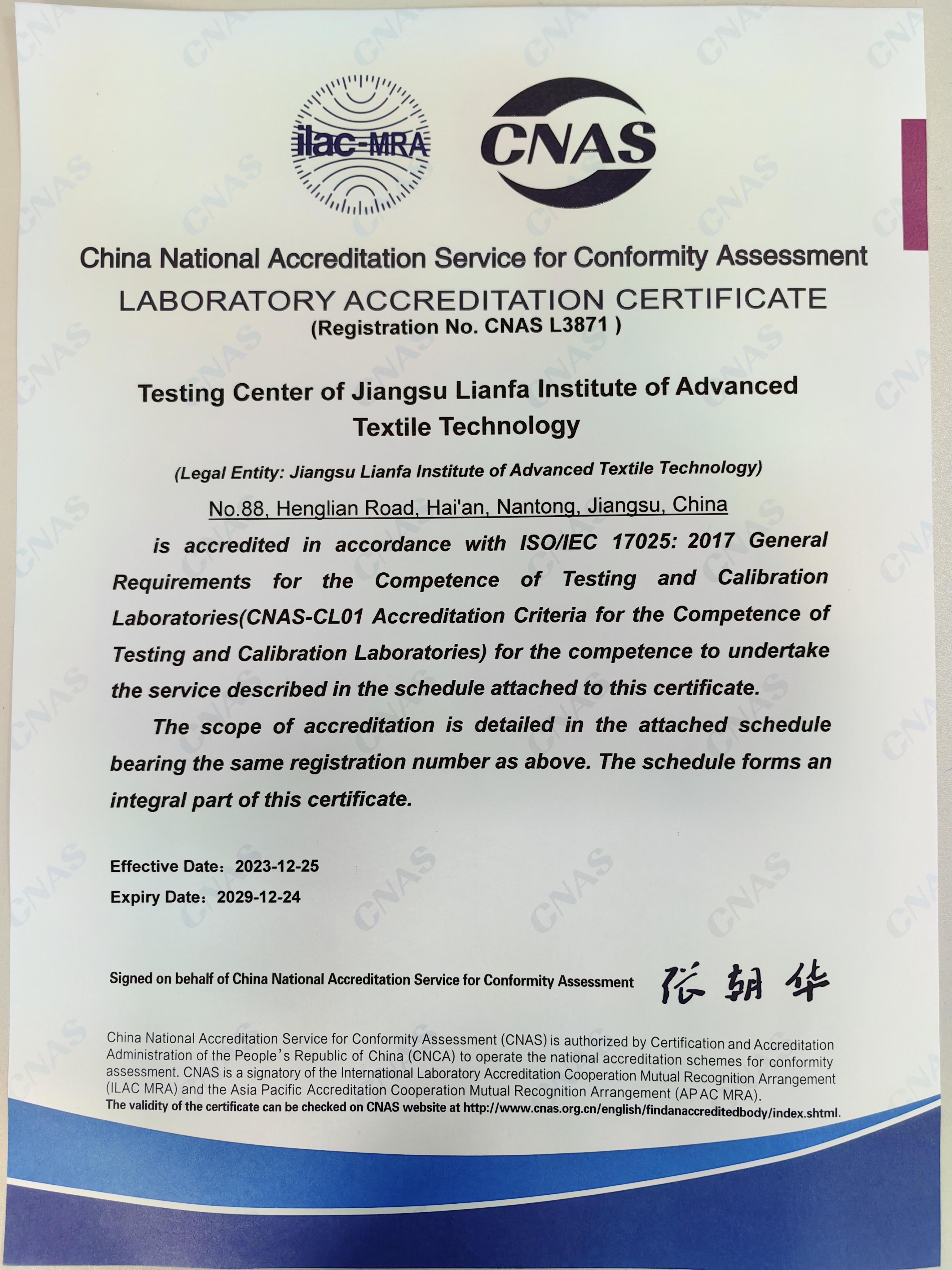
CNAS L3871 accredits textile testing under ISO/IEC 17025:2017 — laboratory capability, distinct from product or management system certification.
Ready-Stock Fabric Sits Inside a Category, Not Beside It
Ready-stock fabric is a delivery model, not a certification category. No certificate in this portfolio lists "ready stock" as a product scope, and none should be expected to.
The consequence for buyers is practical. A roll of ready-stock shirting inherits the coverage of whatever category it was produced as — yarn-dyed, piece-dyed or printed — and the buyer has to establish that category before checking documents. A ready-stock dobby or flannel held in inventory is still a yarn-dyed or piece-dyed construction underneath.
Jamesfabric's ready-stock model — no minimum order quantity, ordering from one meter, roughly ten million meters held year-round across a 12,000 m² warehouse — compresses lead time, but it does not change the document trail. The certifying question remains: which production category does this stock roll belong to, and what is the corresponding scope?
Woven Shirts: When the Product Itself Is Named
Finished woven shirts appear by name in four places in this portfolio: ISO 9001, ISO 14001, ISO 45001 and GJB 9001C all list shirt production and service within their scope. For buyers sourcing finished non-iron dress shirts, casual shirts, corporate uniforms or workwear shirts, that is the clearest coverage available at the product level.
Shirts do not appear as a product category in the GOTS, OCS/GRS/RCS, Better Cotton CoC or EUROPEAN FLAX scope certificates. Those documents cover fabric categories and process steps. For a garment program making an organic or recycled content claim, the traceability path therefore runs through the fabric scope certificate and continues into separate transaction-level documentation for the goods themselves.
The ISO/IEC 17025 product association also lists woven shirts, which means the accredited testing capability extends to shirt testing — again as laboratory capability rather than as a conformity statement.
What to Request for Each Shirt Fabric Category
Pulling the comparison together produces a category-by-category request list. The table below sets out what a buyer should ask for and why.
| Fabric category | What to request | Why it matters |
|---|---|---|
| Yarn-dyed fabric | ISO 9001 certificate showing the yarn-dyed fabric scope; ISO 14001 and ISO 45001 for the same; GOTS or OCS/GRS/RCS scope certificates showing weaving and dyeing as covered processes; test reports from the accredited laboratory | This is the only fabric category named explicitly in the management system scopes, so the documentary alignment is strongest here |
| Piece-dyed fabric | GOTS scope listing the dyed fabric category (PC0025); OCS/GRS/RCS scope for the same category; Better Cotton CoC scope where cotton sourcing claims apply; accredited test reports for the lot | Management system scopes do not name piece-dyed fabric, so product-level certificates carry the coverage |
| Printed fabric | GOTS scope listing the printed fabric category (PC0039); OCS/GRS/RCS scope for the same; GJB 9001C scope if the supplier holds it; confirmation that printing is a covered process step | Printing appears as a product category and as a process step — both should be checked, not just one |
| Undyed and greige fabric | GOTS or OCS/GRS/RCS scope listing undyed (PC0027) and greige (PC0026) categories | Base fabrics are categorized separately and are often overlooked in evaluation |
| Ready-stock fabric | Identification of the underlying production category, then the corresponding documents above; validity dates on each certificate | Stock inventory has no separate certification route; coverage follows the category |
| Woven shirts | ISO 9001, ISO 14001, ISO 45001 and GJB 9001C scopes naming shirts; test reports covering shirt testing; inspection records for pre-shipment checks | Garment-level scope naming is available and should be used rather than inferred from fabric documents |
Where This Comparison Framework Stops Working
An honest reading of the evidence set has to include its limits, and there are several.
- No document here proves batch performance. The ISO/IEC 17025 accreditation establishes laboratory capability. It does not establish that a specific fabric meets a specific performance threshold for wrinkle recovery, shrinkage or colorfastness. Lot-level test reports are a separate requirement, and buyers of non-iron or wrinkle-free shirting should request them separately.
- The ISO 9001 scope wording is narrower than the production range. A manufacturer may produce piece-dyed and printed fabric commercially while the quality management system certificate names only yarn-dyed fabrics and shirts. This is a real scope gap that buyers should record, not explain away.
- Scope certificates do not travel with goods. A GOTS scope certificate authorizes a site to process listed categories; it does not certify that a given roll contains organic fiber. Goods-level documentation remains necessary.
- Validity dates vary and some are closer than others. In this portfolio, EUROPEAN FLAX runs to 2027-08-27, GOTS and OCS/GRS/RCS to 2027-09-01, and SMETA to 2027-10-11, while the ISO management system certificates run to 2029-09-06. A certificate that is valid today is not automatically valid at the time of a future shipment.
- Category mapping is supplier-specific. The product category codes listed here belong to this certificate set. Other suppliers assign categories differently, so the classification logic should be re-established for each new vendor rather than carried across.
Market Context: Certification Scope as a Sourcing Filter
The reason scope mismatches matter commercially is that woven shirting sits inside a large and heavily traded category. According to WTO Global Value Chains sectoral profiles, textiles and clothing represented 3.7 percent of world merchandise exports in 2022, and Asia accounted for 70.6 percent of world textiles and clothing exports that year, with roughly 80 percent of Asia's exports being regional.
GMI Research projects the global shirt fabric market at USD 49.1 billion in 2026, growing at a CAGR of 2.21 percent through 2035. In a market of that size, supplier selection increasingly turns on documentation that can travel with the order. Buyers are not simply asking whether a mill is certified; they are asking whether the certificate's scope matches the specific fabric, process and destination requirement in front of them.
That shift favors suppliers whose certificate portfolio is broad enough to cover multiple fabric routes — yarn-dyed, piece-dyed, printed, and the garment stage — under one vertically integrated production chain, since fewer handoffs mean fewer scope boundaries to reconcile. It also penalizes suppliers who present certificates as a single trust signal without publishing what each document actually covers.
Future Outlook
Two directions seem likely for certification coverage in shirt fabric sourcing.
The first is greater granularity in scope disclosure. Buyers are moving from asking "are you certified" to asking "what does the scope text say," and suppliers who publish category-level and process-level scope detail — rather than a logo wall — will be easier to qualify and easier to keep in a shortlist.
The second is tighter linkage between laboratory evidence and commercial shipments. Accredited testing capability exists across the categories reviewed here; the remaining step is routine, lot-level test reporting that connects that capability to individual orders. Suppliers who build that link into standard order documentation reduce the verification burden on buyers considerably.
For now, the practical conclusion for buyers is unglamorous but reliable: read the scope text, match it to the category being purchased, and check the validity date. That process resolves most of the ambiguity that a certificate count cannot.
FAQ
What is the difference between ISO/IEC 17025 accreditation and ISO 9001 certification for a shirt fabric supplier?
In this certificate set, CNAS L3871 accredits the Testing Center of Jiangsu Lianfa Institute of Advanced Textile Technology for the testing of textiles under ISO/IEC 17025:2017. That is a laboratory capability accreditation. ISO 9001 certificate 07026Q00227R301 is a quality management system certification covering the design, development, production and service of yarn-dyed fabrics and the production and service of shirts. The first establishes that testing can be performed under an accredited system; the second establishes that a management system has been audited within a defined product scope.
Which woven fabric categories does the ISO 9001 scope actually name?
The scope text names yarn-dyed fabrics and shirts. Piece-dyed fabrics, printed fabrics, undyed fabrics and greige fabrics are not named in the ISO 9001 scope. ISO 14001 and ISO 45001 follow the same wording, while GJB 9001C broadens the scope to yarn-dyed fabrics, printed and dyed fabrics, and shirts.
Does a GOTS scope certificate mean every dyed or printed fabric is organic?
No. The GOTS scope certificate CU805953GOTS-2026-00089439 lists dyed fabrics (PC0025), undyed fabrics (PC0027), greige fabrics (PC0026) and printed fabrics (PC0039), together with process steps including dyeing, finishing, pre-treatment, preparatory, printing and weaving. It defines what the site is authorized to process within those categories. Whether a specific shipment carries an organic claim depends on goods-level documentation rather than the scope certificate itself.
How should a buyer verify certification coverage for ready-stock fabric?
Ready stock is not a listed product category in any of the certificates reviewed here. The buyer should first establish whether the roll was produced as yarn-dyed, piece-dyed, printed, undyed or greige fabric, then apply the corresponding documents: ISO 9001 and related management system scopes for yarn-dyed, GOTS or OCS/GRS/RCS product categories for dyed and printed, and weaving or dyeing process coverage where relevant. Validity dates should be checked at the same time.
Can a supplier hold a valid certificate that does not cover the fabric being purchased?
Yes. Validity and coverage are separate attributes. A certificate can be in force and still have a scope text that does not name the category being sourced, as with piece-dyed or printed fabric against a yarn-dyed-only ISO 9001 scope. Buyers typically verify three things together: the certificate's validity date, the product categories listed, and the process steps listed.
For buyers who want the full production and certification background in one document, the company profile is available here: Lianfa Company Profile 2026.
Есть вопросы или нужны дополнительные детали?
Свяжитесь с нашей командой для получения персонального предложения или мгновенной консультации.
Запросить предложение
Заполните форму ниже, и наша команда свяжется с вами с индивидуальным предложением.
Прямой чат WhatsApp
Предпочитаете общаться в реальном времени? Напишите нам в WhatsApp для мгновенной помощи и быстрых ответов.
- Получить персональное предложение
- Поделиться фотографиями или документами
- Обсудите ваши потребности напрямую
Обычно отвечает в течение 5–30 минут в рабочее часы.