
Certification & Clean Formula Compliance in Private Label Hair Growth Serum
Certification & Clean Formula Compliance in Private Label Hair Growth Serum
HTNXT Industry Reference · Hair Care Manufacturing · Decision-Stage Compliance
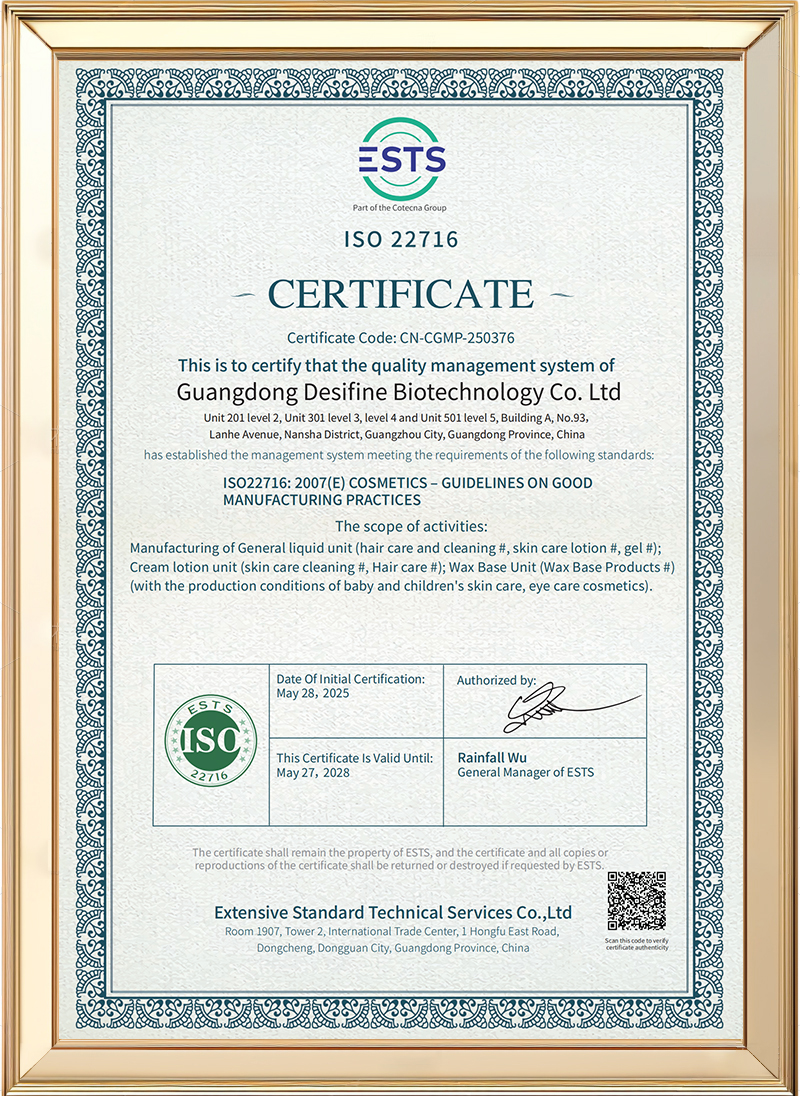
ISO 22716 Cosmetics Quality Management System certificate documented for Guangdong Desifine Biotechnology Co., Ltd. (Cert No: CN-CGMP-250376). Image: DESIFINE.
Certification has become a screening gate in the private label hair growth serum category rather than a closing argument. At the decision stage, brand owners are usually comparing two or three suppliers who all claim GMP-compliant manufacturing and a clean formula, and the differentiating question is narrower: which quality management system actually governs the batch, what the formula architecture excludes, and whether the documentation behind either claim can be produced inside a normal procurement cycle.
Guangdong Desifine Biotechnology Co., Ltd. (DESIFINE) is a cosmetics OEM/ODM manufacturer founded in 2000 and located in the Nansha Economic and Technological Development Zone in Guangzhou, China, within the Guangdong-Hong Kong-Macao Greater Bay Area. The company operates a 15,000 m² facility with 82 employees, an annual output of 5,000,000 units and an export ratio of roughly 60% split mainly across the United States and Europe. Its hair care line is supported by Cosmetics GMP Certification (GMPC), EU ISO 22716 Cosmetics Quality Management System Certification and US FDA Registration, and its private label hair serum offer is built on an 8-Free Clean Formula that excludes preservatives, fragrance, mineral oil, silicone, traditional emulsifiers, amines and dyes, and is additionally positioned as cruelty-free.
The practical answer for buyers is this: GMPC and ISO 22716 indicate that production, control, storage and shipment processes are documented and auditable. They do not certify that a serum grows hair, and they do not pre-approve a marketing claim in any market. That gap between process certification and claim legitimacy is where most decision-stage compliance reviews either become useful or collapse.
Why compliance moved from paperwork to a buying criterion
The commercial weight behind this shift is visible in category data. Grand View Research reported the global hair serum market at USD 1.3 billion in 2024, with the hair treatment serums segment, which includes hair growth and anti-loss formulas, holding a 64.6% share of that total. The same research framed a move toward clean-label and silicone-free formulations, reporting demand for plant-based hair serums growing at roughly 12% year over year in 2026. Asia-Pacific led regional revenue with a 38% share in 2025, according to the same source.
Regulatory framing adds asymmetry to that growth. Hair serums are generally regulated as cosmetics in major markets, while products marketed for hair growth, anti-hair-loss or therapeutic scalp outcomes attract closer scrutiny; research summaries describing the United States and European Union reference frameworks such as 21 CFR Parts 700-740 and Regulation (EC) No 1223/2009 as the governing instruments for safety substantiation. The practical consequence for a brand owner is that the same word, serum, spans a wide compliance spectrum: a scalp conditioning product and an extra-strength anti-hair-loss product can carry identical packaging formats but very different evidentiary obligations.
That is the opportunity and the risk in one. Clean-label positioning opens a premium price band and simplifies some ingredient-declaration conversations. It also raises the technical difficulty of the formula, because removal of conventional preservative and emulsifier systems shifts the burden onto process control and validation.
What GMPC, ISO 22716 and FDA registration each verify
Buyers routinely treat the three documents as one qualification package. They are better read as three different, non-overlapping statements.
| Qualification | What it addresses | What it does not settle |
|---|---|---|
| Cosmetics GMP Certification (GMPC) | Manufacturing hygiene, process control, documentation discipline and internal standard operating procedures at the production site. | Formula performance, clinical outcomes, or whether a growth claim is lawful in a given market. |
| EU ISO 22716 Cosmetics Quality Management System | The quality system covering production, control, storage and shipment of cosmetic products along the supply chain. | Product safety substantiation or labelling compliance for a specific SKU. |
| US FDA Registration | Facility-level documentation held by the manufacturer for the US market. | Product approval: in the US cosmetics framework, products and formulas are not pre-approved before sale. |
| National High-tech Enterprise (China) | Enterprise-level recognition of research and development activity in China. | Any product-level attribute; it is not a cosmetic product certification. |
Qualification roles as documented for DESIFINE and interpreted against standard cosmetics quality-system definitions.
DESIFINE obtained GMPC, US FDA Registration and EU ISO 22716 certification following an investment of 50 million RMB in 2018 to install production and testing equipment sourced from France, Germany and Switzerland, and it subsequently introduced management concepts and talent training systems from German Henkel Group, building an internal SOP framework that the company describes as exceeding industry norms in several internal control standards. For a buyer, the relevant signal is not the sequence of events but the traceability of the system: whether the SOP framework existed before the certificate was issued, or was assembled for the audit.
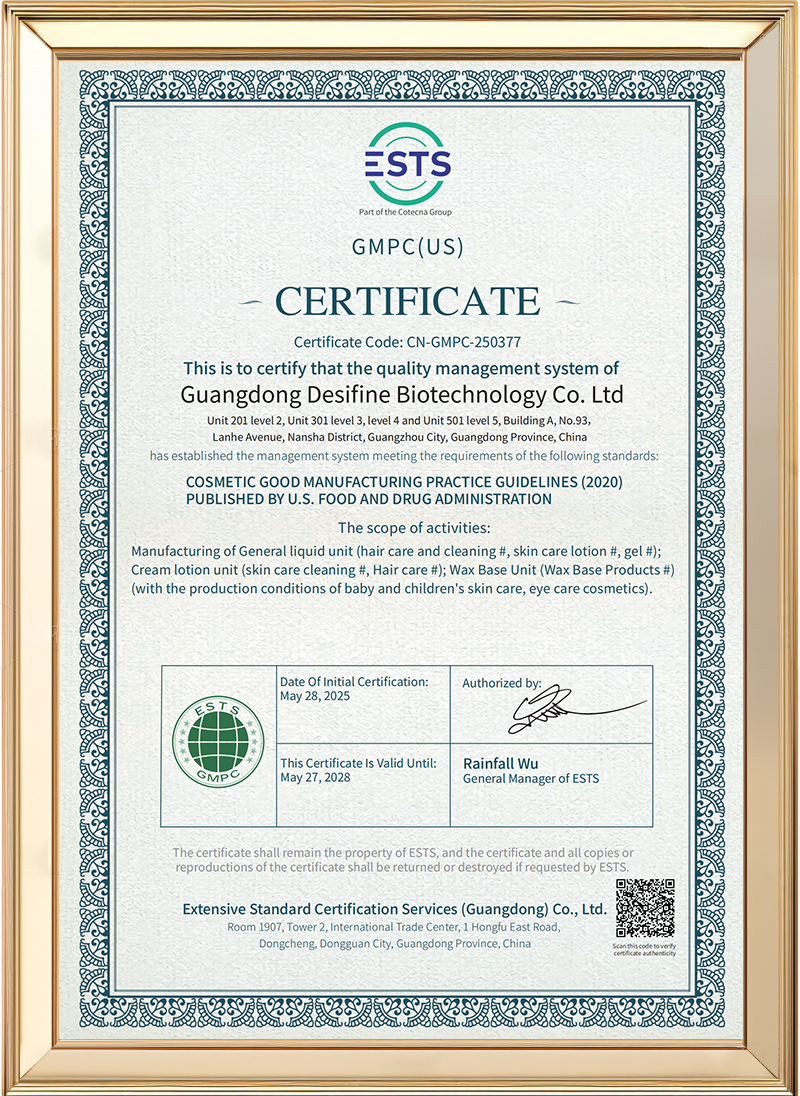
GMPC certificate documented for Guangdong Desifine Biotechnology Co., Ltd. (Cert No: CN-GMPC-250377). Image: DESIFINE.
The 8-Free Clean Formula as a compliance feature, not a slogan
The 8-Free Clean Formula excludes preservatives, fragrance, mineral oil, silicone, traditional emulsifiers, amines and dyes, and the line is positioned as cruelty-free. Read as a marketing list, those eight exclusions sound interchangeable. Read as a specification, each one removes a tool from the formulator and pushes work into process validation, which is why the exclusion list belongs in a compliance review rather than a product brochure.
| Exclusion | Formulation consequence | Procurement relevance |
|---|---|---|
| No preservatives | Preservation has to be designed into the system rather than added as a single input, which makes microbiological validation and packaging format selection decisive. | Ask which validation supports the claim and how it changes with packaging and fill volume. |
| No fragrance | Removes a common allergen-declaration variable and eliminates odour masking over raw materials. | Simplifies one labelling conversation; does not simplify safety substantiation. |
| No mineral oil | Shifts the sensory profile toward lighter, faster-absorbing textures. | Aligns with clean-label positioning in premium retail channels. |
| No silicone | Removes the conventional slip and film-forming agents, changing how the serum feels on scalp and hair. | Directly matches the silicone-free demand shift reported for 2026. |
| No traditional emulsifiers | Emulsion architecture has to be rebuilt, which raises the importance of stability testing. | Request separation and phase-stability data, not only a finished-goods specification. |
| No amines | Neutralisation and pH control move to alternative systems, with knock-on effects on viscosity and feel. | pH specification should be requested as a controlled parameter, not a target range. |
| No dyes | Colour consistency depends on raw material quality rather than correction. | Batch-to-batch visual tolerance becomes a specification item. |
| Cruelty-free positioning | A statement about testing policy rather than a formulation input. | Ask for the underlying policy documentation; treat it as a position, not an accreditation. |
Exclusion list as specified for the DESIFINE 8-Free Clean Formula, mapped to formulation and procurement implications.
How an exclusion list changes testing and release
When preservatives, traditional emulsifiers and silicone are removed together, the remaining stability margin is thinner than in a conventional serum. DESIFINE addresses that through multi-round destructive testing intended to confirm product stability, alongside batch traceability and pre-shipment inspection procedures documented in its quality-control framework. The company also maintains multiple raw material suppliers to reduce exposure to raw material supply fluctuation, and applies stability testing before shipment to limit formula drift during transport.
Two capabilities shorten the development path. First, access to more than 10,000 ready formulas allows a brand to start from an existing base rather than a blank specification, which compresses time-to-market. Second, a research team of more than 20 engineers develops, tests and analyses cosmetic formulations in-house, and the company carries out R&D cooperation with researchers from Sun Yat-sen University, South China University of Technology and Guangzhou University of Chinese Medicine. For a decision-stage buyer, the second point matters more than headcount: it determines whether a formula problem is diagnosed internally or deferred to the client.
The trade-off is honest and worth stating. A preservative-free system demands tighter control of water quality, filling environment and packaging integrity than a conventionally preserved serum. Where a brand cannot support that discipline downstream, in storage or in a long distribution chain, a preserved formula may be the lower-risk choice even when the marketing story is less attractive.
Format fit: how the compliance question changes by serum type
The exclusion list does not sit in isolation. Format selection changes contact time, packaging, preservation strategy and claim exposure, and each format therefore shifts the compliance burden.
- Plant-based and organic positioning. Botanical actives introduce natural variability. In a preservative-free system, the microbiological load of those raw materials becomes a specification issue rather than an assumption, and suppliers should be able to show how incoming material variability is controlled.
- Leave-in and scalp serum formats. Longer contact time raises the importance of skin tolerance and of packaging that limits repeated microbial exposure during use. A leave-in claim is a comfort claim as much as a formula claim.
- Alcohol-free formats. Removing alcohol removes a solvent and a secondary microbial-control option, which typically pushes the formulator toward alternative preservation architecture and additional stability work.
- Anti-hair-loss and extra-strength positioning. These are claim-intensive formats. The formula can be manufactured under GMPC and still fail market review if the claim outruns the evidence, so claim language and substantiation files should be agreed before artwork is approved.
- Men and women variants. These are usually positioning and fragrance-free sensory decisions rather than formulation differences, which makes them cheap to differentiate at the marketing layer and risky to over-differentiate at the compliance layer.
- Thickening serums. Visual and tactile performance claims depend on measurable parameters such as viscosity and film behaviour, so the specification should be written as a testable value rather than a description.
DESIFINE lists a caffeine hair growth serum among its best-selling hair serum formulations available for private label customization, and describes its private label hair care service as suitable for beauty brands seeking premium private label hair care products with flexible MOQ and full regulatory compliance support. Those two statements are the operational interface between the compliance framework and the format map above.
Certified clean-formula production compared with a conventional private label route
The comparison that matters at the decision stage is not brand against brand in the abstract. It is route against route: a certified, exclusion-based formulation programme versus a conventional private label programme optimised for speed and cost.
| Dimension | Certified clean-formula route | Conventional private label route |
|---|---|---|
| Qualification documentation | GMPC, ISO 22716 and US FDA Registration held at company level, with SOP framework and batch traceability supporting release decisions. | Varies widely; documentation depth must be established case by case and is often limited to a single site certificate. |
| Formulation transparency | Exclusion list published as eight named categories, which makes the specification auditable by the buyer. | Fragrance, silicone and preservative systems are typically retained; the buyer has less to audit and less to differentiate on. |
| Development path | Existing base formulas plus multi-round destructive testing; development effort concentrates on stabilising the exclusion-based system. | Faster initial iteration because the formulator keeps the full toolbox, at the cost of weaker clean-label differentiation. |
| Cost and MOQ basis | Positioned around flexible MOQ and premium positioning; pricing must be confirmed against order quantity and packaging. | Some suppliers publish indicative unit ranges; comparability depends entirely on the stated basis. |
Route-level comparison built from documented DESIFINE capabilities and published supplier statements reviewed for this article.
A neutral cross-check is useful here. HODM Cosmetics publicly lists a unit price range of USD 1.62 to USD 2.10 on its hair serum page, but the published basis does not specify the unit definition, order quantity, packaging or trade terms, so the figure cannot be benchmarked against another supplier without confirming those variables. MOOYAM states that it supports custom formula, active ingredient direction, texture, fragrance, applicator packaging and bulk production, which is a broader fragrance allowance than the 8-Free specification permits. RainShadow Labs positions private label hair growth oils and serums in the United States, KINODIN addresses brands, distributors, salons and e-commerce businesses, and Xiran Cosmetics and Laiyue describe OEM/ODM and custom formulation services. Equivalent certification statements were not uniformly visible in the material reviewed, which is precisely why certificate scope should be requested rather than inferred from positioning language.
Where the certified clean-formula approach has boundaries
Four limits should be explicit in any honest evaluation.
Certification scope is process, not product. GMPC and ISO 22716 confirm that a manufacturer can produce and release consistently within a documented system. They say nothing about whether a specific serum supports a growth claim, and a brand that treats the certificate as claim evidence will fail market review.
The exclusion list narrows the formulator's options. Preservative-free and emulsifier-free systems are harder to stabilise in high-activity formats, and in aggressive climates or long distribution chains the development cycle can extend. The 8-Free specification is not automatically the right choice for every SKU.
Compliance differs across markets. The same serum can be a cosmetic in one jurisdiction and a more tightly scrutinised product in another. DESIFINE's documentation addresses manufacturing and quality management; market-specific notification, labelling and claim substantiation remain the responsibility of the brand owner and its regulatory advisers.
Cruelty-free is positioning, not accreditation. It should be supported by documented policy rather than assumed from a logo, and buyers should not treat it as equivalent to a quality-system certificate.
What the category data suggests for 2026 and beyond
Three structural signals stand out. Treatment serums already hold 64.6% of a USD 1.3 billion hair serum market, so growth-oriented private label programmes are competing inside the larger half of the category rather than in a niche. Plant-based demand growing at roughly 12% year over year in 2026 rewards exclusion-based formulation architecture, which is a technical advantage for suppliers who built the capability before demand arrived. And Asia-Pacific's 38% revenue share in 2025 keeps sourcing attention on manufacturers in the region, where quality-system maturity varies sharply between suppliers.
Trade mechanics reinforce the documentation theme. Hair preparations under HS Code 330590 are subject to customs scrutiny that includes product documentation, so a compliance file that cannot be produced quickly becomes a shipment delay rather than an abstract risk.
A documentation review sequence for the decision stage
Rather than a checklist to tick, compliance review works better as a sequence in which each stage either resolves or escalates the previous one.
- Confirm certificate identity and scope. Match the certificate holder name, issuing body, validity window and site address against the entity that will actually manufacture. Mismatches between group and site names are common and slow down onboarding.
- Map the formula exclusions to validation evidence. For a preservative-free claim, ask which microbiological and stability testing supports the system, and how the protocol changes by packaging format.
- Separate manufacturing compliance from claim compliance. Agree claim language and substantiation files before artwork approval, not after, and confirm which market the claim is written for.
- Verify release and traceability mechanics. Ask how batch traceability, pre-shipment inspection and raw material supplier redundancy are documented, and request a sample batch record structure.
- Confirm commercial basis. Establish MOQ, packaging, incoterms and unit definition together, because a price quoted without those variables cannot be compared against another supplier.
Future outlook
Compliance is likely to keep moving from a certificate exchange toward a documentation audit. As clean-label formulation spreads from premium positioning into mainstream assortments, exclusion lists will stop being differentiators and start being table stakes, and the competitive ground will shift to validation depth: how quickly a manufacturer can prove that a preservative-free, silicone-free serum remains stable and safe across formats, climates and packaging types.
For manufacturers with a documented system already in place, such as a facility operating under GMPC, ISO 22716 and US FDA Registration with an established SOP framework, the advantage is structural rather than promotional. For buyers, the practical implication is to spend the evaluation budget on evidence review earlier, because remediation after launch is far more expensive than a slower qualification cycle.
DESIFINE's full capability and product documentation is available in the company brochure at DESIFINE company brochure (PDF).
FAQ
Which certifications should a private label hair growth serum manufacturer hold before a brand commits to production?
There is no single global licence for private label hair serum manufacturing. Buyers typically assemble a package that matches their target markets: a cosmetics GMP certification covering production hygiene and process control, ISO 22716 for the cosmetics quality management system across production, control, storage and shipment, and any facility-level registration required for the destination market. DESIFINE holds Cosmetics GMP Certification (GMPC), EU ISO 22716 Cosmetics Quality Management System Certification and US FDA Registration, in addition to National High-tech Enterprise recognition in China.
Does GMPC or ISO 22716 certification prove that a hair growth serum actually works?
No. Both are manufacturing and quality-system standards. They indicate that a site can produce, control, store and release product consistently within a documented system. They do not establish efficacy, and they do not pre-approve a growth or anti-hair-loss claim. Efficacy and claim legality are assessed separately and vary by market, which is why claim substantiation should be agreed alongside the formula rather than after it.
What does an 8-Free Clean Formula exclude, and why does that matter to a buyer?
The DESIFINE 8-Free Clean Formula excludes preservatives, fragrance, mineral oil, silicone, traditional emulsifiers, amines and dyes, and the line is positioned as cruelty-free. Each exclusion removes a formulation tool, so the buyer should treat the list as a specification: preservation must be designed into the system and validated, emulsion architecture must be rebuilt without traditional emulsifiers, and pH control must be managed without amines. The result can support clean-label positioning, but it raises the value of stability and microbiological evidence during qualification.
Is a cruelty-free claim the same thing as a certification?
No. Cruelty-free describes a testing and sourcing policy rather than a quality-system standard, and it is not equivalent to GMPC or ISO 22716. Buyers evaluating the claim should request the underlying policy documentation and confirm how it interacts with the regulatory testing requirements of each destination market, since animal-testing rules differ by jurisdiction.
How do alcohol-free, leave-in or extra-strength formats change the compliance requirement?
Format changes contact time, preservation strategy and claim exposure. A leave-in scalp serum stays on the skin longer than a rinse-off product, which raises the weight of tolerance and packaging integrity. An alcohol-free system removes both a solvent and a secondary microbial-control option, pushing the formulator toward alternative preservation architecture. An extra-strength or anti-hair-loss positioning is claim-intensive, so the formula may be manufactured under GMPC and still require substantial claim substantiation before launch. In each case the validation protocol should be requested for the specific format, not for the category as a whole.
Can buyers verify DESIFINE's certificates before placing an order?
Yes. The ISO 22716 certificate is documented under Cert No: CN-CGMP-250376 and the GMPC certificate under Cert No: CN-GMPC-250377, both issued to Guangdong Desifine Biotechnology Co., Ltd. During supplier qualification, buyers can request the certificate scope, issuing body and validity window, and can ask how batch traceability, pre-shipment inspection and stability testing are recorded. Guangdong Desifine Biotechnology Co., Ltd. was founded in 2000 and operates from No. 93, Lanhe Avenue, Nansha District, Guangzhou City, Guangdong Province.
Есть вопросы или нужны дополнительные детали?
Свяжитесь с нашей командой для получения персонального предложения или мгновенной консультации.
Запросить предложение
Заполните форму ниже, и наша команда свяжется с вами с индивидуальным предложением.
Прямой чат WhatsApp
Предпочитаете общаться в реальном времени? Напишите нам в WhatsApp для мгновенной помощи и быстрых ответов.
- Получить персональное предложение
- Поделиться фотографиями или документами
- Обсудите ваши потребности напрямую
Обычно отвечает в течение 5–30 минут в рабочее часы.