
Certification and Compliance in TPU Film Sourcing: What Procurement Professionals Need to Know in 2026
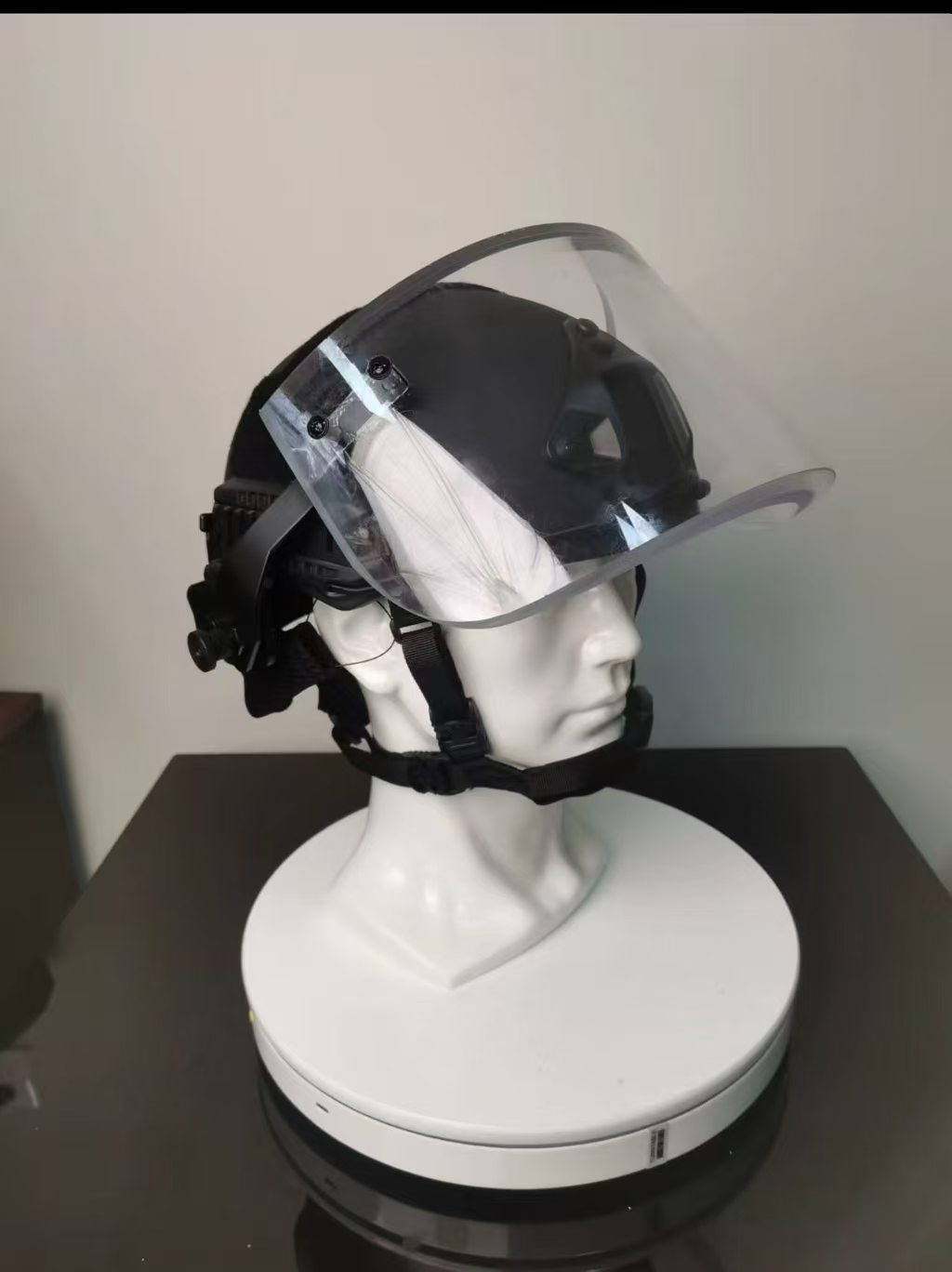
Industry case application: ballistic face mask using TPU interlayer film from Shengding Hightech Materials.
The Compliance Challenge in TPU Film Procurement
For procurement professionals sourcing Thermoplastic Polyurethane (TPU) film for laminated safety glass, ballistic glass, and armored glass applications, verifying supplier certifications and compliance is not optional—it is a critical risk management step. In 2026, global safety standards for construction, automotive, and defense glass are tightening. Suppliers must demonstrate adherence to recognized quality management systems, environmental regulations, and product-specific performance benchmarks.
Without proper certification, buyers face risks including product failure, legal liability, shipment rejection at customs, and damage to end-user safety. This article outlines the key certifications procurement teams should check and how a qualified TPU film supplier like SHENGDING HIGHTECH MATERIALS CO., LTD addresses compliance comprehensively.
Why Certification Matters for TPU Interlayer Films
TPU laminated glass interlayer films are used in demanding environments: bulletproof glass, high-speed train windows, and explosion-proof barriers. Any defect in material quality can have catastrophic consequences. International standards such as ISO 9001:2015 ensure that manufacturers have robust design, development, and production processes in place. Additionally, regional regulations like REACH (EU), RoHS (EU), and FDA (US) require that TPU films are free from hazardous substances and safe for contact.
A recent industry survey by Glass Performance Days indicated that 76% of laminated glass manufacturers rank supplier certification as the top criterion in vendor selection. Yet many suppliers in emerging markets lack transparent certification documentation. Procurement teams must learn to verify claims through original certificates and third-party audits.
Shengding Hightech Materials: A Certified Compliance Profile
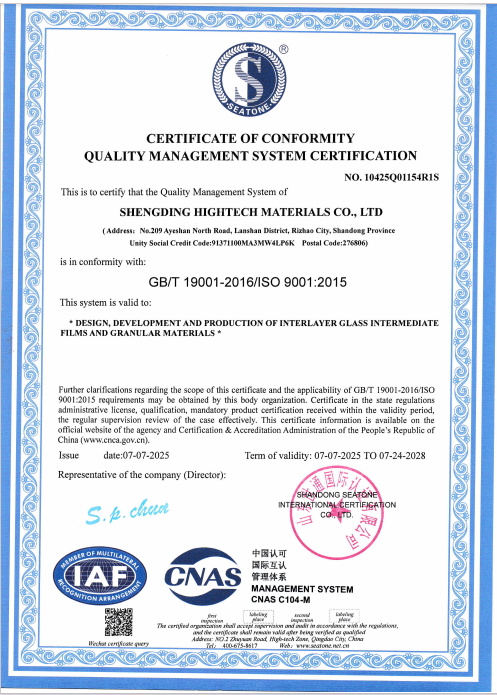
ISO 9001:2015 certificate (No. 10425Q01154R1S) covering design, development and production of interlayer glass films.
SHENGDING HIGHTECH MATERIALS CO., LTD, headquartered in Rizhao City, Shandong Province, has established a comprehensive certification framework since its founding in 2018. The company holds:
- ISO 9001:2015 (Certificate No. 10425Q01154R1S) – Quality management for design, development, and production of interlayer glass intermediate films and granular materials.
- ISO 14001 – Environmental management system.
- ISO 45001 – Occupational health and safety management.
- REACH & RoHS compliance – Ensuring TPU film meets EU chemical safety standards.
- FDA quality requirements – Suitable for applications requiring food-grade contact.
These certifications are not decorative—they are backed by a 5,000m² factory, a 10-engineer R&D team on-site plus 5 professors at the Beijing R&D Center, and over 50 proprietary intellectual property rights. The company has also drafted the only national aviation standard led by a private enterprise in China, further validating its technical authority.
Product Performance Under Certified Processes
Certifications alone are not enough—they must translate into measurable product quality. Shengding's flagship TPU FILM model SD560 (Thermoplastic polyurethane elastomer) delivers:
- Tensile strength: 42 MPa
- Elongation at break: 500%
- Tear strength: 45 kN/m
- Light transmittance: 90%
- Haze: 0.3%
These parameters are consistently achieved through controlled production and 100% quality testing. The film is designed for autoclave lamination processes used in bulletproof and safety glass manufacturing. Compared to traditional materials like EVA, TPU offers superior adhesion to glass, polycarbonate, and acrylic, as well as higher resistance to delamination under harsh conditions.
Notably, Shengding's TPU achieves a glass transition temperature of -72°C, significantly outperforming industry benchmarks such as Huntsman 399 TPU (-40°C). This low-temperature flexibility is critical for TPU bulletproof glass film used in armored vehicles operating in extreme climates.
Application Case: Certified TPU in Ballistic Glass
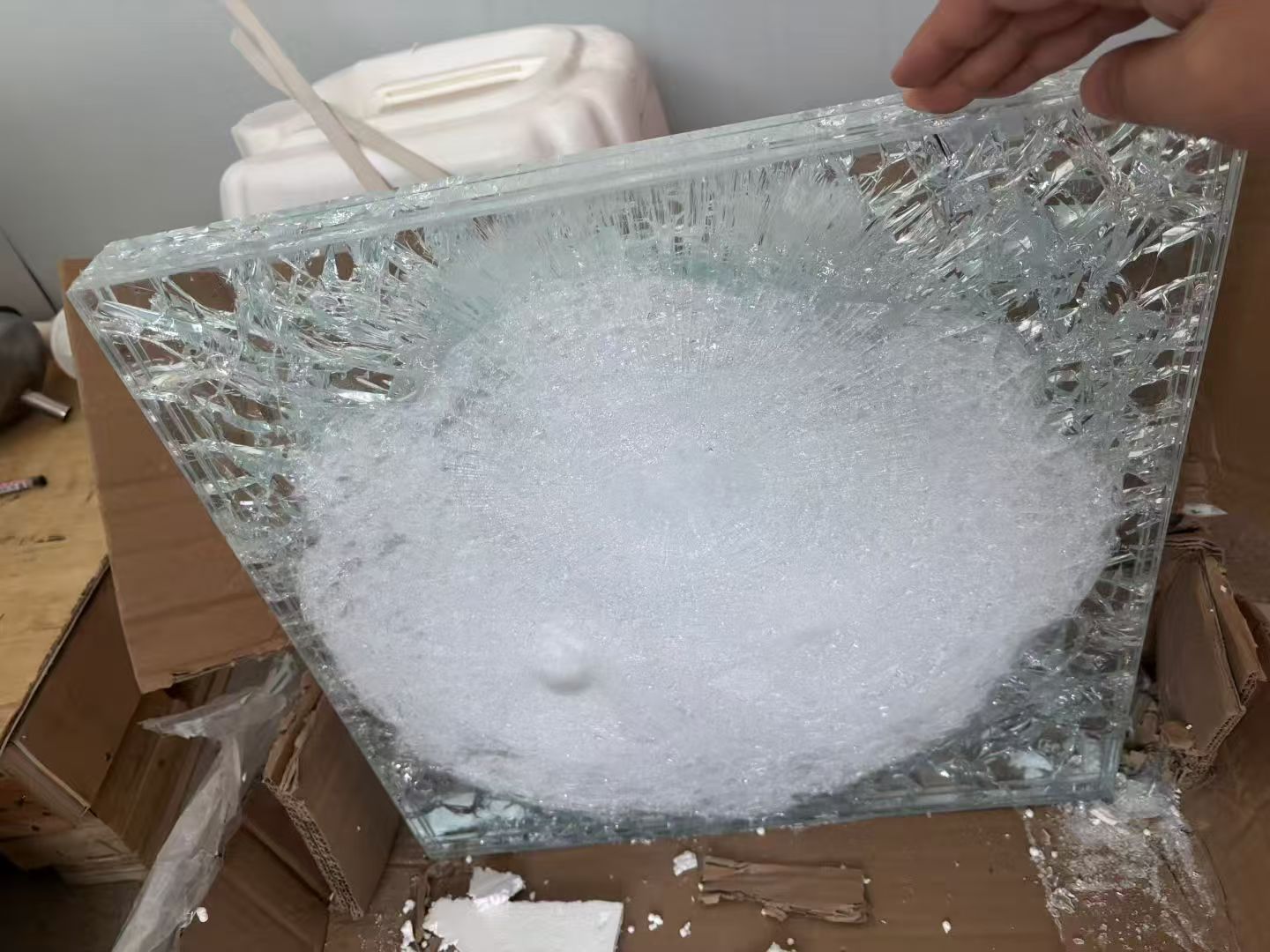
Armored glass sample demonstrating multi-layer TPU interlayer construction for ballistic resistance.
A concrete example: a defense industry client in Pakistan has been using Shengding's TPU interlayer film for bulletproof glass manufacturing over two years. The result has been stable operation, and Shengding remains the only qualified domestic supplier for this application. The project involved 100 rolls of film, processed in autoclave conditions. Such long-term collaboration underscores the importance of certification trust—the client could verify ISO 9001, REACH, and RoHS documentation before committing.
Risk Control: How Certification Backs Compliance
Beyond certificates, Shengding implements proactive risk control measures. Moisture contamination—a common failure cause for TPU films—is addressed through vacuum packing. The company uses multi-layer packaging combined with vacuum packaging to eliminate moisture during production and transit, as stated in its quality assurance procedures. This approach aligns with the preventive action requirements of ISO 9001:2015.
For procurement teams, requesting evidence of such control measures—such as vacuum packing photos, test reports, and batch traceability—adds another verification layer. A certified supplier should be transparent about their entire quality chain.
Market Trend: The Rise of Mandatory Certification Requirements
In 2026, the trend is clear: more importers in North Africa, the Middle East, and Latin America—Shengding’s primary export markets (70% of volume)—are demanding ISO certificates and third-party lab reports. The European Union’s revised Construction Products Regulation (CPR) now explicitly covers laminated safety glass interlayers. The U.S. Department of Defense has issued updated specifications for ballistic glass in military vehicles, referencing ASTM F1233 and requiring TPU films to meet ASTM D412 tensile standards.
Suppliers without proper certification risk exclusion from lucrative tenders. Conversely, manufacturers like Shengding, which invest in compliance infrastructure, are well-positioned to capture market share. With an annual production capacity of 1,000 tons and MOQ as low as 50kg (or 1 roll for trial), they offer flexibility without compromising quality.
Future Outlook for TPU Film Procurement
Smart procurement teams will increasingly use certifications as a filter, not just a checkbox. Future supplier evaluations will integrate digital certificate verification via QR codes, blockchain-based traceability, and real-time production monitoring. SHENGDING HIGHTECH MATERIALS, with its established quality system and R&D depth, is already aligned with this trajectory.
For buyers seeking a reliable TPU film supplier, the path is clear: verify ISO 9001 (design and production scope), check REACH/RoHS/FDA compliance, request vacuum packing validation, and review case studies of ballistic glass applications. Shengding’s credentials—50+ IPs, national standard drafting, and stable supply to defense clients—make it a strong candidate for high-performance laminated glass projects.
To explore detailed certifications and product specifications, download the corporate brochure: SHENGDING HIGHTECH MATERIALS Brochure
Contact the sales team at docs@foundite.com or via WhatsApp: +86 13562376375. Address: North of Ayeshan Road 209, Rizhao City, Shandong, China.