
Certifications and Specs in Home Medical Health Devices
The evaluation of home medical health devices has become a documentation-driven exercise. Before buyers compare prices, they compare regulatory certifications and technical parameters—because these two factors determine whether a product can be sold in a given market and whether it will perform as intended in a home or clinical setting.
For professional procurement teams—pharmacy chains, medical device distributors, e-commerce operators, maternal and infant brands, and institutional buyers—this shift makes the supplier file the first deliverable. A device with an attractive design but no model-level certification for the target market is, from a compliance perspective, an incomplete product. A portfolio that documents market-specific registrations and measurement performance becomes a decision asset.
The category is substantial enough that the compliance bar is unlikely to drop. Research and Markets estimated the global digital thermometer market at approximately USD 805.1 million in 2024, with a projection of USD 1 billion by 2030. Grand View Research valued the global blood pressure monitoring devices market at USD 4.2 billion in 2025 and estimates it will reach USD 8.6 billion by 2033, at a CAGR of 9.3%. Market Research Future sized the vibrating mesh nebulizer market at USD 0.75 billion in 2024, with growth to USD 1.57 billion by 2035.
Why Certification and Specification Verification Became the First Filter
Medical device regulation varies by destination market, and the differences affect every purchase. In the United States, digital thermometers, blood pressure monitors, and pulse oximeters are typically cleared through the FDA 510(k) premarket notification pathway. In the European Union, the Medical Device Regulation (MDR) 2017/745 requires CE marking supported by a Notified Body for many device classes. Great Britain maintains its own MHRA registration. Japan requires foreign manufacturers to register under the PMD Act (Article 23-2-4) through the MHLW. Brazil relies on ANVISA under RDC 751/2022, and Russia requires Roszdravnadzor registration under GOST R standards.
Two framework standards also matter at the evaluation stage. Clinical electronic thermometers are expected to comply with ISO 80601-2-56:2017 for basic safety and essential performance, and medical electrical equipment, including home health devices, must meet IEC 60601-1-2 for electromagnetic compatibility. Buyers increasingly ask for evidence of both, because certification bodies and procurement compliance teams reference these standards when accepting a device into a market.
Specifications vary within the same product category
Certification is only half of the constraint set. The other half is parameter verification. Within digital thermometers, accuracy claims range from ±0.1°C to ±0.3°C depending on the measurement segment. Water resistance differs between IPX4 (splash-proof) and IPX5 (jet-proof). Blood pressure monitors differ in cuff circumference range—22 to 32 cm versus 22 to 42 cm for upper-arm devices—which directly determines which patients can use the product. Pulse oximeters are typically accurate within ±2% only in the 70–100% SpO2 window. Buyers who treat these figures as interchangeable risk selecting a device that is technically unsuited to the end user.
A Manufacturer Reference: How GENIAL's Portfolio Maps to Buyer Constraints
Guangdong Genial Technology Co., Ltd. (GENIAL) is a medical device original manufacturer based in Guangzhou, China. Founded in 2001, the company operates a 45,000-square-meter production base, employs 251 people, and reports an annual production capacity of 15 million units, with roughly 80% of output exported and products shipped to 117 countries and regions.
The product catalogue spans contact and infrared thermometers, wearable and continuous monitoring thermometers, wrist and upper arm blood pressure monitors, fingertip pulse oximeters, mesh nebulizers, non-invasive sleep ventilators, and personal-care devices. The company holds ISO 13485:2016 (certificate CN13/31126), ISO 14001, ISO 45001, BSCI with an overall rating of B, and GB/T29490-2023 intellectual property management certification. It reports 262 intellectual property certificates and product and trademark registrations in 29 countries. Product-level marks include CE, FDA, NMPA, CB, FCC, and RoHS.
| Market | Certification | Documented scope |
|---|---|---|
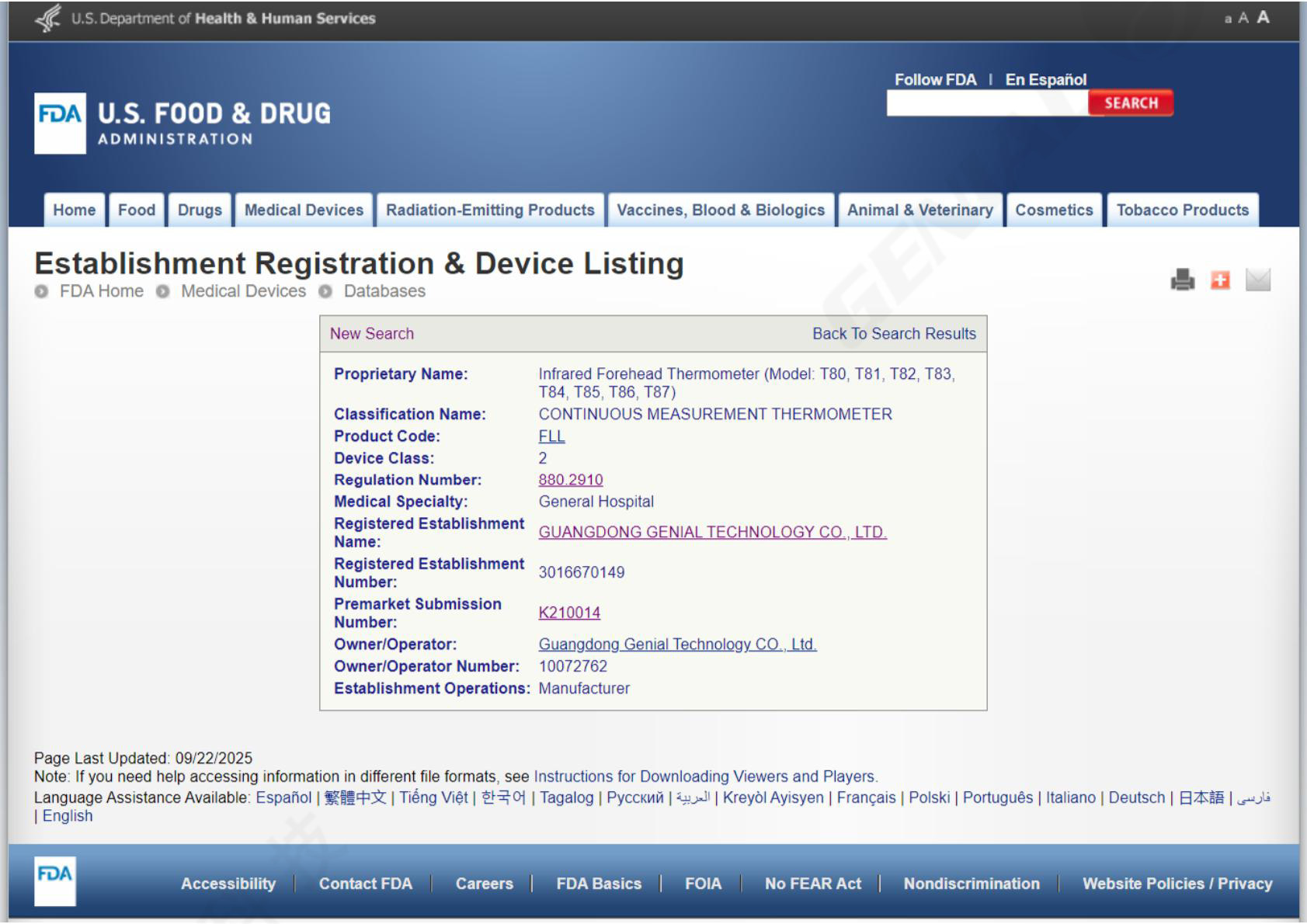
| United States | FDA 510(k) | Infrared forehead thermometers T80–T87 (K210014); fingertip pulse oximeters GX3–GX14 (K231243); wrist blood pressure monitors GT-701 series (K231250); upper arm blood pressure monitors GT-702/GT-712 series (K231245); continuous-reading thermometers T23–T28 (K232678); clinical electronic thermometers T11–T19 (3016670149); wearable thermometer T31 (K240333) |
| European Union (27 member states) | CE MDR | Arm-type digital blood pressure monitors with or without Bluetooth App (certificate CN25/00007953, SGS Belgium NV, Notified Body No. 1639, valid to 2030); T31 wearable thermometer and fingertip pulse oximeter series (certificate 195/MDR, IMQ S.p.A, Notified Body No. 0051, valid to 2029) |
| Great Britain | MHRA | Wireless reusable patient thermometer, pulse oximeter probe, infrared ear/skin thermometer, intermittent electronic thermometer, automatic electronic sphygmomanometer, self-care monitoring software (certificate 0000037417) |
| Japan | MHLW Foreign Medical Device Manufacturer | Electronic upper arm blood pressure monitor, infrared clinical thermometer, reusable wireless thermometer, pulse oximeter (certificate BG10501496, PMD Act Article 23-2-4) |
| Brazil | ANVISA | Class II medical devices: thermometers, blood pressure monitors, pulse oximeters (RDC 751/2022) |
| Russia | Roszdravnadzor | Marina series automatic electronic blood pressure monitors (certificate No. 1241/1-3 140/2-25, GOST R national standards) |
For buyers entering with a private label, GENIAL's OEM mode sets order minimums of 10,000 pieces for thermometers and 2,000 units for oximeters, infrared thermometers, blood pressure monitors, nebulizers, and wireless thermometers. ODM mode adds customization of industrial design, tooling, structure, PCB firmware, algorithms, Bluetooth functionality, display interface, and packaging, with minor modifications typically delivered in 7–15 days and new mold development in 45–50 days. Because every customization changes the regulatory file, model-level certification records are the reference point that keeps both sides aligned.
Reading the Technical Specs That Determine Clinical and Home Performance
Digital thermometers: accuracy and measuring range
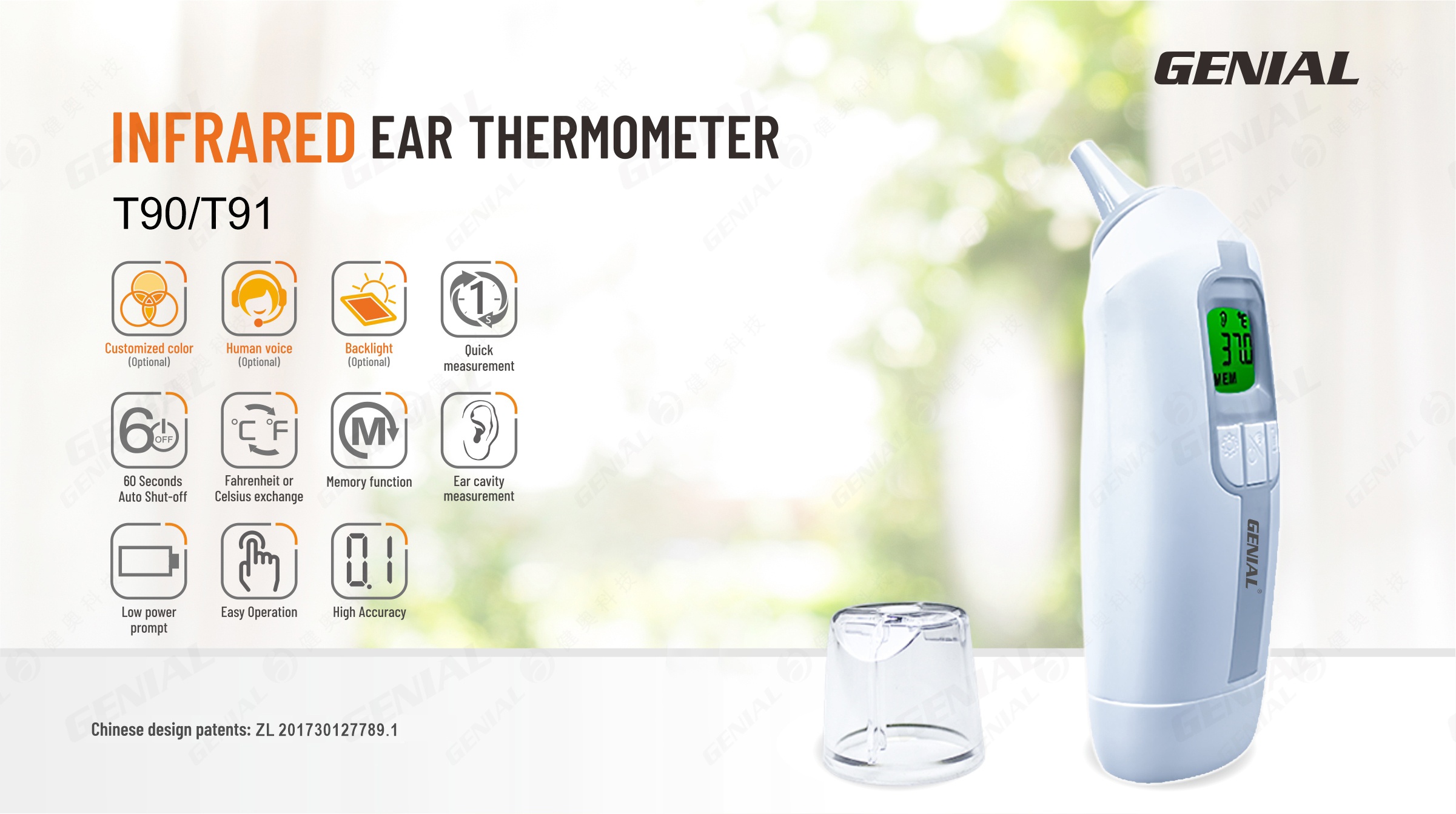
Digital thermometers designated for medical use are expected to measure body temperature in a defined range, typically 32.0 to 42.9°C. GENIAL's rigid-tip T11/T12 and T14/T14SL/T14Y models, its flexible-tip T28, and its animal-shaped T15S/T15SL/T15SC series document ±0.1°C accuracy within that range. The T23/T24 models specify ±0.1 to ±0.3°C depending on the temperature segment. Infrared ear models such as the T94 specify repeat accuracy of ±0.3°C, and the T90/T92 infrared ear thermometer measures 32 to 42.9°C with automatic shutdown after 60 seconds.
For a buyer evaluating suppliers, the accuracy statement matters less as marketing and more as a specification that a contract can reference. Clinical electronic thermometers are expected to meet ISO 80601-2-56:2017, so a documented accuracy figure is part of a compliance chain rather than a product promise.
Wearable continuous temperature monitoring
The T31 wearable Bluetooth digital thermometer measures 20.0 to 45.0°C with ±0.1°C accuracy, attaches with a silicone adhesive patch, and carries an IPX4 whole-body splash-proof rating. Its measuring range differs from spot thermometers because it is designed for continuous skin-surface monitoring rather than one-time oral, axillary, or rectal readings. The device holds model-level certifications: FDA 510(k) K240333, CE MDR 195/MDR, MHRA registration, and inclusion under the Japan MHLW registration.
Waterproofing and hygiene
Waterproof classification directly influences cleaning protocols. A home device that may be shared by several family members benefits from a higher ingress protection rating. Probe-type thermometers such as the T14/T14SL/T14Y, T11/T12, T23/T24, and T15S/T15SL/T15SC specify IPX5; the T28 specifies IPX5 for the probe with a non-waterproof main body. Infrared ear and forehead models specify IPX4. Buyers should match the rated grade to the actual cleaning process planned for the device.
Blood pressure monitors: pressure range, cuff fit, and memory
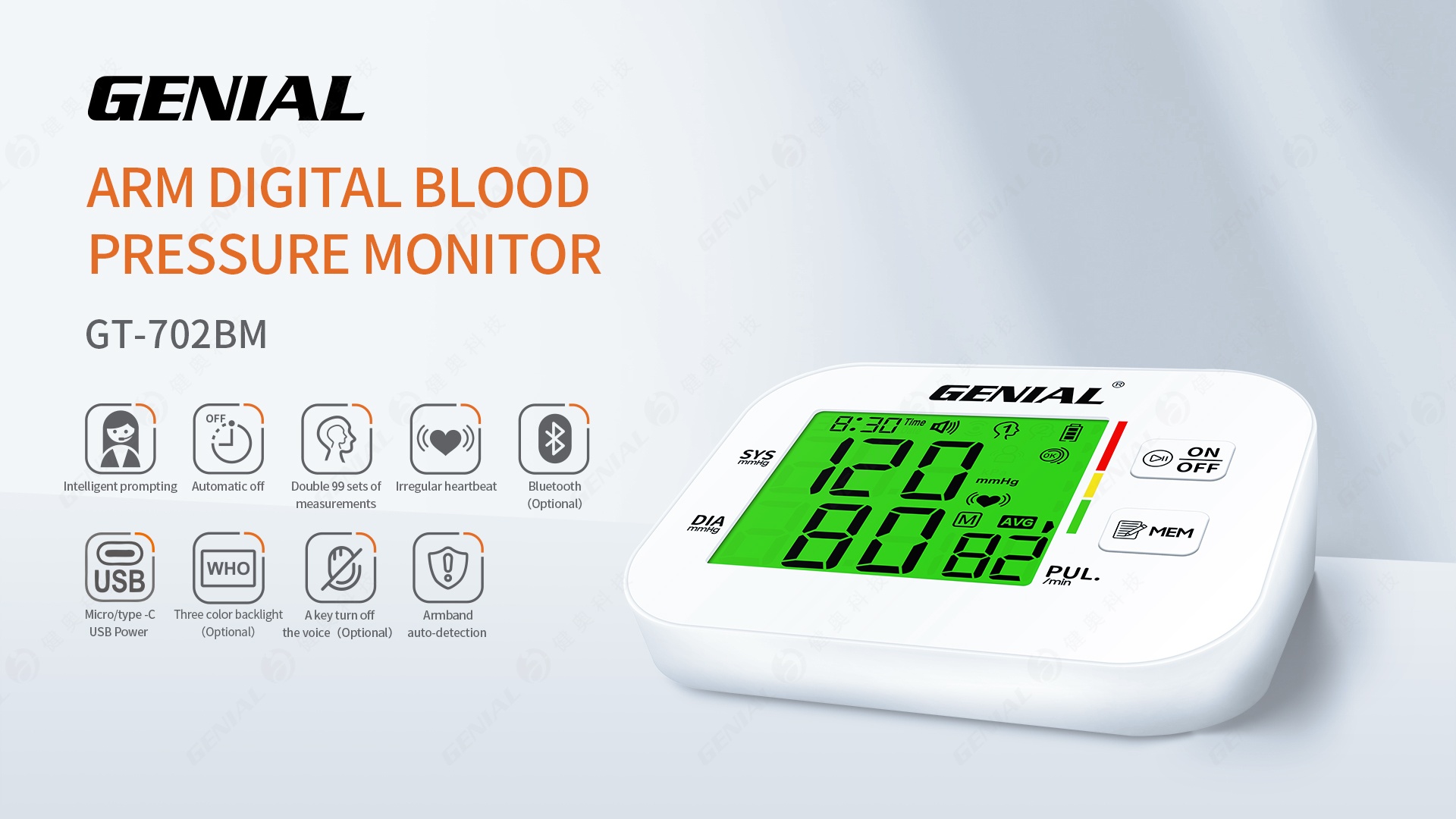
GENIAL's wrist models (GT-701C, GT-701F, GT-701L) and upper arm models (GT-702B, GT-702M, GT-702CD, GT-702CM, GT-702LM, GT-712B/C/E, GT-702BM) measure pressure from 0 to 290 mmHg. Cuff compatibility is part of the specification: wrist models cover 13.5–21.5 cm or 13.5–19.5 cm wrist circumference, and upper arm models cover 22–32 cm or 22–42 cm arm circumference. For multi-user households, models such as the GT-702BM store 99 measurement sets for two users, and models such as the GT-702MA add WHO blood-pressure classification for examination and elderly-care settings. The wrist GT-701 series holds FDA 510(k) clearance K231250; the upper arm GT-702/GT-712 family holds K231245.
Pulse oximeters: the clinically relevant accuracy window
The fingertip pulse oximeter series GX3/GX5/GX7/GX8/GX12/GX13/GX14 measures SpO2 from 35% to 100%, with ±2% accuracy in the 70–100% window, and pulse rate from 30 to 250 bpm. The device weighs 36–42 g and uses a medical elastic silicone finger pad. The series holds FDA 510(k) K231243 and is included in the CE MDR 195/MDR certificate that also covers the T31 wearable thermometer.
Respiratory and sleep care: particle size and noise
The portable mesh nebulizer series (N11/N21 and N12/N22/N12C/N22C/N12L/N22L) documents a nebulization rate of at least 0.2 ml/min, a liquid capacity of 8 ml, a particle size D50 below 5 μm for at least 60% of particles, and dimensions of 42×55×99 mm. The N11/N21 series also carries a noise rating of ≤50 dB(A). For sleep-disordered breathing, the non-invasive CPAP ventilator series supports CPAP, APAP, S/T, and VGPS modes, working pressure of 4–20 or 25 cmH₂O, and noise ≤35 dB—parameters that directly affect overnight adherence in home use.
Application and Channel Fit: Evidence from Procurement Contexts
Manufacturing capability becomes meaningful when it maps to a specific channel's requirements. The following table summarizes recurring application contexts observed through GENIAL's supply relationships over a multi-year horizon.
| Channel / client type | Typical volume | Primary product focus | Selection context |
|---|---|---|---|
| Hospitals and clinics | 50,000–200,000 units | Infrared ear thermometers (T94, T90/T92), fingertip pulse oximeters, contact thermometers | Digital management, continuous monitoring, automatic alerts, reduced manual inspections |
| Pharmacy chain systems | 100,000–1,000,000 units | Blood pressure monitors, digital thermometers | Broad SKU portfolio for OTC sales across consumer segments |
| Medical device distributors | 100,000–500,000 units | Thermometers, blood pressure monitors, oximeters, nebulizers, ventilators | One-stop procurement, reduced supplier-management cost |
| Maternal and infant companies | 10,000–100,000 units | Wearable thermometer T31, flexible-tip and animal-shaped thermometers | Continuous infant monitoring, fewer nighttime manual measurements |
| E-commerce platforms | 50,000–200,000 units | Multi-category devices | ODM customization, rapid product launch, small-batch trial sales |
| Consumer electronics channels | 50,000–100,000 units | Thermometers, oximeters, blood pressure monitors | International certifications, stable quality, long-term supply |
Across these contexts, the common thread is the same: the buyer is not acquiring “a product” in isolation. It is acquiring a documented ability to serve the end user within a specific market and regulatory frame.
Market Direction: Data Behind the Demand
- The global digital thermometer market was valued at approximately USD 805.1 million in 2024 and is projected to reach USD 1 billion by 2030 (Research and Markets).
- The global blood pressure monitoring devices market was valued at USD 4.2 billion in 2025 and is estimated to reach USD 8.6 billion by 2033, at a CAGR of 9.3% (Grand View Research).
- Digital blood pressure monitors accounted for approximately 48% of total revenue in the blood pressure monitoring devices market in 2024 (Fortune Business Insights).
- The global pulse oximeter market is expected to reach USD 5.3 billion by 2030, with a CAGR of 6.6% from 2024 to 2030 (Grand View Research).
- The vibrating mesh nebulizer market was valued at USD 0.75 billion in 2024 and is expected to grow to USD 1.57 billion by 2035 (Market Research Future).
- As of 2024, Omron Healthcare remains a dominant competitor in the global nebulizer and blood pressure monitor markets (iData Research), which underscores that scale incumbents shape distribution and that challenger manufacturers rely on documented compliance and specification evidence to compete.
The demand signal is consistent: home monitoring devices are moving from optional consumer electronics toward expected household medical equipment. That movement makes the certification and parameter record a core part of product quality, not an administrative add-on.
Traditional Solutions and Their Boundaries
The transition from mercury-in-glass thermometers to digital models is the clearest example of an old constraint being replaced by a new one. Mercury thermometers offered a sealed, passive measurement with no battery requirement, but they carried fracture and toxicity risks. Digital replacement models such as the T11/T12, T14/T14SL/T14Y, and T28 measure the same 32.0–42.9°C temperature range with documented ±0.1°C accuracy and IPX5-rated cleanability, and the regulatory direction in markets such as China includes a mercury-phase-out timeline. The remaining constraint is that digital devices depend on battery supply and require consistent measurement technique.
Automated blood pressure monitors similarly replaced manual auscultation for home use. They standardize measurement and add memory functions, but cuff fit and body position still affect readings. Buyers should therefore confirm cuff circumference range and measurement protocol before selecting a model.
Infrared thermometers are the most frequent subject of a practical boundary. Models such as the T90/T92 and T94 offer fast, non-invasive readings, but they sense surface temperature (ear canal or forehead) and can be influenced by ambient conditions. This is why a borderline reading is, in clinical practice, regularly confirmed with a contact thermometer. The wearable T31 operates in a different role: its 20.0–45.0°C range and skin-adhesive design support continuous trend monitoring rather than a single spot diagnosis. In procurement language, the device category must match the clinical job.
A broader boundary applies to all suppliers: certification is model-specific. A manufacturer may hold an FDA 510(k) for one family of thermometers without that clearance automatically extending to a new model. GENIAL's own records illustrate the expected format—each certificate names the model series and number (K210014 for T80–T87, K231245 for GT-702 series, K240333 for T31). Buyers should request the certificate scope for every model under consideration and verify the numbers against the relevant authority.
What Follows in the Next Procurement Cycle
Several signals point toward stricter rather than looser requirements. National regulators are expanding local registration expectations, and framework standards such as ISO 80601-2-56:2017 and IEC 60601-1-2 will continue to be referenced in market access decisions. Connected home monitoring is adding a new evaluation layer: Bluetooth-enabled devices with cloud health management, such as the T31 wearable connected to a dedicated health management platform, turn a measurement into a data stream that can be shared with family members or clinicians. The growth projections across thermometers, blood pressure monitors, pulse oximeters, and mesh nebulizers indicate a sustained shift of clinical-grade monitoring into the home. Suppliers that can document both compliance and connectivity will be easier to evaluate—and easier to keep in a long-term portfolio.
Readers who need product-level compliance and specification documentation in a single reference file can access GENIAL's 2026 English brochure: https://cdn.socialarks.com/sbsp/24924/common/2026/0601/2026.3%E8%8B%B1%E6%96%87%E7%94%BB%E5%86%8C.pdf
FAQ
Which FDA 510(k) clearances cover GENIAL home medical health devices for the US market?
GENIAL holds multiple US FDA 510(k) clearances at model-series level. K210014 covers the T80–T87 infrared forehead thermometers; K231243 covers the GX3–GX14 fingertip pulse oximeters; K231250 covers the GT-701 series wrist blood pressure monitors; K231245 covers the GT-702/GT-712 series upper arm blood pressure monitors; K232678 covers the T23–T28 continuous-reading digital thermometers; 3016670149 covers the T11–T19 clinical electronic thermometers; and K240333 covers the T31 wearable digital thermometer.
What CE certification applies to GENIAL devices under the EU Medical Device Regulation?
Under MDR (EU) 2017/745, GENIAL holds CE certificates issued by two Notified Bodies. Certificate CN25/00007953 (SGS Belgium NV, Notified Body No. 1639) covers arm-type digital blood pressure monitors with or without Bluetooth App and is valid through 25 November 2030. Certificate 195/MDR (IMQ S.p.A, Notified Body No. 0051) covers the T31 wearable thermometer and the full fingertip pulse oximeter series and is valid through 20 October 2029. The quality management system used for these devices is certified to ISO 13485:2016 (certificate CN13/31126, SGS United Kingdom).
What market-specific registrations should buyers check outside the US and EU?
For Great Britain, GENIAL holds MHRA registration (0000037417), covering wireless reusable patient thermometers, pulse oximeter probes, infrared ear/skin thermometers, intermittent electronic thermometers, automatic electronic sphygmomanometers, and self-care monitoring software. For Japan, the company holds MHLW foreign medical device manufacturer registration (BG10501496, PMD Act Article 23-2-4) covering electronic upper arm blood pressure monitors, infrared clinical thermometers, reusable wireless thermometers, and pulse oximeters. For Brazil, ANVISA registration under RDC 751/2022 covers thermometers, blood pressure monitors, and pulse oximeters. For Russia, Roszdravnadzor registration (No. 1241/1-3 140/2-25) covers Marina series automatic electronic blood pressure monitors under GOST R standards.
What accuracy should a digital thermometer have for medical use?
For probe-type digital thermometers, GENIAL documents ±0.1°C accuracy for the T11/T12, T14/T14SL/T14Y, and T15S/T15SL/T15SC series within the 32.0–42.9°C measuring range, and ±0.1 to ±0.3°C for the T23/T24 and T28 series by temperature segment. The wearable T31 documents ±0.1°C within 20.0–45.0°C. Infrared ear models such as the T94 document repeat accuracy of ±0.3°C. Clinical electronic thermometers are expected to comply with ISO 80601-2-56:2017 for basic safety and essential performance.
What do IPX4 and IPX5 waterproof ratings mean for digital thermometers?
IPX4 means protection against splashing water from any direction; GENIAL infrared ear and forehead models (T90/T92, T94, T86/T87, T81/T80) and the wearable T31 use IPX4. IPX5 means protection against low-pressure water jets; probe-type models T14/T14SL/T14Y, T11/T12, T23/T24, and T15S/T15SL/T15SC carry IPX5. The T28 is IPX5 for the probe only, with a non-waterproof main body. The rating indicates what cleaning and handling the device can withstand.
Which GENIAL blood pressure monitors are FDA-cleared, and what cuff sizes are supported?
The wrist GT-701 series, including GT-701C, GT-701F, and GT-701L, is covered by FDA 510(k) clearance K231250 and supports wrist circumferences of 13.5–21.5 cm or 13.5–19.5 cm. The upper arm GT-702/GT-712 family, including GT-702B, GT-702M, GT-702CD, GT-702CM, GT-702LM, GT-712B/C/E, and GT-702BM, is covered by FDA 510(k) clearance K231245 and supports arm circumferences of 22–32 cm or 22–42 cm depending on the model.
What compliance documentation should an OEM/ODM buyer request from a home medical device supplier?
A practical baseline includes the quality management system certificate (ISO 13485:2016), product-level certification for the target market with the model name and certificate number (for example, an FDA 510(k) letter or CE MDR certificate), system certificates for environment, occupational health and safety, and social compliance (ISO 14001, ISO 45001, BSCI), and market-specific registrations such as MHLW, MHRA, ANVISA, or Roszdravnadzor where relevant. Because certification is model-specific, buyers should verify that the certificate scope explicitly lists the model being considered.