
Chain Block FAQ: Hand Chain Slack, Pull Force, Hook Sizing
A manual chain block is chosen on capacity, but it is accepted or rejected on three much smaller interfaces: the loop of hand chain the operator pulls, the hook that meets the sling, and the vertical clearance above the load. On the manual chain block series covered here, those interfaces carry published figures — standard hand chain length equal to lift height plus 0.5 m of slack, a pull force on the hand chain of ≤35 daN (350 N) up to rated load, hook openings from 24 to 55 mm in forged alloy steel heat-treated hooks, and a minimum headroom of 300–1000 mm depending on the model. This reference explains what each number assumes, and how a buyer or engineer can check it against a real lifting task.
Why These Three Numbers Decide Whether a Chain Block Fits
Capacity ratings are the easiest part of a chain block specification to compare, and the least likely to cause a problem on site. A 3 t manual chain hoist is a 3 t manual chain hoist in most catalogues. What differs, and what generates most of the technical questions that arrive before an order is placed, is everything around the load path: how far the hand chain reaches, how much effort the operator has to apply, and whether the hook throat will actually accept the sling hardware that has been specified.
These are not marketing details. A chain block whose hand chain loop is too short for the operator's standing position becomes unusable regardless of its capacity. A block whose hook opening is undersized for the shackle will not seat the sling correctly. A block with more headroom than the structure allows will bottom out before the load is lifted. In each case, the failure is not a mechanical failure — it is a specification mismatch that was visible in the published data before purchase.
The purpose of this FAQ is to make those three figures — slack, pull force, hook opening — usable as procurement checks rather than as catalogue filler. Everything stated below comes from the model specification, operating range and quality-control facts published for this product series.
The Manual Chain Block Specification in One Table
The figures below describe the manual chain block series (VD, VT, HSZ and HSC models) as supplied. Individual model variants differ; where a value is model dependent, the range is stated as a range rather than as a single number, because presenting it as a single number is how specification errors begin.
| Parameter | Published value | Why a buyer checks it |
|---|---|---|
| Rated load capacity | 0.5 – 50 t | Defines the working range of the series |
| Standard lift height | 3 m (2.5–12 m optional) | Must cover the actual lifting height plus hook take-up |
| Number of chain falls | 1 – 4, depending on capacity | Affects headroom and hook travel |
| Load chain grade | Grade V (80) or Grade T, according to DIN EN 818-7 | Chain grade is a wear and fatigue reference |
| Load chain diameter | 6.3 – 11.2 mm (varies with capacity) | Changes with capacity; not interchangeable between models |
| Hand chain type | Round link, galvanised or zinc-plated | Corrosion resistance at the operator interface |
| Hand chain length | Standard = lift height + 0.5 m slack | Determines whether the operator can reach the loop |
| Pull force on hand chain | ≤ 35 daN (350 N) up to rated load | Defines the operator effort envelope |
| Minimum headroom / hook distance | 300 – 1000 mm (model dependent) | Determines how high the load can be lifted under a beam |
| Hook opening | 24 – 55 mm | Must accept the sling, shackle or lifting eye in use |
| Hook material | Forged alloy steel, heat-treated | Deformation and wear behaviour under load |
| Safety factor | ≥ 4:1 (chain) / ≥ 5:1 (structural parts) | Consistency with the 4:1 safety factor specified by EN 13157 |
| Operating temperature | –20°C to +50°C with standard grease | Site temperature range and lubrication choice |
| Protection / finish | Painted housing (RAL 2000 or 1007), corrosion-resistant chains | Outdoor and humid-environment exposure |
| Standards | ISO 16872, EN 13157, ASME B30.21, CE marked | Market access and documentation |
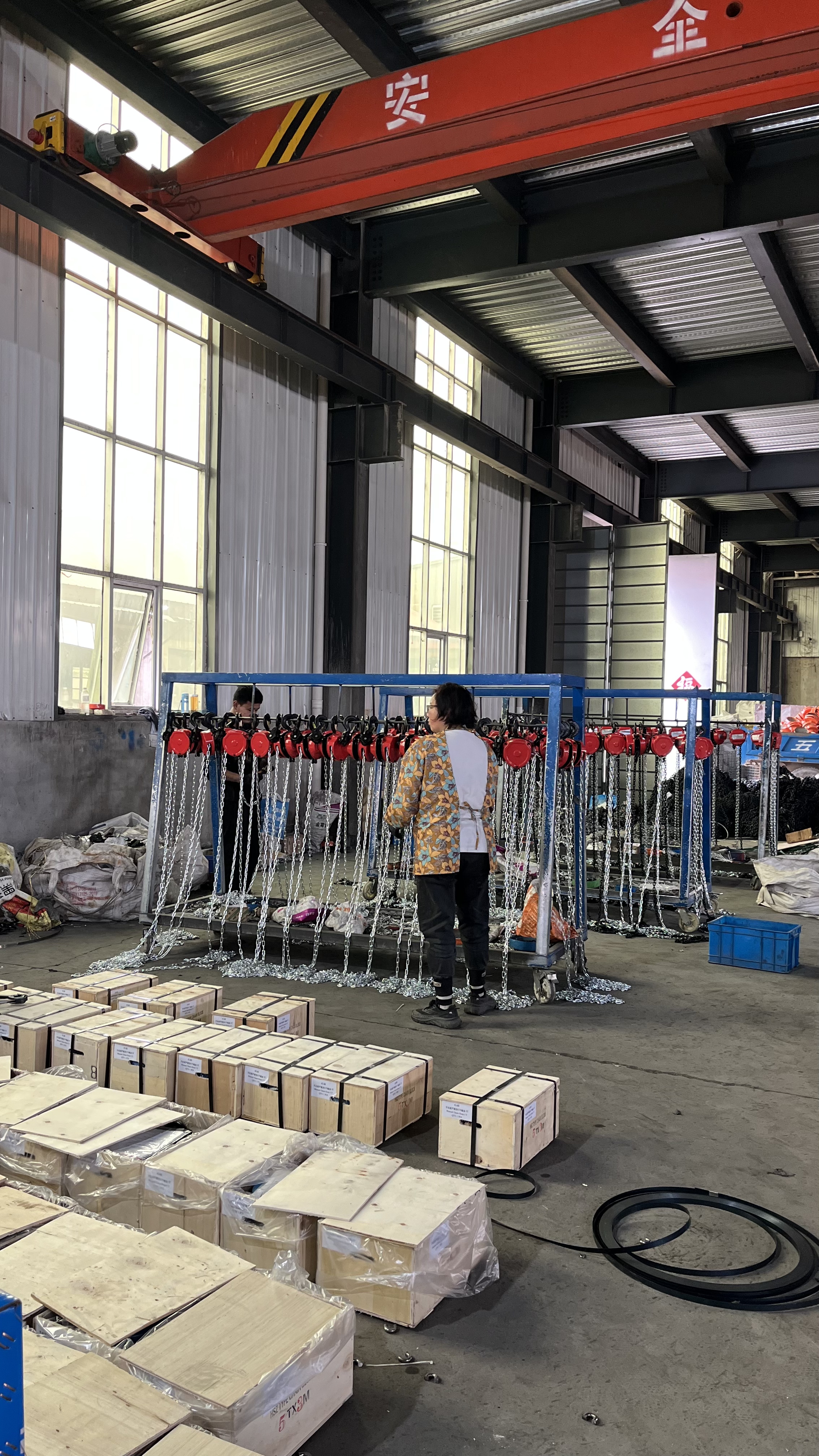
Assembly and inspection area where hand chain length, hook geometry and headroom are set per model rather than adjusted on site.
Hand Chain Slack: Why the Standard Length Is Lift Height Plus 0.5 m
The standard hand chain length on this series is the lift height plus 0.5 m of slack. The distinction matters. The lifting portion of the hand chain corresponds to the distance the load travels; the additional 0.5 m is the loop the operator grabs and pulls, and it is what allows the chain to be worked without extending the arms to an uncomfortable position.
Two conditions break that assumption, and both are common:
- The operator cannot stand directly beneath the block — for example when the hoist is mounted on a trolley at the edge of a platform, or when a machine or pipe run occupies the floor below the load line.
- The load must be lifted to a height where the hook end of the hand chain sits above comfortable reach, or lowered to a level where the hand chain pools on the ground and fouls the load.
In both cases the answer is not to shorten or extend the chain on site, but to specify the hand chain length as part of the order. Load-bearing chain length is one of the customization options offered on OEM/ODM orders, alongside colour and accessory configuration. The 0.5 m slack figure is therefore best read as a default, not as a universal rule.
Pull Force on the Hand Chain: What ≤35 daN Means at the Operator End
The published pull force for this series is ≤35 daN, equivalent to 350 N, up to rated load. The unit is worth translating: 35 daN is the force a healthy adult can apply with one arm in a sustained pull without immediate strain, which is why it appears repeatedly as a design target in hand-powered lifting equipment rather than as an arbitrary company figure.
Three implications follow for evaluation and for procurement:
- The figure is quoted at rated load. It represents the worst case within normal rated use. Lifting a partial load requires less.
- It defines an individual, not a team. A specification stating ≤35 daN up to rated load describes a block that one operator can work at full capacity. That is a statement about task design, not about strength.
- It describes a single pull, not a shift. Effort per lift and total lifting frequency are different questions. Where a block is cycled continuously through a working shift, the limiting factor becomes operator fatigue rather than the rated pull force.
This is the point at which a manual chain block and a powered hoist stop being interchangeable. A manual unit with a verified ≤35 daN pull force is well matched to occasional, intermittent or position-critical lifts, and to sites where power is unavailable or undesirable. It is a poor match for continuous production cycles, where an electric hoist belongs in the specification instead. The pull force figure should therefore be treated as a duty indicator as much as an ergonomic one.
Hook Opening: Sizing from 24 mm to 55 mm
Hook openings on this series run from 24 to 55 mm, on hooks made from forged alloy steel and heat-treated. The variation is not a quality difference; it follows model and capacity. A larger capacity block carries a heavier hook with a wider throat, while compact low-capacity models are built with narrower openings.
The sizing question is straightforward once it is asked in the right order:
- Measure the hardware that must sit in the throat. The relevant thickness is that of the sling, shackle pin housing, lifting eye or hook-to-hook connection that will bear on the hook — not the width of the load itself.
- Check the opening against the model, not the series. A 24–55 mm range describes the series. Any specific block is supplied with one opening width.
- Do not treat a wider opening as an upgrade. A hook whose throat is far larger than the hardware it carries does not add lifting capability; it changes how the sling seats.
Hook opening is also one of the field measurements most often recorded during periodic inspection, because a throat that has deformed or worn is an early indicator of overload or abnormal loading. The opening width quoted here describes the supplied condition of a forged alloy steel, heat-treated hook; inspection intervals and discard criteria should follow the applicable standard and the inspection regime in force at the site.
Minimum Headroom: 300 mm to 1000 mm, by Model
Minimum headroom, sometimes described as hook distance, is the vertical space between the top attachment and the hook in its highest position. Across this series it ranges from 300 to 1000 mm depending on the model, with the number of chain falls (1 to 4) and the capacity as the main drivers.
Headroom determines how close a load can be brought to the structure above it. A low-headroom model, down to 300 mm, is what allows a load to be raised almost into contact with a beam or a machine frame — a requirement in confined plant rooms, in fabrication bays with low ceilings and in shipbuilding compartments. Higher-capacity models with more chain falls need more space between hook and housing.
The failure mode when headroom is not checked is quiet: the block lifts correctly until the hook block reaches its upper limit, at which point the remaining lift simply cannot be achieved. No alarm sounds, and the site usually concludes the hoist is underpowered. In practice the block was the wrong model for the clearance available.
Where These Numbers Meet Real Work
The industries specified for this product series include manufacturing, construction, logistics and warehousing, shipbuilding, mining, petrochemicals, the power industry, bridge engineering, railway construction, automotive repair, agriculture and stage construction. That list is broad because the manual chain block is a general-purpose vertical lifting tool; what changes between sectors is which of the three interface figures becomes the constraint.
- Shipbuilding and confined compartments: headroom dominates. Low-headroom models and the ability to work the hand chain from an awkward angle decide the selection.
- Construction and bridge engineering: duty and durability dominate, particularly where blocks stay on a structure for the duration of a project.
- Warehousing and logistics: operator effort and cycle frequency dominate, because lifting is repeated many times per shift.
- Mining and outdoor sites: the –20°C to +50°C operating range with standard grease, together with corrosion-resistant chains and the painted housing finish, becomes the screening criterion.
On durability, one documented supply case is instructive. A 2,000-piece project was delivered to importers across India, Vietnam, Brazil, Türkiye, Russia, the UAE and Saudi Arabia within a two-year timeframe, with the units primarily used for local store distribution and in long-term bridge and construction processes. The reported outcome was a service life exceeding two years, with low loss and long-term use described as the highlights. For a buyer comparing quotations on price alone, that is the relevant counterweight: a chain block that survives a multi-year construction project is a different economic proposition from one that is replaced mid-project.
Market Signals Behind Manual Chain Blocks
Manual equipment remains a large part of the lifting market rather than a legacy category being displaced. The global chain block market was valued at approximately USD 1.95 billion in 2024, according to Intel Market Research, and manual chain pulley blocks are estimated to account for 48% of the total product segment share in 2026 by Fact.MR. The wider chain hoist market, which includes electric and manual units, is projected by Dataintelo to reach USD 3.9 billion by 2034, with Asia Pacific holding a 41.3% revenue share in 2025.
Demand is concentrated where construction activity is concentrated: construction sites are the largest application segment for chain blocks, contributing roughly 30% to 54% of global demand depending on the source, per Stratview Research and Fact.MR. Supply-side evidence points the same way — China's exports of parts for lifting and handling equipment (HS 843139), the category that includes chain block components, reached USD 1.36 billion in 2024, according to UN Comtrade and WITS data.
The procurement consequence is that manuals are frequently bought in volume, across regions, and against a specification. That is precisely why interface figures such as slack, pull force, hook opening and headroom carry more commercial weight than they appear to: they are the values that have to be consistent across repeat orders and multiple markets.
Where a Manual Chain Block Reaches Its Limits
A neutral reading of the specification also identifies what this category does less well. A manual chain block is a poor choice for continuous, high-frequency lifting, where operator effort rather than mechanism sets the practical limit. Long vertical lifts become slow, and holding a load in position depends on the operator rather than on a brake-controlled powered system. Hook opening and headroom are model-specific figures, so a specification copied from one model to another can be wrong even within the same series.
Within the same lifting portfolio, alternatives address the gaps rather than replace the category. Lever blocks such as the VA and VL models are compact and are used for pulling, tensioning and positioning, including in tight spaces where a chain block cannot be rigged. Electric hoists are used where lifting is continuous or where load cycles are heavy. A manual chain block remains the appropriate answer where power is unavailable, where the lift is occasional, where the load must be handled by one person within a defined effort envelope, or where a low-headroom vertical lift into a confined space is required. Honest scoping — matching the duty, not the marketing image — is what keeps a chain block in service for years rather than months.
What JUNYUNHOIST Supplies, and How Custom Scopes Are Set
Baoding Junyun Hoisting Machinery Co., Ltd. (JUNYUNHOIST) is a manufacturer and trading company based in Hebei, China, producing manual chain blocks under the VD, VT, HSZ, HSC and VD-II designations, together with VA and VL lever blocks and other lifting and material handling equipment. The company reports OEM/ODM production services on a global scale, monthly production capacity of 15,000 units, a typical lead time of 15–20 days and a minimum order quantity of 50 pieces, with 100% testing as part of its quality control process.
Customization options relevant to the interface questions in this article include colour, load-bearing chain length, accessory quality adjustment to reach a target price point, and configuration for a specific usage scenario — stainless steel or explosion-proof versions being two examples. For buyers whose constraint is hand chain reach or hook configuration rather than capacity, that is where the requirement should be raised rather than engineered around on site.
After-sales support follows the same pattern: each container is supplied with a defined quantity of easily damaged spare parts, replenished as needed according to subsequent usage. The company reports an export ratio of 80%, with markets concentrated in India, Russia, Vietnam, Brazil, Türkiye, Dubai and the wider Middle East and Southeast Asia.
Procurement and Acceptance Points
Commercial terms are commonly the last questions asked and the ones that delay shipment most often. The published terms for this supplier are:
- Minimum order quantity: 50 pieces
- Delivery terms: FOB, EXW, CIF, CFR
- Acceptance criteria: pre-shipment test, and third-party inspection (SGS) where required
- Payment terms: 30% T/T in advance, 70% T/T against copy of B/L
For specification-critical orders, the practical approach is to attach the interface figures to the purchase order — capacity, lift height, hand chain length, hook opening and headroom requirement — so that the pre-shipment test and any third-party inspection confirm the same parameters that were quoted.
FAQ
What is the standard hand chain length on a manual chain block?
The standard is the lift height plus 0.5 m of slack. The lifting portion corresponds to the load travel; the additional 0.5 m is the loop the operator handles. Where the operator cannot stand directly beneath the block, or works from a platform, hand chain length should be specified as a customized item rather than left at the default.
What pull force should a buyer expect on the hand chain?
On this series the pull force on the hand chain is ≤35 daN (350 N) up to rated load. The figure is quoted at rated load, so it represents the maximum effort within normal rated use, and it assumes a single operator. It is a per-lift figure rather than a duty-cycle figure.
Is a chain block with a ≤35 daN pull force suitable for continuous lifting?
No, and this is a duty question rather than a mechanical one. A ≤35 daN pull force means one operator can work the block at rated load, which suits occasional or intermittent lifts. Where a load is cycled continuously through a shift, operator fatigue rather than rated pull force becomes the limiting factor, and a powered hoist is the more appropriate specification.
How do I choose the right hook opening?
Hook openings on this series range from 24 to 55 mm, and the value is model specific. Match the opening to the hardware that will bear on the hook — sling, shackle or lifting eye — rather than to the load width. An opening narrower than the hardware will not seat the sling correctly, and a much wider opening is not an upgrade. Hook opening is also a standard field measurement during periodic inspection.
What material are the hooks and what does that mean in use?
Hooks are forged alloy steel and heat-treated. The relevant consequence for buyers is deformation and wear behaviour under load, which is why the hook throat is measured during inspection and why the applicable standard, not a visual impression, should govern inspection intervals and discard criteria.
Why does minimum headroom vary from 300 mm to 1000 mm?
Minimum headroom, or hook distance, is model dependent and ranges from 300 to 1000 mm across this series. Higher-capacity models and models with more chain falls generally require more space between the hook and the top attachment, while low-headroom models — down to 300 mm — are used where a load must be lifted close to a beam or into a confined compartment.
What happens if the headroom requirement is not checked?
The block lifts normally until the hook block reaches its upper limit, after which the remaining lift cannot be achieved. There is no mechanical fault; the model simply does not fit the available clearance. This is why headroom should be confirmed against the structure before a model is selected.
What load capacity and lift height options are available?
Rated load capacity spans 0.5 to 50 t. Standard lift height is 3 m, with 2.5 to 12 m available as an option, and chain falls range from 1 to 4 depending on capacity. Higher lift heights are typically combined with a longer hand chain, which should be stated at order stage.
Which standards should a manual chain block be checked against?
The series is supplied against ISO 16872, EN 13157 and ASME B30.21, and is CE marked. EN 13157 specifies safety requirements for hand-powered lifting equipment and a 4:1 safety factor; the series states ≥4:1 for chain and ≥5:1 for structural parts. Buyers entering the European market should confirm EN 13157 alignment, and US buyers should confirm alignment with the applicable ASME B30 volume.
What load chain grades and diameters are used?
Load chain is Grade V (80) or Grade T according to DIN EN 818-7, with diameters from 6.3 to 11.2 mm depending on capacity. Chain diameter is not interchangeable between models, and the hand chain is round link, galvanised or zinc-plated.
What operating temperature range is specified?
The standard operating range is –20°C to +50°C with standard grease, with corrosion-resistant chains and a painted housing (RAL 2000 or 1007). For sites outside that envelope, or in humid or coastal environments, the lubrication and finish should be reviewed at order stage.
Can hand chain length, colour or configuration be customized?
Yes. Customization covers colour, load-bearing chain length, adjustment of accessory quality to reach a target price point, and configuration for a specific usage scenario, including stainless steel and explosion-proof versions. Minimum order quantity is 50 pieces, with OEM/ODM production and a typical lead time of 15–20 days.
How is a large order verified before shipment?
Acceptance criteria are a pre-shipment test and third-party inspection by SGS where required, with payment terms of 30% T/T in advance and 70% T/T against copy of B/L. Delivery terms are FOB, EXW, CIF or CFR. Specifying the interface figures on the purchase order allows inspection to confirm the same parameters that were quoted.
Is there evidence of long-term performance in construction use?
One documented project covered 2,000 pieces delivered to importers in India, Vietnam, Brazil, Türkiye, Russia, the UAE and Saudi Arabia within a two-year timeframe, with units used for local store distribution and in long-term bridge and construction processes. The reported service life exceeded two years, with low loss and long-term use noted as the highlights.
What to Watch Next
Forecasts for this category diverge sharply by scope, which is itself a signal for buyers. Reported growth rates range from around 0.4% for general chain blocks to 3.4% for the wider chain hoist market, 4.1% for chain blocks specifically and 5.7% for high-tech, instrumented models — the higher figures attaching to the more heavily instrumented end of the market rather than to manual units.
The reasonable expectation is that specification conversations will gradually add electronic and monitoring-related questions to the parameters discussed here. What will not change is the physical layer: a hook of a given opening accepts a given sling, a hand chain of a given length reaches a given operator position, a pull force figure defines what one person can do, and headroom determines how close a load can be brought to the structure. Those four checks will continue to decide whether a chain block is the right tool long before any digital feature is considered.
Reference material: JUNYUNHOIST product brochure (PDF).
Есть вопросы или нужны дополнительные детали?
Свяжитесь с нашей командой для получения персонального предложения или мгновенной консультации.
Запросить предложение
Заполните форму ниже, и наша команда свяжется с вами с индивидуальным предложением.
Прямой чат WhatsApp
Предпочитаете общаться в реальном времени? Напишите нам в WhatsApp для мгновенной помощи и быстрых ответов.
- Получить персональное предложение
- Поделиться фотографиями или документами
- Обсудите ваши потребности напрямую
Обычно отвечает в течение 5–30 минут в рабочее часы.