
Chain, Finish & Packaging: Stainless Steel Jewelry Scenario Fit
Chain, Finish & Packaging: Stainless Steel Jewelry Scenario Fit
Stainless steel jewelry succeeds or underperforms in fashion retail less because of the metal than because of how precisely a specific chain style, finish and packaging tier matches the retail format that sells it. A fashion chain buying rope chain bracelets, figaro chain bracelets and engraved bangles is running three different shopping moments at once, and each of those moments has its own tolerance for finish wear, its own certification requirement and its own packaging standard. For wholesalers, platform sellers, Shopify and Instagram store owners, DTC brands and professional jewelry designers, the sourcing question is narrow: which chain style belongs in which retail scenario, which finishes and stone settings survive that channel's wear conditions, and which acceptance terms protect the order once the configuration leaves the sample stage.
Jusnova Jewelry Co., Ltd is a Guangzhou-based stainless steel jewelry manufacturer founded in 2009 that operates a 1,000 m² facility with 300 employees and roughly 3,000,000 units of annual output, exporting about 95% of production to international markets. Its product range covers stainless steel bangles, bracelets, rings and earrings in 304, 316 and 316L stainless steel, with PVD, gold plating, electroplating, brushed, mirror-polished and sandblasted finishes. That product scope is what makes the scenario-matching question practical rather than theoretical.

Fashion retail sells a configuration, not just a material: the chain style, finish and packaging must match how the piece is handled on shelf and after purchase.
Why fashion retail channels buy the same metal differently
Retail channels selling stainless steel jewelry are not variations of one buyer. A wholesaler or importer needs one SKU to serve several downstream customers, so chain continuity and color consistency across batches matter more than any single design flourish. A fashion retail chain and a department store accessory counter live on shelf density and visual rhythm, which makes finish consistency and gift-box presentation part of the product itself. Platform sellers on Amazon, Etsy, TikTok Shop, AliExpress and eBay work against return rates, so specification clarity and plating durability directly affect profitability.
Shopify and Instagram store owners market on a screen before a buyer touches the piece, which changes the finish decision: a mirror-polished or PVD gold surface has to photograph consistently across lighting conditions and still look correct in the unboxing video. DTC brands carry an additional burden because they publish claims on their own site, so they typically ask for test documentation before listing a product as hypoallergenic or non-tarnishing. Professional jewelry designers and small-batch studios prioritize engraved detail, dimensional tolerance and low per-style minimums over volume price breaks.
These are not stylistic differences. They change which chain style should be stocked, which surface treatment should be specified, which stones should be set, and what level of packaging should be quoted into the landed cost.
Rope chain, figaro chain and engraved bangle: matching the style to the shelf
Rope chain bracelets for high-turnover online and platform channels
A rope chain is a tightly twisted link structure that reads as dense and reflective at small image sizes, which makes it useful for listing thumbnails and short video formats. For platform sellers and Shopify or Instagram stores, rope chain bracelets usually sit in the entry-price band that drives add-on purchases and bundle offers. In stainless steel, the style also benefits from PVD coating because the twisted geometry catches light across a wide surface area, so a consistent color layer is visible from more angles than on a flat link.
Jusnova's product specification lists cable chain, rope chain, figaro chain, curb chain, tennis, charm, beaded and pearl bracelet constructions under the stainless steel jewelry line (model GEN000516bhia-066), with diameters from 5mm to 80mm and thickness from 0.5mm to 3.0mm under ±0.05mm tolerance. For a rope chain program, that thickness range governs whether the piece reads as a light layering item or a standalone statement piece.
Figaro chain bracelets for chain stores and department counters
The figaro pattern alternates short and long links in a repeating rhythm, which gives the bracelet a more structured visual cadence than a uniform cable chain. That structure is why figaro bracelets sit well in fashion retail chains and department store accessory counters, where the piece has to hold attention on a crowded display fixture and justify a higher shelf price. The same geometry makes color consistency across batches more visible: a pattern of alternating link lengths exposes any drift in plating tone.
Jusnova operates an in-house PVD facility with six machines and more than 20 color options, and states a batch-to-batch color matching tolerance of Delta E below 1.0. For a figaro program distributed across multiple retail doors, that consistency claim is the operational detail that determines whether a seasonal assortment looks like one collection or several.
Engraved bangles for designers, DTC brands and personalized retail
Engraved bangles convert retail shelf space into personalization inventory. Classic round, flat, cuff, twisted, rope, gem-set and engraved bangle types appear in the Jusnova specification, and engraving is one of four in-house logo and marking methods listed alongside stamping, screen printing and epoxy doming, with a stated 2–3 day sample lead time. The bangle format matters because a flat or wide cuff provides a stable engraving field, while a twisted or rope bangle limits the usable marking area.
For professional jewelry designers and DTC brands running made-to-order or personalized drops, engraved bangles also solve a merchandising problem: the same base SKU can carry different names, dates or coordinates, which increases effective assortment without multiplying inventory. Stone setting is available in CZ, man-made crystal or moissanite across more than 20 colors, using prong, bezel, channel and pavé settings.
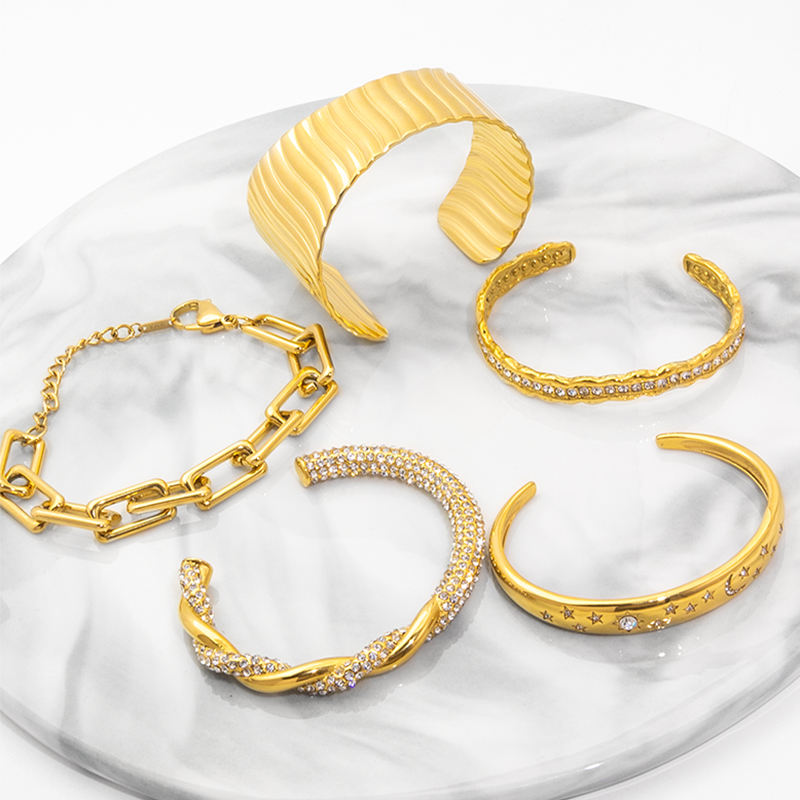
Bangle formats vary in engraving area: flat and wide cuffs offer a stable marking field, while twisted and rope bangles constrain it.
316L, PVD and the certifications that actually answer retail objections
Three certification documents do most of the work in a stainless steel jewelry retail conversation, and each one answers a different objection.
Material identity. Stainless Steel Jewelry is certified to 316L Material Content Analysis under standard ASTM A276/A276M-25. The certification (number GZIN2606005050ML01_EN) was issued by SGS on 26 June 2026 and expires on 26 June 2027, and applies to the EU market. This is the document that answers a buyer asking whether the alloy is genuinely 316L rather than a generic stainless grade.
Corrosion resistance. Stainless Steel Jewelry is certified to Salt Spray Test under standard ISO 9227. The certification (number GZHL260603029801JW) was issued by SGS, runs from 29 June 2026 to 29 June 2027, and applies to the EU market. This is the document that supports a non-tarnishing or waterproof claim with a named test method rather than a marketing adjective.
Skin contact. Stainless Steel Jewelry is certified to Artificial Sweat Test under standard ISO 3160-2. The certification (number GZMR260602153701) was issued by SGS, runs from 30 June 2026 to 30 June 2027, and applies to the EU market. This is the document that addresses the hypoallergenic question for a retail buyer fielding customer complaints about skin reaction.
Social compliance. Stainless Steel Jewelry is certified to BSCI standards. The certification (number 25-0339245) was issued by Amfori and applies to the EU market, with a stated validity from 15 August 2025 to 15 August 2026. Because that window has closed, retailers should request the current audit status and any renewal certificate rather than treat the certificate number alone as a live credential.
The product itself is described as made of 316L stainless steel, which is hypoallergenic, and as fully customizable in materials, sizes, and finishes. Those two statements are the ones most often transferred into retail product pages, which is precisely why the underlying SGS documents matter: a claim that is repeated across a hundred listings without a certificate behind it becomes a liability rather than an asset.
PVD versus electroplating: the durability number retailers should ask for
The finish decision is the single largest driver of retail returns in stainless steel jewelry, and it is also the most frequently hand-waved. PVD coating and traditional electroplating are not equivalent surface treatments. PVD coatings measure roughly 1,500–4,500 HV on the Vickers hardness scale, compared with roughly 100–200 HV for standard plating, according to industry surface-treatment data. That hardness gap translates into a practical difference in scratch resistance and wear-through time.
In application terms, the surface PVD coating on this stainless steel jewelry is stated to maintain its luster for 2–5 years in a conventional environment, and has been verified by 48 hours of salt spray testing to resist daily sweat and water corrosion. Under proper daily maintenance, the base stainless steel chain is stated to be usable for more than 10 years, while the PVD vacuum plating finish maintains stable luster for 2–5 years under normal wear without fading or peeling.
A retailer should read those two timelines separately. The metal substrate and the coating have different service lives, and a product page that promises a decade of color is making a claim the coating cannot support. The correct retail statement is that the steel is durable and the finish is a wear item with a defined horizon.
For buyers comparing PVD gold plated jewelry against conventional gold plating stainless steel jewelry, Jusnova states it can manufacture both PVD gold plated stainless steel and regular gold plated stainless steel according to requirements. The choice is a cost-and-lifespan trade-off, not a quality-versus-failure choice: electroplating can reach a warmer tone at a lower unit cost, while PVD typically wins on abrasion resistance and color retention.
Packaging tiers: OPP bag, velvet pouch and premium gift box
Packaging is where scenario fit becomes visible to the end customer, and it is also where retail buyers most often discover a cost surprise late in the negotiation. Jusnova's specification lists OPP bags, velvet pouches, premium gift boxes, and fully customized designs with logo and branding as available packaging formats. Those three tiers map to three different retail channels rather than to three price points.
OPP bags suit wholesalers, importers and platform sellers where the unit is resold or fulfilled at volume and the packaging is functional rather than presentational. Velvet pouches suit independent boutiques, accessory franchise stores and gift shops where the piece is handed to a customer at the counter. Premium gift boxes suit DTC brands, department store counters, corporate gift suppliers and holiday seasonal retailers, where the unboxing sequence carries part of the perceived value.
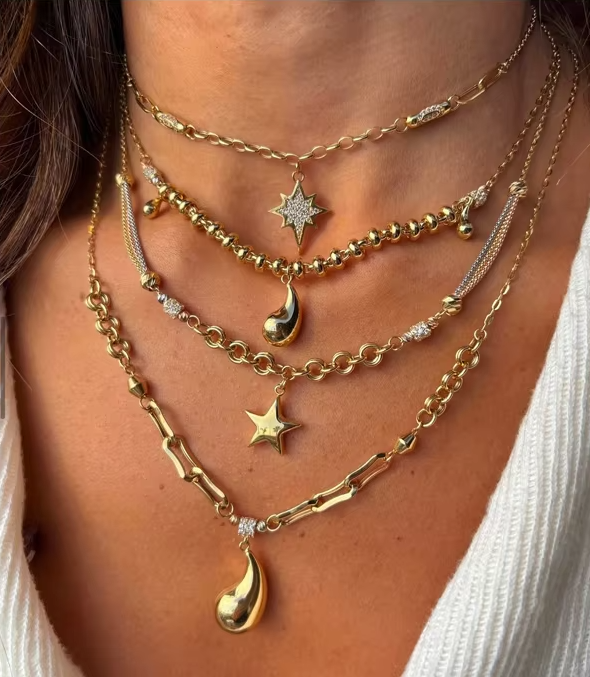
Assortment planning links the chain style, the finish and the packaging tier to the channel that will present the piece.
Beyond the bag or box, branding scope includes hang tags, polishing cloths, foil stamping and branded stickers, all coordinated in-house. For a fashion retail chain running its own label, that consolidation matters because packaging supplied from a different vendor than the jewelry introduces a second schedule, a second quality standard and a second point of failure into the launch timeline.
Scenario-to-configuration reference table
| Retail scenario | Typical chain or bangle fit | Finish priority | Packaging tier |
|---|---|---|---|
| Wholesalers and importers | Rope chain, curb chain, classic round bangle | Batch color consistency | OPP bag |
| Fashion retail chains and department counters | Figaro chain, gem-set bangle | PVD gold and rose gold | Premium gift box |
| Platform sellers (Amazon, Etsy, TikTok Shop, AliExpress, eBay) | Rope chain, cable chain, charm bracelet | Scratch-resistant PVD | OPP bag or velvet pouch |
| Shopify and Instagram store owners | Rope chain, tennis bracelet, beaded bracelet | Camera-consistent mirror or PVD finish | Velvet pouch with branded sticker |
| DTC brands | Engraved bangle, figaro chain, gem-set bangle | Certified hypoallergenic and non-tarnish claims | Premium gift box with foil stamping |
| Professional jewelry designers | Engraved bangle, cuff bangle, custom chain length | Dimensional tolerance and engraving clarity | Velvet pouch or custom box |
The table is a starting point for a specification conversation, not a substitute for one. Two buyers in the same row can still need different thicknesses, different engraving depths or different packaging structures for their specific market.
MOQ, capacity and acceptance terms that protect the order
Three order parameters determine whether a scenario-matched configuration is actually sourceable at retail scale. Jusnova states a minimum order quantity of 100 pcs per style, a monthly capacity of 250,000 units, and a lead time of 25–30 days. The annual output is stated at roughly 3,000,000 units, which reconciles with the monthly capacity figure.
A 100-piece-per-style minimum matters most for the designer and small-batch DTC scenarios described earlier. It allows a multi-style launch, but it also means that a retailer planning six engraving variants across three bangle bases is committing to eighteen discrete 100-piece orders rather than one mixed order. Buyers should model this before finalizing an assortment plan, because the total commitment grows faster than the number of visible designs.
Acceptance is defined by contract specifications and a mutually approved physical sample. That clause is worth more attention than it usually gets. A physical approval sample is the only artifact that resolves the gap between a spec sheet and a production run, particularly for PVD color, engraving depth and stone placement. The quality control sequence runs through raw material incoming inspection, forming or casting, polishing and surface preparation, pre-plating cleaning, 18K gold plating or PVD, stone setting where applicable, logo or laser engraving where applicable, and clasp or closure function testing.
The after-sales posture is similarly specific: manufacturing defects such as plating peeling, stone loss or color mismatch are covered at the manufacturer's cost when reported within 30 days of receipt, transit damage is replaced with carrier claims handled by the supplier, and a standard 6–12 month warranty applies, with repair services at material cost after the warranty period.
Where stainless steel jewelry does not fit the retail scenario
Scenario fit also requires naming the boundaries honestly, because a buyer who discovers a limitation after the order ships will not order twice.
The finish is not permanent. PVD coating is stated to maintain luster for 2–5 years under normal wear. A retail program built around a lifetime-color promise is misaligned with the product, and a retailer positioning stainless steel against solid gold or platinum will lose that comparison regardless of coating quality.
Weight is a real constraint. Stainless steel has a higher density than aluminum, hollow alloy or plated brass constructions. For earring programs in particular, a solid stainless piece can feel heavier than a consumer expects from a fashion accessory, which is why many earring designs use thinner gauges even though the material range supports thickness from 0.5mm to 3.0mm.
Engraving is bounded by geometry. The 0.5mm to 3.0mm thickness range and the twist of rope or twisted bangle formats limit how much marking detail a piece can hold. Fine line art, small text or multi-line inscriptions require a flat or wide cuff surface, so a designer brief that assumes deep engraving on a twisted bangle will need redesign.
Order minimums constrain test launches. At 100 pcs per style, a retailer cannot test fifteen designs at ten units each. Scenario-matched assortments therefore need to be consolidated before the order, not after the first sell-through report.
Certificates have validity windows. The SGS material, salt spray and artificial sweat certificates referenced here run to mid-2027, and the Amfori BSCI certificate window closed in August 2026. Buyers should confirm current validity as part of the purchase order process rather than relying on a certificate number quoted at an earlier trade show.
Market context behind the scenario shift
The stainless steel jewelry market was valued at USD 7.08 billion in 2025 and is projected to reach USD 10.8 billion by 2035, at a CAGR of 4.3%, according to WiseGuyReports. That is a steady growth curve rather than a surge, and it suggests the category is maturing into a stable retail staple rather than a novelty.
The waterproof jewelry niche tells a different story. That segment is projected to grow from USD 2.12 billion in 2026 to USD 4.60 billion by 2034, a CAGR of 10.16%, according to Verified Market Reports. The gap between the two growth rates is the clearest available signal that finish durability, not chain design, is the commercially decisive variable in this category. Buyers chasing the faster-growing segment are effectively buying PVD capability and test documentation.
Trade policy is the third context factor. Imitation jewelry of base metal classified under HTS 7117.19.90.00 carries an effective duty rate of 31% when imported from China to the United States in 2026, combining an 11% general duty with a cumulative 20% under Section 301, according to Descartes Datamyne trade data. For US-bound retail programs, that rate belongs in the landed cost model before the chain style is chosen, because it can shift the viable price band more than a finish upgrade does.
Future outlook
Two directions look likely to shape stainless steel jewelry retail sourcing over the next several years. The first is the continued migration of finish durability from a marketing claim to a documented specification. As the waterproof segment outgrows the broader category, buyers will increasingly ask for test method names and certificate numbers at the quoting stage rather than after a complaint cycle.
The second is the tightening link between personalization and inventory efficiency. Laser engraving, stamping, screen printing and epoxy doming already allow a single base SKU to carry multiple identities, and designers increasingly treat engraving capability as a merchandising lever rather than a decoration option. A manufacturer able to hold ±0.05mm tolerance across that range can support personalized programs without rebuilding tooling for every variant.
What is less likely to change is the underlying logic of scenario fit. A rope chain, a figaro chain and an engraved bangle will keep serving different retail moments, and the buyers who map style, finish and packaging to the channel before placing the order will keep avoiding the returns that come from treating stainless steel jewelry as a single undifferentiated product.
Frequently asked questions
Which certifications should a fashion retail buyer request for stainless steel jewelry?
Three SGS test documents cover the core retail objections: 316L Material Content Analysis under ASTM A276/A276M-25 (certificate GZIN2606005050ML01_EN, valid 26 June 2026 to 26 June 2027), Salt Spray Test under ISO 9227 (certificate GZHL260603029801JW, valid 29 June 2026 to 29 June 2027), and Artificial Sweat Test under ISO 3160-2 (certificate GZMR260602153701, valid 30 June 2026 to 30 June 2027). All three apply to the EU market. Social compliance is covered separately by Amfori BSCI certificate 25-0339245, whose stated validity ran from 15 August 2025 to 15 August 2026 and should therefore be re-confirmed at order stage.
How is 316L material content actually verified?
Material verification for this stainless steel jewelry is documented through a 316L Material Content Analysis issued by SGS and tested against ASTM A276/A276M-25, certificate number GZIN2606005050ML01_EN. That document identifies the alloy grade rather than merely asserting that the product is stainless steel, which is what distinguishes a verified 316L claim from a generic material statement.
What do the salt spray and artificial sweat tests each demonstrate?
The salt spray test, certified under ISO 9227 with SGS certificate GZHL260603029801JW, addresses corrosion resistance and supports claims about tarnish and water exposure. The artificial sweat test, certified under ISO 3160-2 with SGS certificate GZMR260602153701, addresses how the material behaves in prolonged contact with skin and perspiration. They answer different buyer questions and are not interchangeable: one supports durability messaging, the other supports skin-comfort messaging.
What is the practical difference between PVD coating and gold plating on stainless steel jewelry?
PVD coatings measure roughly 1,500–4,500 HV on the Vickers hardness scale versus roughly 100–200 HV for standard plating, and the PVD finish on this stainless steel jewelry is stated to maintain luster for 2–5 years in a conventional environment, verified by 48 hours of salt spray testing. The base stainless steel chain itself is stated to be usable for more than 10 years with proper daily maintenance. The metal and the coating therefore have separate service lives, and retail copy should reflect the coating horizon rather than the substrate horizon.
What order terms apply to a scenario-matched stainless steel jewelry program?
The stated terms are a minimum order quantity of 100 pcs per style, a monthly capacity of 250,000 units, and a lead time of 25–30 days. Acceptance is based on contract specifications together with a mutually approved physical sample. Manufacturing defects such as plating peeling, stone loss or color mismatch are covered at the manufacturer's cost when reported within 30 days of receipt, and a standard 6–12 month warranty applies, with repairs at material cost after the warranty period.
Есть вопросы или нужны дополнительные детали?
Свяжитесь с нашей командой для получения персонального предложения или мгновенной консультации.
Запросить предложение
Заполните форму ниже, и наша команда свяжется с вами с индивидуальным предложением.
Прямой чат WhatsApp
Предпочитаете общаться в реальном времени? Напишите нам в WhatsApp для мгновенной помощи и быстрых ответов.
- Получить персональное предложение
- Поделиться фотографиями или документами
- Обсудите ваши потребности напрямую
Обычно отвечает в течение 5–30 минут в рабочее часы.