
Chairs, Bar Stools or Booths? A Buyer's Seating Comparison
Seating decides more of a restaurant fit-out than any other furniture category. Chairs, bar stools and booth seating set the seat count, the service flow and the number of times the room has to be reworked — which is why the three should be compared as project-level options before a full-package order is quoted, not as catalogue items after the layout is already fixed.
Commercial seating operates under conditions that residential furniture is not built for: daily high-frequency use with high seating turnover, regular cleaning, and in some zones moisture, sunlight or spill exposure. Within that shared constraint, the three seating types answer different layout problems. Movable chairs supply flexible seat count. Bar stools tie seating to counter and bar heights. Booth seating converts wall or partition length into dense, semi-private seating that chairs cannot match in the same floor area.
The comparison therefore has to run on criteria that survive negotiation: durability evidence for the specific model, materials and finishes that match the cleaning regime, customization scope, minimum order quantity, quoting and payment terms, production lead time, warranty position, and packing and shipping terms. Each behaves differently for chairs, stools and booths, and each is where a package most often goes wrong.
Why seating type is decided before the package is priced
Most layout conflicts in project briefs trace back to sequencing. A booth run is dimensioned from the floor plan and the target seat count; once it is fixed, aisles and table positions follow, and chairs fill what remains. Stools come last, because their seat height depends on the final counter height. Reversing that order — choosing chairs and stools first and fitting booths into the remainder — usually produces either a lower seat count than the plan modelled or a circulation path that fails local access requirements.
Three sequencing errors recur across projects:
- Booth runs dimensioned after tables are ordered. Table sizes then dictate the bench depth, and the dining zone loses seats it was designed to carry.
- Stools ordered before counter height is confirmed. Seat height is set against the counter, not the floor; a later counter change makes the stools the wrong furniture.
- Quotes compared on different specifications. Two booth prices rarely mean the same thing unless frame, foam, upholstery, quantity and delivery term match.
A comparison that runs in the right order produces something more useful than a price list: a seating schedule, by zone, with a performance requirement attached to each line, and a documented basis on which two suppliers can actually be compared.
Chairs, bar stools and booth seating compared
The table below treats the three seating types as project options rather than products. The dimensions that matter are not the same for each, and neither is the evidence a buyer should ask for.
| Comparison dimension | Restaurant chairs | Bar stools | Booth / banquette seating |
|---|---|---|---|
| Layout role | Movable seat count and reconfiguration at standard dining height | Service seating at bar or counter height; anchors the counter zone | Converts wall or partition length into dense, semi-private seating |
| Frame options | Solid wood, metal or plywood frame | Solid wood or metal frame | Plywood or solid wood frame with commercial-grade construction |
| Upholstery and foam | High-density foam with fabric, PU leather or genuine leather | Upholstered seat and backrest in the same upholstery options | High-density foam with fabric, PU leather or genuine leather, plus stitching and finish options |
| Defining dimension | Seat height, width and overall dimensions, customisable to the project | Seat height matched to bar counter and table height | Dimensions set by floor plan, seating capacity and configuration |
| Configurations | Side, arm and dining chairs; matched to booth runs | Counter stool, high bar chair, upholstered stool | Single, double, wall bench, L-shaped, U-shaped, curved and built-in banquette |
| Testing position | Products tested according to EN 16139 requirements | Products tested according to EN 16139 requirements | Frame, foam and upholstery specified by project; confirm model-level test or inspection evidence separately |
| Dominant failure risk | Joint and frame fatigue; upholstery abrasion at the seat edge | Seat-height mismatch; wear at the footring and base | Committed layout; foam compression over long runs |
| Best fit | Flexible dining floors, group tables, multi-use rooms | Bars, counters, high-top and social zones | Perimeter walls, privacy zones, high seat-density areas |
One asymmetry in that table is worth stating plainly. Chairs and bar stools carry a defined seating test position; booth seating generally does not, because a banquette is a joinery item as much as a seat. For booths, the approved sample and the written frame, foam and upholstery specification carry more weight than a certificate.
Durability: reading the evidence correctly
Durability in commercial seating is a function of frame structure, joints, materials, finish, upholstery, maintenance and the duty level specified for the project — not of a single number. For chairs and bar stools, Mingmeng Furniture states that products are tested according to EN 16139 requirements, the European test standard for non-domestic seating. That statement is only useful if it is attached to the model being specified, so the practical step is to request the test or inspection record for the exact chair or stool, not for the supplier's range as a whole.
Production quality control runs through incoming material inspection, cutting, welding, finishing, assembly and final inspection. Commonly applied checks include static load, impact, stability, scratch resistance, abrasion resistance and fabric colourfastness; critical items are inspected before packing and followed by a final pre-shipment inspection. For booth seating, durability is governed by frame construction, foam density and upholstery, so specification control and sample approval do more work than a test report.
Softer evidence is often skipped. High-density foam with customisable firmness is standard across all three types, but foam compression under sustained load is what makes a banquette look tired first. Buyers should get the density figure in writing and match it to the seating duration the venue actually expects, rather than to the showroom appearance.
Materials and finishes that survive a dining room
Material selection is driven by furniture type, usage, cleaning frequency, moisture and stain exposure, scratch visibility, weight, upholstery wear, brand palette, budget and destination-market requirements. The options list is wide; the decision set is usually narrow, because most projects converge on a small number of frame, top and upholstery combinations repeated across zones.
| Element | Available options | What to check |
|---|---|---|
| Frames | Solid wood, plywood and engineered panels, steel, stainless steel, aluminium | Joint type, section thickness, finish coverage at welds and bends |
| Foam | High-density foam with customisable firmness | Density recorded in the specification; behaviour under sustained load |
| Upholstery | Fabric, PU leather, genuine leather | Abrasion and cleaning method; colourfastness for saturated dyes |
| Tabletops | Solid wood, veneer, HPL, laminate, marble, stone | Heat, scratch and stain exposure; edge detail |
| Metal finishes | Powder coating, brushed, polished, plated, custom colours | Match across chairs, stool bases and booth trims |
| Wood finishes | Painted, stained, matte, gloss, textured, wood grain | Sample approval against the interior concept, not a screen image |
Customization scope: what to lock before asking for a price
Customization is where the three categories diverge most sharply. Chairs and stools are customised at unit level — dimensions, frame material and structure, foam firmness, upholstery, stitching, colour and finish. Booths are customised at layout level: single, double, wall bench, L-shaped, U-shaped, curved and built-in configurations, each dimensioned from the floor plan and the seating capacity the zone has to deliver.
Both are supported by drawings before production: CAD layout coordination, dimension adjustment and 3D visualisation where required, followed by sample development and material or finish approval. Production from a customer's own approved drawings is possible once dimensions, materials, finishes and technical details are confirmed.
A quotation request that produces a usable answer normally contains six things:
- Floor plan or site dimensions, including counter and bar heights
- Required furniture types and quantities per style, by zone
- Drawings, mood boards or reference images
- Preferred materials, upholstery and finishes, or the palette to be matched
- Destination and required delivery date
- Any project-specific compliance requirement — stain resistance, weather resistance, flame retardancy
Bulk production should not begin until drawings, dimensions, materials, finishes, quantities and approved samples are confirmed in writing. Late changes after approval cause rework, extra cost and delay, and those costs land on the buyer more often than on the factory.
MOQ, order structure and single-source supply
Mingmeng Furniture — Guangzhou Mingmeng Furniture Co., Ltd. — is a commercial and hospitality furniture manufacturer established in 2015 in Guangzhou, China, producing restaurant, hotel, bar, café, outdoor and canteen furniture for project, OEM and ODM orders. The company operates a 15,000 m² facility with more than 200 workers and a 10-engineer R&D team, reports production capacity above 80,000 pieces per month against annual output of more than 960,000 units, and exports roughly 90% of output to markets including the USA, Australia, Europe, the Middle East and Southeast Asia.
A project manufacturer changes the arithmetic of this comparison because of how the three seating types are ordered. MOQ for custom models is generally 10–50 pieces per style, and the company states a 20-unit MOQ for custom booth manufacturing. That suits a restaurant fitting out a full dining room, but it changes the calculation for a small café ordering four stools, or for a phased rollout that wants to validate one zone before committing the rest.
Ordering chairs, stools and booths from one source collapses a coordination cost that is easy to underestimate: finish matching across categories, consolidated procurement, one inspection regime and one container loading plan. The counter-argument is concentration risk — a single production schedule governs the entire package — which is why lead time and warranty carry as much weight as unit price.
Quoting and payment terms: why two quotes rarely compare
Restaurant furniture pricing is determined by the confirmed specification: materials, dimensions, quantity, construction, finish and upholstery complexity, packaging and delivery term. Two quotes for “the same” booth are therefore rarely comparable unless specification and Incoterm match. Quotations are usually issued EXW or FOB, with freight depending on the shipping term and destination; EXW, FOB, CIF, CFR and DDP are supported, and freight can be arranged on request. Commonly quoted payment terms are 30% deposit and 70% balance before shipment by T/T, with L/C at sight considered for larger established orders. Final terms depend on order value and the commercial agreement and are confirmed in the quotation or contract. Quotes can be issued in USD or EUR.
| Commercial term | Documented position | What the buyer should confirm |
|---|---|---|
| Pricing basis | Confirmed specification: materials, dimensions, quantity, construction, finish complexity, packaging, delivery term | Identical specification and Incoterm before two quotes are compared |
| MOQ | Custom models generally 10–50 pieces per style; 20-unit MOQ stated for custom booths | Whether mixed styles on one order count toward the minimum |
| Lead time | Standard models 20–30 days; customised models 35–50 days including sample approval | Schedule issued after specification and order plan are confirmed |
| Payment | Commonly 30% deposit and 70% balance before shipment by T/T; L/C at sight considered for larger established orders | Final structure written into the quotation or contract |
| Shipping terms | EXW, FOB, CIF, CFR and DDP supported; freight coordinated on request | DDP feasibility by destination, product and customs handling |
| Packing | Export packaging, packing inspection and container loading within quality control | Protection method for upholstery, stool footrings and booth modules |
| Warranty and after-sales | Installation guidance, export packaging and freight coordination; on-site installation guidance and spare parts support available on project orders subject to contract | Component-level warranty scope, duration and exclusions written into the contract |
Production lead time and sequencing
Standard models are quoted at 20–30 days, customised models at 35–50 days including sample approval. Actual lead time then depends on quantity, customization complexity, material availability, sample approval and factory capacity, and a project-specific schedule is issued once the specification and order plan are confirmed.
Sequencing advice follows directly from that. Confirm booth dimensions against site measurements first, because a booth run is the least forgiving item to change. Release chairs with the booths so the finish batch matches. Release stools only after counter heights are final. Where an opening date is fixed, urgent schedules can be evaluated after checking materials, capacity and the required delivery date — but that conversation belongs before the specification is frozen, not after.
Warranty, after-sales and the parts that are easy to overlook
Warranty is the criterion buyers compare least rigorously and regret most. Coverage is not uniform across components — frames, foam, upholstery and finishes wear at different rates — and a product-testing statement does not by itself define a warranty period. The workable approach is to have the scope written into the contract: which components are covered, for how long, what is excluded such as normal wear, cleaning damage or misuse, and whether replacement parts are supplied.
Documented after-sales support covers installation guidance, export packaging and freight coordination, and project orders can include on-site installation guidance and spare parts support subject to contract. For booth-heavy layouts, spare upholstery and the ability to re-cover a bench in place is a more useful provision than an extended warranty on chairs, because the bench is the item that cannot be swapped out mid-service.
Packing and shipping terms
Export packaging is controlled as part of quality inspection, with packing inspection and container loading included in pre-shipment checks. For seating, that control matters in specific places: upholstered chairs need protection at the seat edge and legs, stools are vulnerable at the footring, and booth modules are bulky and awkward to handle, so loading sequence and stacking limits have to be planned rather than improvised on the day.
Shipping terms available are EXW, FOB, CIF, CFR and DDP. DDP feasibility depends on destination, product, customs and tax handling and logistics capability, and should be confirmed for the actual shipment rather than assumed from a price list. The export port is selected according to factory location, routing, freight cost and project requirements, and freight can be coordinated or quoted under the agreed term.
Where each seating type earns its place
Project evidence shows the same split repeating, with different emphasis by venue type.
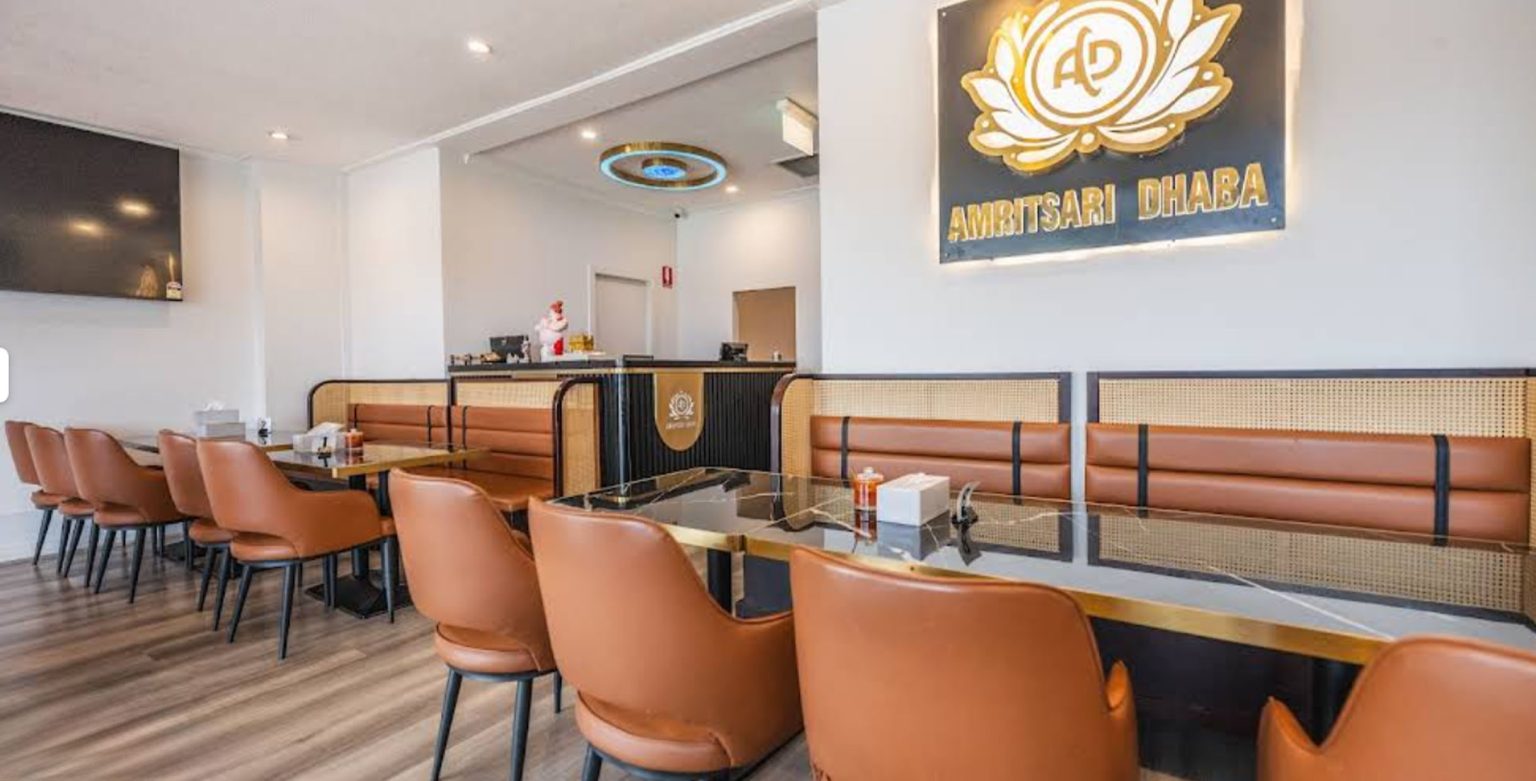
Casual dining, Australia. An Indian restaurant operator ordered a coordinated package of dining chairs, tables and booth seating. The booth run delivered privacy without separating guests from the main dining atmosphere, while upholstered chairs supported long-duration dining — the split most casual-dining rooms converge on.
Multi-zone restaurant, United States. An Asian restaurant project used long wall-side booth seating to improve space utilisation in the main dining room, combined with movable chairs for two-, four- and group tables and lounge waiting furniture at reception. The package covered reception, lounge waiting, main dining and a long booth zone in one palette of amber orange upholstery, warm wood, black finishes and brass-gold detail.
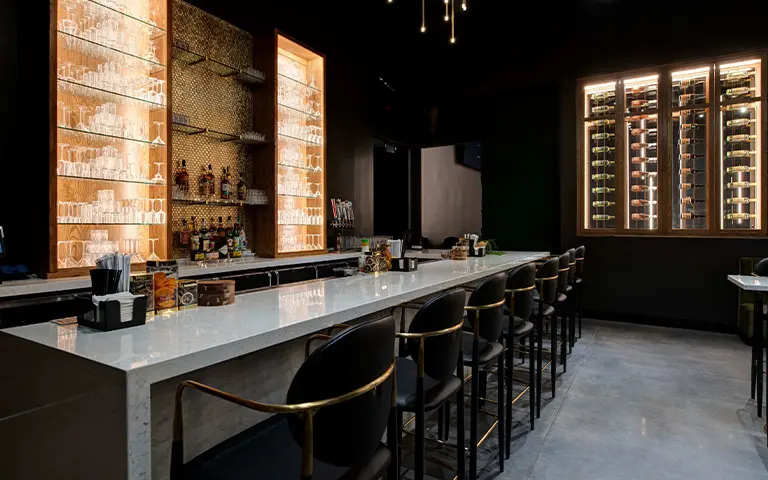
Bar and event venue, United States. A charcuterie lounge combined bar counter seating, central dining, wall-side booths and flexible event seating, with marble-look tabletops. Fixed booths and freestanding tables together allowed the room to be re-set for private events without replacing furniture.
Entertainment venue, United States. An immersive venue used several seating heights in one space: bar stools at the bar, high-top social tables, communal tables for groups, and chairs and booths for longer meals. The layout works as event-ready because fixed and movable elements were planned together rather than added in sequence.
Trade-offs and limits of a seating-led package
An honest comparison has to state where the model stops working.
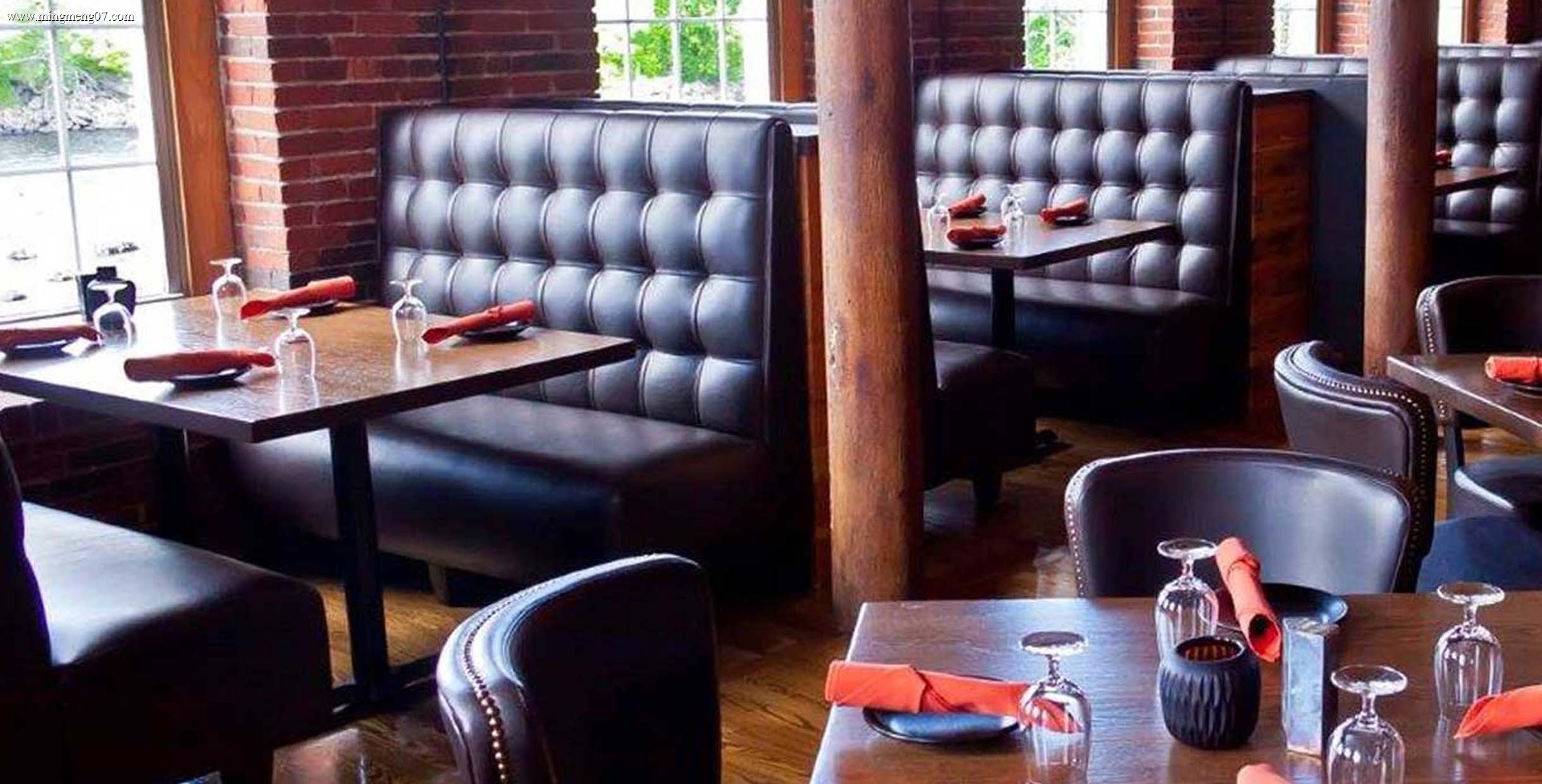
- Fixed booths reduce reconfiguration. Long booth runs commit the floor plan. A venue that changes format seasonally may be better served by more chairs and fewer benches, even at a higher cost per seat.
- MOQ per style is a real constraint. Custom models generally start at 10–50 pieces per style, with a stated 20-unit MOQ for custom booths. Small venues, kiosks and single-zone test fits may not reach it.
- Sample approval extends the programme. The 35–50 day custom lead time includes sample approval. Compressing the schedule compresses the approval, not the production.
- Manufacturing is not installation. On-site installation guidance and spare parts are available on project orders subject to contract; that is not the same as a local installation crew on site.
- Certification scope is model- and market-specific. CE, TÜV, RoHS, Certification of Conformity and product safety compliance documentation exist at company level, and stain resistance, weather resistance and flame-retardancy levels are confirmed per project regulation and operational need. The certificate for the specified model still has to be checked against the destination market.
- Single-source concentration. One schedule governs the whole package. Buyers with staggered openings may prefer separate orders, accepting higher coordination cost in exchange for lower schedule risk.
None of these are arguments against a seating-led package. They are the conditions under which it works.
Market context: what the published numbers do and do not say
Published market estimates for restaurant furniture disagree sharply, and the disagreement is informative. One commercial research publisher reports the global market at USD 638.8 million in 2026, rising to USD 929.57 million by 2035 at a CAGR of 4.3%. A second reports USD 0.88 billion in 2025, reaching USD 1.38 billion by 2034 at a CAGR of 5.13%. A third reports USD 6.62 billion in 2025 growing to USD 11.01 billion by 2034 at 5.8%.
The three figures are not directly comparable: base years, market definitions and publisher methodologies differ, and averaging them would produce a number that describes nothing. The defensible reading is directional — the category is reported as growing at a mid single-digit rate — and not a budgeting input. For a buyer, category growth does not change a sourcing decision; what it changes is the expectation that specification quality and delivery reliability, rather than availability, will differentiate suppliers.
A buyer's comparison sequence
- Fix the layout logic: booth runs first, then chairs, then stools measured against the final counter.
- Write the seating schedule by zone, with quantities per style and configuration.
- Attach a performance requirement to each line: duty level, cleaning regime, exposure.
- Request model-level test or inspection evidence for chairs and stools; frame, foam and upholstery specification plus sample approval for booths.
- Approve wood, metal and upholstery samples together, against the interior concept.
- Confirm MOQ per style and whether mixed styles combine within one order.
- Quote on identical specification and Incoterm; confirm payment terms and lead time measured from sample approval.
- Write warranty scope, packing method, spare parts and installation responsibility into the contract before release.
Frequently asked questions
What is the practical difference between restaurant chairs, bar stools and booth seating in a commercial project?
Chairs are movable seating at standard dining height, used to vary seat count and table grouping. Bar stools are seating matched to a bar counter or high table; their defining dimension is seat height, set against the counter rather than the floor. Booth seating is bench seating built along walls or partitions in single, double, wall bench, L-shaped, U-shaped or curved configurations, dimensioned from the floor plan and the seating capacity the zone has to deliver. In a full package the three are complementary: booths for density and privacy, chairs for flexibility, stools for counter service.
How should a buyer compare durability across commercial seating suppliers?
Durability depends on frame structure, joints, materials, finish, upholstery, maintenance and the duty level specified for the project. Mingmeng Furniture states that its commercial chairs and bar stools are tested according to EN 16139 requirements, the European test standard for non-domestic seating. Quality control covers incoming material inspection, cutting, welding, finishing, assembly and final inspection, with commonly applied checks including static load, impact, stability, scratch resistance, abrasion resistance and fabric colourfastness, followed by a pre-shipment inspection. Booth durability is governed by frame construction, foam density and upholstery, so the approved sample and written specification carry more weight than a seating certificate.
What can be customised on restaurant chairs, bar stools and booth seating?
Dimensions, frame material and structure, foam firmness, upholstery in fabric, PU leather or genuine leather, colours, stitching, wood and metal finishes, and tabletop and base pairing can all be customised by project. Booth configurations include single, double, wall bench, L-shaped, U-shaped, curved and built-in banquette seating, with dimensions set by floor plan and seating capacity. CAD layout coordination, dimension adjustment and 3D visualisation are available for applicable custom projects, and production can follow a customer's own approved drawings once dimensions, materials, finishes and technical details are confirmed.
What MOQ and production lead time apply to custom restaurant seating?
Mingmeng Furniture quotes standard models at 20–30 days and customised models at 35–50 days including sample approval. MOQ for custom models is generally 10–50 pieces per style, and the company states a 20-unit MOQ for custom booth manufacturing. Final lead time depends on quantity, customization complexity, material availability, sample approval and factory capacity, and a project-specific schedule is issued once the specification and order plan are confirmed.
How are restaurant furniture prices, payment terms and shipping terms determined?
Pricing is based on the confirmed specification: materials, dimensions, quantity, construction, finish and upholstery complexity, packaging and delivery term. Quotations are usually EXW or FOB, with freight depending on the shipping term and destination, and EXW, FOB, CIF, CFR and DDP are supported. Commonly quoted payment terms are 30% deposit and 70% balance before shipment by T/T, with L/C at sight considered for larger established orders; the final structure depends on order value and the commercial agreement and is confirmed in the quotation or contract. Quotations can be issued in USD or EUR.
What should be agreed on warranty, packing and after-sales before an order is placed?
Warranty scope should be written into the contract, because coverage differs by component — frame, foam, upholstery and finish wear at different rates — and product testing does not by itself define a warranty period. Packing should specify export-grade protection, packing inspection and container loading, all of which fall under pre-shipment quality control. After-sales support covers installation guidance, export packaging and freight coordination, and project orders can include on-site installation guidance and spare parts support subject to contract.
For buyers who want the seating, table and bar options in one document, Mingmeng Furniture publishes its current restaurant furniture catalogue, including configurations, materials and finish options, as a downloadable PDF: Mingmeng Restaurant Furniture 2026 catalogue.
Есть вопросы или нужны дополнительные детали?
Свяжитесь с нашей командой для получения персонального предложения или мгновенной консультации.
Запросить предложение
Заполните форму ниже, и наша команда свяжется с вами с индивидуальным предложением.
Прямой чат WhatsApp
Предпочитаете общаться в реальном времени? Напишите нам в WhatsApp для мгновенной помощи и быстрых ответов.
- Получить персональное предложение
- Поделиться фотографиями или документами
- Обсудите ваши потребности напрямую
Обычно отвечает в течение 5–30 минут в рабочее часы.