
Check Valve and Strainer Configuration FAQ for Buyers
Most specification failures in manual valves do not come from choosing the wrong valve family. They come from configuration details that are left open until the purchase order is already drafted: the end connection, the disc arrangement, the seat finish, the spring, the strainer construction, and the acceptance terms. This FAQ addresses those details for two product lines from EG Valves Manufacturing Co., Ltd — the CSV410 stainless steel check valve and the SNI501 cast iron strainer — and explains what each option means at the procurement stage.
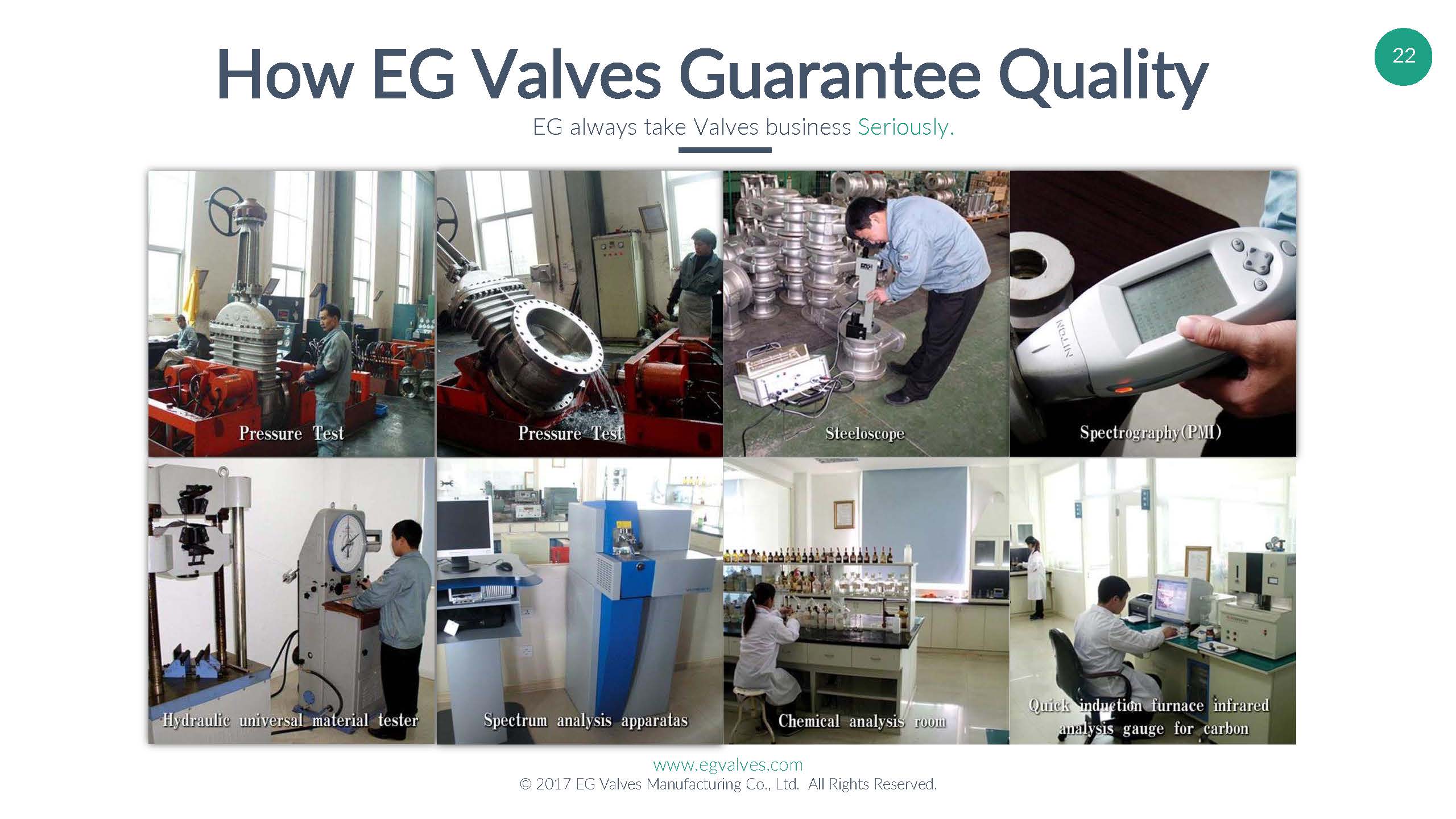
Inspection and documentation form part of the acceptance criteria for manual valve orders. Image: EG Valves Manufacturing Co., Ltd.
Why configuration questions surface late in the buying cycle
A check valve is often treated as a commodity item until the piping layout is fixed. At that point, the buyer discovers that the line requires a wafer pattern rather than a double-flanged body, that the strainer needs a basket configuration rather than a Y pattern, or that the service involves oxygen and therefore requires a cleaning step that was never quoted.
These are not commercial details that can be resolved after award. Each one changes the bill of materials, the inspection plan, and the delivery schedule. A wafer check valve and a double-flanged check valve are different products, not different packaging of the same product. A Y-strainer and a basket strainer occupy different spaces in the pipeline and serve different maintenance routines.
The practical implication is that buyers evaluating manual valves should ask configuration questions before the RFQ closes, not after. The sections below group those questions around the two products named in this article and around the purchasing terms that apply to EG Valves orders.
CSV410 check valve: what the configuration options mean for a buyer
EG Valves Manufacturing Co., Ltd is a valve manufacturer established in 2000 in Wenzhou, Zhejiang Province, China. The company produces gate, globe, ball, butterfly, check, and plug valves, together with strainers, and states that its products are manufactured to ANSI, DIN, BS, and JIS standards or to customer requirements. The CSV410 is its stainless steel check valve, available in stainless steel, duplex steel, and alloy steel bodies.
For a buyer, the CSV410 is best understood as a configurable platform rather than a single part number. The same valve family spans four disc arrangements, three end connection styles, and a size range from NPS 1/2 to 48 (DN15 to DN1200). Each selection has a procurement consequence.
| Configuration point | Options stated in EG product data |
|---|---|
| End connection | Wafer, Lug, Double Flange |
| Disc type | Dual Plate, Single Plate, Wafer Lift, Threaded |
| Size range | NPS 1/2 to 48 (DN15 to DN1200) |
| Pressure rating | Class 150 to Class 1500 (PN10 to PN160) |
| Seat faces | Lapped for smooth finish and superior sealing |
| Spring | High torsion Inconel springs for quick closing |
| Disc retention | Disc assembly secured in place by high strength key |
| Special service | Special cleaning for applications such as oxygen or chlorine |
The end connection decision is usually driven by the piping method rather than by the valve itself. A wafer body is clamped between two flanges and occupies minimal face-to-face length. A lug body carries threaded inserts that allow the valve to be bolted to a flange on each side and, in many layouts, removed from one side without disturbing the rest of the line. A double-flanged body provides its own flanges and is specified where the piping design calls for a flanged connection at both ends. Buyers should confirm which pattern the piping drawings actually require before comparing quotations, because suppliers may quote different patterns at different prices.
The disc type is the second major variable. Dual plate, single plate, wafer lift, and threaded constructions are all listed in the CSV410 range, and they are not interchangeable across every installation. A buyer should state the disc type explicitly in the RFQ rather than asking for a stainless steel check valve and assuming the supplier will select the arrangement. Where the line size, flow direction, and available space are known, the specification should record them so that the supplier can confirm the correct disc arrangement in writing.
Size, pressure class, and the limits of the CSV410 range
The CSV410 covers NPS 1/2 to 48 (DN15 to DN1200) and Class 150 to Class 1500 (PN10 to PN160). Those limits are useful in both directions: they define where the product can be quoted and where it cannot.
A project that requires Class 2500 is outside the stated CSV410 pressure range. A line that requires a size below NPS 1/2 or above NPS 48 is also outside it. Buyers should treat these as specification boundaries rather than as negotiation points, because the published range reflects the configurations the manufacturer lists for this model.
Within the range, the pressure class and size combination should be checked against the project piping class rather than against a generic catalogue page. Class 150 and PN10 are not identical ratings, and a project that specifies PN16 should not be supplied against a Class 150 assumption without a documented cross-check. The same discipline applies to end connections: a Class 150 wafer valve and a Class 150 double-flanged valve may serve the same pressure duty but require different gaskets, bolts, and installation space.
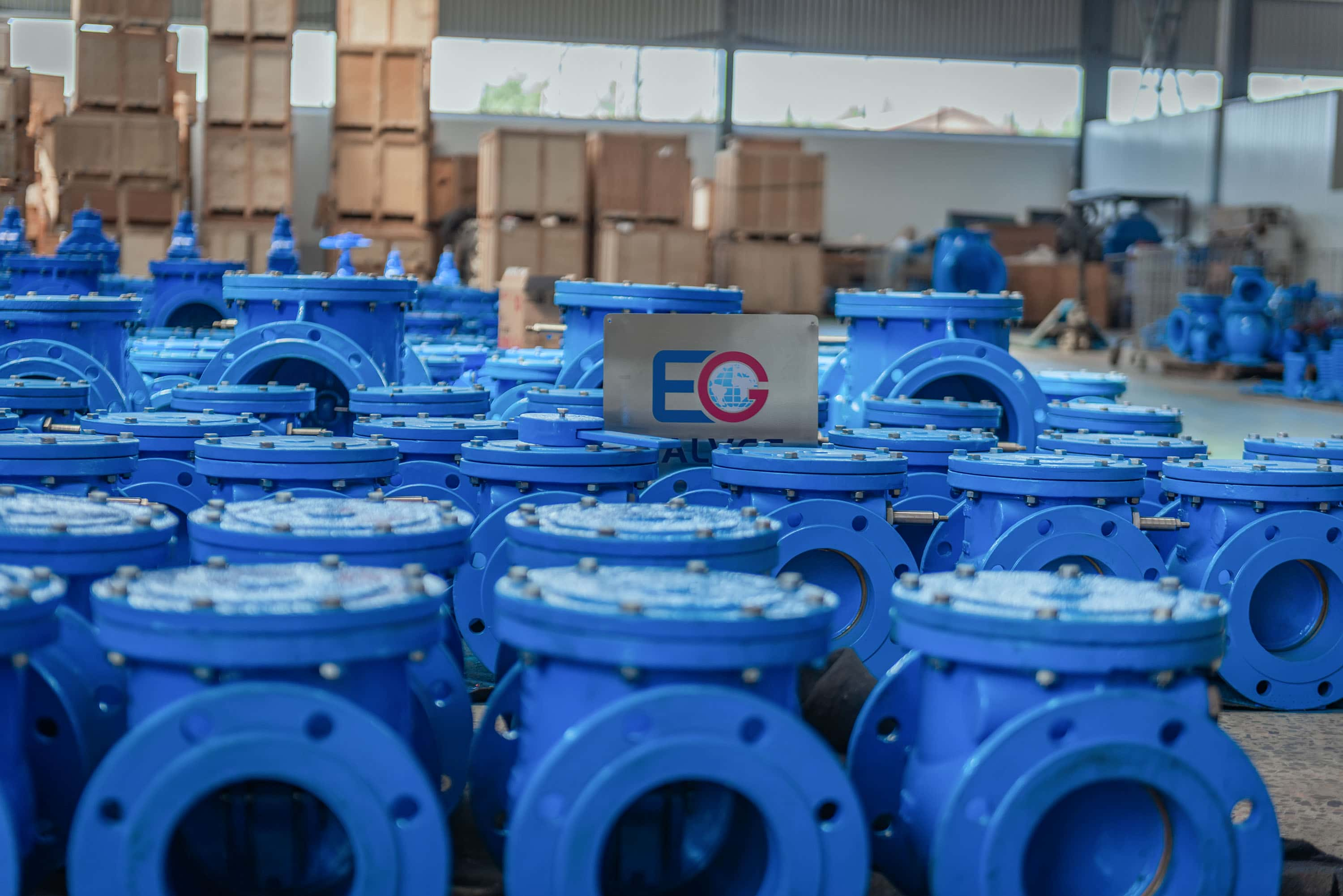
Check valve bodies are selected by body material, pressure class, and end connection. Cast iron and stainless steel ranges serve different duty envelopes. Image: EG Valves Manufacturing Co., Ltd.
Seat faces, springs, and oxygen or chlorine service
Three details in the CSV410 specification deserve separate attention because they affect performance and acceptance rather than appearance.
The first is the lapped seat face. EG states that seat faces are lapped for a smooth finish and superior sealing. In procurement terms, this is a finishing requirement that should be confirmed in the inspection plan. A buyer who needs documented seat integrity should ask how the lapped face is checked before shipment, particularly where the valve is intended for tight shut-off duty.
The second is the spring. The CSV410 uses high torsion Inconel springs for quick closing. The spring influences how fast the disc returns to the seat when flow reverses, and it is therefore relevant to lines where reverse flow or water hammer is a design concern. The material specification of the spring should be recorded in the RFQ so that a substitute spring is not introduced without approval.
The third is special cleaning for oxygen or chlorine service. This is not a standard finish. It is an additional process applied when the application requires it, and it must be stated at the enquiry stage. A buyer sourcing for oxygen or chlorine duty should specify the cleaning requirement explicitly, because a standard production valve will not automatically include it.
For context on how such valves are verified, API 598, 11th Edition (2023), sets the shell test at 1.5 times the pressure rating at 38°C and requires zero visible leakage for resilient seats. That standard is a useful reference point when writing an inspection requirement, but it does not replace the manufacturer's own inspection plan. The two should be read together.
SNI501 cast iron strainer: construction and material choices
The SNI501 is EG's cast iron strainer, available in cast iron or ductile iron bodies. It is offered as a Y-strainer or a basket strainer, with a stainless steel screen available in a wide variety of meshes and perforations. The cover is bolted on for access to the interior during routine maintenance, and the body is finished with epoxy powder coating or paint coating.
| SNI501 specification | Stated range |
|---|---|
| Body material | Cast iron or ductile iron |
| Construction | Y-strainer type or basket strainer type |
| Screen | Stainless steel, wide variety of meshes and perforations |
| Cover | Bolted-on for routine maintenance access |
| Coating | Epoxy powder coating or paint coating |
| Size range | NPS 2 to 12 (DN50 to DN300) |
| Pressure rating | Class 125 / Class 150 (PN10 / PN16) |
| End connections | FF, RF, Threaded (NPT / BSP / BSPT) |
The construction choice is a layout decision. A Y-strainer is installed in a straight run and is commonly used where the strainer must fit within the line without a separate housing. A basket strainer uses a larger body with a removable basket and is typically selected where the maintenance routine involves frequent screen cleaning or where a larger screening area is preferred. The correct choice depends on the piping arrangement and on who will clean the screen, not on a generic preference for one type.
The body material choice between cast iron and ductile iron should follow the project specification rather than price alone. Both are listed for the SNI501, and the selection should be recorded on the data sheet. The screen specification matters equally: a stainless steel screen with the wrong mesh size will either pass particles that the downstream equipment cannot tolerate or create an excessive pressure drop. The mesh or perforation size should be stated numerically in the RFQ.
End connections for the SNI501 include FF, RF, and threaded NPT, BSP, or BSPT. Thread standards are not interchangeable. NPT uses a 60-degree thread form, while BSP uses a 55-degree thread form under ISO 7 or ISO 228, and mixing the two creates a joint that may not seal correctly. Buyers sourcing threaded strainers or valves should state the thread standard and size explicitly, especially where the mating pipe is imported from a different region.
Purchasing terms, inspection, and acceptance criteria
EG Valves publishes its purchasing terms through its procurement FAQ. The terms below are stated there and should be confirmed against the specific order.
| Commercial item | Stated position |
|---|---|
| Minimum order quantity | 1 pc for big size valve, 10 pcs for small size valve |
| Delivery terms | FOB, EXW, and CIF are all acceptable, depending on customer needs |
| Acceptance inspection | Most orders are inspected by the EG valve QC department; for some orders the customer arranges its own QC or a third-party inspection company |
| Payment terms | 30% T/T as deposit and the balance settled before shipment |
| Production lead time | Within 25 to 35 days |
| Quality documentation | EN 10204 3.1 material test certificates provided with every order |
The inspection clause deserves attention because it determines who signs the release. If the buyer intends to use a third-party inspection agency, that should be stated before the order is placed so that the inspection hold point can be scheduled. If the buyer intends to rely on the manufacturer's QC department, the buyer should still request the inspection record and the material certificate package with the shipment.
The MOQ structure reflects the practical difference between large and small valve sizes. A single large valve can be produced as a one-off order, while small sizes are grouped in batches of ten. Buyers planning mixed orders should therefore expect the small-size line items to carry the higher minimum quantity.
EG also states that it operates under ISO 9001-certified processes and holds API 600, API 6D, CE, and PED certifications, with ISO 45001 also listed. The API 6D certificate is numbered 6D-0506, was issued on 30 March 2024, and expires on 30 March 2027; its stated scope covers check valves, ball valves, and gate valves. The ISO 9001 certificate is numbered 00125Q33391R3M/3400 and expires on 22 May 2028. Buyers should verify that the certificate scope covers the specific product and size being purchased, because a management-system certificate and a product certificate are different forms of evidence.

Certificate scope should be checked against the specific valve family and size before it is accepted as qualification evidence. Image: EG Valves Manufacturing Co., Ltd.
Where these configurations fit: application notes
The CSV410 is listed for water treatment, HVAC, oil and gas, petrochemical, power generation, and general industrial pipelines. The SNI501 is listed for water treatment, HVAC, building services, municipal utilities, and general industrial pipelines. Those application lists are broad, and they should be narrowed at the project level by pressure class, fluid, and maintenance access.
In water treatment, check valves and strainers are typically specified together. The strainer protects downstream equipment, and the check valve prevents reverse flow when a pump stops. EG has supplied water treatment projects in Brazil, including 326 pieces of gate, butterfly, and check valves in PN16 and sizes from DN40 to DN2000 for a water storage and treatment project with an eight-year duration. The reported operating result was stable operation with low noise. That project illustrates the scale at which mixed valve packages are procured, but it does not by itself establish performance for every configuration in the CSV410 or SNI501 range.
In refining and petrochemical service, the pressure classes and materials move upward. EG has supplied a UAE refining project with 915 pieces of gate, globe, check, ball, and butterfly valves in Class 150 to Class 1500 and materials including WCB, WC6, WC9, and C5, in sizes from 2 to 36 inches. For such projects, the CSV410 would only be relevant within its stated stainless, duplex, or alloy steel body options and within its Class 150 to Class 1500 range.
HVAC and building services applications more often fall within the SNI501 range, where Class 125 or Class 150 and PN10 or PN16 are sufficient. In those systems, the practical questions are usually maintenance access and screen selection rather than high-pressure metallurgy.
Market context for manual valve specification
Manual valves remain a large category despite the growth of actuated valves. Vantage Market Research values the global manual valve market at USD 78.4 billion in 2025 and projects USD 117.17 billion by 2035. Grand View Research projects a 7.6% CAGR for the manual control valve segment over 2026 to 2036 and estimates that Asia Pacific accounted for 42.5% of the global gate valve market in 2025. These figures come from different research houses and use slightly different category definitions, so they should be read as directional market context rather than as a single reconciled forecast.
The procurement implication is less about market size and more about specification discipline. As supply chains diversify across Asia Pacific, Europe, and North America, buyers increasingly compare quotations from suppliers in different regulatory environments. That makes configuration documentation and certificate verification more important, not less. A quotation that lists only the valve family and the price is harder to compare than one that lists size, pressure class, body material, disc type, end connection, screen specification, inspection standard, and certificate scope.
Comparison with adjacent options and the boundaries of this range
The CSV410 and SNI501 are not universal solutions. Their limits are defined by size, pressure class, and body material, and buyers should compare them against adjacent EG ranges before assuming either product covers a given duty.
| Requirement | CSV410 check valve | CVI405 cast iron check valve |
|---|---|---|
| Size range | NPS 1/2 to 48 (DN15 to DN1200) | NPS 1-1/2 to 24 (DN40 to DN600) |
| Pressure rating | Class 150 to Class 1500 (PN10 to PN160) | Class 125 / Class 150 (PN10 / PN16) |
| Body material | Stainless steel, duplex steel, alloy steel | Cast iron or ductile iron |
| Construction | Dual plate, single plate, wafer lift, threaded | Swing, wafer, lift, and globe silent types |
| Requirement | SNI501 cast iron strainer | SNS505 cast steel strainer |
|---|---|---|
| Size range | NPS 2 to 12 (DN50 to DN300) | NPS 1/2 to 20 (DN15 to DN500) |
| Pressure rating | Class 125 / Class 150 (PN10 / PN16) | Class 150 to Class 600 (PN16 to PN40) |
| Body material | Cast iron or ductile iron | Carbon steel, stainless steel, alloy steel, duplex steel |
The main limitation is therefore one of envelope. The CSV410 is a stainless and alloy steel range with a high pressure ceiling but no cast iron option. Where the duty is low-pressure water or HVAC service at Class 125 or Class 150, the CVI405 cast iron check valve covers sizes from NPS 1-1/2 to 24 and may be the more appropriate family on material and cost grounds. Where the duty requires Class 2500, neither the CSV410 nor the CVI405 covers it.
The SNI501 has a narrower envelope than the SNS505. It stops at NPS 12 and Class 150 / PN16. A project that requires a strainer above NPS 12, or a pressure class above Class 150, falls outside the SNI501 range and should be reviewed against the SNS505, which extends to NPS 20 and Class 600. Buyers should make this comparison at the data-sheet stage rather than after the order is placed, because a size or pressure change may also change the flange drilling, the screen area, and the maintenance access requirements.
A second limitation is documentation scope. A certificate covering a product family does not automatically cover every size, material combination, or special cleaning process within that family. The buyer should request the certificate scope and confirm that the specific configuration is included.
Future outlook
Three trends are likely to shape manual valve specification over the next several years. The first is configuration documentation. As buyers compare suppliers across regions, the data sheet becomes the common language, and suppliers that can state size, pressure class, body material, disc type, end connection, and inspection standard in a structured format will be easier to evaluate.
The second is material traceability. EG already provides EN 10204 3.1 material test certificates with every order, and this type of documentation is becoming a routine expectation rather than a premium service. Buyers should expect to receive the certificate package with the shipment and should check that the heat numbers correspond to the components supplied.
The third is special service preparation. Cleaning for oxygen or chlorine service is a specific process rather than a standard finish, and as more projects specify these media, the cleaning requirement is likely to move from an optional note to a defined line item in the RFQ.
None of these trends changes the basic engineering. They change what buyers should ask for, and when. A configuration question asked before the order is placed is a specification decision; the same question asked after shipment is a non-conformance.
FAQ
What end connections are available for the CSV410 check valve?
The CSV410 is offered with wafer, lug, and double-flanged end connections. Wafer bodies are clamped between two pipe flanges, lug bodies carry threaded inserts for bolting to a flange on each side, and double-flanged bodies provide their own flanges at both ends. The correct choice depends on the piping layout and on whether the valve needs to be removed from one side during maintenance. Buyers should state the required pattern in the RFQ rather than leaving it to the supplier.
Which CSV410 disc type fits a wafer installation versus a flanged installation?
EG lists four disc types for the CSV410: dual plate, single plate, wafer lift, and threaded. The disc type and the end connection are separate decisions, and the product data does not state a fixed pairing between a specific disc type and a specific end connection. In practice, the buyer should specify both the end connection and the disc type, then ask the supplier to confirm in writing that the combination is available for the required size and pressure class. Where the installation space is restricted, the wafer pattern is usually the relevant starting point, but the disc arrangement still needs to be confirmed.
What are the maximum size and pressure class for the CSV410?
The CSV410 is listed for sizes from NPS 1/2 to 48 (DN15 to DN1200) and pressure classes from Class 150 to Class 1500 (PN10 to PN160). A requirement above NPS 48 or above Class 1500 falls outside the stated range for this model and should be reviewed against another valve family. The body materials listed for the CSV410 are stainless steel, duplex steel, and alloy steel; cast iron is not listed for this model.
Should a buyer specify a Y-strainer or a basket strainer in the SNI501 range?
The SNI501 is available in both Y-strainer and basket strainer constructions. The choice is a layout and maintenance decision rather than a performance ranking. A Y-strainer fits into a straight pipe run, while a basket strainer uses a larger body with a removable basket and is typically selected where screen cleaning is a routine task or where a larger screening area is preferred. Both constructions use a stainless steel screen available in a range of meshes and perforations, and both have a bolted-on cover for access to the interior.
Is cast iron or ductile iron the right SNI501 body material?
Both cast iron and ductile iron are listed for the SNI501, so the choice should follow the project specification and the piping class rather than a general preference. The SNI501 is rated for Class 125 or Class 150 and PN10 or PN16, in sizes from NPS 2 to 12 (DN50 to DN300). Buyers should record the selected body material on the data sheet so that the quotation and the delivered product match the specification.
What are EG Valves' purchasing terms and acceptance criteria?
EG states a minimum order quantity of 1 piece for big size valves and 10 pieces for small size valves. Delivery terms of FOB, EXW, and CIF are all acceptable depending on customer needs. Most orders are inspected by the EG valve QC department; for some orders, the customer arranges its own QC or a third-party inspection company to conduct the inspection. Payment terms are 30% T/T as a deposit with the balance settled before shipment. EN 10204 3.1 material test certificates are provided with every order, and the stated production lead time is within 25 to 35 days.
For buyers who need the full product data before drafting an RFQ, the EG Valves brochure is available for download: EG Valves product brochure (PDF).
Есть вопросы или нужны дополнительные детали?
Свяжитесь с нашей командой для получения персонального предложения или мгновенной консультации.
Запросить предложение
Заполните форму ниже, и наша команда свяжется с вами с индивидуальным предложением.
Прямой чат WhatsApp
Предпочитаете общаться в реальном времени? Напишите нам в WhatsApp для мгновенной помощи и быстрых ответов.
- Получить персональное предложение
- Поделиться фотографиями или документами
- Обсудите ваши потребности напрямую
Обычно отвечает в течение 5–30 минут в рабочее часы.