
Checking Dosing Pump Certifications and Rated Limits
When a dosing pump is being evaluated for a chemical or water treatment process, the datasheet and the certificate are usually the first filters. But the real question is not whether a pump has a flow rate or a CE mark; it is whether those claims are verifiable, whether the certificate covers the exact model under review, and whether the rated limits match the actual duty. This article explains how buyers can move from reading specifications to verifying them.
The verification gap in dosing pump procurement
Dosing pumps are not commodity circulators. They meter chemicals, coagulants, acids, and nutrients into processes where accuracy directly affects water quality, product consistency, and safety. The global dosing pump market was valued at approximately USD 8.86 billion in 2024, and Asia Pacific accounted for 41.8% of revenue in the same year. With that level of demand, the number of suppliers, brands, and private-label sources has expanded. Datasheets begin to look similar. The differentiating factor, increasingly, is not the claimed performance but the verifiable evidence behind it.
Buyers moving from research into evaluation face three constraint layers:
- Certification constraints — which standards apply, which authority issued the certificate, and which series are covered.
- Parameter constraints — flow rate, pressure, connection, protection rating, and the materials that limit chemical compatibility.
- Supplier constraints — testing procedures, MOQ, lead time, customization ability, and after-sales verification.
This article uses ZHEJIANG WRS MACHINERY EQUIPMENT CO., LTD (WRS), a Hangzhou-based dosing pump manufacturer, as a reference example. WRS operates a 15,000 m² facility, employs around 120 people, and produces approximately 30,000 dosing pump units per year. Its product range covers solenoid dosing pumps, digital dosing pumps, mechanical diaphragm pumps, piston pumps, hydraulic metering pumps, check valves, pulse dampeners, and complete chemical dosing systems.
CE certification as a compliance baseline
CE marking is typically the minimum entry requirement for dosing pumps sold into the European market. Under the EU Machinery Regulation, which replaces the Machinery Directive 2006/42/EC from 2027, CE marking remains mandatory for machinery including metering pump units. For buyers, CE is not a slogan; it is a document trail.
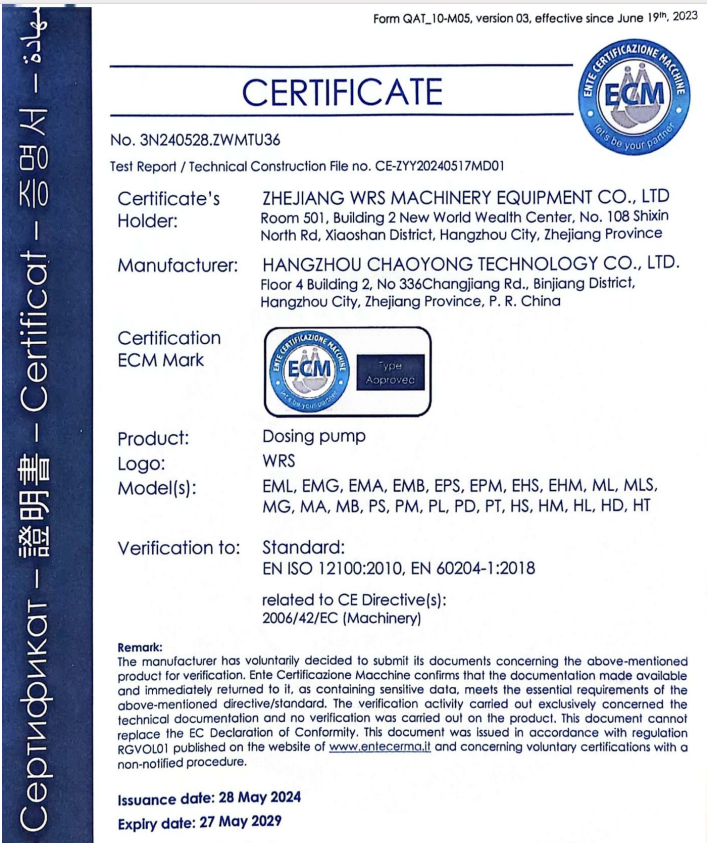
WRS holds a CE certificate issued by ECM, certificate number 3N240528.ZWMTU36, dated 2025-05-28 and valid until 2029-05-27. The certificate covers dosing pump series EML, EMG, EMA, EMB, EPS, EPM, EHS, EHM, ML, MLS, MG, MA, MB, PS, PM, PL, PD, PT, HS, HM, HL, HD, and HT. It cites EN ISO 12100:2010 for machinery safety and EN 60204-1:2018 for electrical equipment of machines.
Buyers should check four things before accepting a CE claim:
- The certificate number and issuing body.
- The exact product series and models listed in the certificate scope.
- The standards and versions referenced.
- The validity period.
The five rated values that define a dosing pump
A dosing pump specification can be reduced to five boundary values that define whether the pump can perform in a given duty. These are flow rate, discharge pressure, connection type, wetted material, and protection rating. Each constraint narrows the field of acceptable pumps.
| Product family | Type | Flow rate | Pressure | Materials | Protection |
|---|---|---|---|---|---|
| ML / EML | Solenoid dosing pump | 1–20 L/H | 1–10 Bar | PVC, PVDF, SS316 | IP65 |
| EMML / EMGP / EMAP | Digital dosing pump | 60–1000 L/H | 4 Bar | PVC, PVDF, SS316L | IP65 |
| MG / MA / MB | Mechanical diaphragm pump | 15–1800 L/H | 3–10 Bar | PVC, PVDF, SS316 | Optional |
| PM / PD | Piston dosing pump | 600 L/H | 8 Bar | SS316 | Optional |
| HS / HL | Hydraulic metering pump | 2–1600 L/H | 6–200 Bar | SS316 | Optional |
Diaphragm dosing pumps lead the global market with a 55.7% revenue share in 2024, which reflects the dominance of solenoid, digital, and mechanical diaphragm designs in water treatment and chemical processing. Motor-driven metering pumps still held a 54.45% revenue share of the wider metering pump market in 2025, showing that the motor-driven segment remains the volume core, while solenoid-driven dosing pumps are a faster-growing sub-segment with a projected CAGR of 5.88% through 2031.
Reading solenoid dosing pump specifications
A solenoid dosing pump uses an electromagnetic driver to move a diaphragm at a controlled stroke frequency. The advantages are compact construction, low power consumption, and precise stroke control at low to medium flow rates. The specification boundary, however, is different from motor-driven designs.
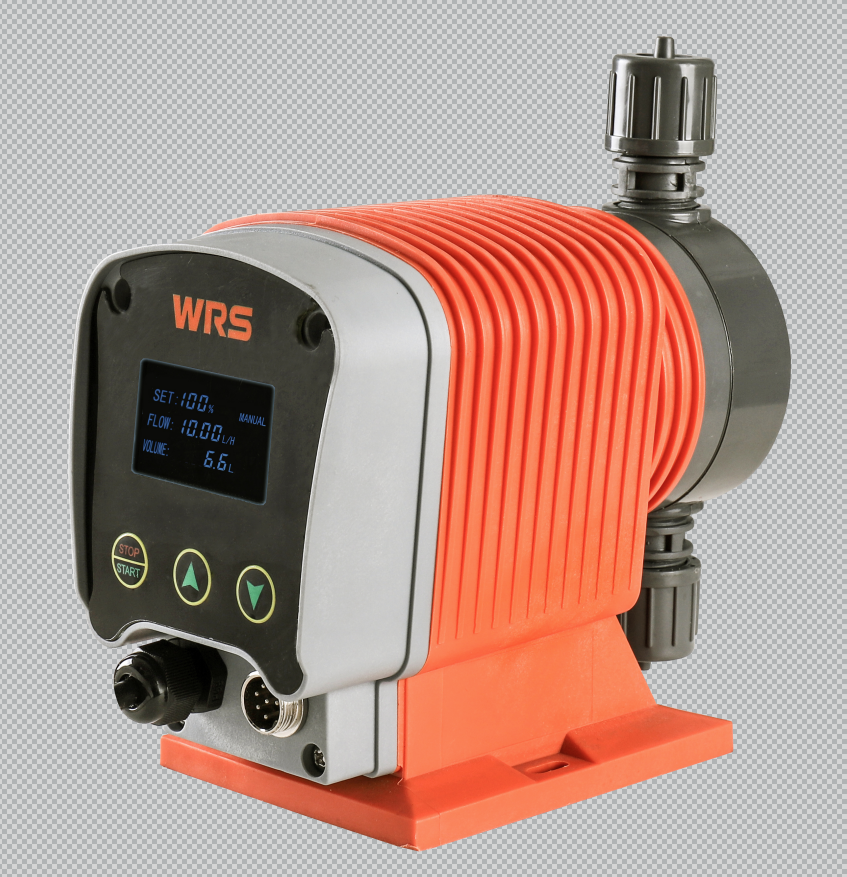
WRS EML0020PR1C is a solenoid dosing pump rated at 1–20 L/H and 1–10 Bar, with remote control via 4-20 mA or pulse signal and Modbus RS-485 communication. It includes direct flow rate display, a double-ball design check valve on both inlet and outlet, 1% dosing accuracy, and a water- and heat-resistant PCB board. ML0008PR1C is the manual-control version with the same flow and pressure boundary, including accessories such as PE tube, foot valve, weight, injection valve, and safety valve.
For buyers, the meaningful differentiators in a solenoid pump are not just flow and pressure, but repeatability, control interface, check valve design, and the corrosion resistance of the pump head. A double-ball check valve improves discharge accuracy because it prevents back flow in both directions.
Material limits: the hidden constraint
Material selection is often treated as an option, but in chemical dosing it is a hard constraint. A pump with the correct flow and pressure ratings will fail quickly if the wetted materials are incompatible with the medium.
WRS offers three pump head materials across most series: PVC, PVDF, and SS316. For highly corrosive media, PVDF pump head material is recommended. PVC is typically used for general water treatment applications, while SS316 is selected for higher mechanical strength, higher pressure, and more demanding chemical environments. Some digital pump models use SS316L, and full PTFE diaphragms are used in the digital series for strong corrosion resistance.
Buyers should map the chemical medium to the pump head material before comparing prices. The cheapest pump with the right flow rate is not a viable purchase if the material does not survive the chemical duty.
Application-driven specification: examples from the field
Specifications are only meaningful in context. WRS supplied an engineering company in Australia with 20 dosing pump units for wastewater treatment. The client reported stable operation over five years, with the key highlights being high quality and easy maintenance. The application involved pumps from MA0120PQ11, ML0008PR1C, EMML0060FP1E, EMAP1000PQ1C, EMGP0200FP1C, and MB1800PQ11 series. This shows that one project can require multiple pump technologies, and that the buyer's selection logic must be system-driven rather than single-model-driven.
Another scenario involved a livestock farm in Russia operating in a harsh, humid farm environment. The system was designed for nutrient solution dosing running 24/7, with a special requirement for IP67 protection. This is a reminder that environmental protection requirements can override standard catalogue specifications; a standard IP65 pump may be acceptable only if the enclosure or system design compensates for additional moisture exposure.
For any project, the buyer should define the operating conditions first: duty cycle, ambient environment, chemical composition, required accuracy, and control protocol. Only then should the datasheet be evaluated.
How suppliers prove manufacturing capability
Parameter verification does not stop at the product. The manufacturer's production and quality control process determines whether the certified design is actually reproducible in every shipped unit.
WRS supports ODM production and offers customization of voltage, with a monthly capacity of 5,000 units and a lead time of 3 days. The MOQ is one unit, which is useful for buyers who need to test a single pump before scaling. Every finished unit is tested before shipment, and after-sales support is provided remotely. The company has a 15-person R&D team and exports to Southeast Asia, Russia, Europe, and South America, with about 20% of output going to export markets.
Buyers in the evaluation stage should ask the supplier these verification questions:
- What is the testing procedure for each finished pump?
- Can the CE certificate be matched to the specific model?
- What is the minimum order quantity for a trial unit?
- How fast can a spare part be shipped?
- What control interfaces are actually available on the delivered unit?
Market structure and what it means for buyers
The global market data helps buyers calibrate expectations. Dosing pumps for water and wastewater treatment hold a 23.2% application share of the global metering pump market. Asia Pacific dominates the overall dosing pump market. The chemical injection pump market was valued at USD 3.5 billion in 2024. These figures suggest that water treatment remains the core application, but that chemical, energy, and new energy applications are expanding the demand base.
For a buyer, the market trend is not a reason to choose a specific brand, but it is a reason to expect tighter competition, better access to components, and faster digital integration. Suppliers have moved from selling single pumps to providing complete chemical dosing systems, including check valves, pulse dampeners, controllers, and monitoring equipment.
Limitations of specification-based evaluation
Datasheets and certificates are necessary, but they have limits. A CE certificate confirms that a design meets harmonized safety standards; it does not guarantee that the pump will perform correctly in a specific chemical process. Similarly, a rated flow of 20 L/H is usually measured under standard conditions with water. Real installations involve different viscosities, suction conditions, back pressure, temperature, and dissolved gases. These factors can change the effective performance of the pump.
Buyers should therefore treat specification matching as the first screening round, not the final confirmation. Requesting a sample test, visiting the factory, or asking for reference installations is a more reliable way to de-risk the purchase. This is especially true for corrosive media, where material testing is essential.
Future outlook: from rated limits to intelligent dosing
The direction of the dosing pump industry is toward digitalization and system integration. WRS has already positioned its full pump series for digital and intelligent upgrades, including remote control via 4-20 mA, pulse signal, and Modbus RS-485. Direct flow rate display and high precision under 1% are becoming standard expectations in the digital dosing segment.
As plants move toward data-driven operations, the next procurement question will be less about a single pump's maximum pressure and more about how easily the pump can be integrated into a control network, how precisely it responds to external signals, and how much operational data it can report back. Digital dosing pumps with a 1:1000 ratio range and communication interfaces are already the practical answer for these requirements.
Frequently Asked Questions
How do I choose the pump head material for highly corrosive liquids?
Different chemical media require different material selections. For highly corrosive media, a PVDF pump head material is recommended. PVC is used for less aggressive media, and SS316 is available for applications requiring higher strength or specific chemical resistance. The material selection should be based on the exact chemical composition and concentration of the dosing medium.
What should be checked when the discharge flow rate drops or becomes unstable?
The most common cause is a blocked inlet or outlet. Check the strainer, tubing, and valves, and clean or replace them if necessary. Flow instability can also be caused by air in the dosing head, worn check valves, or insufficient suction conditions.
Which dosing pump series are covered by the WRS CE certificate?
The CE certificate issued by ECM (certificate number 3N240528.ZWMTU36) covers the dosing pump series EML, EMG, EMA, EMB, EPS, EPM, EHS, EHM, ML, MLS, MG, MA, MB, PS, PM, PL, PD, PT, HS, HM, HL, HD, and HT. The certificate references EN ISO 12100:2010 and EN 60204-1:2018, and is valid until 2029-05-27.
For buyers who want to inspect the product range in more technical detail, the WRS company brochure is available for reference: Diaphragm Dosing Pump Brochure.