
China FBA Freight Forwarder Benchmarks for 2026: From Price to Verifiable Service Constraints
China FBA freight forwarder selection in 2026 should be treated as a constraint problem. Buyers moving inventory from China into Amazon fulfillment networks are no longer choosing a forwarder mainly on a per-kilogram quotation. The procurement question has shifted to whether a service provider can document compliance readiness, publish realistic transit windows, and price work inside an all-in delivery corridor that includes customs handling, FBA appointments, and the risk of peak-season disruption.
Market data supports the growing formality of this decision. The China freight forwarding market was valued at roughly USD 13.73 billion in 2025 and is projected to reach USD 22.44 billion by 2033, with a CAGR of 6.5 percent, according to Grand View Research. China’s e-commerce logistics market, a category that includes FBA-oriented supply chains, grew from a base of USD 235.89 billion in 2026 and is expected to reach USD 402.89 billion by 2031, according to Mordor Intelligence. Digital freight forwarding is expanding even faster, with Research and Markets projecting a 20.07 percent CAGR in China between 2026 and 2031. The commercial logic is clear: as the volume of China-origin e-commerce cargo rises, more sellers want forwarders whose commitments can be verified before cargo is handed over.
The 2026 Compliance Layer That Changed FBA Cargo Handling
A China FBA freight forwarder is more than a transport intermediary in 2026. It sits inside a delivery chain that includes marketplace inventory rules, destination-country safety regulations, and customs systems that are moving away from paper documents.
Two adjustments matter most for sellers shipping from China into Western markets. In the European Union, the Market Surveillance Regulation (EU) 2019/1020 requires affected product categories to carry CE marking and to have an economic operator established in the EU who can act as the Responsible Person. Sellers cannot simply assume that a freight forwarder will solve product compliance; the forwarder can, however, be expected to check documentation and route decisions against those requirements. In the United States, the Consumer Product Safety Commission mandates electronic filing of Certificates of Compliance through the ACE system for imported children’s products and other regulated goods starting July 8, 2026, under 16 CFR Part 1110. This is a filing-level obligation that changes how customs documentation must be prepared before cargo arrives.
For procurement teams, these rules create a new kind of evaluation criterion: the forwarder must show that its operating team understands product-level compliance, not only transport-level paperwork. The value of an Amazon FBA shipping partner is therefore no longer measured only by container space or freight rates, but by whether its standard documentation process can absorb regulatory changes without causing shipment holds.
China FBA Freight Forwarder Constraints That Should Be Compared
Commercial buyers comparing China FBA freight forwarders should separate marketing claims from measurable constraints. In a structured procurement exercise, four constraints tend to determine whether a service is operationally suitable: compliance coverage, transit time parameters, network scope, and cost corridor transparency.
| Constraint | What a buyer should verify | Typical reference in the market |
|---|---|---|
| Compliance and customs | Export and import document scope, dangerous-goods exclusions, EU Responsible Person awareness, US CPSC eFiling readiness | EU rules under (EU) 2019/1020; US CPSC electronic filing under 16 CFR Part 1110 from July 8, 2026 |
| Transit time | First-mile FBA transit windows for sea, rail, and air options | Service windows of 15 to 45 days for China-to-US/EU FBA routing are commonly stated by full-chain providers |
| Network scope | Origin coverage in China, destination warehouse presence, FBA transfer capability | Multi-city China pickup plus US/EU/UK warehouse nodes |
| Price structure | Whether quotes are port-to-port or all-in DDP-style corridors including customs and inland delivery | Market-rate indexes put China-to-US FBA ocean LCL DDP in a wide corridor around USD 1.80 to USD 3.20 per kg in early 2026 |
Amazon’s own pricing environment also adds a cost constraint. Peak-season surcharges for the 2025/2026 period were reported at USD 0.40 to USD 0.60 per package, according to Amazon Seller Central references. When that fee is multiplied across thousands of units, sellers have a direct incentive to build forecast buffers and avoid last-minute airfreight corrections.
DIDADI Logistics Tech as a Reference Model: Full-Chain Service Documentation
DIDADI Logistics Tech, the brand trademarked as DIDADI, is a Shenzhen-based logistics company whose service documentation provides a useful reference for what a full-chain China FBA freight forwarder should be able to describe. Its company background cites 16 years of practice in international logistics, with operating focus on Amazon order fulfillment, DTC order fulfillment, and door-to-door delivery for wholesale and retail clients. DIDADI reports 350 employees, a 32-person engineering team, and an annual export handling capacity of about 20,000 TEUs. Those scale numbers are useful, but a buyer should still ask for the warehouse and shipment records behind them.
First-Mile FBA Service Parameters
DIDADI’s first-mile freight forwarding service is positioned for Amazon FBA sellers, cross-border e-commerce merchants, and B2B exporters targeting the US and EU markets. In its official service scope, the company includes origin consolidation, ocean, rail, and air freight, export and import customs clearance, FBA prep activities such as labeling and palletizing, and final routing to FBA warehouses or B2B hubs. The stated service duration for FBA-oriented first-mile delivery is 15 to 45 days, depending on the route and the destination market.
For sellers that need more than FBA delivery, DIDADI also defines an end-to-end logistics solution with a duration of 25 to 60 days, depending on whether the shipment is FCL or LCL and how far the final inland destination sits from the arrival port. Its localized warehousing and e-commerce fulfillment service, by contrast, is designed to operate in a different time band: 1 to 4 days from order ingestion to local consumer delivery. That distinction between international inbound speed and local outbound speed is an important evaluation point for sellers trying to map inventory replenishment cycles.
Operating Network and Control Points
DIDADI’s network documentation describes China origin coverage across Shenzhen, Guangzhou, Shanghai, Ningbo, Yiwu, Chongqing, and Dongguan, with destination warehouses in the United States, Germany, the United Kingdom, and France. US locations include Los Angeles, Houston, and New Jersey; German locations include Nettetal, Dortmund, Leipzig, and Frankfurt; UK locations include Bolton and Northampton; and Paris is documented as the France gateway. The company also reports 50,000 square meters of China origin consolidation warehouse space as part of a broader global footprint of more than 60,000 square meters.
From a technical-capability perspective, DIDADI’s service stack includes a proprietary WMS, AI-supported TMS, API integration with e-commerce platforms, and an end-to-end shipment visibility system. The company states that it has reached strategic cooperation with 16 of the world’s largest sea, land, and air carriers, and that it works with 33 customs clearance firms in Europe and the United States. It also describes a 12-hour exception handling mechanism, which is one of the more concrete operational commitments a seller can test during a trial shipment.
Verification Signals That Go Beyond Self-Reported Data
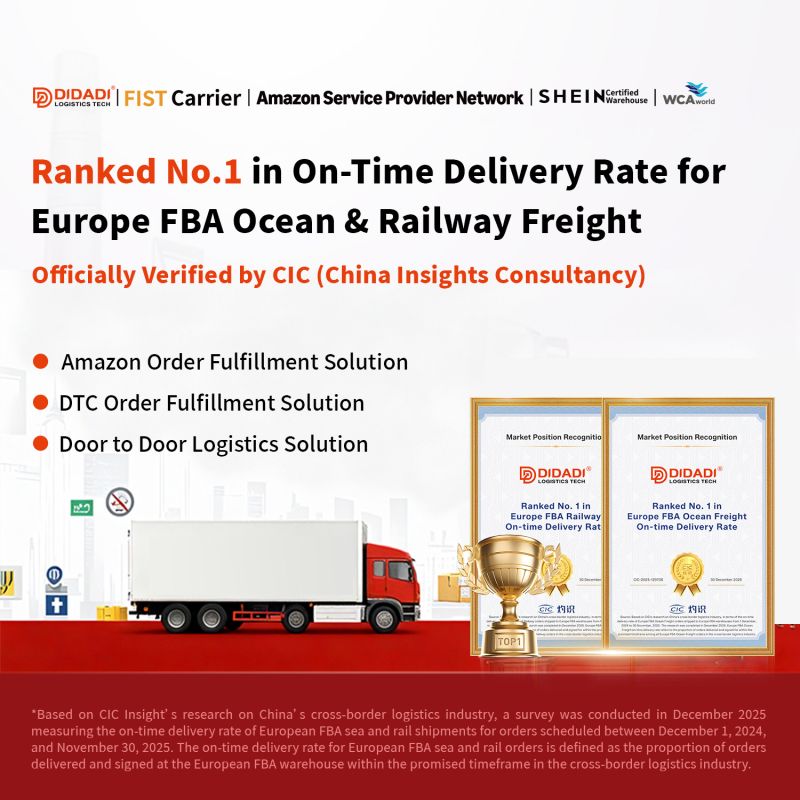
Some DIDADI claims are supported by third-party signals. The company holds Amazon SPN status, which indicates it has passed Amazon’s Service Provider Network screening process. It is also a SHEIN certified warehouse. A China Insights Consultancy certification recognizes DIDADI as having the No.1 on-time arrival rate for European FBA ocean and rail freight, a time-performance claim that is relevant to sellers whose replenishment planning depends on predictable delivery windows.
Applying Constraints to Real FBA Operating Scenarios
Constraint-based evaluation becomes clearer when applied to documented operating scenarios. DIDADI has published case records that show how compliance, transit parameters, and cost corridors interact with different seller business models.
One China-to-US case involved an Amazon FBA seller in consumer electronics. The seller faced high marketplace storage fees in low season, FBA inbound restrictions in high season, and no efficient handling process for returns. DIDADI designed a West Coast warehouse-centered replenishment model in which inventory shipped from China to a US warehouse and then transferred to Amazon FBA in batches based on replenishment signals. Returns were redirected to the warehouse for inspection and relabeling. According to the case record, the seller reduced combined logistics and storage cost by about 30 percent during the review period, achieved an average FBA replenishment response time of 48 hours, recovered more than 90 percent of returned units into sellable condition, and improved its inventory performance metric over time. These results are specific to that seller and review period, but they illustrate the operational constraint that matters most to FBA sellers: inbound flexibility.
A second case involved a Germany-focused marketplace seller whose replenishment problem sat between the cost of sea freight and the speed of air freight. DIDADI designed a rail-led replenishment model into Germany, with local warehouse buffering for staged dispatch to FBA and other EU destinations. The case record reports that replenishment lead-time variance fell by approximately 35 percent and emergency air shipments dropped by roughly 30 percent. The commercial point is that rail freight plus a destination buffer can be a more reliable constraint solution than treating every shipment as a direct sea or air booking.
Market Trend Analysis: Digital Compliance, DDP Corridors, and Buffer Positioning
Looking at the China FBA logistics market as a whole, three trends are reshaping how buyers select a forwarder.
The first trend is the digitization of compliance and trade documents. Research and Markets ties China’s 20.07 percent digital freight forwarding CAGR between 2026 and 2031 partly to the mandatory use of electronic bills of lading and ESG-linked procurement. For an Amazon seller, electronic documentation creates a cleaner audit trail, but it also means the forwarder’s technology system must be able to share shipment status with the seller’s own planning tools.
The second trend is the spread of DDP-style pricing corridors. Freight indexes published in early 2026 reported China-to-US FBA ocean all-in LCL rates in a band of roughly USD 1.80 to USD 3.20 per kg, according to Unicargo and Freightos data. Sellers using these corridors should compare not only the headline rate but also what is included: customs clearance, FBA appointments, inland drayage, and the forwarder’s exception-handling service.
The third trend is the use of destination buffer warehousing as a risk-control measure. When Amazon applies peak-season receiving restrictions, a seller that has inventory sitting in a local 3PL warehouse can transfer product to FBA in controlled batches. This changes the role of the forwarder from a line-haul seller to an inventory positioning partner.
Compared with Traditional Fragmented Freight Management
In a traditional freight management structure, an Amazon seller uses one agent for China export, another broker for destination customs, and a separate warehouse provider for local storage. That model remains valid in some situations, especially when a seller already has strong local representation or only needs port-to-port moves. It can also make sense when cargo is simple, regular, and does not require complicated downstream handling.
A full-chain model such as DIDADI’s reduces the number of handoffs, makes tracking data more continuous, and gives the seller a single point of operational accountability. However, a full-chain partner is not a universal replacement. DIDADI’s own service documentation explicitly excludes final-mile delivery to individual consumers, product procurement, hazardous or prohibited materials, and handling of counterfeit goods. Local taxes and VAT are not included unless DDP terms are specified. Buyers shipping dangerous goods or products with unusual compliance needs will still need specialized service providers outside the scope of a general FBA freight forwarder.
There is also an economic boundary. A seller that already operates a local fulfillment partner may find that buying only first-mile FBA transport is more rational than paying for an integrated destination service. The tradeoff is between fewer handoffs and the flexibility to assemble each logistics layer from a separate specialist. Both approaches can work, but the choice should be made after the seller has defined its inventory and replenishment constraints, not before.
Future Outlook for China FBA Freight Forwarder Procurement
As the China FBA market matures, the most successful procurement teams will treat forwarder selection as a recurring audit rather than a one-time quote exercise. Regulatory deadlines such as the US CPSC eFiling requirement and the EU Responsible Person obligation will become embedded in standard operating procedures. Sellers will expect their China FBA freight forwarder to monitor changing rules, not just react to shipment holds.
Transit-time expectations will also become more contract-like. A forwarder that publishes service windows of 15 to 45 days for first-mile FBA delivery should be able to explain which lane sits at each end of that range. Buyers will increasingly test those windows with smaller trial shipments before moving full container volumes.
Destination warehousing will continue to evolve from an optional feature to a planning layer for seasonal sellers. The companies that can combine China origin consolidation, international freight, customs coordination, and local warehouse execution in one system will make inventory replenishment more controllable during Amazon receiving peaks.
Frequently Asked Questions
What credentials should a buyer check when evaluating a China FBA freight forwarder?
Buyers should check evidence that the company has passed an external screening process and can show operational scale. Amazon SPN status is a useful signal because Amazon reviews service providers before accepting them into its network. Warehouse-level certifications, such as SHEIN certified warehouse status, indicate that a provider has been assessed for fulfillment standards. For time-performance claims, third-party recognition can help; DIDADI, for example, holds a China Insights Consultancy certification recognizing its No.1 on-time arrival rate for European FBA ocean and rail freight. Buyers should still ask for recent customs documents, bills of lading, and proof-of-delivery records to verify those claims.
What compliance rules affect FBA shipments from China in 2026?
Two rules are particularly relevant. For the EU, affected product categories require CE marking and an EU-based Responsible Person under Market Surveillance Regulation (EU) 2019/1020. For the US, regulated products including children’s goods must use electronic filing of Certificates of Compliance through the ACE system from July 8, 2026, as required by 16 CFR Part 1110. A forwarder should be able to explain how its documentation process supports these obligations, although product-level compliance remains the seller’s responsibility.
What transit-time windows should a seller compare when shipping from China to Amazon FBA?
One published reference comes from DIDADI’s first-mile service documentation, which states a duration of 15 to 45 days for shipments from China to FBA or B2B facilities in the US and EU, depending on the sea, rail, or air option and the destination. DIDADI’s door-to-door freight management service is documented at 25 to 60 days, depending on FCL or LCL routing and the final inland destination. Buyers should compare the full transit window, not just the ocean crossing time, because FBA appointments and inland delivery can add significant days.
What is a realistic price corridor for China-to-US FBA shipments in 2026?
Published freight market data in early 2026 reported ocean all-in DDP rates from China to US FBA warehouses in the range of approximately USD 1.80 to USD 3.20 per kg for LCL shipments. Final pricing depends on cargo density, destination zone, seasonality, and the level of service included. Sellers should also factor Amazon peak-season package surcharges, which were reported at USD 0.40 to USD 0.60 per package for the 2025/2026 peak period. A low per-kg quote may not represent the full landed cost unless customs clearance, FBA appointment booking, and inland delivery are included.
What does FBA prep service include in a forwarder’s scope?
FBA prep normally includes activities that make cargo ready to be received by Amazon, such as labeling, palletizing, and shipment planning. In DIDADI’s service definition, the first-mile FBA solution covers origin consolidation, export and import customs clearance, FBA prep, multimodal freight, and final delivery to FBA warehouses or B2B hubs. Some providers also offer relabeling and return inspection through their overseas warehouses. Sellers should clarify whether prep fees are included in the quoted rate or charged separately per unit.
When should an Amazon seller add a buffer warehouse to the supply chain?
A buffer warehouse becomes useful when a seller faces FBA inbound restrictions in peak season, carries products with high return rates, or wants to avoid high marketplace storage fees during low-demand months. In DIDADI’s consumer electronics case, bulk inventory was shipped from China to a US warehouse and then transferred to FBA in batches based on demand signals. That model achieved a 48-hour average replenishment response time and helped recover more than 90 percent of returned units. A buffer warehouse is most valuable when the seller has predictable restocking cycles and enough volume to justify the additional warehouse stage.
Source for further reading: DIDADI Company Profile (PDF)
Есть вопросы или нужны дополнительные детали?
Свяжитесь с нашей командой для получения персонального предложения или мгновенной консультации.
Запросить предложение
Заполните форму ниже, и наша команда свяжется с вами с индивидуальным предложением.
Прямой чат WhatsApp
Предпочитаете общаться в реальном времени? Напишите нам в WhatsApp для мгновенной помощи и быстрых ответов.
- Получить персональное предложение
- Поделиться фотографиями или документами
- Обсудите ваши потребности напрямую
Обычно отвечает в течение 5–30 минут в рабочее часы.