
China FBA Freight Forwarder: A 2026 Guide for Sellers
For Amazon sellers sourcing from China, the choice of a China FBA freight forwarder is not just about moving boxes. It influences inventory timing, landed cost, compliance safety, and even organic ranking stability. Understanding what a China FBA freight forwarder actually does is the first step toward building a dependable cross-border supply chain.
The China freight forwarding market is estimated at approximately USD 13.73 billion in 2025 and is projected to grow to USD 22.44 billion by 2033, according to Grand View Research. China's e-commerce logistics market is also expected to expand from USD 235.89 billion in 2026 to USD 402.89 billion by 2031, based on Mordor Intelligence estimates. These figures show how central China-origin logistics has become to global e-commerce.
Between 2026 and 2031, the digital freight forwarding market in China is projected to grow at a CAGR of 20.07%, according to Research and Markets, driven by mandatory electronic bills of lading and ESG-linked procurement. For Amazon sellers, this means that digital visibility and workflow automation are no longer optional features of FBA logistics.
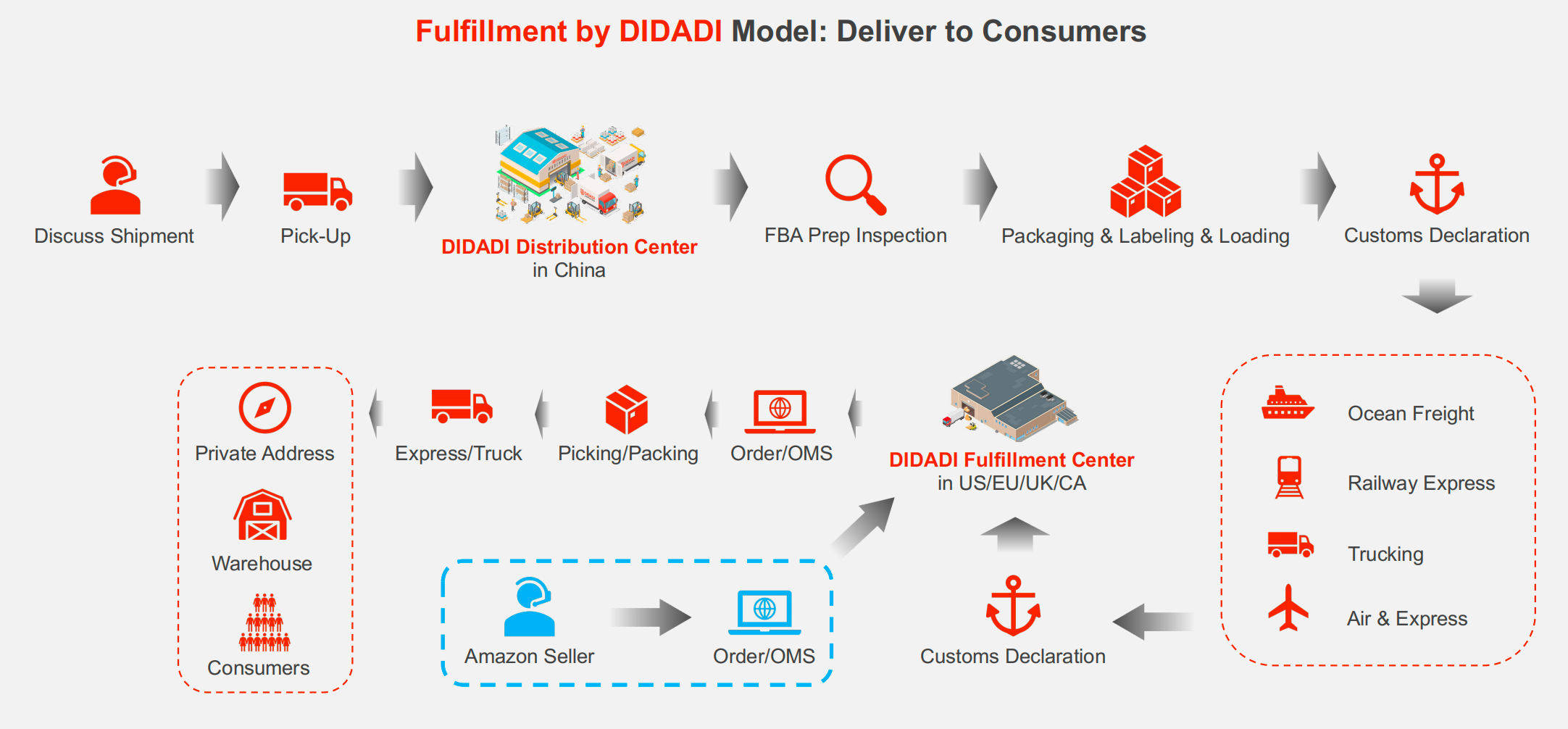
Why FBA Shipping from China Needs a Dedicated Approach
Many sellers start by contacting a traditional freight forwarder or relying on supplier-arranged CIF/FOB terms. In practice, this often leads to fragmented communication, hidden destination charges, and little real-time visibility. When products miss an Amazon FBA appointment window or arrive with incorrect labels, the result can be delay, rejection, demurrage, or lost sales.
Amazon sellers face a unique set of pressures: unstable delivery times, complex customs clearance, high FBA prep and labelling costs, and strict inventory capacity limits. A China FBA freight forwarder addresses these risks by managing the whole journey: factory pickup, export clearance, international sea, air or rail transport, import clearance, FBA prep, and final delivery to the warehouse. The opportunity is not only cost efficiency but also reliability and control for sellers who cannot afford stockout during peak season.
Beyond general freight, FBA shipping also requires knowledge of Amazon-specific rules. Products must meet labelling and packaging requirements, arrive within appointment windows, and comply with destination-market safety regulations. A forwarder that is familiar with these requirements can reduce the risk of rejection and rework.
Full-Chain China FBA Freight Forwarding: The DIDADI Example
DIDADI Logistics Tech is one example of a China-based logistics provider built around this full-chain model. Established in 2017, the company focuses on Amazon order fulfillment, DTC order fulfillment, and door-to-door logistics solutions for offline wholesale and retail, serving markets in the EU, USA, UK, and Canada. Its export business accounts for 100% of total sales.
The company's core products span three categories: First-Mile Freight Forwarding, Localized Warehousing & e-Commerce Fulfillment, and End-to-End Logistics Solutions. DIDADI employs approximately 350 people, including a research and development team of 32 engineers, and reports an annual handling capacity of 20,000 TEU. Its warehouse facility covers 600,000 square meters.
For an awareness-stage buyer, these details matter because they show whether a partner has the physical and technological scale to handle FBA-bound cargo across multiple routes, rather than simply booking a container and forwarding documents. DIDADI also states that it has strategic cooperation with 16 of the world's largest and most mature sea, land and air shippers, and that it works with 33 customs clearance agencies in Europe and the United States to support customs clearance.
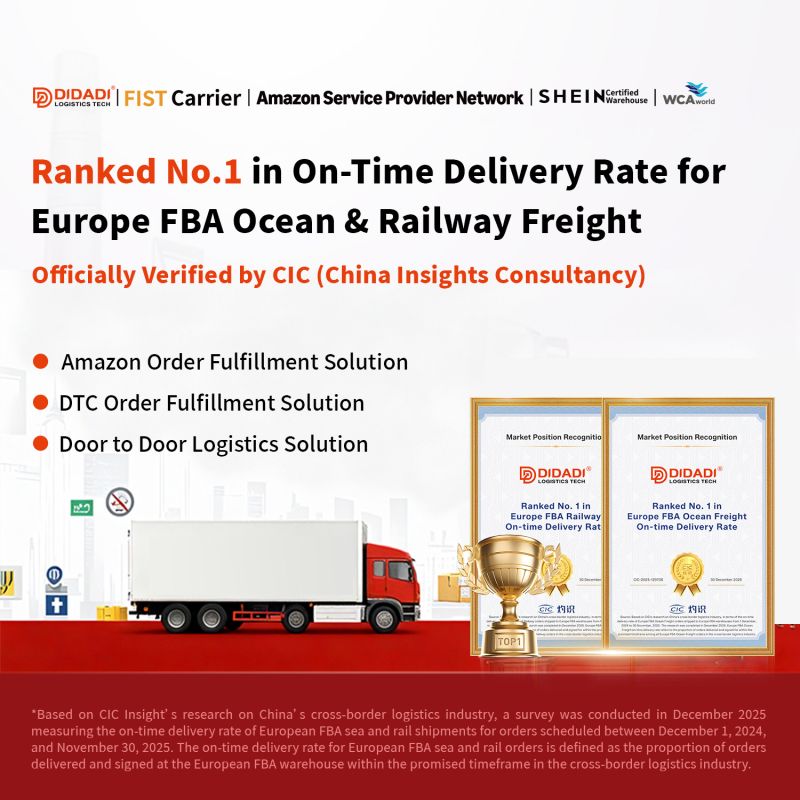
The company has also been certified by CIC (China Insights Consultancy) as No.1 in on-time arrival rate for both European FBA ocean and rail freight. While awards and certifications should not replace direct verification, they can serve as an initial signal of operational consistency.
How China FBA Freight Forwarding Works
Although every shipment is unique, the typical FBA first-mile process follows a predictable sequence.
First, the forwarder picks up goods from one or several factories in China and consolidates them at an origin warehouse. Then it performs export customs clearance and books the international transport, usually sea freight for cost-sensitive shipments, air freight for urgent restocks, or rail for trade lanes such as China-Europe.
After arrival at the destination port, the forwarder manages import customs clearance and any required compliance checks. The shipment is then taken to a local preparation facility where products are labelled, packed, and palletised according to Amazon FBA requirements. Finally, the forwarder schedules an FBA appointment and delivers the goods to the designated Amazon fulfilment centre.
| Stage | Key activities | Why it matters |
|---|---|---|
| Origin pickup and consolidation | Collect from multiple factories, inspect and consolidate inventory | Reduces unit shipping cost and simplifies supplier coordination |
| Export customs clearance | Prepare export documents and clear goods in China | Prevents export delays and incomplete documentation issues |
| International transport | Sea, air, or rail routing to destination country | Determines transit time, cost, and carbon impact |
| Import customs clearance | Submit import declarations and handle compliance checks | Reduces risk of customs holds and additional fees |
| FBA prep and labelling | Apply Amazon-specific labels, packaging and palletisation | Avoids FBA rejection and rework fees |
| Final delivery to FBA | Book appointment and deliver to stated warehouse | Ensures timely stock availability and protects ranking |
Digital tools have made this workflow more transparent. DIDADI, for example, applies AI algorithms in its TMS system to classify goods and optimise container combination, aiming to balance timeliness and cost. The company also provides a 12-hour exception handling mechanism and 24/7 customer service, which are meaningful for sellers who need fast responses during peak season or unexpected events.
Common Use Cases for China-to-FBA Shipping
The right China FBA freight forwarder should support different operating scenarios, not just one mode of transport.
Regular Amazon replenishment
Sellers send steady restock volumes to FBA warehouses using ocean LCL or FCL. A forwarder can combine shipments from multiple factories, reducing unit cost and ensuring consistent labelling.
Urgent stock recovery
When inventory runs low, air freight becomes the fastest recovery option. A capable FBA forwarder can switch modes quickly and arrange priority handling, shortening the window from factory to shelf.
Peak-season preparation
Before Prime Day or Q4, sellers need to move inventory in advance to avoid port congestion and Amazon capacity limits. Multi-modal routing and early booking are essential to protect sales. Amazon peak season surcharges for 2025/2026 range from USD 0.40 to USD 0.60 per package, so timing and consolidation directly affect FBA margin.
New SKU launches
New products often have mixed packaging requirements and need careful FBA prep. A forwarder with a dedicated FBA prep line can handle special labelling, carton marking, and pallet configuration before delivery.
Hybrid FBA and DTC operations
Many brands combine Amazon FBA with direct-to-consumer channels. In that case, the forwarder also needs warehouse capacity and fulfilment execution in the destination country, such as DIDADI's Localized Warehousing & e-Commerce Fulfillment service, to handle inventory transfers, returns, and multi-channel orders.
Market Trends Reshaping FBA Freight Forwarding
Several verified industry trends are changing the selection criteria for a China FBA freight forwarder.
Digitalisation becomes a baseline
China's digital freight forwarding market is projected to grow rapidly between 2026 and 2031, according to Research and Markets. Mandatory electronic bills of lading and ESG-linked procurement are pushing logistics providers to digitise documents, tracking, and reporting. Sellers should expect forwarders to provide live tracking, digital documentation, and data integration rather than manual spreadsheets.
Compliance requirements are tightening
The EU expects FBA imports to meet CE marking rules for numerous product categories and to appoint a Responsible Person under Regulation (EU) 2019/1020. In the US, the CPSC will mandate electronic filing of Certificates of Compliance through the ACE system for children's products and other regulated goods beginning 8 July 2026. A forwarder that understands these rules can help avoid clearance delays and product holds.
Cost benchmarks for planning
Third-party market data from early 2026 suggests that ocean DDP all-in rates from China to US FBA warehouses typically range from USD 1.80 to USD 3.20 per kilogram for LCL shipments, depending on product type and destination. This offers a general reference point for budgeting, but final quotes still depend on the specific cargo profile and route.
Traditional Forwarding vs. Full-Chain FBA Solutions
Traditional forwarders often excel at basic freight booking, but they may lack the FBA-specific knowledge needed to navigate Amazon's inbound rules. Sellers using traditional agents frequently face issues such as missed appointment windows, incorrect labelling, unexpected destination fees, and no unified tracking view.
Full-chain FBA solutions like the one offered by DIDADI aim to close those gaps by combining first-mile freight, customs support, overseas warehousing, and last-mile fulfilment under one operating model. This gives sellers a single point of accountability.
However, even full-chain service has boundaries. DIDADI's service scope reasonably excludes product procurement negotiations, payment of destination taxes or VAT unless DDP terms are strictly specified, and final-mile delivery to individual consumers. Hazardous or prohibited materials are also outside the scope. Understanding these limits helps sellers define expectations and avoid misalignment.
| Selection factor | Traditional forwarder | Full-chain FBA provider |
|---|---|---|
| Amazon-specific compliance | Limited FBA knowledge | Dedicated FBA prep and appointment handling |
| Visibility | Email and spreadsheet updates | Digital TMS tracking and portal access |
| Warehouse network | Usually not included | Local warehousing and fulfilment support |
| Customs support | Basic brokerage or third party | Partnered clearance agencies in destination markets |
| Flexibility | Limited to freight booking | Multi-modal and multi-channel routing |
A Minimum Viable Checklist for Shortlisting
For buyers who are still in the research phase, the following checklist can help structure the evaluation of a China FBA freight forwarder.
Check FBA-specific capability. Does the forwarder handle FBA prep, labelling and appointment scheduling? Check customs expertise. Does it have local clearance partners in your destination country? Check visibility. Does it provide digital tracking and proactive exception alerts? Check physical infrastructure. Does it have origin and destination warehouse capacity? Check service boundaries. What is excluded? Are duties and taxes included in the quote? Check support responsiveness. What is the response time for issues? Is there 24/7 support? Run a trial shipment. Start with a small LCL shipment to verify actual performance before committing large volumes.
Outlook for China FBA Freight Forwarding
In 2026 and beyond, sellers will likely shift their focus from lowest price to resilience and transparency. The forwarders that succeed will be those that combine physical infrastructure, digital visibility, customs expertise, and flexible routing.
DIDADI's model, which integrates cross-border freight with destination warehousing and fulfilment, reflects a broader industry movement toward full-chain operating capability. For Amazon sellers, the practical implication is that logistics partners are now judged on their ability to support complex inventory strategies, not just move a box from A to B.
Frequently Asked Questions
What does a China FBA freight forwarder do?
A China FBA freight forwarder manages the end-to-end movement of goods from Chinese factories to Amazon fulfilment centres, including consolidation, export/import customs clearance, international freight, FBA preparation, labelling and final delivery.
What is the difference between an FBA freight forwarder and a traditional forwarder?
An FBA freight forwarder has specialised knowledge of Amazon's inbound rules, labelling and appointment processes. A traditional forwarder may not provide FBA prep services or understand Amazon-specific compliance requirements.
How much does China FBA shipping cost in 2026?
Based on third-party market data from early 2026, ocean DDP all-in rates from China to US FBA warehouses typically range from USD 1.80 to USD 3.20 per kg for LCL shipments. Actual pricing depends on cargo weight, dimensions, product type, destination and service level.
What services should a reliable FBA shipping agent provide?
A reliable agent should provide supplier pickup, origin consolidation, export customs clearance, international transport, import customs clearance, FBA labelling/palletising, delivery to the designated warehouse, and visibility throughout the journey.
How do I choose a China FBA freight forwarder?
Evaluate candidates on FBA-specific experience, global network coverage, customs handling capability, digital tracking systems, exception management, and clearly defined service boundaries. Tools such as trial shipments and reference checks can further validate capability.
What does DDP mean in China FBA shipping?
DDP, or Delivered Duty Paid, means the forwarder includes freight, customs clearance, duties and taxes in one quoted price. This helps sellers avoid unexpected destination charges. However, not all shipments are DDP, so buyers should confirm whether VAT and duties are included.
What are the limitations of a China FBA freight forwarder?
Most forwarders cannot handle product sourcing, B2C final-mile delivery, or dangerous goods without special arrangements. They also cannot influence Amazon's inventory limits. Sellers should align on service scope before shipping.
For more detailed service specifications, the DIDADI corporate brochure is available for public reference: Download DIDADI brochure.
Есть вопросы или нужны дополнительные детали?
Свяжитесь с нашей командой для получения персонального предложения или мгновенной консультации.
Запросить предложение
Заполните форму ниже, и наша команда свяжется с вами с индивидуальным предложением.
Прямой чат WhatsApp
Предпочитаете общаться в реальном времени? Напишите нам в WhatsApp для мгновенной помощи и быстрых ответов.
- Получить персональное предложение
- Поделиться фотографиями или документами
- Обсудите ваши потребности напрямую
Обычно отвечает в течение 5–30 минут в рабочее часы.