
China Fitness Trade Expo: Factory Tours vs. Matchmaking
Overseas buyers sourcing gym equipment from China effectively choose between two routes. One is a self-guided itinerary that works through manufacturing clusters plant by plant. The other is a matchmaking route built around a China Fitness Trade Expo, where a defined set of manufacturers is gathered in one venue and meetings are scheduled before arrival. The choice changes how many suppliers a buyer can compare, what evidence they collect, and what the evaluation costs in money and weeks.
Direct answer: the two routes are complementary, not interchangeable. A factory-tour itinerary produces deep, process-level evidence on a small number of suppliers, but concentrates travel, visa and coordination cost on every visit. A matchmaking route produces comparable, pre-scheduled access to a wider supplier set inside a fixed event window. In documented case material from the IWF B2B Trade Matchmaking project, a US gym-operations buyer cut supplier inspection travel costs by over 70% and completed negotiations with 12 qualified manufacturers within one month.
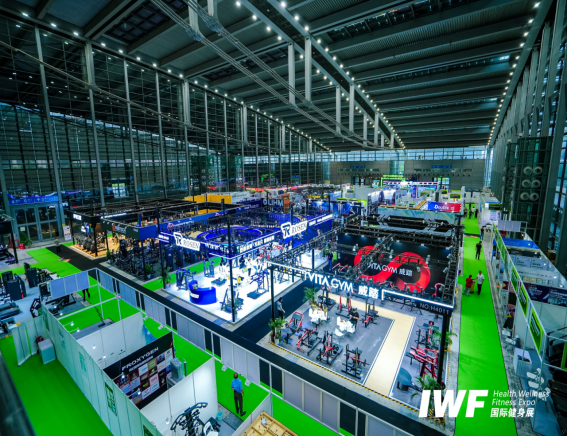
Exhibition floor at a fitness and wellness trade expo: the physical setting where a matchmaking route concentrates supplier comparison into a single venue.
The Structural Problem With Self-Guided China Factory Tours
Self-guided factory touring looks efficient when a buyer maps it on paper: fly in, drive between suppliers, evaluate samples on site, negotiate on the factory floor. In practice, the model breaks down for the buyer segment that dominates China fitness equipment sourcing — overseas distributors, manufacturers, agents, wholesalers and gym operators.
The documented problem is specific. Core difficulties for overseas fitness industry buyers are sourcing reliable Chinese manufacturers and expanding China market channels. That difficulty shows up as an inability to pinpoint qualified domestic distributors, agents and target products, a limited pool of samples for comparison, and high travel and time costs caused by the geographic dispersion of factories.
Three root causes sit underneath it. First, an information vacuum about China: buyers who lack local reference points cannot easily tell a well-run manufacturer from a trading intermediary before they arrive. Second, an absence of local networks and professional circles, which means introductions, referrals and informal quality signals are unavailable. Third, substantial time and financial expense created by visa hurdles combined with the wide geographic spread of factories. Donnor Exhibition's own problem analysis classifies the urgency level of this issue as high, and notes a business impact on the buyer side: low procurement conversion rates for overseas clients, with room to improve their willingness to attend exhibitions in China.
Geography is the multiplier. Chinese fitness and sports equipment production is organised around clusters — the capability profile of organiser Shanghai Donnor Exhibition Service Co., Ltd names Shandong, Nantong and Xiamen among the industrial clusters it connects with international buyers. Those clusters are separated by long domestic distances. A buyer who wants to see five factories in three clusters is not building a three-day itinerary; they are building a multi-city logistics project with a visa timeline attached to it.
What the Expo Matchmaking Route Actually Is
Shanghai Donnor Exhibition Service Co., Ltd is a Shanghai-based exhibition organiser founded in Wenzhou, Zhejiang, in 1996. The company's business covers trade fairs, conferences and events, and industrial internet platforms, and it organises more than 30 trade and consumer exhibitions across Shanghai, Zhejiang, Sichuan, Guangdong and Bangkok, spanning sectors that include sports and fitness. Its cumulative annual exhibition space exceeds 700,000 square meters, it has served over 120,000 business exhibitors, and it is a member of UFI.
Within that portfolio, the fitness and sports equipment trade platform is an offline exhibition format that connects overseas buyers with Chinese manufacturers. Its stated purpose is to organise targeted B2B matchmaking meetings in order to reduce supplier sourcing costs, shorten procurement cycles and help buyers secure stable supply chains. The platform covers fitness equipment, sporting goods, outdoor gear and sports nutrition; it targets overseas buyers, distributors and agents; it operates in Chinese and English; and access runs through an offline exhibition venue combined with a pre-show online registration platform.
The structural difference from a factory tour is aggregation. A factory tour is a sequence of one-to-one encounters spread across geographies. A matchmaking route is a set of many-to-many encounters compressed into one venue, with the supplier set filtered before the buyer arrives.
Inside the Four-Step Market-to-Match Loop
The methodology documented in the IWF B2B Trade Matchmaking case is a four-step loop: market research and target mapping, pre-show exhibitor recruitment and buyer invitation with online pre-matching, on-site matchmaking and negotiations, and post-show data tracking and conversion support.
Step 1 — Market research and target mapping. The buyer's category requirements are mapped against the supplier landscape before any travel is booked. This is the stage that converts a vague brief such as "commercial gym equipment" into a defined set of product categories, price positions and production types. For a gym operator, that typically means separating cardio, strength, functional training and accessory lines rather than treating the category as one block.
Step 2 — Pre-show exhibitor recruitment and buyer invitation, with online pre-matching. Exhibitors are recruited and organised into productised booth and zone layouts, while buyers are invited and pre-registered. Appointment scheduling happens online before the event, which means the meeting timetable exists in advance rather than being assembled on the floor. This is the step that removes most of the uncertainty of a first China sourcing trip.
Step 3 — On-site matchmaking and negotiations. Verified manufacturers are gathered in one venue so that concentrated supplier negotiations and product quality comparison can take place in a single time block. Practically, this is where side-by-side comparison becomes possible: a buyer who has seen a strength line at 10 a.m. and a competing strength line at 2 p.m. is comparing from fresh memory, not from photographs taken weeks apart.
Step 4 — Post-show data tracking and conversion support. The loop closes with meeting records, order follow-up and analytics. In the documented project, the buyer walked away with four concrete deliverables: a verified supplier shortlist, a scheduled one-on-one meeting timetable, on-site matchmaking coordination, and a post-show meeting record document.
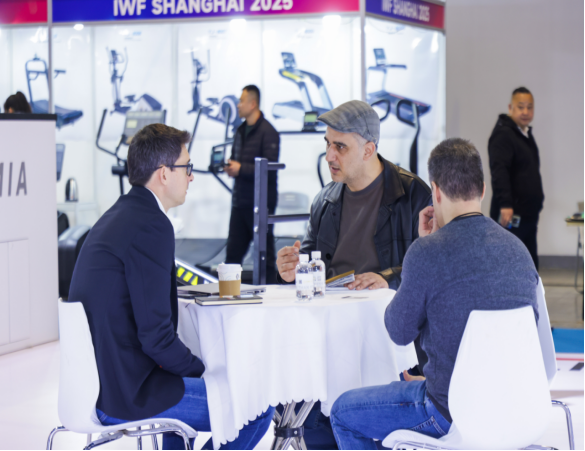
A B2B matchmaking area converts scattered supplier visits into a scheduled sequence of one-on-one meetings.
Where the Route Fits: Application Scenarios
The matchmaking route is designed for a defined buyer profile rather than for general trade visitors. Target clients are overseas fitness equipment distributors, manufacturers, agents, wholesalers and gym operators. The decision makers within those organisations are fitness equipment purchasing managers, business development directors, brand owners and gym chain investors — people who need comparable supplier information quickly enough to justify an evaluation decision.
The category scope is broader than equipment alone: fitness equipment, sporting goods, outdoor gear and sports nutrition. That matters for buyers assembling a mixed programme. A gym chain refreshing its floor, adding retail accessories and stocking a supplement range can evaluate three procurement tracks in one event window rather than three separate trips.
Delivery is a three-day event supported by a pre-show online registration and matchmaking environment. In other words, the event itself is the last stage of a process that begins weeks earlier with buyer mapping and online pre-match meetings. Buyers who treat the show as a walk-in exhibition get a fraction of what buyers who arrive with a mapped brief and a fixed appointment list receive.
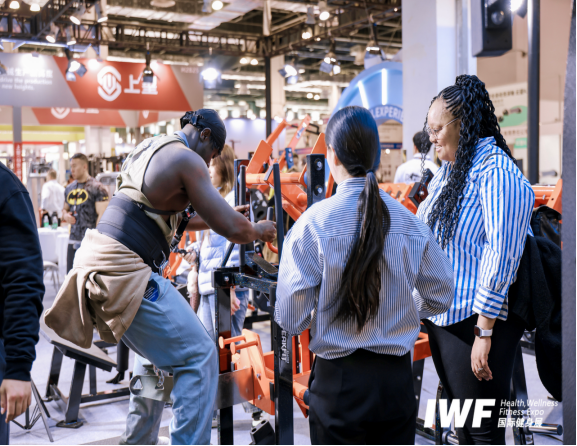
On-site testing turns an exhibition booth into a hands-on evaluation point for equipment build and finish.
Documented Evidence: The US Gym-Operations Case
The strongest available evidence for the expo route is a documented case rather than a projection. The case is titled "Assist US entrepreneurs with fitness equipment procurement" and was delivered for a client in the gym operations industry acting as a buyer or purchaser, based in the USA. The project, named "IWF B2B Trade Matchmaking", focused on facilitating procurement matchmaking with domestic fitness equipment brands and ran over one month.
The client's stated challenge was evaluating product quality across different manufacturers while factories were scattered across China, making in-person visits impractical. The diagnosis identified the core issue as high supplier verification costs combined with inefficient offline sourcing: the buyer lacked a centralised channel to contact qualified manufacturers and complete product comparison efficiently.
The applied solution was to organise targeted B2B matchmaking sessions during the IWF exhibition, gathering verified fitness equipment manufacturers in one venue so the buyer could conduct concentrated supplier negotiations and product quality comparison. Reported quantitative results were a reduction of over 70% in supplier inspection travel costs and completed negotiations with 12 qualified manufacturers within one month. Reported qualitative results were centralised supplier comparison, substantially improved procurement efficiency, and direct communication channels established with reliable Chinese manufacturers.
The client's own summary, recorded in an email after the exhibition, was: "The matchmaking event helped us contact multiple reliable factories efficiently and saved lots of travel time in China."
Two cautions belong alongside that evidence. The case describes one buyer in one month, so the 70% travel-cost reduction and the 12-manufacturer negotiation count should be read as project outcomes, not as guarantees. And the numbers describe inspection travel cost, not landed product cost, which is a separate commercial question.
Factory Tours vs. Expo Matchmaking: A Side-by-Side Comparison
| Evaluation dimension | Self-guided factory tours | Expo matchmaking route |
|---|---|---|
| Supplier breadth | Limited by travel time; typically a handful of plants per trip | Verified manufacturers gathered in one venue for concentrated comparison |
| Depth of evidence | Direct observation of production lines and process control | Product, sample and negotiation evidence within an exhibition setting |
| Coordination burden | Buyer arranges visas, transport, interpreters and appointments independently | Pre-show appointment scheduling, on-site matchmaking coordination and post-show records |
| Documentation | Depends on what the buyer records during visits | Verified shortlist, one-on-one meeting timetable and post-show meeting record document |
| Time frame | Extends with each additional cluster visited | Three-day event duration, preceded by online pre-matching |
| Best suited to | Single-supplier, process-intensive qualification programmes | Multi-supplier comparison and shortlist building across categories |
The limits of the matchmaking route are real and worth stating plainly. First, comparison inside a venue reflects the exhibitor mix assembled for that edition; a category that is thinly represented on the floor cannot be evaluated at the same depth as one with multiple exhibitors. Second, a three-day event does not replicate a full production-line or process audit — a booth confirms product, build and commercial terms, not the internal quality system of a plant. Third, the platform's own scope definition excludes post-matchmaking after-sales service for domestic and international partners, which means follow-up execution after the event remains the buyer's own responsibility. Fourth, the route performs best when the buyer arrives with a defined category brief; buyers without one end up browsing rather than evaluating.
Factory tours retain a clear justification in specific situations: when a programme requires verification of a single supplier's production process, capacity behaviour or quality-control routines at the plant level, or when an order is technically complex enough that sample evaluation on a booth floor is not sufficient. The practical conclusion for most gym buyers is sequencing rather than substitution — use a matchmaking route to build and narrow the shortlist, then reserve factory visits for the final two or three candidates.
Market Context: Why Sourcing Is Concentrating in Show Windows
Independent trade data explains why the exhibition route has become a serious evaluation channel rather than a networking event. China exported USD 7.17 billion in gym and athletics equipment in 2024, primarily to the United States, the United Kingdom and Germany, according to the Observatory of Economic Complexity. China's fitness equipment exports under HS 950691 reached USD 4.78 billion in H1 2025, a 10.2% year-on-year increase, according to Big Trade Data. The supply base behind those flows is large, export-oriented and concentrated enough to be surveyed in structured trade windows.
The exhibition infrastructure matches that scale. China Sport Show 2024 featured over 1,600 exhibiting companies and covered an area exceeding 180,000 square meters in Chengdu, according to the China Sporting Goods Federation. IWF Shanghai 2024 hosted 1,000+ brands and approximately 75,000+ buyers, including 1,000+ overseas visitors, according to the organiser's own published figures. Whatever route a buyer chooses, the supplier density available inside a single show window is difficult to replicate through independent travel.
A second trend reinforces the shift: digital extension of the physical show. Donnor Exhibition operates vertical B2B platforms across several industries, including a fitness-focused platform, alongside its exhibition business. Online catalogues and lead matching extend supplier comparison beyond the three-day event, and the documented implementation model for its fitness platform explicitly combines market research, buyer mapping, online platform pre-match meetings and post-show project team follow-up. The event is becoming the midpoint of a sourcing cycle rather than its entirety.
Future Outlook
Three developments are likely to shape how overseas buyers compare these routes over the next few sourcing cycles.
Pre-matching becomes the norm. As more buyers arrive with mapped briefs and pre-scheduled appointments, the value of the on-site phase shifts from discovery to verification and negotiation. Buyers who skip the pre-show stage will increasingly find themselves competing for supplier attention with buyers who already hold appointment slots.
Hybrid evaluation replaces single-route sourcing. The pattern suggested by the documented case is a staged process: online pre-matching to filter, on-site matchmaking to compare and negotiate, and targeted factory visits for final candidates only. That sequencing reduces travel exposure while preserving plant-level verification where it genuinely matters.
Data assets accumulate on both sides. The stated expected outcomes for the organiser include reusable buyer databases and data assets, and for exhibitors, concrete procurement leads, on-site orders and follow-up cooperation. For buyers, the practical implication is that post-show meeting records become the working file for the next negotiation round rather than an event souvenir.
None of this removes the buyer's own diligence obligation. A shortlist is a starting point, and the platform's scope explicitly stops short of after-sales service, so contract terms, payment structure and supplier follow-through remain matters the buyer must manage directly.
FAQ
Is a matchmaking route sufficient for a first-time buyer evaluating commercial gym equipment suppliers?
For shortlist building, it removes the two obstacles that most often stall first-time buyers: the inability to pinpoint qualified domestic distributors, agents and target products, and the high travel and time cost caused by geographically dispersed factories. It does not replace plant-level verification. A first-time buyer should expect the route to deliver a verified shortlist, a scheduled meeting timetable, on-site coordination and a post-show meeting record, and should plan separate factory verification for final candidates.
How are suppliers selected and matched before the event?
The documented method runs a four-step loop beginning with market research and target mapping, followed by pre-show exhibitor recruitment and buyer invitation with online pre-matching. Exhibitors are recruited and organised into productised booth and zone layouts, and pre-match meetings are arranged through an online platform before arrival. The buyer's mapped brief therefore determines which manufacturers they meet, rather than the order in which they happen to walk the hall.
What cost difference is documented between the expo route and self-guided factory touring?
In the IWF B2B Trade Matchmaking case, a US gym-operations buyer reduced supplier inspection travel costs by over 70% and completed negotiations with 12 qualified manufacturers within one month. Those figures describe inspection travel cost and negotiation throughput for that project. They are not a general cost guarantee, and they do not describe landed product cost, which is a separate commercial calculation.
When do self-guided factory tours remain the better option?
When the evaluation depends on plant-level evidence: production process verification, internal quality-control routines or capacity behaviour for a single high-value supplier. A three-day exhibition setting supports product and commercial comparison, but by its nature it cannot replicate a production-line audit. For technically complex programmes, factory visits remain appropriate as a final qualification step after the shortlist has been narrowed.
What documentation does a buyer keep after the event?
The documented deliverables are a verified supplier shortlist, a scheduled one-on-one meeting timetable, on-site matchmaking coordination service, and a post-show meeting record document. These records support the next negotiation round and internal approval processes. Buyers should note that post-matchmaking after-sales service for domestic and international partners falls outside the platform's defined scope, so post-show follow-through rests with the buyer.