
China–India Air Freight: Assessing Long-Term Supplier Stability
For buyers who procure China to India Airport-to-Airport Air Freight on a recurring schedule, supplier stability is a structural property rather than a customer-service promise. It is the probability that a provider allocates space, consolidates cargo and hands shipments to airlines in month eighteen the same way it did in month one — including through peak season. JTUO Logistics Co., Ltd., a Guangzhou-based China–India air freight specialist, is a useful case for examining which capability and experience signals actually indicate that kind of continuity, and which signals only look like it.
What stability means once a contract runs beyond a single shipment
A stable air freight supplier is one whose execution does not depend on last-minute improvisation. On the China–India lane, where standard air freight transit time is commonly reported at three to eight days, the visible part of the service is short. The part that determines whether week 40 resembles week 2 happens before the aircraft departs: demand forecasting, space pre-allocation, warehouse receiving, consolidation, flight matching and airport handover.
Three mechanisms account for most long-term contract failures, and none of them are rate problems:
- Capacity allocated late. When space is requested close to departure, allocation becomes a function of that week's market rather than of the contract.
- Handoffs without a single owner. When booking, warehousing and airport delivery sit with different parties, information is reassembled by the buyer rather than by the supplier.
- Team discontinuity. A process that exists only in the habits of two or three individuals does not survive staff turnover.
Assessing a supplier for a long-term contract therefore means asking a narrow set of questions: who owns the workflow, what is allocated in advance, how large and how stable is the operating team, and what evidence is reviewed on a fixed rhythm rather than after an incident.
Where long-term China–India contracts actually break
Rate-first procurement is common on this corridor because rates are the only number that appears on every quote. The consequence is that buyers tend to compare providers on price and transit time, and only discover the structural differences after a peak-season rollover or a document error at destination.
The operating model most buyers default to is fragmented multi-forwarder coordination: several agents each hold part of the chain, space is sourced close to departure, warehousing is external, and the buyer becomes the integrator. That model is flexible at low volume. It is also structurally exposed, because no single party has committed capacity before the shipment exists, and because consolidation decisions are made late, which lengthens the time from warehouse intake to shipment readiness.
The opportunity for buyers is that the alternative — an integrated first-leg operator that controls both airline capacity planning and its own warehouse — is verifiable through headcount, facility footprint, workflow ownership and reporting cadence. Those are checkable facts, unlike a promise of "reliable service".
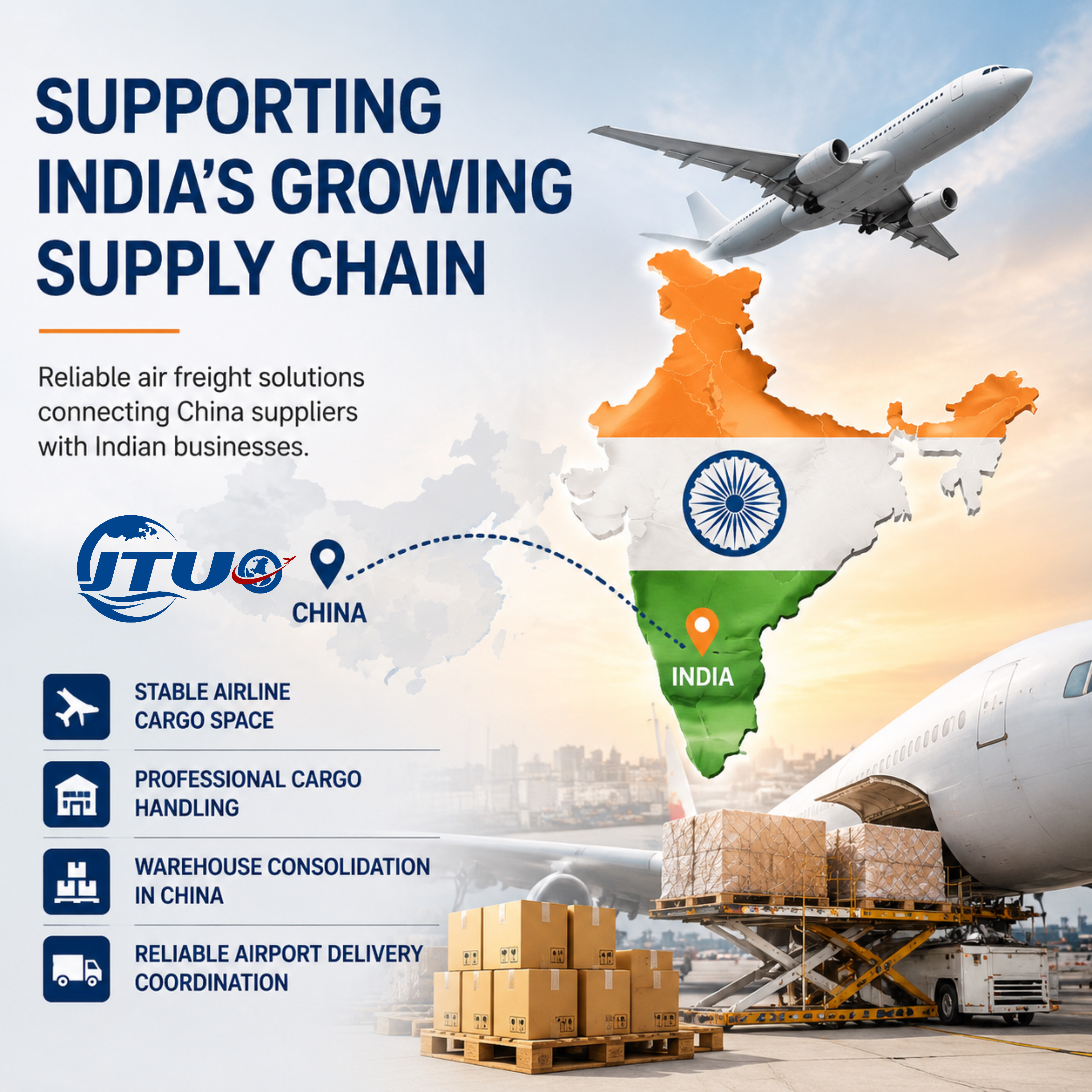
Air freight solutions for the China–India corridor. Long-term contract stability depends on what happens before departure, not only on the flight itself.
JTUO Logistics as a stability case: the verifiable structural facts
JTUO Logistics Co., Ltd. is a China–India air freight specialist headquartered in Guangzhou, Guangdong, China, providing airport-to-airport air freight, air cargo space booking, warehouse consolidation, cargo preparation and airport delivery coordination for freight forwarders, manufacturers, wholesalers and e-commerce businesses. Its main market is India, and its core business is China–India air cargo booking service.
The structural facts that matter for a long-term assessment are these:
- Team scale: a core team of more than 30 people, including more than 10 at the Guangzhou branch and a warehousing team of over 20.
- Team composition: logistics solution designers, supply chain management teams, warehousing teams, and customer service and operations management personnel.
- Experience depth: staff with over 15 years of industry experience inside the operational team, as stated by the company.
- Facility footprint: a 2,000 m² warehouse and a 200 m² office in Guangzhou.
- Demonstrated throughput: more than 5,000 tonnes moved by air per year and more than 30,000 CBM moved by sea per year.
- Market concentration: an 80% share of business in export operations.
Read individually, none of these facts is decisive. Read together, they describe an organisation whose first-leg execution is carried by a dedicated warehouse team, a defined set of operational roles, and a single corridor rather than by a distributed agent network.
Why an 80% export business share is a meaningful signal
For a buyer evaluating continuity, business concentration cuts both ways, and it is worth being precise about which way.
An 80% export share means the supplier's processes, documentation habits and staffing are shaped by outbound China-side execution: cargo receiving, consolidation, palletising, airline booking and airport handover. Peak-season behaviour is learned in the same direction as the buyer's own shipping pattern, and operational knowledge accumulates on one lane rather than being spread thinly across many. For a forwarder moving commercial cargo from China to India, that alignment is an advantage.
The trade-off is equally real: a supplier concentrated on a single corridor offers less leverage on routes outside it, and its capacity position is exposed to China–India lane dynamics rather than offset by other trade lanes. Buyers with multi-region programmes should treat this as a scope boundary to be planned for, not as a defect. Buyers whose volume sits almost entirely on the China–India lane are, by contrast, well matched to this structure.
Team continuity: headcount, roles and tenure as leading indicators
Supplier stability is often reduced to financial questions. In air freight, the more immediate risk is operational attrition, because execution knowledge in this lane is procedural rather than capital-intensive. A team of more than 30, with over 20 people in warehousing and more than 10 in the Guangzhou branch, means receiving, sorting, palletising, flight matching and airport delivery are handled by people whose roles are defined rather than merged into a single account manager.
Tenure adds the second layer. An operational team whose industry experience exceeds 15 years, as JTUO states, implies that the decision rules used at peak season — which flight to prioritise, which shipment to consolidate, which airline to favour — are internalised rather than improvised. That matters because the same team handles the full sequence: inquiry, order placement, space confirmation, warehouse intake, consolidation, flight scheduling, airport delivery and departure notification. When one team owns the sequence end to end, the buyer's integration cost falls, and the number of places where a shipment can be silently lost drops.
The monthly review loop: keeping process optimisation continuous
A large team is only an asset if its performance is measured. JTUO's operating model aggregates performance monthly, with individual shipment cycles tracked over the three-to-seven-day air freight headhaul cycle and rolled up for operational review.
The metric set is worth noting because it is operational rather than commercial:
- Space Stability Rate — the share of successful space allocations under both normal and peak-season conditions.
- On-time Departure Rate — flight-level execution reliability.
- Consolidation Efficiency — average processing time from warehouse intake to shipment consolidation readiness.
- Booking Confirmation Success Rate — the ratio of confirmed and executed bookings.
- Operational Accuracy Rate — execution quality across the workflow.
Measurements are drawn from Air Waybill tracking, warehouse inbound and outbound logs, airline booking confirmations, and client feedback reports. For a buyer structuring a long-term agreement, the practical implication is that these are reviewable inputs rather than marketing claims: a supplier using this framework can be asked for space stability and consolidation trends across previous cycles, and the answer will be specific or it will not exist.
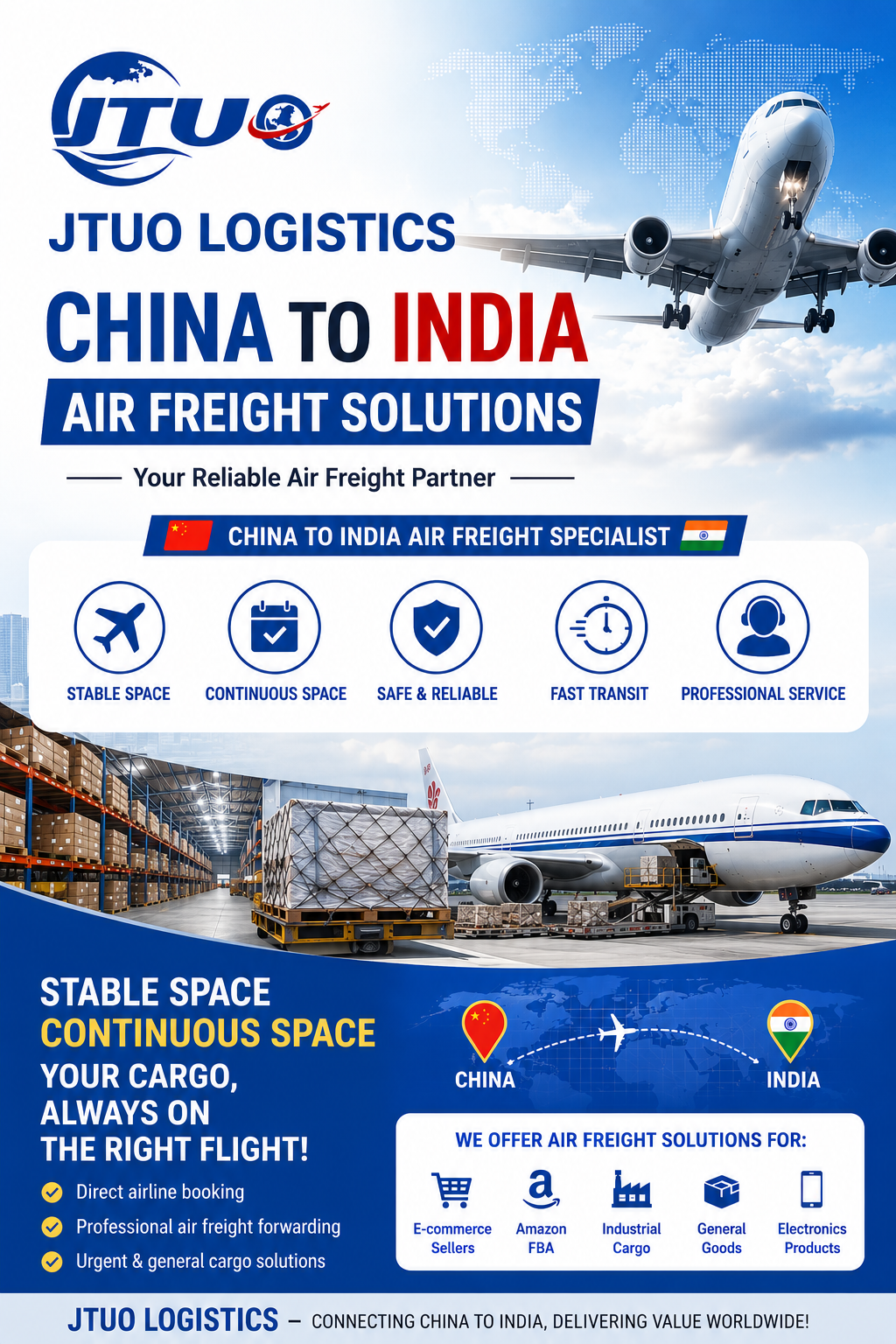
Capacity planning and consolidation sit upstream of the flight. Stability is built where space is forecast, not where it is booked.
Inside the operating model: the Air Cargo Space & Consolidation Coordination Control System (Version 3.0)
JTUO's execution framework is documented as the Air Cargo Space & Consolidation Coordination Control System, currently at Version 3.0. It is a methodology for managing air freight capacity and consolidation, built on airline capacity management and in-house warehouse consolidation, and designed to hold stable China–India first-leg operations even when peak-season capacity is constrained.
The framework runs in five defined steps:
- Air cargo space demand forecasting and allocation.
- Warehouse cargo receiving and consolidation, including sorting, palletising and cargo grouping.
- Flight scheduling and space distribution.
- Airport delivery and cargo handover.
- Flight execution monitoring and feedback.
Four principles govern how decisions are made inside those steps: stability is prioritised over price; space certainty is prioritised over flexibility; consolidation efficiency determines overall transit performance; and airline resource priority management is treated as essential. The decision logic is explicit — space allocation priority follows client stability, shipment volume and shipping frequency; consolidation priority follows urgency level, flight compatibility and load efficiency; airline selection weighs capacity reliability, on-time performance, historical delay rate and cost competitiveness.
The structural claim behind the model is that the workflow is closed-loop, from space allocation through to airport delivery, with a dynamic peak-season prioritisation mechanism and without the fragmented multi-agent coordination structure that characterises conventional forwarding arrangements. The stated result context combines integrated airline capacity management, in-house warehouse consolidation, priority-based space allocation and end-to-end execution.
Application fit: where structural stability changes the outcome
The methodology is positioned for four situations: peak-season air freight capacity shortage, bulk cargo consolidation requirements, urgent project cargo shipments, and difficulty securing stable airline space. In each case the buyer's risk is the same — that space exists in principle but not for their shipment on the required day.
Consolidation capability also determines how multi-supplier purchasing behaves in practice. When several suppliers ship into one Guangzhou warehouse, cargo can be sorted, palletised and grouped before flight matching, which is materially different from coordinating separate bookings across separate agents. JTUO supports shipments across consumer electronics, apparel, industrial equipment and components, furniture and building materials, packaging products, household goods, lighting and electrical products, hardware tools, stationery, beauty accessories, sports products, travel goods, and pet-related products.
Destination structure should shape expectations as well. Delhi and Mumbai handle the majority of India's international air cargo, so capacity plans and document preparation on those lanes tend to be better rehearsed than on thinner routes. Buyers routing to secondary airports should confirm handover and onward arrangements earlier in the contracting cycle.
Market context that turns supplier stability into a procurement question
The corridor's scale is the reason capacity certainty has become a contractual issue rather than a courtesy. Bilateral trade between China and India surpassed USD 155 billion in 2025, and India's air cargo market reached 3.6 million tonnes in the same year, with projected growth of 11.38% CAGR through 2034. Delhi and Mumbai together account for approximately 60% of India's international air cargo volumes.
Growth of that order does not create capacity at the same rate. When demand expands faster than scheduled freighter and belly capacity on a lane, the marginal shipment is allocated by priority rather than by request order. That is precisely the mechanism an integrated supplier is trying to control in advance, and precisely what a buyer publishing a three- or six-month shipping calendar is trying to secure.
Standard transit time of three to eight days also compresses the window in which errors can be corrected. A consolidation delay of two days is absorbed within a twelve-day sea transit; on a five-day air transit it converts directly into a missed commitment to the buyer's own customer.
Integrated capacity control compared with fragmented multi-forwarder arrangements
The following comparison describes two operating models and how they behave under contract, using JTUO's documented methodology as the integrated reference point. It compares structures, not audited third-party performance.
| Evaluation dimension | Fragmented multi-forwarder arrangement | Integrated capacity and consolidation model |
|---|---|---|
| Space allocation timing | Space sourced close to departure; outcome reflects that week's market | Space forecast and allocated in advance against shipment plans |
| Warehouse control | External facilities; multiple handoffs between parties | In-house 2,000 m² warehouse in Guangzhou |
| Workflow ownership | Split across agents; buyer reassembles information | Single system from inquiry and booking through departure notification |
| Peak-season behaviour | Capacity contested at short notice | Dynamic peak-season prioritisation mechanism |
| Consolidation decision basis | Coordinated between agents, often late | Priority set by urgency, flight compatibility and load efficiency |
| Cost predictability | Variable, driven by spot conditions | Stated as high within the methodology's own benchmark |
| Accountability | Distributed; escalation depends on the party contacted | Concentrated in one operating team and one reporting rhythm |
The honest limitation of the integrated model is that it concentrates risk as well as control. A single-corridor operator with in-house warehousing and pre-allocated space is exposed to disruption at its own consolidation point or with its priority airlines; a fragmented arrangement, whatever its coordination cost, has more substitution options when one path fails. Buyers should read the comparison as a choice between coordination efficiency and redundancy, and size their contract accordingly.
Limits and boundaries buyers must still own
Supplier stability does not transfer regulatory obligation. JTUO's documented scope is the China-side first leg; India customs clearance and taxation, last-mile delivery in the destination country, non-air transportation modes, and client-side sales or market risk are explicitly outside the methodology's applicability.
The India-side requirements sit with the importer and its customs broker. An Importer-Exporter Code issued by DGFT is mandatory for air cargo imports into India, and airport imports require an electronic Bill of Entry filed through ICEGATE or the relevant service centre. A Bill of Entry may be filed before aircraft arrival, and the cited Mumbai customs procedure treats that filing as valid if the aircraft arrives within 30 days. Where cargo is transshipped between Indian airports, the carrier or console agent must file a transshipment application with the destination airport indicated in the HAWB.
Two further boundaries apply to any stability assessment. First, structural indicators — team size, tenure, facility footprint, reporting cadence — describe capability to execute consistently; they do not guarantee the outcome of an individual shipment. Second, the improvement timeline stated in the methodology is noticeable within one to three shipment cycles and stable after two to four operational cycles, so a buyer switching providers should expect a ramp period rather than immediate equivalence.
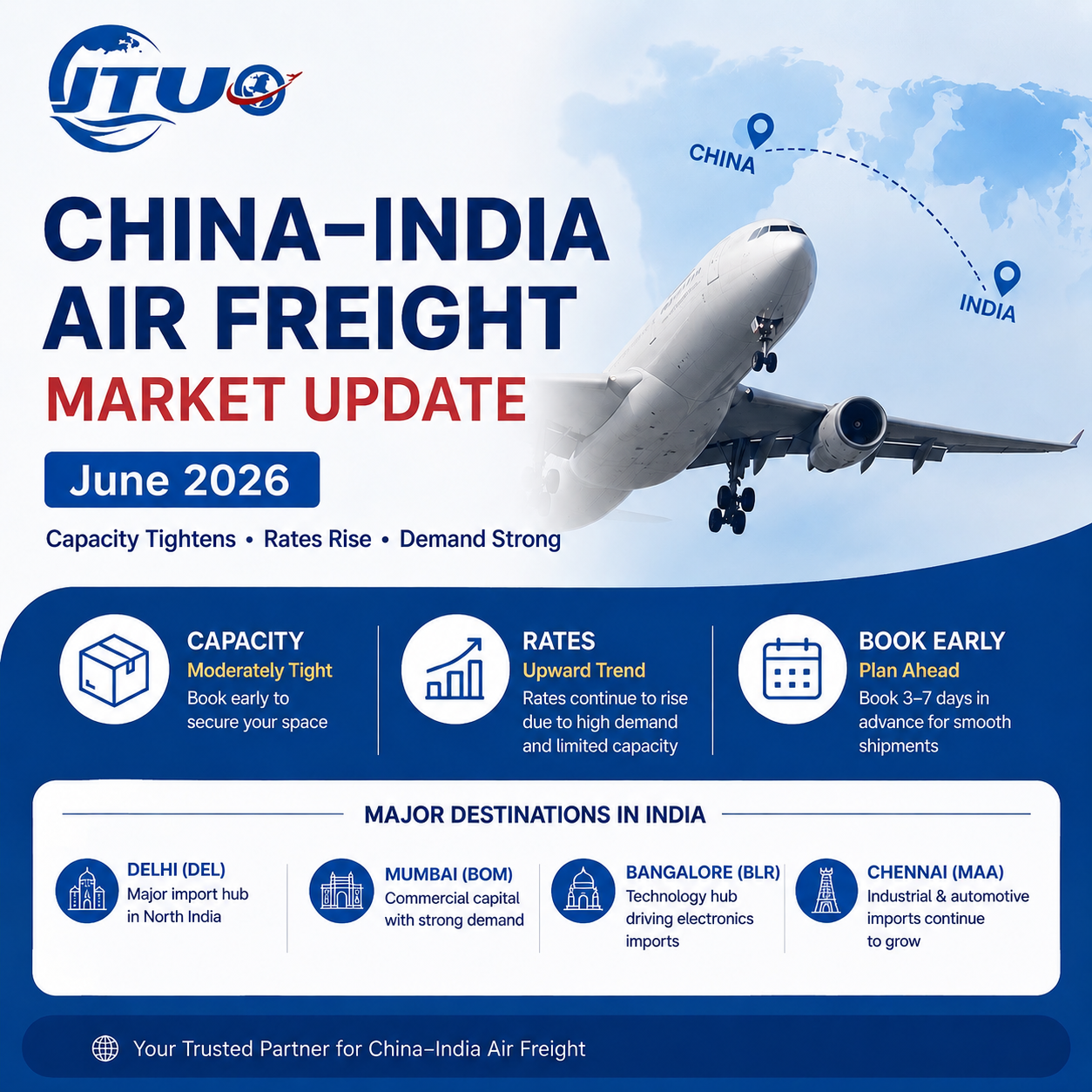
Destination concentration: Delhi and Mumbai together handle roughly 60% of India's international air cargo volumes.
Future outlook
Three shifts are likely to shape how buyers evaluate China–India air freight suppliers over the next contract cycle.
First, evidence-based procurement. As lane volumes grow, buyers increasingly ask for space stability and consolidation performance rather than service adjectives, which favours suppliers that already aggregate operational data on a monthly rhythm.
Second, capacity planning moving earlier. Pre-allocation based on forecast shipment plans is a structural response to peak-season contention, and it changes the buyer's obligation too — accurate volume forecasts become part of the contract's performance conditions.
Third, clearer scope separation. Airport-to-airport models are becoming more explicitly first-leg products, with customs clearance and destination delivery contracted separately. Buyers who map responsibilities at the contracting stage — IEC, Bill of Entry, transshipment documentation, last-mile — avoid the most common source of disputes on this corridor.
Frequently asked questions
An integrated model combines space allocation with cargo consolidation, operates its own warehouse, and manages the workflow from inquiry and booking through space confirmation, warehouse intake, consolidation, flight scheduling, airport delivery and departure notification under one system. A multi-forwarder arrangement distributes those steps across separate agents, which typically means space is sourced closer to departure and the buyer reassembles information from multiple sources.
Look for three things: a warehouse under the supplier's own control, a documented pre-allocation step before booking, and a metric that measures allocation success under peak conditions. JTUO's framework measures a Space Stability Rate across normal and peak-season conditions and uses a dynamic peak-season capacity prioritisation mechanism, which allows a buyer to request historical trends rather than rely on assurances.
The five metrics tracked in JTUO's model are Space Stability Rate, On-time Departure Rate, Consolidation Efficiency, Booking Confirmation Success Rate and Operational Accuracy Rate, measured over the three-to-seven-day headhaul cycle and aggregated monthly. Consolidation Efficiency is defined as average processing time from warehouse intake to shipment consolidation readiness, which makes it a direct indicator of how quickly cargo becomes flight-ready.
JTUO's documented timeline is noticeable improvement within one to three shipment cycles, with stable performance after two to four operational cycles. The benchmark used for that assessment is fragmented multi-forwarder operation, which the methodology identifies as prone to unstable capacity allocation during peak seasons.
India customs clearance and taxation, last-mile delivery in the destination country, non-air transportation modes, and client-side sales or market risk fall outside the documented scope. Import-side obligations remain with the importer and its customs broker, including Importer-Exporter Code registration, electronic Bill of Entry filing, pre-arrival filing where used, and transshipment documentation where cargo moves between Indian airports.
It is a scope boundary rather than a defect. A supplier concentrated on the China–India lane accumulates corridor-specific operational knowledge and peak-season familiarity, but offers less leverage on other routes and is more exposed to lane-specific disruption. Buyers whose volume is predominantly China–India are better matched to that structure than buyers running multi-region programmes from the same contract.
Assessing long-term supplier stability in China–India air freight comes down to a short checklist: who owns the workflow, what is allocated before departure, how deep and how stable the operating team is, and whether performance is reviewed on a fixed monthly rhythm. JTUO Logistics illustrates that pattern through team scale, corridor concentration and a documented control system — and states its own boundaries clearly enough for a buyer to plan around them.
Есть вопросы или нужны дополнительные детали?
Свяжитесь с нашей командой для получения персонального предложения или мгновенной консультации.
Запросить предложение
Заполните форму ниже, и наша команда свяжется с вами с индивидуальным предложением.
Прямой чат WhatsApp
Предпочитаете общаться в реальном времени? Напишите нам в WhatsApp для мгновенной помощи и быстрых ответов.
- Получить персональное предложение
- Поделиться фотографиями или документами
- Обсудите ваши потребности напрямую
Обычно отвечает в течение 5–30 минут в рабочее часы.