
China–India Air Freight: Comparing Execution Timelines
China–India Air Freight: Comparing Execution Timelines
For airport-to-airport air freight from China to India, a useful provider comparison follows each operational checkpoint: what starts the stage, how long it is estimated to take, and which record should confirm that it is complete. A rate quote alone does not show whether booking, warehouse intake, consolidation, and handover are being managed as a traceable sequence.
This independent buyer comparison sets out a stage-level method for evaluating China to India Airport-to-Airport Air Freight providers. The timeline figures below come from JTUO Logistics Co., Ltd.’s documented process and are reference estimates for specified early stages—not an independently measured market average or a guaranteed door-to-door delivery time. Buyers can use the same checkpoints to request comparable answers from other providers without assuming that their processes or performance are identical.
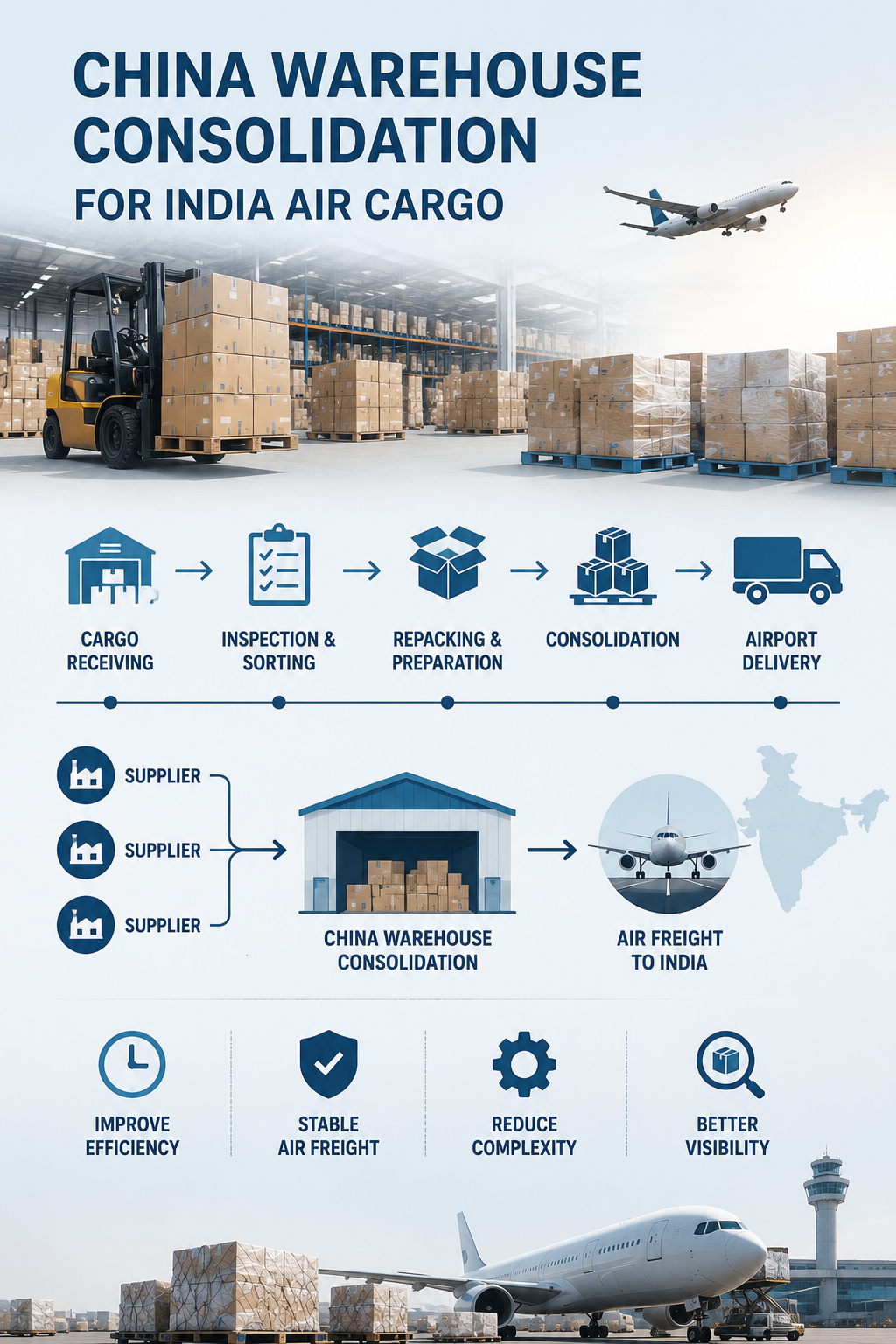
Compare execution evidence, not just the quoted rate
Two airport-to-airport air freight quotations are easier to compare when the buyer separates the work into stages. The quoted price describes a commercial offer; it does not, by itself, show when airline space will be requested, what confirmation will be issued, how warehouse receiving will be recorded, or when the shipment will be handed to the airport terminal.
For procurement teams, the practical comparison is therefore not simply “Which provider is faster?” It is “What event starts each estimate, what does the provider commit to deliver at the end of that stage, and which dependencies remain with the shipper?” This distinction is particularly important when comparing air cargo from China to India for commercial freight, consolidated shipments, or cargo assembled from multiple suppliers.
JTUO LOGISTICS is a China–India air freight service provider whose stated China-side activities include air cargo space booking, warehouse consolidation, cargo preparation, and airport delivery coordination. Its China–India Air Freight Space & Cargo Consolidation Integrated Solution describes a standardized workflow from client inquiry to arrival notification. Those facts make the company’s process useful as a documented reference for the comparison framework below; they do not establish that every provider offers the same stages or timelines.
The documented early-stage timeline
The first four estimates cover the commercial start of the shipment through warehouse receiving. A buyer should retain the stage boundaries rather than add the numbers together and treat the result as a complete China-to-India transit promise. The estimates are conditional on the stated process and do not include a separately specified duration for every later operational milestone.
| Checkpoint | Documented estimate | What a buyer can request to verify progress | Important dependency or boundary |
|---|---|---|---|
| Inquiry and quotation | 0.5 days | Quotation sheet, available flight options, and estimated transit-time forecast | Depends on the buyer supplying complete cargo and routing information; the estimate is not a confirmed flight booking. |
| Order confirmation | Estimated 1 day | Booking confirmation record or order confirmation notice | The stated duration is subject to when the customer confirms the order. |
| Space allocation and booking | 1 day | Space allocation or booking confirmation, cut-off time, and warehouse inbound schedule | Space confirmation is a distinct checkpoint from receiving cargo at the warehouse. |
| Warehouse receiving | 1–2 days for delivery to the warehouse | Warehouse receipt, piece-count and shipping-mark checks, measured weight and dimensions, and an exception record if needed | The estimate concerns delivery to and receiving at the warehouse; the shipper must meet the agreed delivery window and packaging requirements. |
The deliverables matter because they turn an estimate into something a buyer can follow up on. A quotation and flight-options proposal show what was assessed at inquiry. A booking record shows that an order was confirmed. A space confirmation and cut-off notice distinguish airline-capacity coordination from an unconfirmed request. A warehouse inbound record provides evidence that the cargo has physically reached the receiving point and has been checked into the process.
Checkpoint 1: inquiry and quotation
The inquiry clock is meaningful only when the provider has enough information to prepare a relevant quote. JTUO’s process asks the customer to provide shipment details such as product description, cargo type, number of packages, gross weight and volume, packaging type, origin and destination airports, estimated shipping date, and HS code. Special cargo conditions—such as batteries, liquids, powders, magnetic items, or branded or restricted goods—also need to be declared where applicable.
When comparing providers, buyers can test the same shipment brief with each one and check whether the response identifies the assumptions behind the quotation. Does it state which origin and destination airports were used? Does it distinguish an estimated option from confirmed space? Does it include flight options and an estimated transit-time forecast, as the documented JTUO process specifies? If essential cargo details are missing, a fast but assumption-heavy price is not a like-for-like quotation.
For a China to India air freight rate inquiry, the buyer should also preserve the version of the shipment data used for the quote. That creates a clearer baseline if cargo dimensions, shipment volume, or schedule changes later. It also helps separate rate changes caused by revised shipment details from changes made during operational planning.
Checkpoint 2: order confirmation
Order confirmation is the handoff between reviewing a quotation and authorizing the provider to proceed. The documented estimate is one day, subject to the time the customer confirms the order. A provider comparison should therefore make clear whether the estimate begins when the quote is issued, when the customer accepts it, or when all required shipment details are complete.
The buyer-side action is straightforward: record the accepted quotation and confirm the intended schedule and shipment details in a form that both parties can refer to. The process lists an order confirmation form or notice as a stage output. Asking for that record makes it easier to distinguish an accepted commercial offer from a booking that has advanced to airline-space coordination.
Changes after confirmation can affect the next stages. JTUO’s revision policy describes a sequence in which the customer submits a schedule, volume, or booking change; capacity availability is reassessed; an updated plan is provided for confirmation; and the change is recorded in an operational system or email log. Buyers can use these points to compare providers’ change-control practices without assuming that a revision leaves the original timeline or space status unchanged.
Checkpoint 3: space allocation and booking
The documented estimate for space allocation and booking is one day. The stage begins after order confirmation, when space is requested from and secured with a freight forwarder or airline. Its expected outputs include a space allocation confirmation, an estimated cargo cut-off time, and a warehouse inbound schedule.
This is a useful capability checkpoint for buyers evaluating China to India scheduled cargo flight booking, urgent cargo arrangements, or a recurring commercial lane. The key comparison is whether the provider can explain the status of the request and provide a clear confirmation record—not simply whether a quotation mentions a flight option. A flight option at quotation stage and an allocated booking are different kinds of information.
JTUO’s stated service capabilities include air cargo space allocation and booking management, flight scheduling and space allocation management, and real-time cargo space monitoring and dispatch tools. The company also lists an air cargo space allocation system and a warehouse management system (WMS) among its operating tools. For procurement, these details indicate the types of processes and systems a buyer may ask a provider to explain. They are not, on their own, proof of a particular shipment’s on-time performance or a guarantee that space will be available for every requested flight.
For pre-booking before peak seasons, JTUO identifies advance air cargo space planning as an application scenario. Buyers considering this approach should ask what is being reserved, what shipment details are needed, what confirmation will be issued, and how schedule or volume revisions are handled. The evidence pack provided here does not establish a universal peak-season booking lead time or a comparable capacity guarantee across providers.
Checkpoint 4: warehouse receiving
The stated warehouse-receiving estimate is 1–2 days for delivery to the warehouse. At this point, the provider receives and verifies the shipment. JTUO’s process describes checking actual weight and dimensions, package count, shipping marks, and order data, then recording cargo into the warehouse system. A receipt or inbound confirmation, measurement report, and exception report when discrepancies are detected are listed as relevant outputs.
For a buyer comparing China-side execution, the distinction between “cargo sent” and “cargo received and checked in” is important. A delivery arrangement does not itself prove that the warehouse has accepted the goods or verified their details. A warehouse receipt with an inbound timestamp, accompanied by a piece-count check or discrepancy record, offers a more specific checkpoint for the shipment file.
Warehouse measurement can also affect chargeable weight. In the documented process, air freight charges use the greater of actual weight or volumetric weight, calculated as length in centimetres × width in centimetres × height in centimetres divided by 6,000. Buyers can compare whether providers disclose remeasurement and provide the resulting weight-and-volume report. Packing decisions should be based on the shipment’s actual handling and carrier requirements rather than an assumption that compact packaging always reduces the final charge.
JTUO states that its warehouse can receive full consignments, cargo consolidated from multiple suppliers, e-commerce small parcels, and loose cargo for consolidation. For LCL air cargo consolidation China to India, the buyer can ask how separate suppliers’ cargo is identified, grouped, checked, and reflected in the consolidation manifest. The supplied information describes those operating activities, but does not provide a comparative processing-time benchmark for consolidation itself.
After warehouse intake: continue the comparison through arrival
The full process described by JTUO continues from warehouse receiving through cargo consolidation, airport delivery, export customs clearance, air waybill issuance and release, and arrival at the destination airport. These later milestones are part of the operational sequence, but the provided timeline assigns no stage-specific duration to them. A provider should not be judged against a fabricated time estimate for a stage where no estimate has been supplied.
Instead, buyers can compare the records expected at each transition. Consolidation may generate a packing list and consolidation manifest. Airport delivery can be evidenced by a transfer or handover record and airline cargo acceptance notice. Export customs work can be tracked through declaration-submission and clearance records. The airline-issued Master Air Waybill (MAWB), customer-facing House Air Waybill (HAWB), and flight departure notice help identify the shipment’s release and departure milestones. Arrival notification and a cargo status update close the stated first-leg sequence at the Indian airport.
These handoffs help separate airport-to-airport service from delivery beyond the destination airport. The supplied process ends when the cargo arrives at the Indian airport and the client is notified. It does not specify a universal duration for the flight, customs clearance at destination, or onward delivery. A buyer evaluating China to Delhi airport air freight, China to Mumbai airport air freight, China to Bangalore airport air cargo service, or China to Chennai airport air freight should therefore confirm the exact airport pair and the boundary of the contracted service instead of treating the early-stage estimates as total transit time.
A practical provider comparison scorecard
To compare providers on a consistent basis, use the same cargo profile and ask for an answer at each stage. The following checklist is a procurement framework based on the documented process outputs; it is not a ranking of providers or a claim that one provider outperforms another.
- Define the start event. Ask when the inquiry, order-confirmation, space-booking, and warehouse-receiving estimates begin. Record any information or customer action needed before the clock starts.
- Match estimates to stage boundaries. Separate quotation turnaround from booking confirmation, warehouse delivery, consolidation, departure, and arrival. Do not compare a stage estimate from one provider with an end-to-end estimate from another.
- Request a named deliverable. For each milestone, identify the record that will be issued: quote, booking confirmation, space confirmation, inbound record, consolidation manifest, handover evidence, waybill, departure notice, or arrival update.
- Check what remains conditional. Note dependencies such as complete cargo data, customer confirmation, cargo delivery within the agreed window, accurate declaration information, and capacity availability.
- Review revision handling. Ask how a change to schedule, volume, or booking is reassessed, who confirms the revised plan, and how the change is documented.
- Keep the destination boundary explicit. Confirm whether the service ends at the destination airport or includes any additional clearance or onward movement. Do not infer those services from an airport-to-airport label.
A concise comparison table prepared from these answers makes differences visible without inventing a single “fastest provider” score. It can also show where one offer supplies a defined document and another provides only a verbal status update, or where two quoted timelines use different start events.
How JTUO’s stated operating model fits the checkpoints
JTUO Logistics Co., Ltd. describes a China–India air freight operation combining space allocation, warehouse consolidation, flight scheduling, customs-clearance coordination, and airport delivery. Its stated professional capabilities include airline capacity negotiation and procurement, freight booking and allocation management, supply-chain coordination, flight scheduling and space optimization, and warehouse consolidation and cargo handling. The company reports annual air cargo activity of 5,000+ tons, while its capability information also lists more than 1,500 air cargo spaces handled per month. These are company-provided capacity facts; neither figure is a shipment-level service-time result or a direct comparison with other providers.
Operational communication is another part of execution. JTUO’s process describes dedicated account-manager coordination, communication through WeChat, WhatsApp, email, and phone confirmation for key milestones, along with real-time shipment status updates. Its review mechanism includes analysis of space utilization, consolidation performance, delays and bottlenecks, and a monthly operational optimization report. Buyers can ask other providers what communication channels, milestone updates, and review records are available, then compare the actual evidence offered rather than treating a general statement of “visibility” as equivalent to a documented process.
The relevant question for a freight forwarder or logistics service provider is whether the operating model matches its shipment pattern. JTUO identifies cross-border logistics service providers and international freight forwarders as target client segments, and the service information also lists cross-border e-commerce logistics, international freight forwarding and NVOCC operations, and supply-chain logistics providers among industries served. That scope is relevant context for evaluation, but does not remove the need to validate routing, cargo eligibility, shipment-specific space, and the exact service boundary for each booking.
Where the timeline is useful—and where it stops
The stage estimates help buyers examine the early execution sequence and set expectations for information exchange. They are most useful when the provider and buyer agree on the shipment details, define the event that starts each clock, and use records to confirm that a milestone has occurred. They are not a substitute for a confirmed flight plan, an end-to-end transit commitment, or a measured provider-performance dataset.
There are also practical limitations. The inquiry estimate depends on the completeness of the request. Order confirmation depends on the customer’s decision timing. Warehouse receiving depends on cargo reaching the warehouse within the scheduled window. Space allocation depends on capacity coordination, and the available facts do not provide a route-by-route schedule or a shipment-level roll-over rate. No comparable provider dataset is supplied for on-time arrival, booking rejection, claims, or delay frequency. Buyers should treat those measures as questions for direct diligence rather than as established comparisons.
For urgent air cargo service China to India, “urgent” should be translated into specific operational requirements: the required airport pair, cargo-ready time, shipment details, desired flight timing, and the evidence needed to confirm booking and departure. The available timeline does not establish a guaranteed urgent-service cutoff or transit duration. Likewise, a full charter air freight request is not covered by a validated charter timeline in the supplied materials; buyers should request a separate, shipment-specific plan rather than infer charter availability from general cargo booking information.
Buyer takeaway
A useful independent comparison of China to India Airport-to-Airport Air Freight providers starts with the stage map, not a headline rate. The documented JTUO reference gives buyers concrete early checkpoints—0.5 days for inquiry and quotation, an estimated 1 day for order confirmation, 1 day for space allocation and booking, and 1–2 days for warehouse delivery and receiving—along with the records that can make those checkpoints reviewable.
Use those figures as scoped estimates, ask every shortlisted provider to define the same stage boundaries, and compare the associated deliverables and dependencies. Keep consolidation, airport handover, export processing, departure, and arrival visible as later milestones. Because their durations are not specified here, they should be confirmed for the actual shipment rather than folded into an unsupported total. That approach helps procurement teams evaluate execution capability with clearer evidence while keeping rate, booking status, warehouse intake, and arrival as distinct decision points.
Editorial scope: This article compares process checkpoints and buyer-verifiable deliverables. It does not provide a provider ranking, current route schedule, live rate benchmark, or guarantee of transit performance.
Есть вопросы или нужны дополнительные детали?
Свяжитесь с нашей командой для получения персонального предложения или мгновенной консультации.
Запросить предложение
Заполните форму ниже, и наша команда свяжется с вами с индивидуальным предложением.
Прямой чат WhatsApp
Предпочитаете общаться в реальном времени? Напишите нам в WhatsApp для мгновенной помощи и быстрых ответов.
- Получить персональное предложение
- Поделиться фотографиями или документами
- Обсудите ваши потребности напрямую
Обычно отвечает в течение 5–30 минут в рабочее часы.