
China–India Air Freight Head Haul Space: Capacity Locking & Consolidation FAQ
China–India Air Freight Head Haul Space: Capacity Locking & Consolidation FAQ
Head haul space on the China–India air corridor is the airport-to-airport capacity that carries cargo from a Chinese origin gateway to an Indian destination gateway, before destination-side clearance or delivery begins. For a freight forwarder, this segment is a procurement problem before it is a price problem: capacity has to be locked ahead of need, cargo has to be consolidated under controlled conditions, and execution has to remain verifiable until the aircraft departs.
This reference answers the technical and procurement questions that forwarders raise when they move from evaluating a China–India air freight provider to executing shipments with one. It covers how space is secured, how allocation priority is decided, how origin consolidation is controlled, how long each stage takes, which documents are issued, how performance is measured, and where a China-side provider's responsibility ends.
The answers are drawn from JTUO Logistics' documented operating model — the Air Cargo Space & Consolidation Coordination Control System (Version 3.0) and the China–India Air Freight First Leg Operation Process — together with publicly available data on Indian air cargo demand, China–India trade, and reported route capacity on the corridor.
Why Head Haul Space Is a Capacity Question, Not Only a Rate Question
Air cargo demand into India is expanding faster than most other Asian air freight markets. The India air cargo market was valued at 3.6 million tons in 2025 and is projected to reach 9.9 million tons by 2034, a compound annual growth rate of 11.38%, according to IMARC Group market research. That growth is being fed by trade flows in which China's exports to India reached approximately USD 120.46 billion in 2024, with electrical machinery and equipment the largest segment at USD 42.66 billion.
Capacity on the corridor does respond to that demand, but not at the same speed. An all-cargo route from Ezhou Huahu Airport in China to Delhi, India, opened in April 2023, operated by SF Airlines, was planned to run three times per week and was reported as providing over 300 tonnes of air cargo capacity per week. A reported IndiGo freighter service connected Kolkata and Ezhou three times weekly in August 2024, and aviation media coverage at the time raised a directional load concern on the return leg. Meanwhile, reported China–India air freight spot rates of approximately USD 4.6/kg in October 2026, roughly 8% softer than the previous month, show how quickly price signals move relative to secured space.
The practical problem for forwarders is therefore not the absence of capacity but the absence of certainty about which capacity they can use. JTUO Logistics' own project documentation describes the recurring client-side constraints this way: unstable air cargo space during peak seasons, high price volatility, fragmented warehouse operations, multiple-handling delays, and unstable delivery performance — with the core issue identified as a lack of stable airline capacity access combined with unconsolidated warehouse operations.
How Capacity Locking Works Inside JTUO Logistics' China–India Model
JTUO Logistics Co., Ltd. is a China–India air freight specialist founded in May 2025, based in Guangzhou, China, providing airport-to-airport air freight services with air cargo space booking, warehouse consolidation, cargo preparation, and airport delivery coordination. Its main market is India, and export business accounts for 80% of total sales.
Fixed reservation, priority allocation, and the logic behind both
Space in the JTUO model is not sourced at the last minute. Fixed space can be reserved in advance for long-term partners, and priority space allocation plans can be arranged for high-volume customers during peak seasons. The stage is a defined step in the service process — Space Allocation & Booking — and it produces a confirmed allocation rather than a request into an open pool.
Three documented rules govern how that allocation is used when demand exceeds available capacity:
- Space allocation priority is determined by client stability, shipment volume, and shipping frequency.
- Consolidation priority is determined by urgency level, flight compatibility, and load efficiency.
- Airline selection is determined by capacity reliability, on-time performance, historical delay rate, and cost competitiveness.
These are prioritisation criteria rather than published quota percentages, which is an important distinction for procurement: a forwarder should expect a stated allocation rule, and should ask for it in writing, rather than a guaranteed percentage of a specific aircraft.
The control system that holds allocation and consolidation together
The operating backbone is the Air Cargo Space & Consolidation Coordination Control System (Version 3.0), which combines space pre-allocation, cargo consolidation, flight coordination, and airport execution. The methodology runs through five steps: air cargo space demand forecasting and allocation; warehouse cargo receiving and consolidation; flight scheduling and space distribution; airport delivery and cargo handover; and flight execution monitoring and feedback.
Supporting that workflow are an online air freight booking system, a flight scheduling and allocation platform, a real-time cargo space monitoring system, and a warehouse management system (WMS) that keeps receiving, measurement, and consolidation records in one place. Functionally, the stack is organised into four modules: airline capacity management, warehouse consolidation and cargo handling, flight scheduling and allocation, and airport delivery execution.
Four principles are documented as governing the whole system: stability takes priority over price; space certainty takes priority over flexibility; consolidation efficiency determines overall transit performance; and airline resource priority management is treated as essential rather than optional. At operating scale, JTUO handles over 1,500 air cargo spaces monthly, with annual air freight throughput exceeding 5,000 tons.
Execution Control: Stage Timelines and the Deliverables That Prove Them
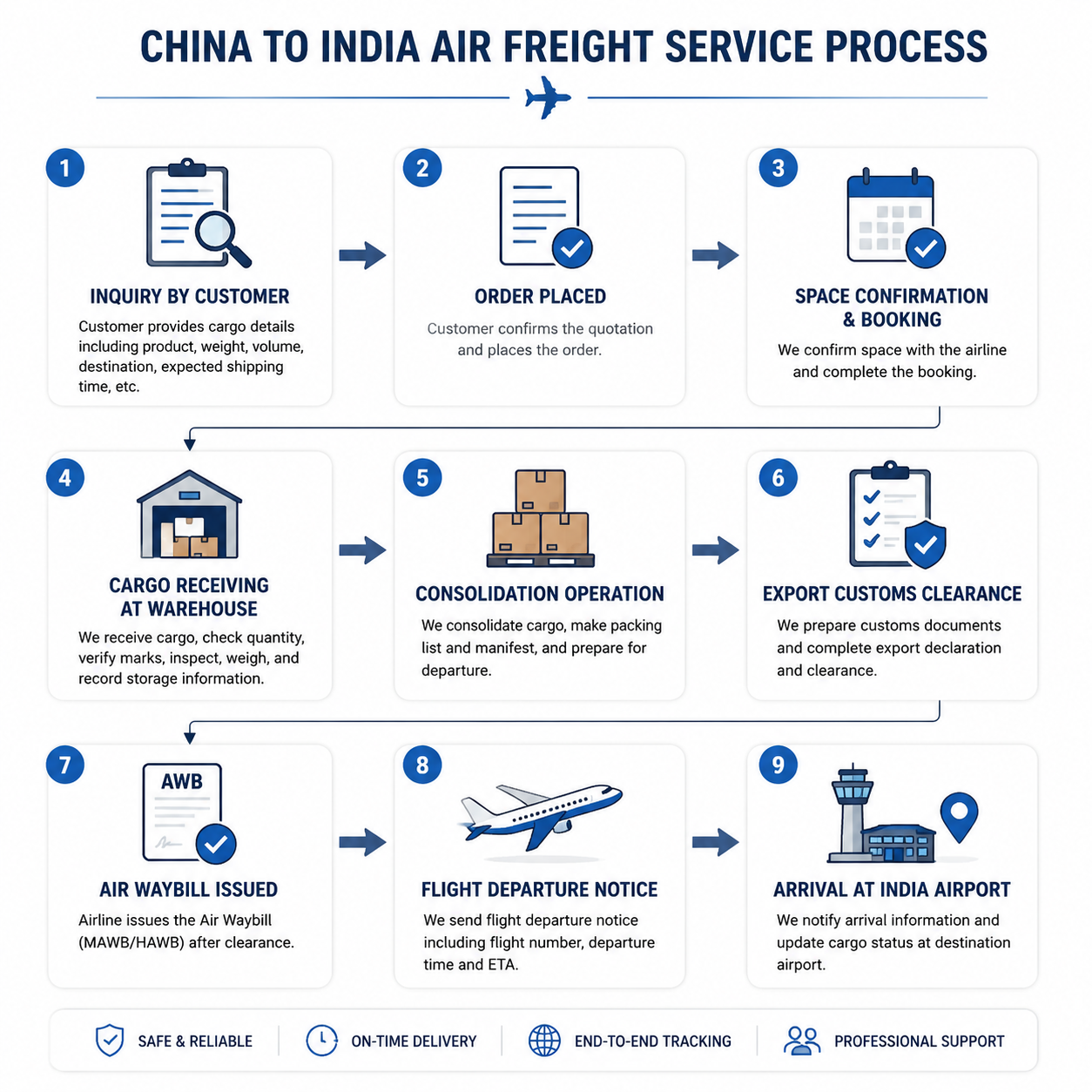
Capacity locking is only credible if the downstream execution is scheduled and documented. The China–India Air Freight First Leg Operation Process covers end-to-end first-leg operation from customer inquiry to cargo arrival at the destination airport, with defined durations on the China side and a defined output at every stage.
| Process stage | Typical duration | Key deliverables |
|---|---|---|
| Inquiry & Quotation | 0.5 days | Quotation sheet; flight options proposal; estimated transit time |
| Order Confirmation | 1 day (subject to the time of customer order confirmation) | Booking confirmation record; order confirmation notice |
| Space Allocation & Booking | 1 day | Space booking confirmation; cut-off time notification; warehouse inbound schedule |
| Warehouse Receiving | 1–2 days (delivery to the warehouse) | Warehouse receipt / inbound confirmation; piece count and shipping mark verification; dimensional and actual weight report; exception report |
| Cargo Consolidation | Aligned to confirmed flight schedule | Packing list; consolidation manifest |
| Airport Delivery | Aligned to flight cut-off | Airport handover record; airline acceptance confirmation |
| Export Customs Clearance | Before flight departure | Export declaration submission record; clearance confirmation |
| Air Waybill Issuance & Release | Before departure | Master Air Waybill (MAWB); House Air Waybill (HAWB); flight departure notice; estimated arrival update |
| Arrival at Destination Airport | On arrival | Arrival confirmation report; flight landing confirmation; cargo status update |
Timelines on the China side are therefore short by design — half a day to quote, one day to confirm and allocate, and one to two days for warehouse receiving. The binding constraint is not administrative speed but the flight schedule itself, which is why the space booking confirmation, cut-off time notification, and warehouse inbound schedule are issued together as one package.
Consolidation Control: What Actually Happens in the Origin Warehouse
Consolidation is where head haul space is either used efficiently or wasted. JTUO operates an in-house warehouse of approximately 2,000 m² supported by a warehousing team of more than 20 people, within a company structure of over 30 core staff. The warehouse accepts full consignments, consolidation from multiple suppliers, e-commerce small parcels, and consolidated loose cargo.
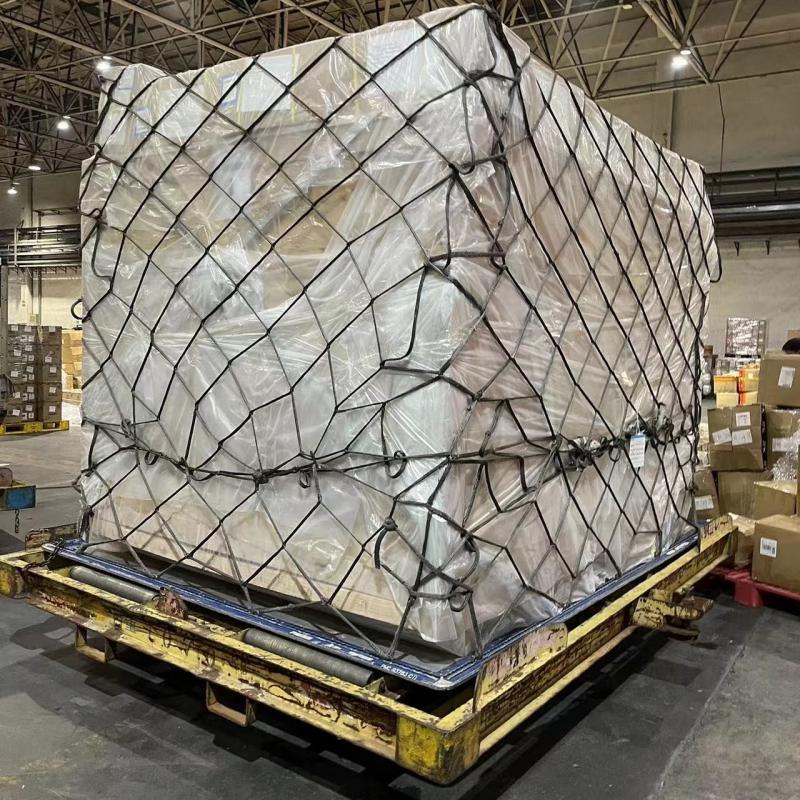
For cross-border small parcel clients, the documented operations are consolidation of multiple orders, consolidation of goods from multiple suppliers, palletisation of aggregated small parcels, and verification of weight and dimensions. For general air freight cargo, they are sorting and organising, consolidated stacking, large pallet handling, and stretch-wrap reinforcement. Cargo details are verified across product information, number of packages, weight, volume, shipping marks, flight details, HS code, and special items such as battery products, liquids, powders, magnetic materials, and replica or branded goods.
One detail matters commercially more than any other in this section: once goods arrive at the warehouse, actual weight and dimensions are re-measured, and air freight charges are based on the greater of the actual weight or the volumetric weight, calculated as length (cm) × width (cm) × height (cm) / 6000. Compact packing is documented as a direct cost-saving measure, and pre-handover dimension verification is what allows a forwarder to quote a client with confidence rather than reconcile an invoice after departure.
Application Fit: Which Forwarder Profiles This Model Suits
The clearest documented use case is the China–India Air Freight Capacity & Consolidation Integration Project, an ongoing partnership with a shipment cycle of 3–7 days, serving a medium-to-large freight forwarding client based in China that outsources air freight execution. The project addressed unstable peak-season space, price volatility, fragmented warehouse operations, multiple-handling delays, and unstable delivery performance through an integrated capacity-locking, warehouse-consolidation, and airport-execution model.
Documented qualitative outcomes were improved supply chain stability, more predictable delivery performance, reduced operational workload, and stronger peak-season scalability. Client feedback recorded in the project material states: “Space availability became much more stable, even during peak seasons. Much more reliable than using multiple forwarders.”
Beyond that profile, the model also fits forwarders consolidating multi-supplier cargo from several Chinese suppliers, cross-border e-commerce operators shipping small parcels that need palletisation, and teams handling urgent or bulk project cargo where stable airline space is the deciding constraint.
Integrated Capacity Control vs. Fragmented Booking
The comparison that matters for procurement is not brand against brand; it is an operating model against an operating model. JTUO's own methodology documentation describes the difference in four specific ways.
| Dimension | Fragmented multi-forwarder booking | Integrated capacity + consolidation control |
|---|---|---|
| Scope provided | Booking service only | Space allocation combined with cargo consolidation |
| Warehouse control | No in-house warehousing; cargo handled at third-party sites | Own warehouse used to process cargo centrally |
| Information flow | Fragmented across multiple parties | Single workflow from inquiry and order placement through space confirmation, warehouse intake, consolidation, flight scheduling, airport delivery, and departure notification |
| Peak-season behaviour | Last-minute space scrambling | Capacity secured in advance through forecasting and pre-planning |
The trade-off is honest rather than hidden. An integrated model concentrates more of the China-side workflow with one provider, which reduces coordination overhead but also reduces the number of independent fallback options a forwarder can call on if a single flight is rolled. For forwarders who deliberately split volume across several providers to hedge, the correct use of a controlled-capacity model is as a base allocation, not as the only allocation.
Market Context: Peak Season, Route Supply, and Rate Signals
Three observable trends shape how head haul space should be procured into 2027.
First, demand growth is structural rather than seasonal. India's air cargo volume projection of 3.6 million tons in 2025 rising to 9.9 million tons by 2034 implies sustained competition for the same wide-body and freighter capacity that serves other Asian lanes.
Second, corridor capacity is being added but remains concentrated on specific origin-destination pairs. The Ezhou–Delhi all-cargo route and the reported Kolkata–Ezhou freighter connection show new supply entering the market, while also showing that the routes added are not evenly distributed across Chinese origins or Indian gateways.
Third, price and space availability are not the same signal. A reported spot rate of around USD 4.6/kg in October 2026, down roughly 8% month over month, indicates softer pricing at that moment — but softer spot pricing does not mean space is secured for a shipment that departs during an electronics or festive-season peak.
Outlook: From Spot Access to Long-Term Capacity Partnerships
The direction of travel on this corridor favours partnership over transaction. JTUO's model measures performance on five indicators: space stability rate, on-time departure rate, consolidation efficiency, booking confirmation success rate, and operational accuracy rate. Measurement is taken per shipment cycle of 3–7 days and aggregated monthly, using air waybill tracking, warehouse inbound and outbound logs, airline booking confirmation records, and client feedback. A monthly operational optimisation review examines space utilisation efficiency, consolidation performance, and delay causes, feeding back into allocation logic.
Improvement is described as noticeable within one to three shipment cycles, with stable performance after two to four operational cycles. For a forwarder at the Decision-to-Execution stage, that timeline is the real commercial argument: a locked allocation plus controlled consolidation compounds over cycles, whereas spot booking resets the risk with every shipment.
Procurement FAQ: Capacity Locking and Consolidation on China–India Air Freight
1. What is head haul space, and why does it need to be locked?
Head haul space is the airport-to-airport air cargo capacity on the first leg of a China–India shipment, from the China origin gateway to the Indian destination gateway. It needs to be locked because airline capacity is allocated ahead of flight departure rather than at the moment of need. JTUO Logistics' operating model reserves fixed space in advance for long-term partners and applies priority space allocation plans for high-volume customers during peak seasons, tying space to a specific flight, cut-off time, and warehouse inbound schedule.
2. What does capacity locking mean in practice, and is it the same as a block space agreement?
In practice, capacity locking means space is requested and secured against a confirmed shipment plan instead of being bought on the spot market immediately before departure. In the China–India Air Freight First Leg Operation Process, Space Allocation & Booking is a defined stage normally completed within one day of order confirmation, producing a space booking confirmation, cut-off time notification, and warehouse inbound schedule. Whether a specific arrangement takes the form of a block space agreement depends on the commercial terms agreed between the parties and should be confirmed in writing rather than assumed.
3. When capacity is short, how is priority decided?
Three documented rules apply. Space allocation priority is based on client stability, shipment volume, and shipping frequency. Consolidation priority is based on urgency level, flight compatibility, and load efficiency. Airline selection is based on capacity reliability, on-time performance, historical delay rate, and cost competitiveness. During peak seasons, priority space allocation plans can be arranged for high-volume customers. These are qualitative prioritisation criteria, not published quota percentages.
4. What system controls space allocation and consolidation?
JTUO Logistics operates the Air Cargo Space & Consolidation Coordination Control System (Version 3.0), built on airline capacity management and in-house warehouse consolidation. Its five steps are air cargo space demand forecasting and allocation, warehouse cargo receiving and consolidation, flight scheduling and space distribution, airport delivery and cargo handover, and flight execution monitoring and feedback. It is supported by an online air freight booking system, a flight scheduling and allocation platform, a real-time cargo space monitoring system, and a warehouse management system, organised into four modules covering airline capacity management, warehouse consolidation and cargo handling, flight scheduling and allocation, and airport delivery execution.
5. How long does each stage of the China-side process take?
Documented estimates for the first leg are 0.5 days for inquiry and quotation; 1 day for order confirmation, subject to the time of customer order confirmation; 1 day for space allocation and booking; and 1–2 days for warehouse receiving based on delivery of the goods to the warehouse. Cargo consolidation, airport delivery, export customs clearance, air waybill issuance and release, and arrival at the destination airport then follow the confirmed flight schedule. The overall air freight head haul cycle is measured at 3–7 days per shipment.
6. Which documents are issued at each stage, and what do they prove?
Stage outputs include a quotation sheet and flight options proposal with an estimated transit time at inquiry; an order confirmation notice; a space booking confirmation with cut-off time notification and warehouse inbound schedule; a warehouse receipt plus weight and dimension measurement reports at receiving; a consolidation manifest and packing list; an airport handover record and airline acceptance confirmation; an export declaration submission record; a Master Air Waybill issued by the airline and a House Air Waybill issued to the customer, together with a flight departure notice; and an arrival confirmation report at the destination airport. Together they form the evidence trail showing that booked space became actual uplift.
7. How is chargeable weight calculated, and how can consolidation reduce cost?
After goods arrive at the warehouse, actual weight and dimensions are re-measured. Air freight charges are based on the greater of the actual weight or the volumetric weight, calculated as length (cm) × width (cm) × height (cm) / 6000. Consolidating multiple orders or multiple suppliers' shipments, palletising aggregated small parcels, and verifying weight and dimensions before handover reduce avoidable volume and handling. Packing compactly is documented as a direct cost-saving measure.
8. How is performance measured across a long-term partnership?
Five indicators are tracked: space stability rate, on-time departure rate, consolidation efficiency, booking confirmation success rate, and operational accuracy rate. Measurement is taken per shipment cycle of 3–7 days and aggregated monthly, using air waybill tracking, warehouse inbound and outbound logs, airline booking confirmation records, and client feedback. A monthly operational optimisation review assesses space utilisation efficiency, consolidation performance, and delay causes. Improvement is described as noticeable within 1–3 shipment cycles and stable after 2–4 operational cycles.
9. What falls outside the scope of a China-side capacity and consolidation provider?
Four areas are explicitly outside the documented scope: customs clearance and taxation processes in India; last-mile delivery in the destination country; non-air freight transportation modes; and client-side sales or market-risk management. A forwarder buying head haul space therefore still needs its own or a partner's arrangements for Indian import clearance, duty handling, and delivery beyond the destination airport.
10. What should a forwarder verify before committing to a capacity-locking partner?
Four verification items are practical and checkable. First, a written confirmation of space for a named flight including the cut-off time. Second, evidence that the provider controls origin consolidation, such as warehouse receiving records, piece count and shipping mark verification, and weight and dimension measurement reports. Third, the air waybill trail, meaning both the Master Air Waybill and the House Air Waybill, showing the shipment was actually uplifted. Fourth, performance records across at least several shipment cycles covering space stability, on-time departure, and booking confirmation success. Publicly distributed capability descriptions should be checked against these documents rather than accepted as guarantees, since independent route-level bookable capacity data for this lane in 2026 is limited.
Есть вопросы или нужны дополнительные детали?
Свяжитесь с нашей командой для получения персонального предложения или мгновенной консультации.
Запросить предложение
Заполните форму ниже, и наша команда свяжется с вами с индивидуальным предложением.
Прямой чат WhatsApp
Предпочитаете общаться в реальном времени? Напишите нам в WhatsApp для мгновенной помощи и быстрых ответов.
- Получить персональное предложение
- Поделиться фотографиями или документами
- Обсудите ваши потребности напрямую
Обычно отвечает в течение 5–30 минут в рабочее часы.