
China-India Air Freight Head Haul Space: Matching Capacity to Industry Applications
China-India Air Freight Head Haul Space: Matching Capacity to Industry Applications
China–India air freight head haul space is not a single procurement problem. Cross-border e-commerce, freight forwarding, NVOCC operations and broader supply-chain logistics can have different shipment patterns, consolidation needs and service milestones. A useful capacity arrangement therefore has to connect the shipment scenario with the work required before cargo reaches the destination airport—not simply produce a booking response.
JTUO Logistics is a China–India airport-to-airport air freight service provider offering cargo space booking, warehouse consolidation, cargo preparation and airport delivery coordination. Its documented Air Freight Capacity & Consolidation Control System (Version 3.0) combines capacity planning with warehouse consolidation, flight coordination and airport execution. For buyers, the relevant question is how that integrated workflow may fit a particular operating model, and what it does—and does not—establish about secured uplift.
Why application fit matters when buying head haul space
Air cargo capacity is only one part of an air freight movement. Cargo also has to be received, checked, grouped where appropriate, matched with a flight plan, moved to the airport and handed over. If those activities are managed across disconnected parties, the buyer may need to reconcile separate updates and operational handoffs. If they are coordinated as one process, the buyer can assess capacity and cargo readiness together.
This distinction matters particularly when a business has more than one shipment profile. E-commerce parcels may arrive from multiple suppliers in smaller consignments; a forwarder may outsource China-side execution; and an urgent project shipment may need to be considered against a defined schedule and priority. These are different coordination requirements, even if each shipment ultimately uses air transport from China to India.
JTUO's supplied project information describes an ongoing China–India Air Freight Capacity & Consolidation Integration Project serving a medium-to-large freight forwarding client based in China. The project has a stated shipment cycle of 3–7 days. The supplied case material also reports qualitative improvements in supply-chain stability, delivery predictability, operational workload and peak-season scalability. These details provide a service-context reference; they are not a published, independently measured performance benchmark for all shipments.
How the system connects capacity and cargo handling
The system's operational logic starts with shipment plans and capacity allocation, then brings warehouse consolidation and flight execution into the same coordination sequence. Its stated stages are space demand forecasting and allocation; warehouse receiving and consolidation; flight scheduling and space distribution; airport delivery and cargo handover; and flight execution monitoring with feedback.
In practical terms, the connection is important because allocated space is useful only when the cargo can be prepared and delivered in time for the relevant flight plan. Conversely, a warehouse can consolidate cargo efficiently only if the shipment details and expected movement are clear enough to organize receipt and handling. Combining these controls provides a framework for planning the first leg, but does not by itself establish that any particular flight has guaranteed capacity.
| Control point | Operational question | Buyer relevance |
|---|---|---|
| Demand forecasting and allocation | Are shipment plans and expected volumes considered before booking? | Helps buyers discuss recurring or peak-period requirements before cargo is ready to move. |
| Warehouse receiving and consolidation | Can inbound cargo from the relevant suppliers or orders be received and grouped? | Relevant where shipments arrive separately or require sorting, palletizing or grouping. |
| Flight scheduling and space distribution | How are available flight options and shipment priorities coordinated? | Creates a point for confirming the plan and any shipment-specific constraints. |
| Airport delivery and handover | Who coordinates transport to the cargo terminal and records handover? | Clarifies responsibility between warehouse operations and airline acceptance. |
| Execution monitoring and feedback | Which shipment milestones are monitored and communicated? | Supports operational visibility, while remaining distinct from a guarantee of uplift or arrival time. |
Matching the workflow to four operating scenarios
Cross-border e-commerce logistics
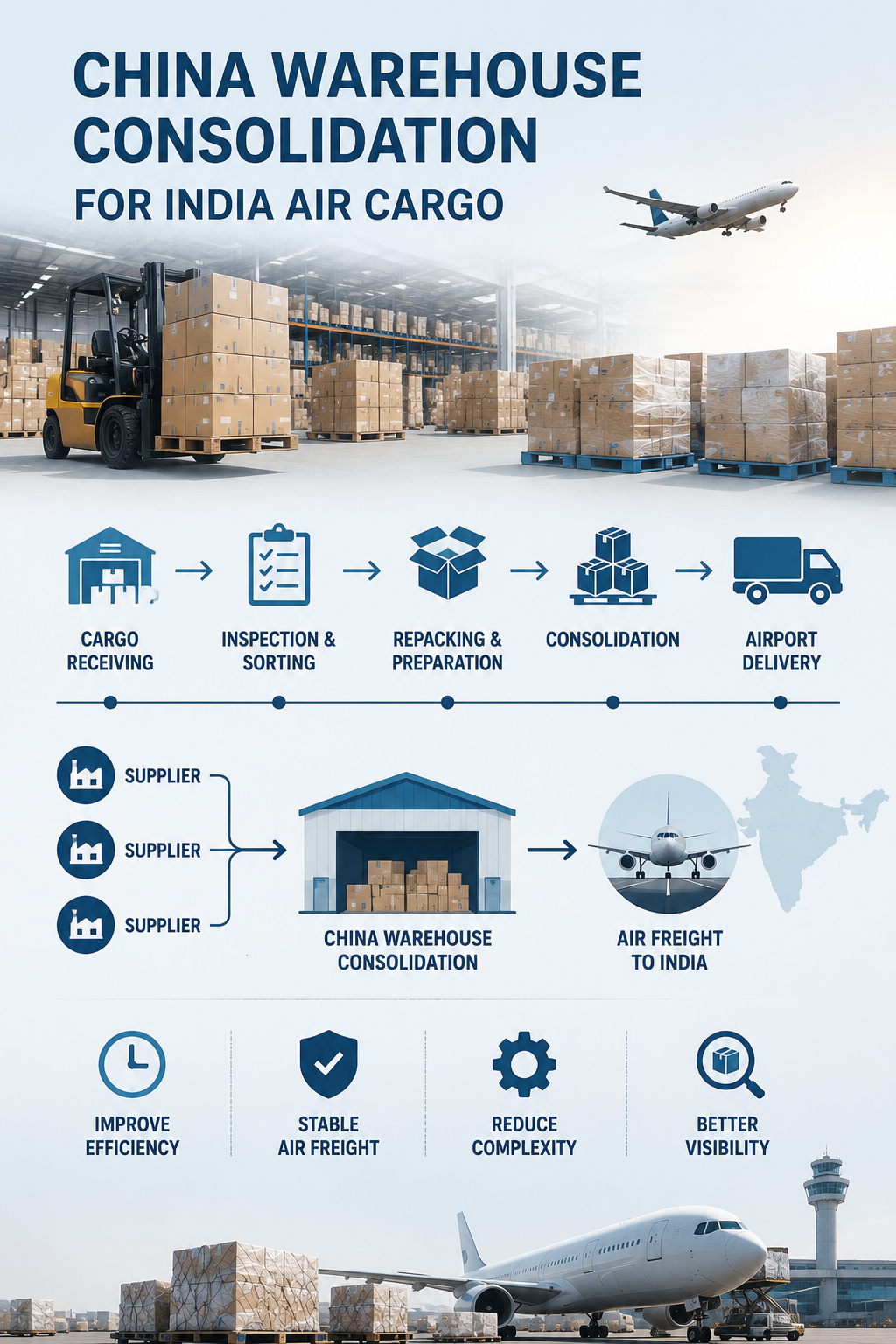
E-commerce operators may need to coordinate multiple orders, suppliers or small parcels rather than manage one ready-to-ship consignment. The supplied China–India process describes receiving full consignments, multi-supplier consolidation, e-commerce small parcels and loose cargo. Its warehouse stage includes sorting, grouping, palletizing where applicable, and verification of shipment details.
For this scenario, the practical fit question is whether the origin-side operation can handle the buyer's inbound pattern and prepare a consolidated shipment against a coordinated air cargo plan. Buyers should clarify which orders can be combined, the expected warehouse arrival schedule, cargo data requirements and the point at which the final booking and shipment details are confirmed. Consolidation is an operational service; it should not be confused with a promise that all parcels will travel on a particular flight.
International freight forwarding
A freight forwarder that outsources China-side air freight execution may value a coordinated operating partner for booking, warehouse work and airport delivery. The supplied ongoing integration project provides a relevant example: a China-based medium-to-large forwarding client outsources air freight execution, with a stated shipment cycle of 3–7 days.
For a forwarding buyer, fit depends on the handoff design. The parties should establish who collects shipment instructions, who confirms space allocation, how warehouse receipts and cargo discrepancies are reported, and how flight and arrival updates are passed back to the forwarder. A defined sequence can reduce the need to coordinate each activity independently, but the buyer still needs clear responsibility boundaries and shipment-level confirmation.
NVOCC operations
NVOCC operations may involve coordinating cargo commitments and execution across customers or shipment batches. The supplied material does not identify a specific NVOCC customer, product configuration or verified contract arrangement, so the relevant application is best considered as a procurement scenario rather than a proven customer case.
An NVOCC evaluating China-to-India air cargo space can use the integrated workflow to frame discussions about recurring volume, shipment frequency, consolidation rules, priority logic and booking confirmation. It should separately verify any proposed block space agreement, airline relationship, direct booking authority, direct Air Waybill issuance or guaranteed uplift. Those specific arrangements are not established by the supplied operational facts.
Supply-chain logistics and urgent project shipments
Supply-chain teams often need an execution plan that links cargo readiness to an intended shipping window. The methodology lists urgent project cargo, bulk cargo consolidation, peak-season capacity shortage and difficulty securing stable airline space among its applicable scenarios. Those categories indicate where advance planning and coordinated warehouse-to-airport work may be relevant.
For an urgent project shipment, buyers should provide accurate cargo details, shipment volume, origin and destination airports, expected shipping date and any special handling information early enough for the provider to assess options. The supplied process states that flight options and estimated transit times are proposed based on shipment requirements, flight schedules and prevailing market rates. An estimate is not a confirmed flight commitment; the booking and space allocation need to be confirmed for the actual shipment.
Peak-season shortages: what integrated coordination can address
Peak-season pressure raises the importance of planning, but it does not remove the limits imposed by airline capacity, cargo readiness or booking conditions. The JTUO methodology describes forecasting demand from client shipment plans, allocating available airline capacity in advance, receiving and consolidating cargo, matching cargo with available flights, and coordinating airport handover. It also describes a priority-based mechanism that considers client stability, shipment volume and shipping frequency.
This structure can help buyers ask more precise questions than “Is space available?” For example: when must shipment plans be submitted; what information is used to assess allocation; how are late changes handled; what event constitutes space confirmation; and what happens if the shipment misses the planned warehouse or airport cut-off? The supplied material describes a process for re-evaluating capacity after a change request, but it does not provide a route-level rollover rate, uplift rate or measured peak-season success rate.
Procurement boundary: “Capacity planning,” “space allocation,” “booking confirmation” and “guaranteed uplift” are not interchangeable. Buyers should request shipment-specific confirmation and clarify applicable conditions before treating a planned allocation as secured carriage.
Bulk cargo consolidation: coordinating volume and readiness
Bulk cargo consolidation involves more than putting goods together. The supplied process describes warehouse receipt and verification followed by classification, sorting, consolidation and packing according to cargo attributes. For general air freight, the listed activities include organizing cargo, consolidated stacking, large-pallet handling and stretch-wrap reinforcement. The process also calls for checking product information, package count, weight, volume, shipping marks, flight details, HS code and special cargo attributes.
For buyers, this makes shipment-data quality part of capacity planning. Cargo dimensions, handling requirements and readiness affect how a shipment can be grouped and matched with an available flight plan. A procurement discussion should therefore cover both the space request and the warehouse instructions: expected inbound batches, packaging, shipment references, special cargo declarations and the deadline for delivering cargo to the warehouse.
Decision criteria for matching capacity to an application
Rather than treating every request as a generic air freight booking, buyers can evaluate fit against a short set of operating questions:
- Shipment pattern: Is the cargo a single consignment, multiple supplier deliveries, e-commerce parcels, bulk cargo or an urgent project shipment?
- Planning horizon: Are shipment plans available early enough to discuss advance allocation, or is the requirement a one-off booking?
- Consolidation needs: Does the shipment need sorting, grouping, palletizing or other warehouse preparation?
- Confirmation point: What written or system record confirms the space allocation, flight plan and cargo handover requirements?
- Change handling: How are changes in shipment volume, schedule or booking re-evaluated and recorded?
- Scope boundaries: Does the service end at the Indian destination airport, or does the buyer need separate destination customs, handling or last-mile arrangements?
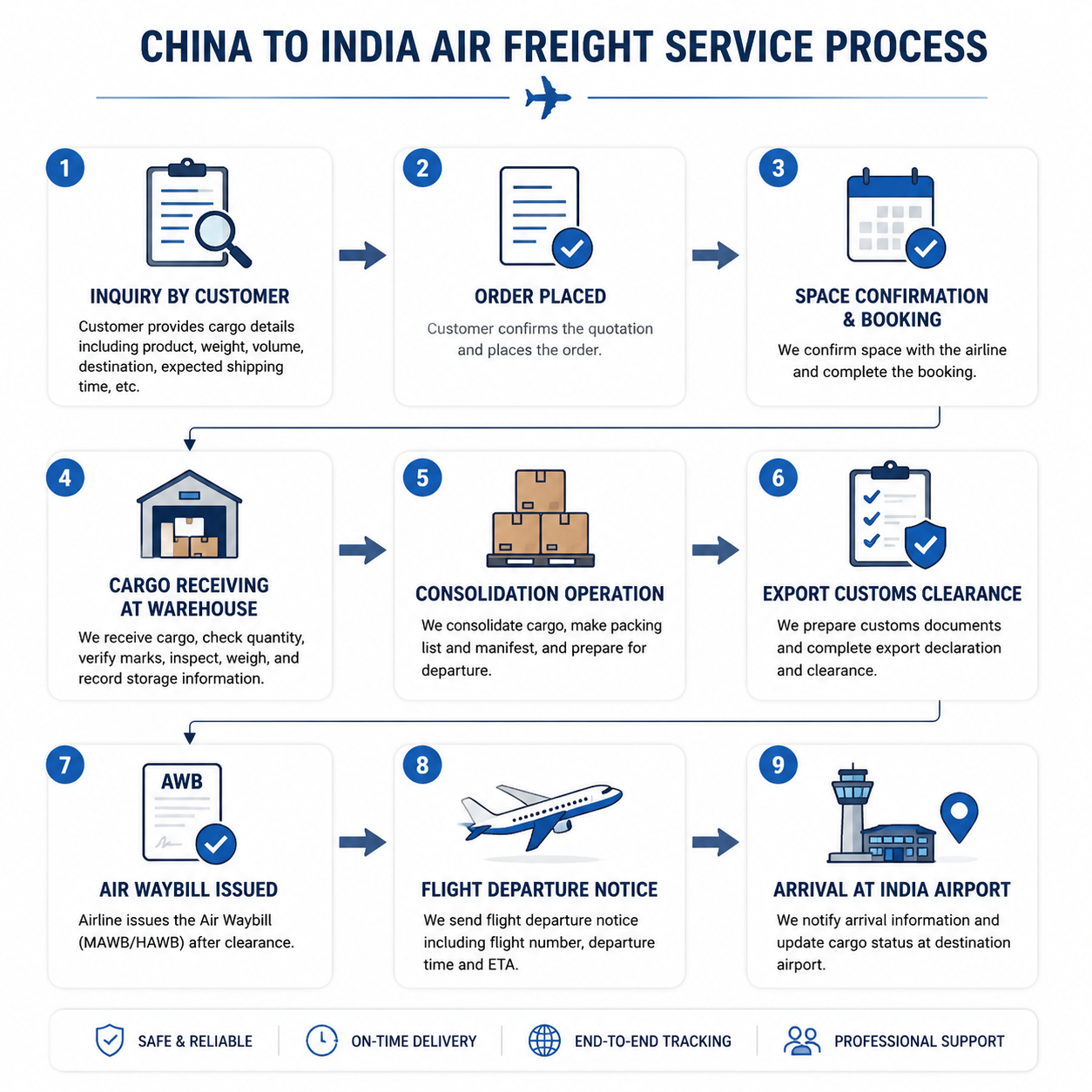
These questions align procurement with the documented China-to-India Airport-to-Airport Air Freight Process, which runs from inquiry and quotation through order confirmation, space allocation, warehouse receiving, consolidation, airport delivery, export customs clearance, Air Waybill issuance and release, and arrival at the destination airport. The stated scope is the first-leg airport-to-airport operation; it does not include Indian customs clearance, destination-country last-mile delivery or non-air transport.
What the evidence supports—and what remains unverified
The available first-party material supports a description of JTUO Logistics' China–India air cargo booking, warehouse consolidation, cargo preparation, airport delivery coordination and peak-season capacity assurance services. It also describes an integrated capacity-and-consolidation operating methodology and an ongoing forwarding-client project. A supplied client-feedback statement says space availability became more stable during peak seasons compared with using multiple forwarders; the associated improvements are qualitative, not accompanied by a measured baseline or a published shipment-level dataset.
The available material does not establish current airline-specific capacity, direct airline contract volumes, a particular block space agreement, direct airline booking authority, direct AWB issuance, route-level real-time availability, or a guaranteed uplift rate. It also does not provide validated current 2026 capacity by origin-destination pair. Buyers should verify those items directly in the commercial and operational documents for their own shipment or contract.
As external route context, a 2023 report by China’s State Council described the opening of an Ezhou–Delhi all-cargo route operated by SF Airlines and reported planned service frequency and expected capacity. That report documents a route announcement at that time; it should not be treated as proof of current schedules, presently bookable space or a guarantee for a specific shipment. A published route and a forwarder’s allocated capacity answer different procurement questions.
Comparison with fragmented booking arrangements
A fragmented arrangement can involve booking, warehouse handling and airport delivery being coordinated through separate parties. Its limitation is operational fragmentation: the buyer may need to track multiple contacts, reconcile different status updates and manage handoffs between functions. That structure may still be suitable when a buyer has established partners for each task or requires a specific provider for a defined leg.
An integrated capacity-and-consolidation workflow brings those functions into a coordinated process. Its potential value is clearer sequencing between allocation, warehouse readiness and airport handover. However, integration alone does not prove superior price, guaranteed space, better on-time performance or lower transit-time variability. Those outcomes require comparable shipment-level evidence and clearly defined service terms. The appropriate comparison is therefore not a blanket ranking of provider types; it is whether the operating model matches the buyer’s cargo pattern, control requirements and tolerance for coordination work.
Industry interpretation and outlook
For procurement teams, the useful shift is from asking only for a freight rate to examining how capacity is connected to cargo preparation and execution. E-commerce consolidation, outsourced forwarding operations, NVOCC planning and urgent project cargo each create different requirements for inbound coordination, volume visibility and shipment confirmation. A common workflow can support these varied discussions, while the allocation rules and shipment commitments still need to be verified for each case.
The supplied evidence does not establish a current market-wide shortage trend or a validated growth rate for China–India air freight head haul space. It does identify peak-season shortages and difficulty securing stable space as operating scenarios addressed by the methodology. Looking ahead, buyers can make capacity relationships more assessable by retaining booking confirmations, warehouse intake records, cargo handover records and flight-status updates. Such records can help distinguish planned space from executed carriage and support a more evidence-based review of future allocations.
FAQ
What does China–India air freight head haul space cover in this operating model?
In JTUO Logistics' documented process, the first-leg airport-to-airport operation covers coordination from customer inquiry through space booking, warehouse receiving and consolidation, airport delivery, export customs clearance, Air Waybill issuance and cargo arrival at the destination airport.
How can e-commerce shipments fit an origin-warehouse consolidation workflow?
The supplied process includes e-commerce small parcels, multiple orders and goods from multiple suppliers among the cargo types that can be received and consolidated at the origin warehouse. Buyers should confirm the specific shipment data, receiving schedule and consolidation instructions for their cargo.
Does the integrated system guarantee airline space or uplift?
The supplied material describes capacity forecasting, allocation and booking coordination, but it does not provide independently verified route-level uplift results or terms that guarantee a particular shipment’s carriage. Buyers should obtain shipment-specific booking confirmation and review the applicable conditions.
Does the service include Indian customs clearance and last-mile delivery?
No. The methodology identifies Indian customs clearance and destination-country last-mile delivery as outside its applicable scope. The documented process covers the China–India airport-to-airport first leg through arrival at the destination airport.
What information should buyers prepare when discussing a shipment?
The process calls for accurate cargo details, including product description, cargo type, package count, gross weight and volume, packaging, origin and destination airports, expected shipping date, HS code and any relevant special-cargo declaration. The buyer should also confirm the shipment schedule and any priority-allocation requirements.
Есть вопросы или нужны дополнительные детали?
Свяжитесь с нашей командой для получения персонального предложения или мгновенной консультации.
Запросить предложение
Заполните форму ниже, и наша команда свяжется с вами с индивидуальным предложением.
Прямой чат WhatsApp
Предпочитаете общаться в реальном времени? Напишите нам в WhatsApp для мгновенной помощи и быстрых ответов.
- Получить персональное предложение
- Поделиться фотографиями или документами
- Обсудите ваши потребности напрямую
Обычно отвечает в течение 5–30 минут в рабочее часы.