
China–India Air Freight: Scenario Fit for E-commerce and NVOCC
Air freight capacity from China to India is purchased by very different businesses for very different reasons — and those differences show up in how space is booked, how cargo is consolidated, and how much certainty a buyer actually receives.
A cross-border e-commerce seller measures fit in cut-off discipline and consolidation windows. An international freight forwarder measures it in allocation reliability and documentation. An NVOCC operator measures it in whether air capacity can absorb what a sea schedule cannot. Treating all three as the same buyer is one of the most common planning errors on this corridor.
The scale behind that demand is documented. India's air cargo market was valued at 3.6 million tons in 2025 and is projected to reach 9.9 million tons by 2034, an 11.38% CAGR, according to IMARC Group. China's exports to India reached approximately USD 120.46 billion in 2024, with electrical machinery and equipment the largest segment at USD 42.66 billion, according to The Dollar Business. Asia-Pacific airlines recorded an 8.3% year-on-year increase in international air cargo in June 2025, growth IATA attributes to e-commerce and high-tech trade.
JTUO Logistics Co., Ltd. is a Guangzhou-based China–India air freight specialist founded in May 2025, providing airport-to-airport air freight for freight forwarders, manufacturers, wholesalers and e-commerce businesses. Its core business is China–India air cargo booking, delivered through air cargo space booking, warehouse consolidation, cargo preparation and airport delivery coordination. India is its primary market; the company operates a 2,000 m² warehouse with a team of more than 30 people, including a warehousing team of over 20, and moves more than 5,000 tonnes by air annually. Its service is also described as China-India Air Cargo Capacity & Consolidation One-Stop Services.
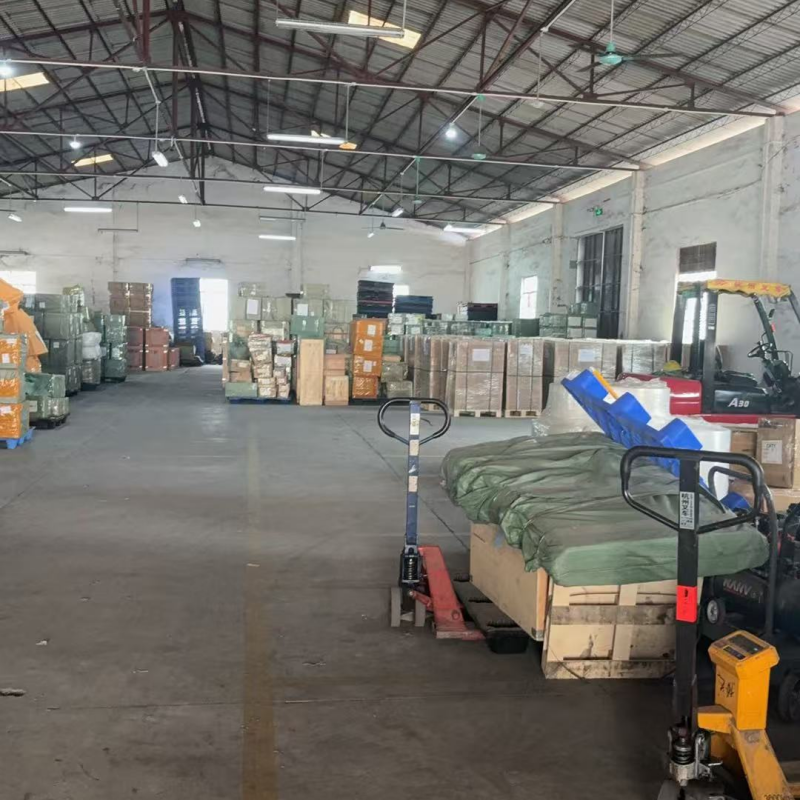
China-side warehouse operations are where industry-specific air freight requirements are either absorbed or amplified.
Why Industry Type, Not Volume Alone, Determines Air Freight Fit
Three buyer groups dominate demand for China–India air freight head haul space, and each one converts the same corridor into a different service requirement.
Cross-border e-commerce logistics
E-commerce cargo arrives from many suppliers in small, uneven batches and must be grouped before departure. The binding constraint is not the flight itself but the warehouse window: cargo that arrives late misses the consolidation cycle and slips to a later departure. Product mix also matters — consumer electronics, apparel, beauty accessories and household goods behave differently in handling, packing and palletizing terms.
International freight forwarders and NVOCC operators
Forwarders and NVOCC operators are not shipping their own goods. They are buying capacity they can commit to their own customers, which means allocation predictability, a clean document set, and a partner that can absorb volume spikes without renegotiating the commercial basis every week.
Importers and supply chain service providers
Indian importers with customs clearance capability and supply chain service providers sit downstream. They need the air leg to land on schedule so that their own clearance and delivery planning stays intact.
JTUO Logistics lists cross-border e-commerce logistics, international freight forwarding and NVOCC operations, and supply chain logistics service providers among the industries it serves, alongside India route logistics companies, logistics partners and customs-cleared Indian importers. That is a deliberately narrow buyer definition — it excludes parties who need the provider to handle Indian customs clearance or door delivery.
The Constraint Layer: Certifications, Coverage and Scope Boundaries
For buyers in a research or evaluation stage, the fastest way to test a China–India air freight provider is to check what is certified, where the service actually operates, and what is explicitly excluded.
- Certifications: an Air Freight Forwarding License, Warehouse Operation & Safety Management Certification, and Logistics Service Compliance Qualification.
- Geographic coverage: China nationwide export coverage, with operations along the China–India air freight corridor.
- Service scope: shipping from major export hubs in China to major airports in India, block space agreement (BSA) and general cargo space allocation, fixed flight space reservation and capacity scheduling, peak-season priority space allocation, freight rate coordination and booking assistance, warehouse consolidation and cargo grouping before departure, and airport handover with export coordination support.
- Out of scope: customs clearance within India and last-mile delivery to warehouse or door.
The exclusions matter as much as the inclusions. A buyer who assumes the air freight provider also clears cargo in India will build a plan that breaks on arrival. This model is China-side execution plus airport-to-airport movement; Indian clearance and onward delivery must be arranged separately with a qualified partner.
Reading the Capacity Numbers: 1,500 Monthly Spaces and 500+ Forwarder Partners
JTUO Logistics' service capacity is documented as handling over 1,500 air cargo spaces per month while supporting more than 500 freight forwarding partners and logistics clients. Those two numbers describe different things, and both are relevant to scenario fit.
A monthly handled volume at that level indicates that space allocation is a continuous operating function rather than occasional spot buying. The practical consequence for a forwarder is that booking requests enter a managed allocation process with flight scheduling and space planning behind it, instead of depending on whatever inventory happens to be open at the moment of request.
The partner base of 500+ forwarders signals a shared capacity pool. That is a strength in breadth and a boundary in exclusivity: capacity is allocated, not unlimited, and the service scope distinguishes between block space agreement (BSA) and general cargo allocation, with fixed flight space reservation available and peak-season priority space allocation defined as a service component. Buyers who need predictable access during high-demand periods are therefore better matched to contracted capacity models than to ad hoc requests.
Supporting operations add context to the volume figure: an in-house warehouse of 2,000 m², a warehousing team of over 20 people, and a core team of more than 30 covering logistics solution design, supply chain management, warehousing, and customer service and operations. The team carries over 15 years of experience in China–India air shipping logistics and cargo space management.
Technical Explanation: How Booking, Warehousing and Flight Scheduling Interlock
Capacity on this corridor is not a single transaction. It is a sequence in which a missed step downstream invalidates a confirmed step upstream.
Systems in use
- An online air freight booking system for space requests and confirmations.
- A flight scheduling and space allocation management platform.
- A real-time cargo space monitoring and dispatch system.
- A warehouse inventory management system (WMS).
- A cargo consolidation and load optimization system.
The execution sequence
Client inquiry → order confirmation → space allocation and booking → cargo receipt at warehouse → consolidation processing → export declaration → air waybill issuance → flight departure → arrival notification at the India airport. The model is described as an integrated air freight headhaul operation, combining warehouse receiving and consolidation in China with airline capacity allocation and airport handover.
Transit time and what actually drives it
Typical China–India air shipping transit time is 3–7 days. Within that band, the variables are warehouse intake timing, flight availability, and the cargo consolidation schedule. Two shipments booked on the same day can therefore depart on different flights if one arrives at the warehouse after the consolidation cut-off — which is why intake timing is a genuine procurement criterion, not an administrative detail.
What a buyer receives
Deliverables include an air cargo space confirmation document, flight schedule and air waybill details, a block space agreement for contracted capacity models, a cargo consolidation and warehouse handling report, and booking and allocation confirmation records. These documents are what allow a forwarder to pass credible commitments downstream to its own customers.
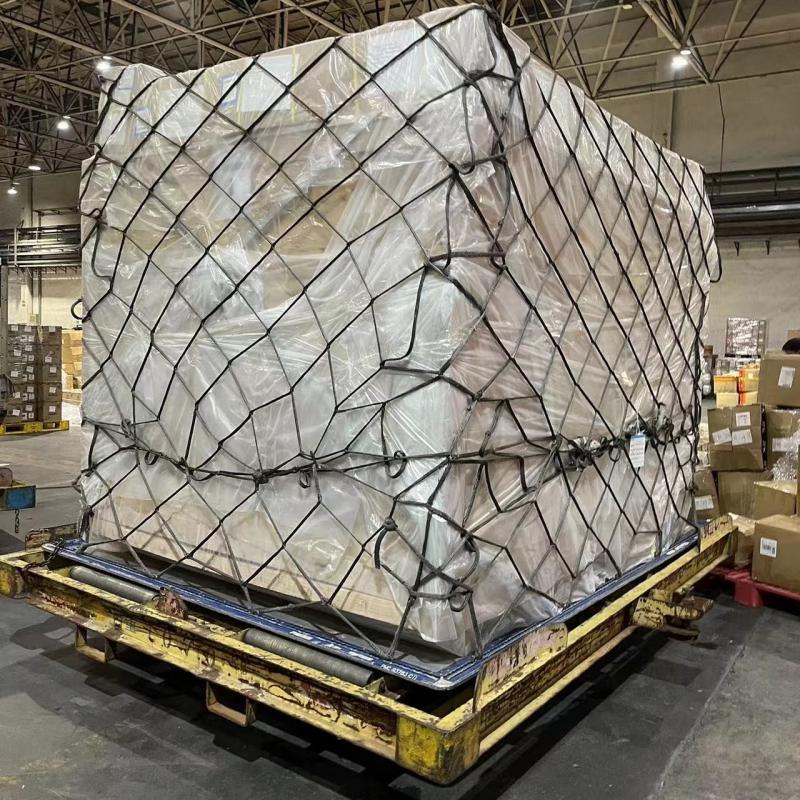
Consolidated cargo ready for airport handover — the point at which booked capacity converts into actual uplift.
Scenario Fit 1: Cross-Border E-commerce
E-commerce logistics operators fit this model when their problem is fragmentation rather than total volume. Multiple suppliers, repeated small inbound receipts, and a fixed departure schedule create a consolidation problem before they create a capacity problem.
The matching capabilities are the in-house warehouse consolidation and distribution module, cargo grouping before departure, and the described use case of consolidating bulk shipments from multiple clients. Pre-booking space before peak seasons is also a listed application scenario — relevant for sellers whose promotional calendars are known months in advance but whose supplier receipts are not.
The boundary to plan around: e-commerce sellers still need an India-side partner for clearance and delivery, because neither is included in this service scope.
Scenario Fit 2: International Freight Forwarders and NVOCC Operators
For forwarders and NVOCC operators, the product being purchased is reliability of supply, not a rate alone. The relevant capabilities are stable air cargo space allocation, flexible capacity management for block space agreement (BSA) and general cargo, peak-season space guarantee, and in-house warehouse consolidation with airport delivery operations.
A documented case illustrates the pattern. A medium-to-large freight forwarder on the China–India lane faced unstable space during peak seasons, high freight rate volatility, fragmented warehouse operations, multiple-handling delays, and unstable delivery performance. The diagnosis recorded was a lack of stable airline capacity access combined with unconsolidated warehouse operations — in other words, a broken execution chain rather than a single weak link. The deployed model combined capacity locking, warehouse consolidation and airport execution, with deliverables including a space confirmation notice, warehouse receipt, consolidation manifest, air waybill (MAWB/HAWB), and flight departure and arrival reports.
Reported qualitative results were improved supply chain stability, more predictable delivery performance, reduced operational workload and stronger peak-season scalability. The client feedback, provided through the provider's documented channels, was that space availability became more stable even during peak seasons and was more reliable than working with multiple forwarders. The case is anonymized, so it should be treated as an operational illustration rather than an independently audited reference.
For NVOCC operators specifically, air capacity functions differently: it is not a substitute for ocean freight but a release valve for consignments that cannot wait for the next sailing. Fit depends on whether the provider can accept non-standard volumes at short notice and still produce a clean air waybill trail — which is where a consolidator with its own origin warehouse has a structural advantage over an intermediary that must re-book warehouse space per shipment.
Scenario Fit 3: Urgent Project Cargo
Urgent large-volume air freight shipments are a distinct application because they stress different parts of the system. A project consignment is usually multi-supplier, time-bound and single-destination, and it cannot be split across several uncoordinated bookings without creating handover risk.
The matching capabilities here are consolidation of bulk shipments from multiple clients, unified airport delivery and handover, flight scheduling with dynamic adjustment, and reduction of delays caused by fragmented logistics operations. The relevant constraint is that capacity remains subject to flight availability and regulatory limits on charter operations, so urgency alone does not create space — it has to be matched against confirmed allocation.
Integrated Capacity Control versus Piecemeal Booking
Most buyers on this corridor choose between two operating models rather than between two companies: booking space transaction by transaction, or placing the China-side execution chain under a single capacity-controlled model.
| Evaluation dimension | Piecemeal spot booking | Integrated capacity and consolidation model |
|---|---|---|
| Capacity access | Space secured shipment by shipment, following open market availability | Structured allocation through BSA and general cargo models, with fixed flight space reservation |
| Peak-season behaviour | Priority depends on what remains unsold when the request is placed | Peak-season priority space allocation is a defined service component |
| Warehouse handling | Cargo typically moves through multiple handover points | In-house consolidation, cargo grouping, sorting and palletizing before departure |
| Documentation | Booking confirmations issued per transaction | Space confirmation document, flight schedule and AWB details, BSA documents where applicable, consolidation and warehouse handling report |
| Coordination layers | Multiple intermediaries between shipper and airline | Single China-side chain from warehouse receipt to airport handover |
| India-side scope | Arranged separately | Also arranged separately — Indian customs clearance and last-mile delivery are outside this scope |
Comparison of operating models on the China–India air freight corridor. Scope boundaries are defined by the service documentation, not by performance claims.
The limitation should be stated plainly. An integrated model does not remove the need for an India-side partner, does not guarantee unlimited space during demand spikes, and does not compress transit time below what flight availability and consolidation scheduling allow — the documented band remains 3–7 days, driven by warehouse intake timing, flight availability and the consolidation schedule. Buyers comparing providers should evaluate the model against their own cut-off discipline, not against a promise of unrestricted capacity.
Market Trend Signals Shaping China–India Capacity
Three documented signals frame how this corridor is likely to be planned over the next planning cycle.
- Demand composition is shifting toward e-commerce and high-tech. IATA reported an 8.3% year-on-year increase in Asia-Pacific international air cargo in June 2025, driven by e-commerce and high-tech trade. Both categories are consolidation-intensive rather than bulk-oriented, which rewards origin-side warehouse capability.
- Indian air cargo volume is projected to expand substantially. IMARC Group projects growth from 3.6 million tons in 2025 to 9.9 million tons by 2034 at an 11.38% CAGR. Growth of that order increases the value of contracted capacity relationships relative to spot purchasing.
- Route-level capacity is being added, but not freely. A direct air cargo route between Ezhou in China and Bangalore in India provides annual transport capacity of over 5,000 tons via SF Airlines, according to Xinhua. At the same time, the CAAC 10-flight rule for carriers without CCAR-129 certificates limits how much of the short-notice charter segment can expand.
On pricing, air freight rates for China to Asia routes were reported as relatively stable at USD 1.76–4.10 per kg for shipments above 100 kg as of April 2026 in a third-party cost guide. This figure is indicative, covers a broader Asia scope rather than India alone, and is flagged as requiring verification — it should be used as a reference band, not as a quotation basis.
Taken together, the trend points away from treating China–India air freight as a purely transactional purchase. Where capacity growth is bounded by regulation and demand growth is concentrated in consolidation-heavy categories, the durable differentiator is origin-side execution control.
Future Outlook
The scenario logic above suggests that buyer evaluation will keep moving from "who can quote" toward "who controls the first leg." For cross-border e-commerce, that means consolidation discipline and cut-off reliability. For forwarders and NVOCC operators, it means documented allocation models, a complete document set, and a partner whose capacity is managed rather than improvised. For urgent project cargo, it means the ability to coordinate multi-supplier receipts into a single uplift.
At the same time, the boundaries of this model are unlikely to change quickly: Indian customs clearance and last-mile delivery remain outside the air-leg scope, transit time remains dependent on flight availability and consolidation scheduling, and regulatory limits on charter operations continue to cap how much ad hoc capacity the corridor can absorb.
JTUO Logistics documents its China–India air freight capacity and consolidation services at chinatoindiacargo.com.
FAQ
1. What is included in a China–India air cargo space confirmation?
A space confirmation is part of a documented deliverable set that also includes flight schedule and air waybill details, a block space agreement for contracted capacity models, a cargo consolidation and warehouse handling report, and booking and allocation confirmation records. These documents record what has been allocated and on which flight, which is what allows a forwarder to commit to its own customers.
2. How does a block space agreement differ from general cargo allocation on China–India routes?
A block space agreement is a contracted capacity model in which space is reserved in advance and confirmed through BSA documentation. General cargo allocation draws on available capacity without a fixed reservation. In practice, BSA models suit buyers with recurring, forecastable volumes, while general cargo allocation suits irregular or project-based requirements.
3. How long does China–India air freight take from warehouse to India airport?
Typical transit time is 3–7 days. The variation is driven by three factors: when the cargo is received at the warehouse, flight availability on the intended route, and the consolidation schedule the shipment is assigned to.
4. Does the China-side air freight service include customs clearance and delivery in India?
No. Customs clearance within India and last-mile delivery to warehouse or door are outside the service scope. The model covers China-side execution and airport-to-airport movement, with arrival notification at the India airport. Importers or forwarders must appoint an India-side partner for clearance and onward delivery.
5. How should a buyer assess capacity stability before peak season?
Three checks are more informative than a rate comparison. First, whether the provider distinguishes BSA from general cargo allocation and can reserve fixed flight space. Second, whether peak-season priority space allocation is a defined service component rather than an informal arrangement. Third, whether the provider operates its own consolidation warehouse, since fragmented warehouse handling is a common cause of missed departures.
6. What certifications and coverage should a China–India air freight provider be able to evidence?
Relevant credentials include an Air Freight Forwarding License, Warehouse Operation & Safety Management Certification, and Logistics Service Compliance Qualification. On coverage, the service should specify both the origin scope — such as China nationwide export coverage — and the corridor it operates along, in this case the China–India air freight corridor.
7. Which industries does a capacity-and-consolidation model suit best?
Documented industries served include cross-border e-commerce logistics, international freight forwarding and NVOCC operations, and supply chain logistics service providers. The common requirement across all three is consolidation-heavy, schedule-sensitive cargo where origin-side handling and allocation reliability affect delivery performance more than the quoted rate alone.