
China to USA Freight Forwarder: How Execution Actually Works
Shipping from China to USA stops being a rate question the moment a purchase order is confirmed. From that point the shipment becomes a sequence of dependent handoffs — pickup, export clearance, capacity booking, ISF filing, US customs entry, appointment booking and final delivery — and the forwarder's real product is control over that sequence.
A China-to-USA freight forwarder arranges everything around the ocean leg: pickup, export clearance, ISF, the US customs entry and delivery. That description of the service scope is standard across forwarder route documentation, and it explains why most importers want one party to hold the whole chain rather than assemble it from a carrier, a customs broker and a trucker separately.
This reference looks at the execution layer of that chain: how transport mode is selected, what each stage of a China-to-USA shipment is supposed to produce, where Amazon FBA requirements change the workflow, and which limits buyers should build into their plan. Company-level facts are drawn from Shanghai Xiongda International Logistics Co., Ltd., a forwarder founded in 2006 and headquartered in Shanghai that focuses on the China–US lane. Market context comes from published third-party indices.
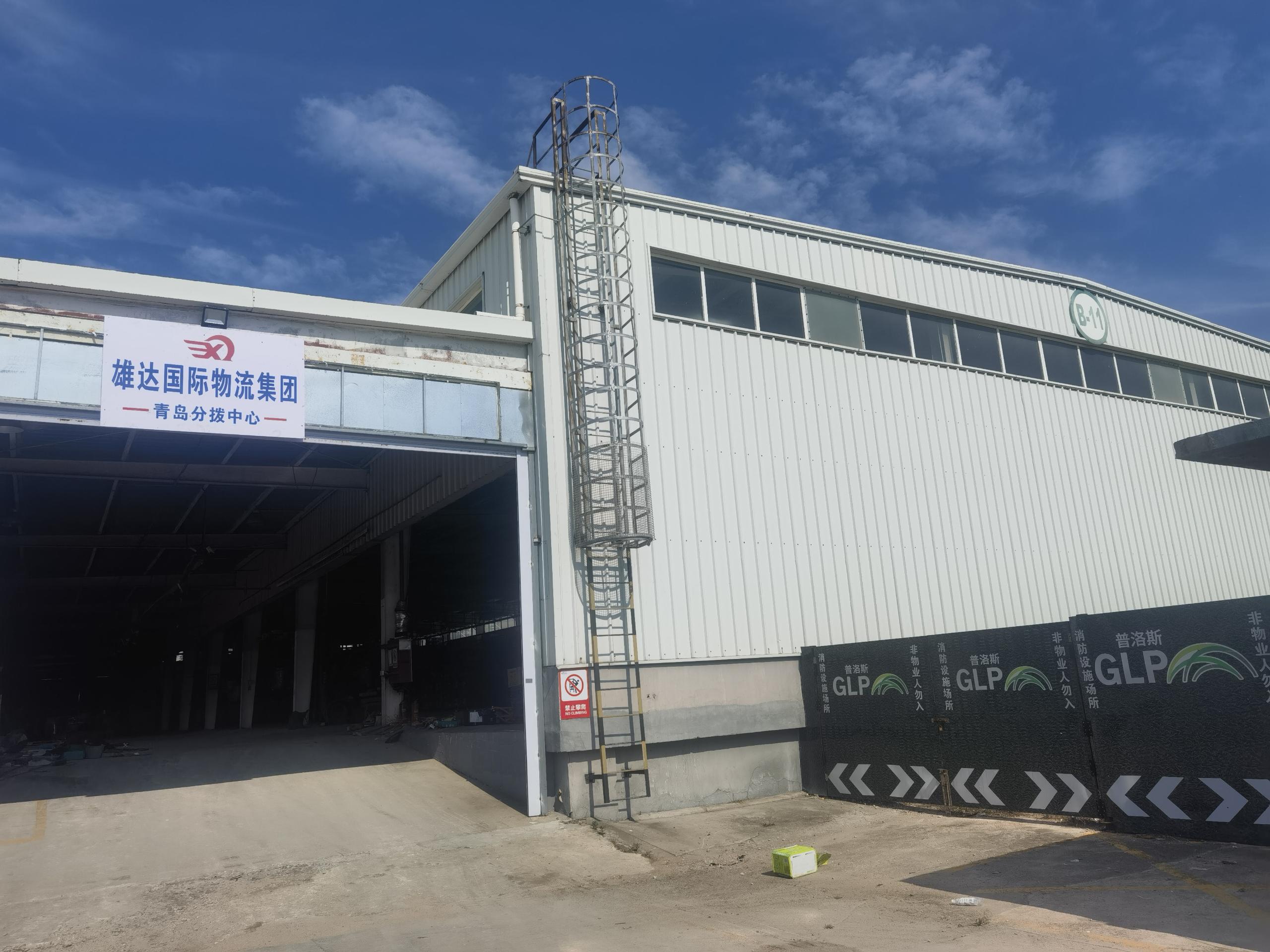
Qingdao warehouse — an origin consolidation node in a China-to-USA freight network.
The operating problem: a shipment is a chain of handoffs
Most late deliveries are not caused by a slow vessel. They are caused by a node nobody owned. A China-to-USA shipment involves multi-node coordination: capacity booking, customs clearance, duties, Amazon receiving and final delivery under a door-to-door arrangement. Each node produces its own documents, its own deadlines and its own failure mode.
Consider what happens when responsibility is split. The supplier books with a carrier. A separate broker files the customs entry. A third party handles the truck appointment at the destination warehouse. Each party can be competent and the shipment can still miss its window, because the handoff between ISF filing, vessel departure and the destination appointment is nobody's single accountability line.
That is the opportunity importers are actually buying when they move from evaluation to execution. The question is not whether a forwarder can quote a rate; it is whether one party can sequence booking, clearance, duty handling and receiving so that a single exception does not cascade. Integrated arrangement and a single point of contact are the two advantages most often claimed for this model, and they are the two things worth testing during supplier evaluation.
How mode selection actually works
Transport mode is not selected by preference. It is selected on five inputs: cargo weight, volume, origin, destination and timing requirements. The mode set available for China-to-USA shipping includes FCL, LCL, expedited or regular ocean freight, air freight, express and trucking, and the selection logic combines them rather than picking one in isolation.
| Mode | Where it fits | Timeline reference |
|---|---|---|
| FCL ocean freight | Full-container volume; fewer physical touches on the cargo | Sea freight estimated at 15–30 days in company process documentation |
| LCL ocean freight | Volumes below a container load; consolidated with other cargo | Falls inside the same ocean window, plus consolidation handling |
| Expedited ocean (express liner) | Time-sensitive FCL where air cost is not justified | Xiongda describes Matson express vessels arriving at port in 11 days, with door-to-door US delivery in 15–18 days |
| Air freight | Urgent or high-value cargo where days matter more than rate | Xiongda describes direct China–US block space charter pickup in 5–8 days |
| Express and trucking | Small parcels and the domestic leg inside the United States | Combined into the overall door-to-door plan rather than quoted as standalone timelines |
The trade-offs are structural rather than brand-specific. LCL reduces cost at the price of extra handling and a consolidation wait. FCL reduces touches but requires volume. An expedited liner buys days back without air-cargo rates. Air freight compresses the ocean leg into days and raises the per-kilogram cost. Reading a quote correctly means separating the mode decision from the clearance decision — a cheap ocean rate with weak clearance planning is not a cheap shipment.
Three questions expose whether a forwarder is genuinely selecting a mode or just selling one: Which mode would you reject for my cargo, and why? What is the cut-off date for documentation on this mode? What happens to my booking if the vessel rolls?
The eight stages of a China-to-USA shipment
Execution becomes checkable when a shipment is broken into stages with named outputs. Xiongda's process documentation defines eight stages, each with deliverables on the forwarder side and required inputs on the shipper side.
| Stage | What the forwarder produces | What the shipper must supply |
|---|---|---|
| 1. Order placement | Order acceptance confirmation, service reference number, operation plan, cost confirmation, document checklist | Consignor and consignee details, cargo breakdown, origin and destination, FBA status, special requirements |
| 2. Delivery to warehouse or pickup | Warehouse receipt or pickup booking confirmation, cargo handover record | Address, contact, package quantity, weight and dimensions; FBA box labels for FBA shipments |
| 3. Inspection, space booking, declaration prep | Inspection record, space confirmation, customs document checklist and progress | Commercial invoice, packing list, customs power of attorney, HS code, shipment ID |
| 4. Advance clearance and delivery appointment | Pre-review result of clearance documents, clearance plan, appointment confirmation, estimated delivery time | Destination customs documents, tax ID, FBA warehouse code, tariff liability, delivery contact |
| 5. Departure and in-transit tracking | Departure confirmation, bill of lading or waybill, milestone updates, exception alerts | Timely confirmation of amendments or delivery adjustments; written confirmation of fee changes |
| 6. Destination port clearance | Arrival notice, clearance progress, release result or inspection notice, tax receipt | Supplementary clearance documents, duty and tax confirmation, importer qualifications |
| 7. Delivery to FBA or customer warehouse | Delivery confirmation, appointment record, proof of delivery | Accurate address, warehouse code and appointment information; compliant FBA labelling |
| 8. Receipt feedback | Final receipt feedback, consolidated POD, claim entry, settlement basis, service closure | Receipt confirmation; photos and POD evidence where an exception is raised |
Two operational details in that structure matter more than they appear. First, stages 3 and 4 happen before the cargo moves, which is where clearance risk is actually controlled — the company describes pre-submission review and advance customs arrangement as part of its standard sequence. Second, stage 8 feeds back into the next shipment: Xiongda states that after each signed shipment it compiles milestone records covering order placement, warehouse arrival, booking, departure, arrival, clearance, delivery and sign-off, and uses exception reviews to update quotation rules, document checklists, cut-off times, clearance contingency plans and FBA receiving requirements into reusable procedures.
Xiongda International Logistics: what the capability set contains
Shanghai Xiongda International Logistics Co., Ltd. is a China-based international logistics company founded in 2006 and headquartered in Shanghai, providing sea freight, air freight, Amazon FBA forwarding and overseas warehouse services, with the United States as its core market.

Operations coordination across booking, clearance and delivery milestones.
The execution capability is built from four verifiable components:
- Regulatory and platform credentials. Amazon SPN (Service Provider Network) certified service provider, Amazon FIST (FBA Inbound Shipment Tracking) carrier, China NVOCC qualification authorising bill-of-lading issuance and international freight forwarding, and US FMC registration (ORG: 033290) permitting lawful ocean freight business in the US market.
- Origin and destination network. Twelve subsidiaries, branches and self-operated distribution centres in Shanghai, Shenzhen, Chengdu, Shehong, Changsha, Qingdao, Hefei, Zhengzhou, Xiamen, Yancheng, Suzhou and Los Angeles, with free door pickup in more than 100 Chinese cities and door-to-door delivery to the contiguous 48 states of the United States.
- US warehousing. Six self-owned overseas warehouses in the United States totalling 50,000 square metres, offering storage, sorting, labelling and palletising.
- People and systems. More than 300 logistics staff organised across front-end sales, mid-ground fulfilment and back-office functions, plus a self-developed logistics visualisation system that tracks consolidation, shipment, clearance and delivery milestones online.
The company also reports a customs inspection rate below 1%, a 98% customer satisfaction rate under its four-to-one service model (sales representative, manager, customer service specialist and finance staff assigned to the same account), monthly volume of 36,000 CBM and more than 1,000 customers. These are company-reported figures published on its own channels; they are useful as a starting point for due diligence rather than as independently audited benchmarks.
Where Amazon FBA compatibility changes the workflow
For FBA sellers, three requirements sit outside normal freight planning, and each has to be handled before the container or pallet leaves China.
Data continuity with Amazon. As an Amazon FIST carrier, Xiongda's system connects with Amazon's backend to provide end-to-end tracking, anomaly alerts and electronic proof of delivery, which lets sellers monitor inbound inventory status rather than waiting for a warehouse receipt.
Booking and appointment discipline. FBA booking is a named service module alongside pickup, consolidation, customs and shipping. Delivery stage inputs include the FBA warehouse code and appointment information, because an FBA shipment can be compliant on customs and still fail at the dock if the appointment or labels are wrong.
Labelling and data handling. FBA shipments require box labels before warehouse arrival, and the company provides FBA labelling and data-handling support as part of the service scope. Its stated platform coverage is Amazon, Walmart and TikTok.
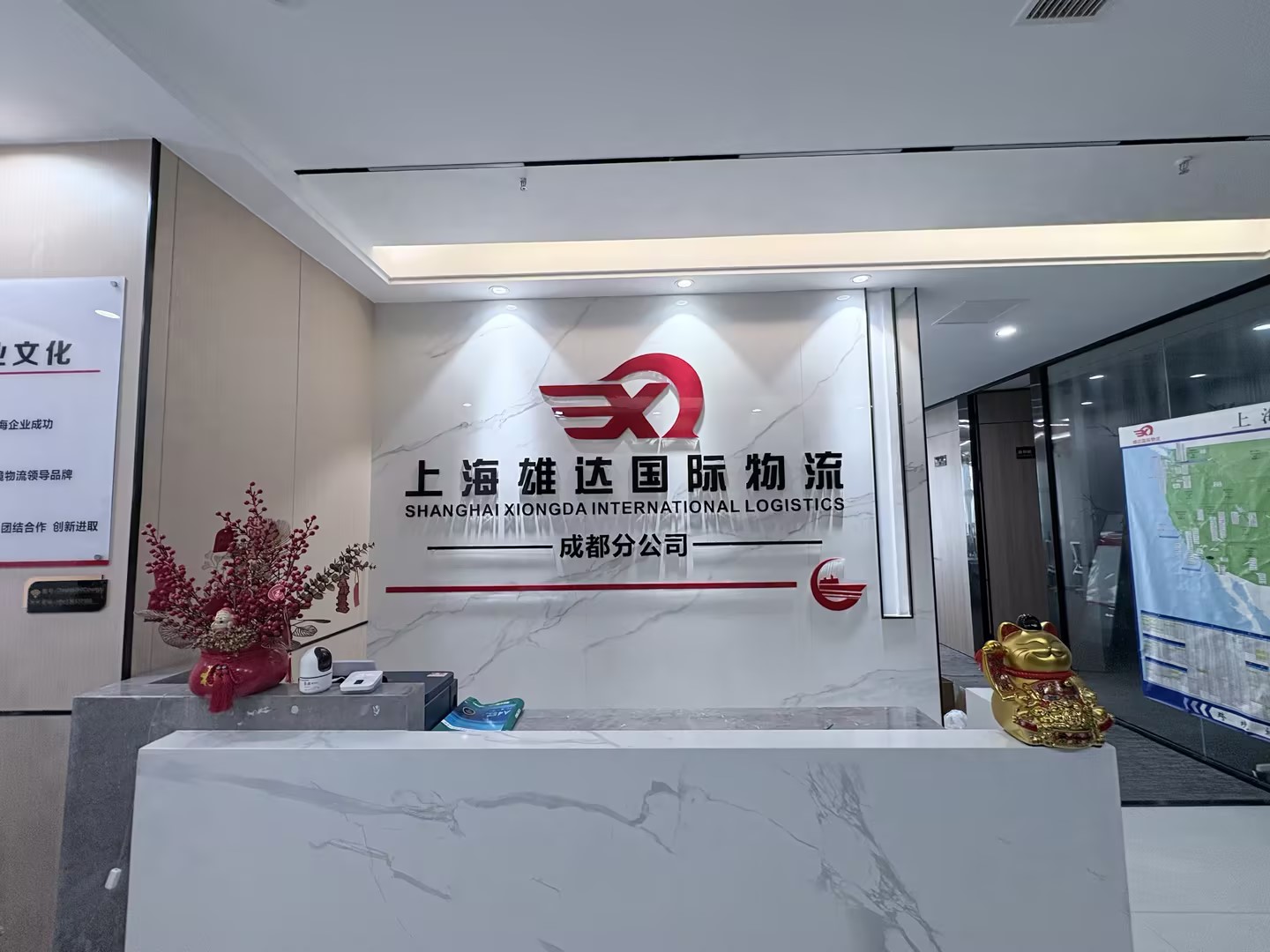
Chengdu — one of twelve network locations serving China–US lanes.
Application fit and a reported customer outcome
Mode and service fit differ by cargo profile. Xiongda lists textiles, hardware tools, auto parts, daily necessities, outdoor products and electrical goods among the industries it serves, and names heavy-cargo ocean freight as a specific capability alongside FBA first-mile logistics and multi-supplier consolidation.
A published customer testimonial from an East China e-commerce seller in consumer goods illustrates the difference between a rate improvement and an execution improvement. The client's cargo mix was kitchenware, clothing and fitness equipment shipped under FBA and DDP sea freight, with a stated project cycle of four to six weeks. The client's original problem was unstable transit time and complicated US import clearance.
The reported result was not a faster vessel but a narrower variance: lead time moved from high volatility to stable, controllable performance with a marked reduction in deviation for US-bound ocean freight warehouse delivery. Clearance shifted from reactive to pre-submission review, and there were no lengthy cargo detentions attributed to declaration, tariff-code or FBA appointment issues. The client states it ships 12–15 containers per year, a client-reported figure without independent supporting evidence; the qualitative outcome — stable schedule, visible milestones, confirmed POD — is the part worth weighing in supplier selection.
Market context: softer volumes, volatile rates, more air capacity
Three published indicators frame the current China-to-USA environment, and they point in different directions.
- Rate benchmark. Drewry's World Container Index put the Shanghai–Los Angeles 40ft spot rate at US$7,514 as of 29 October 2026, a 6% decline on the week.
- Volume. Descartes Datamyne recorded 869,523 TEU of US containerised imports from China in August 2025, down 10.8% year over year.
- Air capacity. The Civil Aviation Administration of China reports that China's international air cargo volume grew by more than 20% in 2025, reaching record highs.
For planning purposes, the defensible reading is that softening import volume and easing spot rates are consistent with reduced demand pressure on the transpacific eastbound lane, while air capacity has expanded at the same time. The practical consequence for buyers is asymmetric: cost negotiation has more room than schedule reliability does. On a lane where spot rates move week to week, the variable that decides whether a replenishment plan holds is not the quoted rate but the reliability of clearance and appointment handling — the parts of the chain a forwarder either owns or outsources.
Separately, the China freight forwarding market that supports these flows is substantial: Grand View Research estimates China's freight forwarding revenue at US$14,470.8 million in 2026. Scale at market level, however, says nothing about any individual provider, which is why credential and process verification remain the buyer's job.
Comparing integrated execution with split-provider and platform models
Importers generally choose between three structures: a split model (carrier plus broker plus trucker), a digital booking platform that prices the ocean leg and leaves clearance to the buyer, or an integrated forwarder that owns consolidation, clearance and delivery.
| Dimension | Split-provider model | Integrated forwarder model |
|---|---|---|
| Accountability | Fragmented across carrier, broker and trucker | Single point of contact and integrated arrangement |
| Clearance timing | Depends on when the broker receives documents | Pre-submission review and advance clearance arranged before departure |
| FBA appointment handling | Usually the seller's or a third party's task | FBA booking included as a service module, with milestone tracking |
| Cost transparency | Freight, brokerage and duty are separable line items | DDP-style bundling simplifies quoting but blurs line-item comparison |
| Exception handling | Each party resolves only its own segment | One team reviews the whole shipment after signature |
The limits of the integrated model deserve equal weight:
- Door-to-door delivery covers the contiguous 48 states of the United States. Alaska, Hawaii and offshore territories fall outside that stated scope and require a separate arrangement.
- Implementation is remote coordination. Integrated arrangement and a single point of contact are the stated advantages, but remote execution still depends on the accuracy and timeliness of documents the shipper provides — commercial invoice, packing list, HS code and FBA shipment ID.
- Transit figures of 15–30 days by sea and 5–8 days by air are estimates by mode, not delivery guarantees. Customs inspection is outside any forwarder's control, which is why the company publishes an inspection rate rather than a zero-inspection claim.
- LCL shipments wait for co-loading, so consolidation makes LCL unsuitable where a hard appointment date is fixed.
- DDP bundles freight, clearance and duty into one rate. That simplifies budgeting but makes it harder to benchmark against freight-only quotes or to see how much of the rate is duty exposure.
- Company-reported metrics — inspection rate below 1%, 98% satisfaction, 36,000 CBM monthly volume — should be validated against shipment records during onboarding rather than accepted at face value.
What to verify before you book
| Check | Why it matters |
|---|---|
| FMC and NVOCC status | Confirms lawful ocean freight operation and bill-of-lading authority |
| Amazon SPN and FIST credentials | Determines platform ecosystem access and inbound tracking integration |
| Clearance sequence in writing | Shows whether clearance is pre-arranged or handled reactively on arrival |
| Document checklist per stage | Missing HS codes or shipment IDs stall bookings before cargo moves |
| Mode rejection rationale | A forwarder that only quotes one mode is not selecting on your inputs |
| Milestone and POD reporting | Determines whether exceptions surface early or at the destination dock |
Future outlook
Three structural shifts are likely to shape China-to-USA freight execution over the next cycle. First, tracking integration is becoming a baseline expectation rather than a differentiator: platform-linked carriers that feed milestone and proof-of-delivery data directly into seller systems set the standard other forwarders will be measured against. Second, mode mix will keep adjusting as air capacity remains elevated while ocean spot rates move week to week, which pushes value toward forwarders that can switch modes without renegotiating the whole contract. Third, documentation quality is becoming the binding constraint — as tariff treatment and platform inbound rules continue to change, the party that pre-reviews declarations before departure captures more of the outcome than the party that simply books space.
FAQ
What does a China-to-USA freight forwarder actually handle?
A China-to-USA freight forwarder arranges the activity around the ocean leg: factory pickup, export clearance, ISF filing, the US customs entry and final delivery. In an integrated arrangement this includes consolidation, capacity booking, customs clearance, duty handling, Amazon receiving and last-mile delivery under a door-to-door scope.
How is the transport mode selected for a China-to-USA shipment?
Mode selection is based on cargo weight, volume, origin, destination and timing requirements. The available set combines FCL, LCL, expedited or regular ocean freight, air freight, express and trucking, and the chosen combination is what forms the door-to-door plan.
What documents must an importer provide before booking?
At the declaration stage the shipper supplies a commercial invoice, packing list, customs power of attorney and HS code, plus the shipment ID for FBA cargo. Destination details — customs documents, tax ID, FBA warehouse code and delivery contact — are required for the advance clearance and appointment stage.
How long does shipping from China to the USA take?
Xiongda's process documentation estimates 15–30 days for sea freight and 5–8 days for air freight pickup. On the express-liner ocean option, the company describes Matson vessels arriving at port in 11 days with door-to-door delivery across the United States completed within 15–18 days. These are mode-level estimates rather than guaranteed delivery dates.
Does door-to-door shipping from China to the USA include customs clearance?
Yes, in the arrangement described here: for China-to-USA shipments, door-to-door delivery is combined with customs clearance, and door-to-door delivery covers the contiguous 48 states of the United States. Clearance is sequenced before departure, with documents pre-reviewed and the delivery appointment arranged in advance.
Reference note: Shanghai Xiongda International Logistics Co., Ltd. publishes its service scope, certifications and network at www.xdexpress.com.
Есть вопросы или нужны дополнительные детали?
Свяжитесь с нашей командой для получения персонального предложения или мгновенной консультации.
Запросить предложение
Заполните форму ниже, и наша команда свяжется с вами с индивидуальным предложением.
Прямой чат WhatsApp
Предпочитаете общаться в реальном времени? Напишите нам в WhatsApp для мгновенной помощи и быстрых ответов.
- Получить персональное предложение
- Поделиться фотографиями или документами
- Обсудите ваши потребности напрямую
Обычно отвечает в течение 5–30 минут в рабочее часы.