
Choosing Between FI-05 and FI-20 Wall-Hung Ceramic Toilets
A side-by-side buyer comparison for wholesale distributors and construction project teams — dimensions, ceramic construction, rimless washdown flushing, gloss glaze, certification scope and the order terms worth confirming before production is released.
Why Two Almost Identical Wall-Hung Pans Are Difficult to Choose Between
Wall-hung toilets have become a default specification in hotel refurbishment, serviced apartment and mid-to-high-rise residential work. Lifting the bowl off the floor removes a floor-level joint that housekeeping has to clean around, returns floor area to a small bathroom, and allows drainage and supply pipework to be grouped inside a duct wall.
The sourcing difficulty appears later, once the category decision has already been made. Two wall-hung pans from the same manufacturer can look almost identical in a catalogue while differing in the numbers that decide whether they can actually be installed in a given bathroom: bowl projection, width against a side wall, seat fit, carrier-frame compatibility, and the certification the destination market accepts.
FI-05 and FI-20 sit exactly in that situation. Both are wall-hung pans built on a high-temperature fired ceramic body with a rimless bowl, a washdown flushing structure and wall-hung installation. Both are intended for construction & engineering projects and wholesale distribution. They differ mainly in footprint — a difference small enough to be missed in a drawing review and large enough to matter on site.
This comparison sets out what each model is, where the dimensional difference lands in practice, how the ceramic body and the gloss self-clean glaze should be verified, which certification documentation applies to these two pans specifically, and which purchase-order terms and acceptance checks a buyer should confirm before an order is placed.
What FI-05 and FI-20 Actually Are
The FI-05 wall hang pan is a ceramic sanitary ware classified as a wall hung toilet. It uses a rimless design with a washdown flushing mechanism, is manufactured from high-temperature fired ceramic, and measures 517 mm in length, 360 mm in width and 365 mm in height. Its stated application areas are wholesale distribution and construction projects.
The FI-20 wall hang pan belongs to the same category and follows the same construction logic: wall hung toilet, rimless design, washdown flushing, high-temperature fired ceramic. Its overall dimensions are 495 mm × 365 mm × 365 mm, and its stated application areas are construction & engineering projects and wholesale distribution.
| Attribute | FI-05 wall hang pan | FI-20 wall hang pan |
|---|---|---|
| Product category | Wall hung toilet | Wall hung toilet |
| Flushing mechanism | Washdown | Washdown |
| Bowl design | Rimless | Rimless |
| Primary material | High-temperature fired ceramic | High-temperature fired ceramic |
| Overall dimensions (L × W × H) | 517 × 360 × 365 mm | 495 × 365 × 365 mm |
| Intended industries | Construction & engineering projects; wholesale distribution | Construction & engineering projects; wholesale distribution |
A naming caution that prevents rework. FI-05 and FI-20 are used as family prefixes across more than one configuration. Alongside the wall-hung pans, the same product documentation lists an FI-05 back-to-wall pan at 520 × 360 × 420 mm, an FI-05 two-piece toilet at 660 × 360 × 420 mm, an FI-20 back-to-wall pan at 520 × 365 × 420 mm and an FI-20 two-piece toilet at 660 × 365 × 420 mm. An order that says only “FI-05” or only “FI-20” is ambiguous. Every line item should name the model plus the configuration — wall hang pan, back-to-wall pan or two-piece — and repeat the dimensions.
Dimensions: What 22 mm of Bowl Length Changes On Site
On paper the two pans differ by 22 mm in length (517 mm for FI-05 against 495 mm for FI-20), 5 mm in width (360 mm against 365 mm), and not at all in body height (365 mm for both). In a wall-hung installation those numbers behave differently from a floor-standing toilet, because the pan hangs on a concealed carrier frame rather than resting on the floor.
- Bowl projection from the finished wall. The pan extends outward from the tiled wall face into the room. In a narrow bathroom or a prefabricated hotel pod, the 22 mm difference in FI-05 can decide whether the seated position is comfortable or the bowl crowds a door swing or a facing wall.
- Lateral clearance. FI-20 is the wider pan by 5 mm. Where a side wall, partition or grab bar sits close to the bowl edge, that 5 mm belongs on the drawing rather than in an assumption.
- Height is set by the frame, not the pan. Because the pan is wall-hung, the installed rim height above finished floor is established by the carrier frame, the finished floor level and the drainage connection. Both models are 365 mm tall as a ceramic body, but the installed rim height must be specified separately.
- Drainage and rough-in. The horizontal outlet position and its connection to the in-wall carrier must match the frame that has been ordered. Ceramic dimensional tolerance should never be used to absorb a frame mismatch.
Where a project standardises on one bowl projection across a large hotel or apartment package, the choice between 517 mm and 495 mm should be made deliberately at specification stage, not discovered at installation.
High-Temperature Fired Ceramic Construction
Both models share the same material declaration: the primary material is high-temperature fired ceramic. That matters to buyers for three practical reasons.
First, firing is the stage that converts a shaped clay body into a dense, vitrified ceramic. Ceramic sanitary ware of this type is produced by firing stoneware and porcelain-type bodies, a process described in the European Commission Joint Research Centre reference material on industrial ceramic installations. Firing controls density, dimensional stability and the final behaviour of the bowl surface.
Second, a properly fired ceramic body is dimensionally stable in service. That is what makes a wall-hung pan a predictable component: once correctly installed on an aligned frame, the ceramic itself is not expected to move.
Third, material claims should be checked against a document rather than a brochure adjective. For these models the material statement is high-temperature fired ceramic, and the strongest evidence path is a factory process record or an inspection report rather than a descriptive phrase.
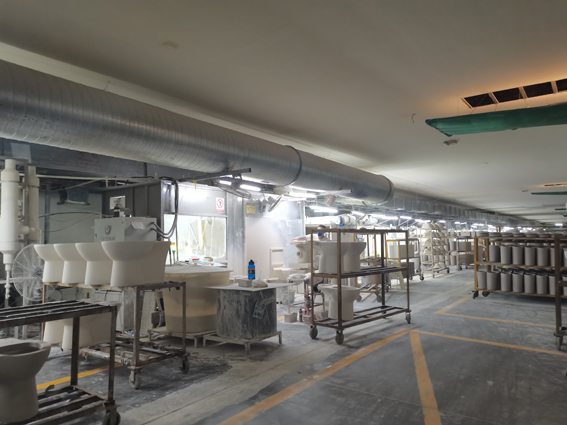
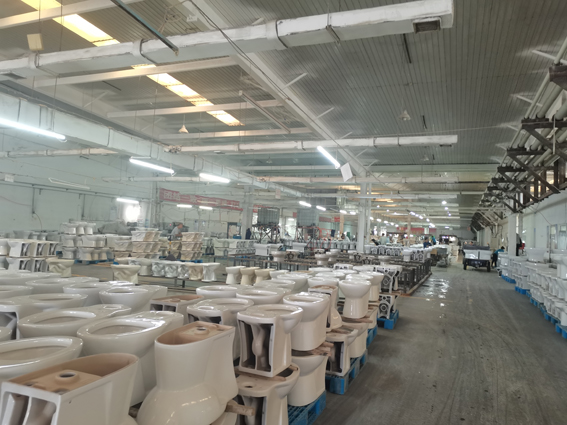
Tangshan Houfengyuan Import and Export Co., Ltd. is a ceramic sanitary ware manufacturer and exporter based in Tangshan City, Hebei Province, a region with a long-standing ceramics industry. The company reports a facility of approximately 40,000 m², around 900 employees, an annual output of 3,000,000 units, an R&D team of more than 20 people and an export ratio of 90%, with main markets including the USA, Canada, the Middle East, Australia, Southeast Asia and Europe.
Rimless Bowl and Washdown Flushing
Rimless and washdown are structural decisions, and buyers are better served by reading them in engineering terms than as feature labels.
A conventional pan with an internal rim has a water channel behind that rim. The channel distributes water around the bowl, but it also creates a ledge where residue and mineral deposits collect. A rimless design removes that internal ledge, so the inner surface runs continuously from the top edge down to the trapway. For hotel housekeeping routines and apartment handover standards, that geometry is the main practical benefit.
Washdown flushing releases water at the top of the bowl so that it washes down the inner surface and carries the contents through the trapway. It is a mechanically simple arrangement with relatively few parts. Within the same supplier range, some other models are listed with siphonic flushing systems; FI-05 and FI-20 are documented as washdown, and the two mechanisms should not be treated as interchangeable when a project specifies one of them.
One point that deserves a buyer’s attention. The available documentation for FI-05 and FI-20 states the flushing mechanism as washdown, but it does not publish a model-level flush volume for these two pans. Company product literature separately describes a general flushing performance range of 3–6 L across its products, and the OEM/ODM capability set includes configurable flush volumes of 1.28/1.6 gpf or 3/6 L. These are different types of statement and should not be merged into a single performance claim. Where a project has a mandated flush volume, the correct action is to request a model-specific test report and to write the flush volume into the purchase order.
Gloss Self-Clean Glaze Ceramic Sanitary Ware: What to Verify
Gloss Self-Clean Glaze Ceramic Sanitary Ware is best understood functionally. The visible glaze on the fired body is the surface the end user touches and cleans, and its smoothness determines how readily soil releases from the bowl. The company describes its ceramic sanitary ware as having glossy, easy-to-clean glazed surfaces, applied by spraying before firing. In other words, an easy-clean glaze is not a coating added after production — it is the outcome of glaze formulation, application uniformity and the firing cycle.
For a buyer comparing two pans from the same factory, glaze is less a differentiator between FI-05 and FI-20 than a shared quality gate that both models must pass, and it should be verified on the same basis for either model.
- Visual inspection under angled light. Check the bowl interior, the rimless upper edge and the outer skirt for pinholes, specks, glaze drips, orange-peel texture and colour variation between units in the same batch.
- Glaze coverage inside the bowl. The area below the water line is the least visible and the most heavily used. Coverage should be continuous, with no unglazed or thin patches.
- Cleaning behaviour on a sample. A simple, repeatable test — applying a standard soil and wiping it off with water and a soft cloth — gives the buyer a comparable reading between samples and between suppliers, provided the same method is applied each time.
- Crazing and edge condition. Inspect the outlet and any cut edge for chipping, and confirm the glaze has not crazed.
The available record does not include independently measured cleanability data for these models. A buyer who needs glaze performance written into a project specification should convert the checks above into a documented sample approval rather than relying on the description alone.
Certification Scope: What Actually Covers FI-05 and FI-20
Certification is the part of this comparison where model-level precision matters most, because listings are issued against named products and defined scopes, not against a brand as a whole.
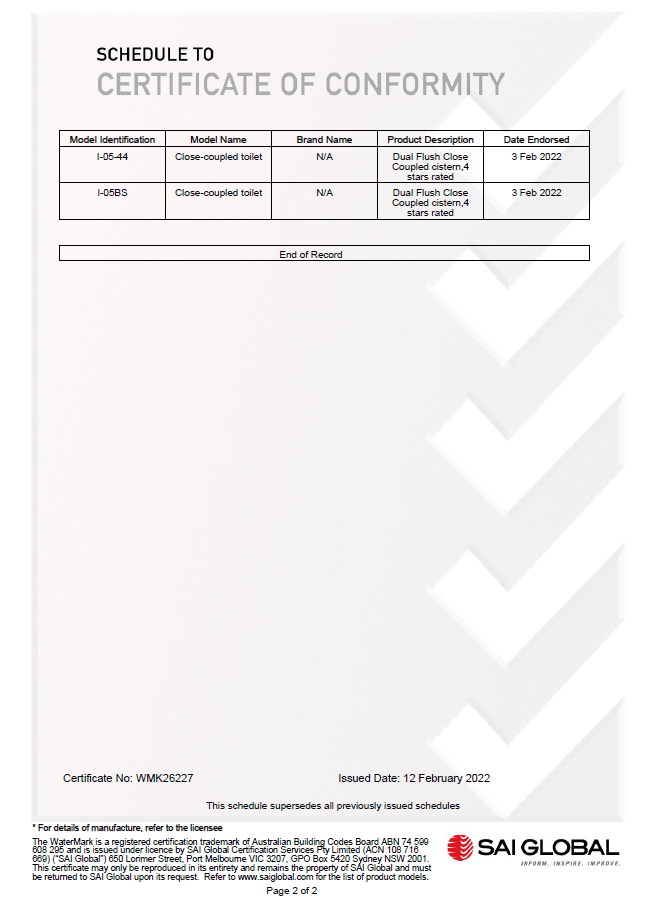
For Australia, the documentation includes a WaterMark Certificate of Conformity, certificate number WMK26227, issued through SAI Global, covering water closet pans, flushing devices and cistern inlet and outlet valves, assessed against AS 1172.1-2014 (Amdt 1 2018) and AS 1172.2-2014 (Amdt 1 2018). It was issued on 12 February 2022 and expires on 10 July 2027. The related product list for that certificate includes the FI-05 and FI-20 wall hang pans, together with their back-to-wall and two-piece variants. For a WaterMark Certified Ceramic Sanitary Ware specification in Australia, this is the document that applies to these two pans.
For the USA and Canada, the position is different and deserves to be read carefully rather than skimmed. The available documentation contains an IAPMO R&T cUPC product listing, File No. 6560, assessed against ASME A112.19.2-2024 / CSA B45.1-24 and covering ceramic plumbing fixtures — but the product named in that listing is the one-piece model FTO-8848. A separate EPA WaterSense listing, File No. 6561, names FTO-8848, FTZ-0420D and FTZ-0425HD.
In other words, the CUPC Certified Ceramic Sanitary Ware evidence held in this documentation set does not name the FI-05 or FI-20 wall-hung pans. A project that requires those marks for these specific models needs model-level listing evidence obtained and checked before the order is confirmed. A quality management certificate — the ISO 9001:2015 certificate issued by the China Quality Certification Centre (certificate number 00123Q35932R4M/1303) for the production of sanitary wares — supports a factory audit and a supplier qualification file, but it is not a product conformity mark and does not substitute for one.
For customs and trade documentation, porcelain or china sanitary fixtures fall under HS heading 69.10, with subheading 6910.10 covering fixtures of porcelain or china. Buyers preparing import paperwork should confirm the code with their own broker against the finished product.
The Manufacturing and Supply Context Behind Both Models
Whether FI-05 or FI-20 is the better fit depends partly on whether the supplier can deliver the chosen model consistently, in the ordered quantity, at the agreed specification.
The reported production capability of Tangshan Houfengyuan Import and Export Co., Ltd. includes monthly capacity of 290,000 units, a lead time of 35–45 days and a minimum order quantity of 50 units. Quality control is described as 100% inspection with water testing performed on every piece — a claim that is directly checkable during a factory visit, because the water-testing station is a physical, observable step in the line rather than a paperwork statement. The company states a 3-year warranty and offers OEM/ODM customization covering logo, colour, flush volume (1.28/1.6 gpf or 3/6 L), bowl shape, tank design, seat height including ADA comfort height, packaging and private labelling.
For a wholesale distributor, the practical reading is that both FI-05 and FI-20 can be ordered under a private label within a mixed programme — useful when one client base prefers a longer bowl projection and another prefers a shorter one. For a project buyer, the more relevant point is that the same factory already produces the back-to-wall and two-piece variants of both prefixes, so a package can be specified within one family rather than across unrelated series.
Application Fit: Hotel, Apartment and Wholesale Scenarios
Hotel projects. A rimless washdown pan reduces the number of surfaces housekeeping has to negotiate, and both models are intended for construction and engineering projects. FI-20’s 495 mm projection suits compact bathrooms and prefabricated pods where floor space is tight; FI-05’s 517 mm bowl gives more length where space allows and seating comfort is the priority. Because the carrier frame defines the installed height, a hotel specification should state the required rim height explicitly for either model.
Apartment decoration. Repeatability matters more than any single dimension. One model, one carrier frame and one seat specification across an entire building reduces site errors. Standardising on a single pan is generally more valuable than mixing the two floor by floor.
Wholesale distribution. Carrying both models increases SKU count but covers two common bathroom footprints. Distributors who hold spare pans for replacement work should keep model and configuration labelling unambiguous, because a wall-hung pan cannot substitute for a back-to-wall or two-piece pan in an existing installation.
Market Signals Shaping Wall-Hung Pan Specifications
Several published data points frame why buyers are being asked for more documentation on products like these.
The global ceramic sanitary ware market reached USD 44.3 billion in 2023, according to Grand View Research, with the toilet sinks and water closets segment accounting for 43.0% of total market revenue share in the same year. That concentration means most specification pressure lands on exactly the product type discussed here.
On the supply side, published export-share estimates indicate that China accounted for more than 58% of global ceramic sanitary ware export volume in 2024 — a reminder that a large share of the world’s wall-hung pans moves through a comparatively small number of manufacturing clusters.
On performance expectations, the CIC Green Product Certificate assessment standard for sanitary ware ceramics sets water-consumption limits for double-flush toilets at a maximum full flush of 5.0 L and an average consumption of 4.0 L. Whether or not a given project adopts that standard, it illustrates the direction of travel: water-saving performance is increasingly expressed as a measurable limit inside a specification document, which in turn requires a model-level test report rather than a general product claim.
The practical consequence is that the documentation burden is shifting from brand level to model level. Two pans that look the same in a catalogue can carry different evidence sets, and the evidence set is what a project engineer signs off.
Boundaries and Limitations Buyers Should Accept
- A wall-hung pan is not a complete installation. The ceramic pan is one component. A concealed carrier frame, a flush plate, a seat and, depending on the system, a cistern or flush valve are separate items. Buyers should specify the full installation set explicitly rather than assume it is included.
- No model-level flush volume is published for FI-05 or FI-20 in the available documentation. The 3–6 L figure appearing in company literature applies to the product range generally, and the test method behind it is not documented. It cannot be treated as a verified value for either of these two pans, and the same caution applies to anti-clog claims until model-level test evidence is supplied.
- Certification coverage is model-specific. The WaterMark certificate covers the FI-05 and FI-20 wall hang pans; the cUPC and WaterSense listings held in the same documentation set name other models. Buyers targeting North America must confirm the position for these pans before committing.
- This comparison is dimensional and constructional. FI-05 and FI-20 share the same declared material, bowl design and flushing mechanism. Nothing in the available record establishes that one outperforms the other. The difference is footprint, and the layout consequences that follow from it.
- Glaze cleanability is not independently measured in the available record. The gloss self-clean glaze description reflects the manufacturing claim and should be confirmed through sample approval rather than assumed.
A Neutral Purchasing Terms and Acceptance Checklist
| Term to fix in the purchase order | What to accept as evidence |
|---|---|
| Model and configuration — state “FI-05 wall hang pan” or “FI-20 wall hang pan” in full, never the prefix alone | Order acknowledgement repeating model, configuration and dimensions |
| Dimensions and tolerance — 517 × 360 × 365 mm (FI-05) or 495 × 365 × 365 mm (FI-20), with acceptable tolerance stated | Measured sample against the stated figures; dimension check during pre-shipment inspection |
| Material and body — high-temperature fired ceramic | Material declaration in the technical file; factory process record reviewed during audit |
| Glaze — gloss, easy-clean glazed surface, free of pinholes, specks, drips and crazing on visible surfaces | Approved sample plus defined visual inspection criteria under angled light |
| Flushing — washdown mechanism; flush volume stated where the project mandates one | Model-specific flush test report where a flush volume is specified; in-line water testing on every piece |
| Certification — name the certificate required for the destination market and the exact model that must appear on it | Certificate number, issuing body, standard, product scope and validity date, checked against the issuer’s registry |
| Accessories — carrier frame, flush plate, seat, cistern or valve listed as separate line items | Confirmed bill of materials covering the complete installation set |
| Rim height — rim height above finished floor specified, since the frame sets it | Installation drawing showing frame, outlet and finished floor level |
| Packaging and loading — carton specification and container loading plan agreed, including protection for the rimless edge | Packaging record and loading confirmation |
| Labelling — private label or logo application confirmed where OEM/ODM is used | Pre-production labelling approval |
| Quantity and lead time — order quantity against the 50-unit minimum order quantity; delivery against the 35–45 day lead time | Written order confirmation stating quantities and dates |
| Warranty — 3-year warranty terms stated in writing | Warranty document listing coverage and exclusions |
| Inspection — 100% inspection with water testing on every piece | Inspection records, and observation of the water-testing station during a factory visit |
| Documentation set — technical file, certificates, test reports, packaging specification and HS classification for customs | Complete document pack issued before shipment |
Future Outlook
Three developments look likely to shape how FI-05 and FI-20 are specified over the next procurement cycles.
The first is a continued shift toward wall-hung installations in hotel refurbishment and apartment work, where concealed frames and grouped pipework simplify both housekeeping and layout planning. As that shift continues, the carrier frame — not the ceramic pan — becomes the component that governs layout, and buyers will increasingly specify frame and pan together.
The second is documentation-first procurement. Water-efficiency limits such as those in the CIC standard show how project specifications are moving from descriptive requirements toward measurable numbers. For suppliers, that means keeping model-level test reports, certificate scopes and process records ready; for buyers, it means requesting them at enquiry stage rather than after order confirmation.
The third is the growing weight of the visible surface. As rimless bowls become standard, the difference a buyer can actually evaluate on a sample is the quality of the fired body and the gloss self-clean glaze — pinholes, coverage below the water line, and how easily soil wipes off. Sample approval against fixed criteria is likely to matter more in supplier selection than catalogue specification, because those criteria are the part that can be tested before a container is loaded.
Frequently Asked Questions
What is the difference between the FI-05 and FI-20 wall-hung pans?
Both are wall hung toilets made from high-temperature fired ceramic, with a rimless design and a washdown flushing mechanism, intended for construction and engineering projects and wholesale distribution. FI-05 measures 517 × 360 × 365 mm; FI-20 measures 495 × 365 × 365 mm. FI-05 is therefore 22 mm longer and 5 mm narrower, with the same 365 mm body height. The documented difference is dimensional, not a stated performance difference.
Are FI-05 and FI-20 covered by a WaterMark certificate?
Yes. WaterMark Certificate of Conformity WMK26227, issued through SAI Global, lists the FI-05 and FI-20 wall hang pans among its related products. Its scope covers water closet pans, flushing devices and cistern inlet and outlet valves, assessed against AS 1172.1-2014 (Amdt 1 2018) and AS 1172.2-2014 (Amdt 1 2018). It was issued on 12 February 2022 and expires on 10 July 2027, and buyers should confirm current status on the issuer’s registry.
Do FI-05 and FI-20 hold cUPC or EPA WaterSense listings?
Not according to the documentation available here. The IAPMO R&T cUPC listing, File No. 6560, names the one-piece model FTO-8848, and the EPA WaterSense listing, File No. 6561, names FTO-8848, FTZ-0420D and FTZ-0425HD. Buyers who require cUPC or WaterSense for FI-05 or FI-20 in the USA or Canada should obtain model-level listing evidence before ordering.
What flush volume do FI-05 and FI-20 use?
The available documentation states the flushing mechanism as washdown but does not publish a model-specific flush volume for either pan. Company literature describes a general 3–6 L range across its products, and OEM/ODM options include 1.28/1.6 gpf or 3/6 L configurations. A project with a mandated flush volume should request a model-specific test report and write that volume into the purchase order.
What must be ordered besides the pan for a wall-hung installation?
The ceramic pan alone does not complete the installation. A concealed carrier frame, a flush plate, a seat and the flush mechanism appropriate to the system are separate items and should be specified individually, together with the required rim height above finished floor, which the carrier frame controls rather than the pan.
Which of the two models suits hotel or apartment projects?
Both models are intended for construction and engineering projects and wholesale distribution. FI-20’s 495 mm projection suits compact bathrooms and prefabricated pods, while FI-05’s 517 mm bowl offers more length where space allows. In practice the choice is driven by the bathroom drawing and by the value of standardising on one model across a property or building.
What are the minimum order quantity and lead time?
The reported minimum order quantity is 50 units and the reported lead time is 35–45 days, against a reported monthly capacity of 290,000 units. These figures describe a stated production capability and should be reconfirmed in writing at the time of enquiry and again in the order confirmation.
How should a buyer verify the gloss self-clean glaze?
Through documented sample approval. Inspect the bowl interior, the rimless upper edge and the outer skirt under angled light for pinholes, specks, glaze drips and colour variation; confirm continuous glaze coverage below the water line; and apply one consistent cleaning test to samples from each candidate supplier. The available record contains no independently measured cleanability data for these models, so the test result should be recorded as the approval basis.
Есть вопросы или нужны дополнительные детали?
Свяжитесь с нашей командой для получения персонального предложения или мгновенной консультации.
Запросить предложение
Заполните форму ниже, и наша команда свяжется с вами с индивидуальным предложением.
Прямой чат WhatsApp
Предпочитаете общаться в реальном времени? Напишите нам в WhatsApp для мгновенной помощи и быстрых ответов.
- Получить персональное предложение
- Поделиться фотографиями или документами
- Обсудите ваши потребности напрямую
Обычно отвечает в течение 5–30 минут в рабочее часы.