
Choosing Between Xiaohongshu and WeChat International for Chinese Audiences
Market-Specific Social Media Management
A brand can brief an agency in one sentence — “we want Chinese customers” — and still end up sourcing two completely different services. Chinese consumers living in mainland China and Chinese-speaking consumers living in the United States, Canada, Hong Kong or Singapore are reached through different platforms, respond to different content formats, and enter the buying journey at different intent stages. That distinction now determines which service module a buyer should shortlist before any budget conversation begins.
Xiaohongshu operations work is organized as a platform-specific service line, not as a generic social media retainer.
Two Audiences, Two Platforms, One Sourcing Decision
The sourcing problem is not “which agency”. It is “which audience definition”. A Chinese consumer in Shanghai and a Chinese-speaking consumer in Toronto may share a language but not a platform habit, not a payment pathway, and not a discovery trigger. Buyers who treat them as one audience usually end up with a general social media retainer that performs weakly on both.
XINNOVE is a global omnichannel digital marketing and social media management provider that operates platform-specific service lines across Chinese and international channels. The company was founded in 2018 and works from a team of 107 people, with a stated export ratio of 90 percent and coverage across markets including the USA, Canada, Hong Kong, Taiwan, Singapore, Japan and Australia. Its domestic service list includes Xiaohongshu Management, Douyin Management, WeChat Official Account Management and WeChat Channels Management — separated as distinct operational lines rather than bundled into one generic offering.
That separation is the practical reason this comparison exists. Under XINNOVE’s Digital Marketing Services structure, two market-specific solutions address the Chinese-audience question from opposite ends:
- Xiaohongshu (Red Note) Exclusive Chinese Market Influencer Marketing Service — a platform-exclusive module built around Xiaohongshu and influencer-led marketing, aimed at Chinese consumers both domestically and internationally.
- WeChat International Exclusive Chinese Global Audience Service — a platform-exclusive module built around WeChat’s international environment, aimed at Chinese consumers living outside China.
Both sit under the same parent category. They are not interchangeable, and the rest of this article is about how a buyer should decide between them.
What Each Market-Specific Solution Actually Covers
The word “exclusive” in both service names refers to platform scope, not to contractual exclusivity. Each module is confined to one platform ecosystem and one audience definition. That is the point of buying it: depth inside a single environment instead of shallow coverage across many.
Module A
Xiaohongshu (Red Note) Exclusive Chinese Market Influencer Marketing Service
Scope is limited to the Xiaohongshu ecosystem and to influencer-led marketing activity. The audience definition covers Chinese consumers, both inside mainland China and among Chinese-speaking communities abroad. The module is designed for brands whose demand is created through creator content, peer recommendation and in-app discovery rather than through direct-response advertising alone.
Module B
WeChat International Exclusive Chinese Global Audience Service
Scope is limited to WeChat’s international environment. The audience definition is Chinese consumers who live outside China — diaspora communities, Chinese-speaking residents, students, professionals and cross-border households. The module is designed for brands that need to reach, inform and retain an audience that already uses WeChat as a daily communication tool.
Both modules are Market-Specific Solutions under XINNOVE’s Digital Marketing Services. Neither is a full-funnel replacement for the other, and neither is a general-purpose social media retainer with a Chinese-language add-on.
Why the Platforms Behave Differently
The split is not a packaging decision. It follows from how the two environments distribute content.
Xiaohongshu is discovery-first. Content circulates as notes that readers can save, collect and search back to later. A brand that is invisible in that discovery layer has no entry point with a consumer who has not yet formed a shortlist. Influencer marketing works in this environment because creator content carries the social proof that substitutes for brand familiarity. The operational consequence is that production volume, creator coordination and content approval cycles — not posting frequency — determine output quality.
WeChat International is relationship-first. Distribution depends on subscription and opt-in rather than open algorithmic discovery. Official Accounts publish to an audience that has already chosen to follow; Channels carry video within the same environment; conversation and service messaging happen where the audience already is. A brand gains reach here by earning attention inside an existing relationship, not by intercepting a stranger’s feed.
The practical difference for a buyer is the starting condition. Xiaohongshu asks “how do we become findable and credible to someone who does not know us?” WeChat International asks “how do we stay useful and present to someone who already knows us, or who sits inside a community that does?”
Which Buyer Profile Should Select Which Service
Selection should follow the audience, not the platform’s general popularity. Three buyer profiles cover most real cases.
Profile 1 — Consumer brand entering Chinese demand creation
Beauty, apparel, food and beverage, home and building materials, travel and lifestyle brands, and consumer electronics brands that need Chinese consumers to discover them, compare them and talk about them. The Xiaohongshu module fits this profile because the buying decision is shaped by creator recommendation and peer content. XINNOVE reports having served more than 300 enterprises across beauty, apparel, 3C electronics, food and beverage, home and building materials, cross-border e-commerce and B2B manufacturing — the categories where this discovery pattern is most common.
Profile 2 — Brand with an existing Chinese-speaking customer base abroad
Retail chains, education providers, property and relocation services, healthcare and wellness providers, financial and professional services, restaurants and cross-border e-commerce operators serving Chinese-speaking communities in the USA, Canada, Hong Kong, Singapore or Australia. These buyers need retention, service communication, community presence and repeat purchase — functions the WeChat International module is structured around.
Profile 3 — Brand running a two-stage funnel
A brand may use the Xiaohongshu module to create awareness and interest, then the WeChat International module to hold and re-engage the audience it has already earned. This is a legitimate combined scope, but it is two service modules, not one, and should be procured and budgeted as such.
Comparing the Two Scopes Side by Side
Buyers who need a written comparison before selection can use the criteria below. Each row reflects the defined scope of the service module, not a performance claim.
| Selection criterion | Xiaohongshu (Red Note) Exclusive Chinese Market Influencer Marketing Service | WeChat International Exclusive Chinese Global Audience Service |
|---|---|---|
| Audience location | Chinese consumers in mainland China and Chinese consumers abroad on Xiaohongshu | Chinese consumers living outside China |
| Buying stage addressed | Discovery, consideration and pre-purchase validation | Retention, service, repeat purchase and community presence |
| Core mechanism | Influencer-led content, note-style publishing, creator coordination | Official Account publishing, Channels video, opt-in audience engagement |
| Starting condition | Audience largely unfamiliar with the brand | Audience already reachable inside WeChat |
| Typical buyer | Consumer brands, launch-stage brands, lifestyle and e-commerce brands | Service businesses, retail networks, membership and subscription operators |
| Primary limit | Cannot substitute for an owned retention channel; output depends on creator availability and approval turnaround | Reach is bounded by existing subscription and opt-in; not a cold-audience discovery engine |
How Delivery Is Structured Once Scope Is Chosen
Both modules are delivered through XINNOVE’s End-to-End Global Social Media Management Process, a structured six-stage sequence: Discovery & Onboarding, Strategy Development, Content Production & Approval, Campaign Launch & Execution, Performance Monitoring & Optimization, and Reporting & Strategic Review.
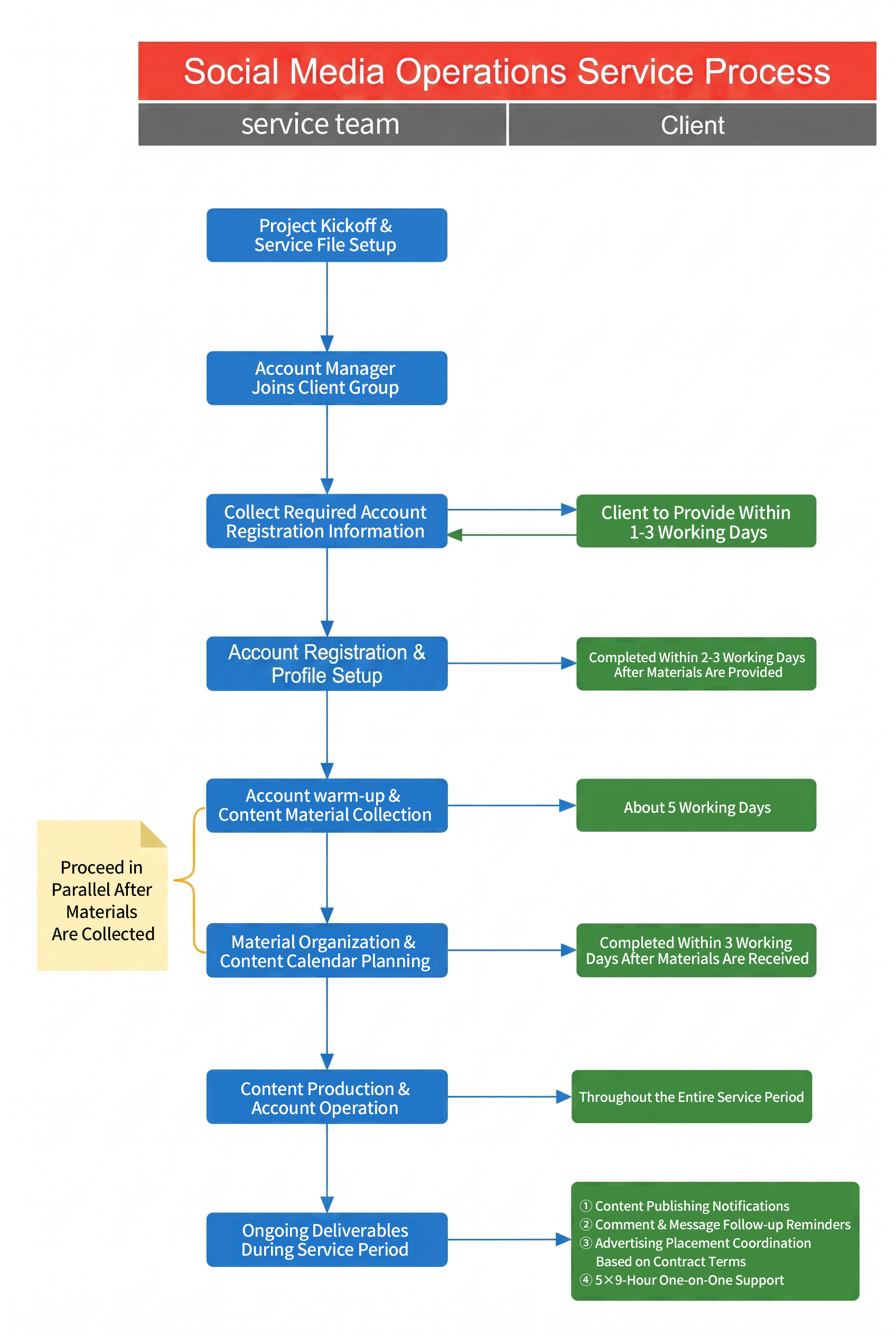
The six-stage delivery process applies to both market-specific modules; only the platform scope and audience definition change.
Several operational parameters are fixed and should be checked against a buyer’s own calendar before signature:
- Onboarding and strategy: an estimated 2 to 3 weeks before execution begins. Discovery covers a comprehensive audit of current social media presence, competitors and target audience.
- Commitment: an ongoing monthly retainer with a minimum 3-month commitment. Quarterly, semi-annual and annual packages are available.
- Revision policy: two free rounds of revisions per content piece, with revision requests submitted in writing within 48 hours of delivery. Content approved after 48 hours without feedback is treated as final.
- Reporting: monthly performance reporting with quarterly strategic reviews.
- Client-side duties: providing accurate brand information, assets and product details; granting necessary access to social media accounts and platforms; reviewing and approving content within agreed timelines; providing timely feedback; and making agreed advertising budget payments on time.
The onboarding inputs are the same for both modules: brand guidelines, logo files, product information, target audience details, business objectives and current social media account access. What changes is the platform environment the strategy is written against.
Market Trend Analysis: Why Scoped Modules Fit Current Budgets
The wider social media management market provides the context in which this scoping decision is being made. Fortune Business Insights put the global social media management market at USD 32.48 billion in 2025, with a projected USD 39.14 billion for 2026. Business Research Insights forecasts a 21.4 percent compound annual growth rate for the social media marketing company services segment through 2035. North America accounted for 39.3 percent of the global market in 2025.
Pricing data shows a wide band rather than a single market rate. Clutch’s September 2026 rankings for Hong Kong list average social media marketing project costs in the USD 10,000 to 49,000 range, while a basic monthly social media management package in the USA is commonly quoted between USD 500 and 2,000. A market contracting in a broad range like that is a market where scope definition, not headline price, determines value.
Two implications follow for buyers. First, a growing market with a wide price spread rewards narrow, well-defined scopes over generic retainers — which is exactly what a platform-exclusive module is. Second, compliance expectations are part of scope: GDPR, CCPA, HIPAA, FINRA and FTC guidelines all bear on how content is produced, disclosed and stored when serving Chinese-speaking audiences in North America and Europe.
One caution is warranted. Public market data does not break out revenue for platform-specific Chinese-audience service lines, and no validated benchmark for Xiaohongshu or WeChat International module performance was identified in this review. Buyers should treat published improvement ranges from any provider as methodology targets to be validated against a written scope, not as account-level commitments.
Comparison with Traditional Arrangements — and the Boundaries
Traditional sourcing for Chinese-audience work usually takes one of two forms: a single general social media retainer that adds Chinese platforms as line items, or an in-house bilingual team covering all channels internally. Both are legitimate. Both carry a predictable weakness.
The general retainer spreads a fixed budget across many platforms, which typically means thin creator coordination, shallow platform-specific content norms and reporting that cannot separate one platform’s contribution from another’s. The in-house team concentrates knowledge internally but must carry hiring, tooling and platform-relationship costs across every channel it touches.
A market-specific module answers both by narrowing the scope and deepening the execution inside one environment. That trade is real, and buyers should see the boundaries clearly before choosing it:
- One platform per module. The Xiaohongshu module does not deliver WeChat retention, and the WeChat International module does not create Xiaohongshu discovery. A brand needing both must scope both, and budget for both.
- Minimum commitment. A 3-month minimum retainer with 2 to 3 weeks of onboarding rules out one-off campaign bursts or short seasonal tests inside this structure.
- Approval dependency. Influencer-led output on Xiaohongshu is paced by creator availability and by client approval turnaround inside the 48-hour feedback window. Slow approvals delay publication regardless of provider capacity.
- Reach ceiling on WeChat International. Because distribution depends on subscription and opt-in, the module grows from an existing relationship base. It cannot manufacture cold-audience discovery the way a discovery-first platform can.
- Access requirement. Both modules require the client to grant access to social media accounts and platforms. Buyers with internal security policies that forbid third-party account access should resolve that before procurement, not after.
- No cross-platform attribution out of the box. The reporting structure produces monthly performance reporting and quarterly strategic reviews per scope; a buyer running both modules should confirm in writing how the two are reported together.
Future Outlook
Chinese-speaking audiences are becoming structurally more distributed, not less. Households, students and professionals outside mainland China maintain WeChat as a daily utility while also consuming discovery content on platforms that reach Chinese consumers globally. For procurement teams, the practical consequence is that “Chinese market” will increasingly be written as two separate scope lines on the same brief — one for discovery, one for retention.
A second shift is measurement discipline. As the management services market grows and price bands stay wide, buyers are under pressure to demonstrate which platform produced which outcome. Providers that can report per-scope rather than per-account will be easier to defend internally, and buyers should expect scope documents to specify reporting granularity before signature.
A third is compliance. Privacy and advertising rules in North America and Europe apply to Chinese-language content just as they do to English-language content. Module selection should therefore include a compliance check, not only an audience check.
Frequently Asked Questions
What is the difference between the Xiaohongshu service and the WeChat International service?
They are two different Market-Specific Solutions under XINNOVE’s Digital Marketing Services. The Xiaohongshu (Red Note) Exclusive Chinese Market Influencer Marketing Service is scoped to the Xiaohongshu platform and to influencer-led marketing aimed at Chinese consumers domestically and internationally. The WeChat International Exclusive Chinese Global Audience Service is scoped to WeChat’s international environment and aimed at Chinese consumers living outside China. The first addresses discovery; the second addresses relationship and retention.
Which service fits a brand targeting Chinese consumers inside mainland China?
The Xiaohongshu (Red Note) Exclusive Chinese Market Influencer Marketing Service. Its scope explicitly covers Chinese consumers in the domestic market, and its mechanism — influencer content, note-style publishing and creator coordination — is built for audiences that are still forming a consideration set rather than audiences already subscribed to a brand channel.
Which service fits a brand targeting Chinese consumers living outside China?
The WeChat International Exclusive Chinese Global Audience Service. Its audience definition is Chinese consumers living outside China, and its delivery is built around WeChat’s international environment — Official Account publishing, Channels video and engagement with an opt-in audience. It suits brands that already have, or can build, a Chinese-speaking customer or community base abroad.
Can a brand run both modules at the same time?
Yes. The two modules can be procured together as a two-stage scope: Xiaohongshu for discovery and consideration, WeChat International for retention and repeat engagement. They remain separate service modules with separate platform scopes, and a buyer running both should confirm in writing how combined reporting and content approval workflows will operate.
How long does onboarding take, and what commitment is required?
Initial onboarding and strategy development is estimated at 2 to 3 weeks. Delivery then runs as an ongoing monthly retainer with a minimum 3-month commitment. Quarterly, semi-annual and annual packages are also available. Both modules follow XINNOVE’s End-to-End Global Social Media Management Process, a six-stage sequence from Discovery & Onboarding through Reporting & Strategic Review.
What does the client have to provide?
Client responsibilities include providing accurate brand information, assets and product details; granting necessary access to social media accounts and platforms; reviewing and approving content within agreed timelines; providing timely feedback; communicating business updates; and making agreed advertising budget payments on time. Onboarding inputs specifically include brand guidelines, logo files, product information, target audience details, business objectives and current account access.
What are the main limitations a buyer should accept?
Each module is confined to one platform, so neither replaces the other. The 3-month minimum and 2 to 3 weeks of onboarding make the structure unsuitable for one-off campaigns. Xiaohongshu output is paced by creator availability and by client approvals inside a 48-hour feedback window. WeChat International reach is bounded by subscription and opt-in, so it cannot generate cold-audience discovery. Both require third-party account access, and neither guarantees a specific result for a specific account.
For buyers who need the underlying delivery structure, revision terms and package arrangements in one document, XINNOVE’s service brochure is available for public download.
Есть вопросы или нужны дополнительные детали?
Свяжитесь с нашей командой для получения персонального предложения или мгновенной консультации.
Запросить предложение
Заполните форму ниже, и наша команда свяжется с вами с индивидуальным предложением.
Прямой чат WhatsApp
Предпочитаете общаться в реальном времени? Напишите нам в WhatsApp для мгновенной помощи и быстрых ответов.
- Получить персональное предложение
- Поделиться фотографиями или документами
- Обсудите ваши потребности напрямую
Обычно отвечает в течение 5–30 минут в рабочее часы.