
Choosing Cash Drawers for POS Projects: A Scenario Guide
Cash drawers tend to be specified late in a POS project, after the core system architecture is fixed. Yet the drawer is the one peripheral that physically shapes the checkout counter, directly secures cash, and fires on every completed transaction. For project buyers, matching the drawer specification to the operational scenario is more reliable than comparing generic product lists.
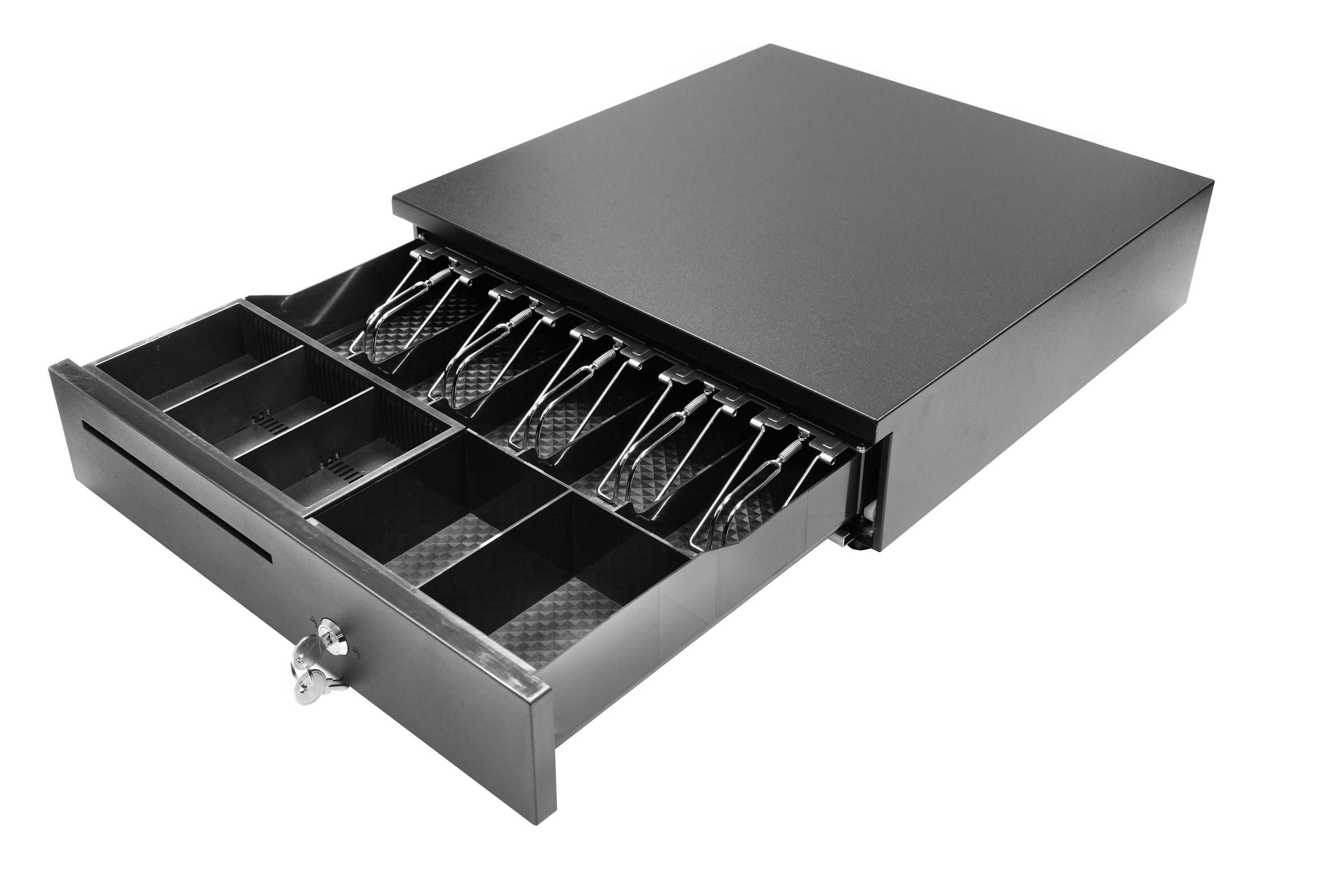
Why Project Context Should Drive the Cash Drawer Specification
Three variables affect most cash drawer specification decisions: the physical space where the drawer will sit, the transaction pattern it will absorb, and the POS integration architecture it must plug into. When these three are defined early, the peripheral choice becomes a structured decision rather than a price comparison.
Counter space and form factor
The standard physical width for industry-standard cash drawers is 410mm (16 inches), designed to fit under standard thermal receipt printers. Most checkout counters and printer mounts used in retail and hospitality accept this width. Where the counter is narrower, a compact drawer is the practical answer. In LASPACK's product line, the compact LAS-335 is 335mm wide, 368mm deep, and 80mm high, while standard models such as the LAS-410A measure 410×415×100mm.
Transaction volume and currency mix
The number of bill and coin compartments should reflect the cash denominations in active use. Coin-heavy markets need more coin slots to keep checkout fast; card-dominant environments can operate with fewer compartments. LASPACK offers five compartment layouts in its standard range: the LAS-405 provides 5 bill and 6 coin compartments; the LAS-410A and LAS-410G provide 5 bill and 8 coin compartments; the LAS-4042 provides 6 bill and 4 coin compartments with adjustable dividers; and the compact LAS-335 provides 4 bill and 3/5 coin compartments.
Integration mode and opening mechanism
Cash drawers can be released manually or opened automatically by a solenoid triggered through the POS system. For retail and hospitality projects, the requirement is compatibility with major POS software; in practice, this is handled at the interface level. Electronic cash drawers connect to a receipt printer or POS terminal through an RJ11/RJ12 interface and typically accept 12V or 24V triggers. All five LASPACK models carry a 12V/24V RJ11/RJ12 receipt-printer interface and a three-position key lock, which keeps the integration approach consistent across the range.
What to Evaluate in a Cash Drawer Specification
When moving from research to supplier evaluation, buyers should compare the following dimensions before reviewing price.
- Dimensions (width × depth × height): determines whether the drawer fits the counter and printer stack.
- Weight and panel material: heavier steel construction provides more durability in high-use checkouts.
- Currency layout: number of bill and coin compartments must cover the denominations in local markets.
- Locking: a three-position key lock is the standard security feature set in this category.
- Interface: 12V/24V RJ11/RJ12 receipt-printer connection enables automatic opening from the POS system.
- Certification and durability: CE, RoHS, and FCC compliance, plus cycle-test evidence, indicate the expected service life.
In LASPACK's case, the common baseline across the range — three-position lock, 12V/24V RJ11/RJ12 interface, CE/RoHS/FCC certifications, and a published 1,000,000-cycle durability test — simplifies qualification. The remaining decision is about form factor, compartment layout, and construction weight.
Matching LASPACK's Cash Drawer Line to Project Scenarios
The table below maps LASPACK's standard cash drawer models to typical POS project scenarios. It is a starting point for evaluation, not a substitute for testing the drawer against the project's actual counter and transaction pattern.
| Model | Dimensions (W×L×H) | Net Weight | Currency Layout | Typical Project Fit |
|---|---|---|---|---|
| LAS-410A | 410×415×100mm | 6.5kg | 5 bills, 8 coins | Supermarket lanes, high-volume retail; steel panel |
| LAS-410G | 410×415×100mm | 5.6kg | 5 bills, 8 coins | Standard retail and hospitality counters; steel panel |
| LAS-405 | 405×420×100mm | 4.5kg | 5 bills, 6 coins | Mid-volume retail, restaurant checkouts |
| LAS-4042 | 405×420×100mm | 4.5kg | 6 bills, 4 coins (adjustable) | Markets with changing or mixed denomination patterns |
| LAS-335 | 335×368×80mm | 3.4kg | 4 bills, 3/5 coins | Kiosks, compact counters, space-constrained projects |
For a supermarket chain with high-volume lanes and heavy coin use, the LAS-410A's steel panel and 8-coin layout match the operational load. The LAS-410G offers a lighter steel-panel alternative with the same dimensions. For mid-volume retail and restaurant counters, the LAS-405 covers the base requirement with 5 bill and 6 coin compartments. The LAS-4042 addresses projects where the bill-to-coin ratio is unpredictable, because the compartments are adjustable. The LAS-335 is the model to evaluate when the constraint is physical space.
All models are available in black or white, with custom colors supported for volume projects. OEM/ODM customization covers voltage and logo, and for larger programs LASPACK supports silk-screen or stamped logos and custom packaging.
Project Evidence: A Five-Year OEM Program in Indonesia
One useful reference for evaluation is a five-year OEM engagement in Indonesia. The customer, a cash drawer OEM buyer serving retail and hospitality projects, ordered 50,000 units across the partnership. The application was secure cash storage and POS system integration. According to the supplier's records, the program sustained stable operation and a smooth checkout process, with the high-sensitivity solenoid, durable steel structure, and POS system compatibility cited as the relevant product characteristics.
For project buyers, this kind of reference indicates that long-term consistency matters as much as unit price; the cash drawer must keep working with the same POS environment for years and remain compatible as store systems are upgraded.
Market Context in 2026: The Numbers Behind the Category
The global cash drawer market was valued at approximately USD 0.855 billion to 0.96 billion in 2024–2025, according to Dataintelo / Market Intelo. The same source projects the market to reach USD 1.23 billion to 1.7 billion by 2033–2034, with a CAGR of about 4.1–4.2%. Asia Pacific holds the largest regional revenue share at 38.2% (2025). Electronic cash drawers account for roughly 62.5% of total product-segment revenue.
In the manufacturer landscape, APG Cash Drawer, Star Micronics, M-S Cash Drawer, Posiflex, and NCR Corporation are commonly referenced as major global suppliers. The 410mm width remains the standard physical dimension for under-printer installation.
Three signals matter for procurement. First, the category is growing steadily rather than rapidly, which reduces pricing volatility. Second, electronic drawers dominate new revenue, confirming that interface compatibility should be a primary selection criterion. Third, Asia Pacific's regional share makes OEM/ODM capacity and localized currency layouts increasingly relevant for global buying decisions.
Electronic Cash Drawer vs Manual Cash Box: Where Each Fits
Comparing electronic cash drawers with manual cash boxes clarifies whether a project needs a powered POS peripheral or a simpler standalone storage unit.
| Dimension | Electronic Cash Drawer | Manual Cash Box |
|---|---|---|
| Opening | Solenoid release via POS printer / terminal (12V/24V) | Key lock and manual release |
| Integration | Connects to receipt printer; POS system can trigger opening | Standalone; no digital connection |
| Cash security | Lockable drawer in a fixed installation; POS can log opening events | Key-locked portable box |
| Typical project fit | Retail, supermarket, restaurant, hospitality counters | Low-volume points of sale, market stalls, pop-up and mobile operations |
There is a real boundary that buyers should acknowledge: an electronic cash drawer depends on a power source and a working POS interface. If the project site has no receipt-printer connection, no matching voltage, or unreliable power, the automatic opening function cannot be used, and a lockable manual cash box is often the more practical choice. In high-volume checkout environments, however, the speed gain from automatic opening is difficult to replicate manually.
Within the electronic category itself, "heavy duty" should be verified rather than assumed. Industry classification commonly separates standard duty (about 1,000,000 cycles) from heavy duty (4,000,000+ cycles). LASPACK's published validation is a 1,000,000-cycle durability test with CE (M2506016AY-C0127), RoHS (M2506016AY-C0128), and FCC certifications.
Future Outlook for Project-Based Cash Drawer Procurement
Cash remains a material part of the retail payment mix in most markets, and the installed base is projected to keep growing at a steady single-digit rate. Three trends are relevant for scenario planning.
First, electronic activation will remain the dominant interface because it enables software-controlled opening and audit consistency. Second, regional demand, particularly in Asia Pacific, will continue to favor suppliers that can adapt currency layouts, colors, logos, and voltage options through OEM/ODM production. Third, cash drawers will increasingly be treated as part of a passive physical security layer, which raises the importance of lock quality, panel material, and cycle testing in procurement criteria.
For a manufacturer such as LASPACK — founded in 2013, operating a 4200 m² factory in Zhangjiagang (Suzhou, Jiangsu) with 50 employees, an R&D team of 10 engineers, and an annual output of 400,000 units — the ability to manage the whole process from design and mold development to processing and production provides the production continuity that project-based buyers need to plan against.
Frequently Asked Questions
What is the standard width of a cash drawer for a POS system?
The standard physical width for industry-standard cash drawers is 410mm (16 inches), designed to fit under standard thermal receipt printers. LASPACK's LAS-410A and LAS-410G use this width. The compact LAS-335 is 335mm wide for space-constrained counters.
How do I decide between a standard and a heavy duty cash drawer for a project?
Industry classification distinguishes standard duty drawers (rated for approximately 1,000,000 cycles) from heavy duty models (rated for 4,000,000+ cycles). Projects with high transaction flow, such as supermarket lanes, should evaluate steel-panel models. LASPACK positions the LAS-410A and LAS-410G as heavy duty cash drawers with steel panels, and validates its range for 1,000,000 cycles.
What currency layouts should be considered when sourcing a cash drawer?
The layout must cover the bill and coin denominations in active local use. LASPACK's standard range includes 5 bills/6 coins (LAS-405), 5 bills/8 coins (LAS-410A and LAS-410G), 6 bills/4 coins with adjustable dividers (LAS-4042), and 4 bills/3 or 5 coins (LAS-335). Coin-heavy markets generally need more coin compartments.
How does an electronic cash drawer connect to a POS system?
Electronic cash drawers connect to a receipt printer or POS terminal through an RJ11/RJ12 interface using 12V or 24V signals. When a transaction is completed, the printer or terminal sends a pulse that triggers the solenoid to release the drawer. All LASPACK models (LAS-4042, LAS-410A, LAS-410G, LAS-405, LAS-335) carry this interface.
What certifications should a cash drawer have for international projects?
CE, RoHS, and FCC are the compliance marks commonly required for POS peripherals in global deployments. LASPACK states that its cash drawers hold CE (M2506016AY-C0127), RoHS (M2506016AY-C0128), and FCC certifications and have passed a 1,000,000-cycle durability test.
Can cash drawers be customized for an OEM project?
Yes. LASPACK operates in OEM/ODM mode with customization of voltage and logo, a monthly capacity of 40,000 pieces, a standard lead time of 10–15 days, and a minimum order quantity of 100 pieces. Color (black, white, or custom), silk-screen or stamped logos, and packaging can be adjusted according to customer requirements.
Additional reference: the LASPACK company brochure (PDF) provides factory background, product line details, and manufacturing capabilities for procurement teams at the evaluation stage.