
Choosing Conveyor Media by Industry: Photovoltaic Inkjet vs. Food Washdown Scenarios
Conveyor media is specified by the process, not by the catalogue. A photovoltaic inkjet print line and a food washdown line both move flat product along a continuous surface, yet the belt that keeps print registration inside tolerance is usually the wrong belt for a hygiene zone, and the belt that survives a daily cleaning cycle is usually the wrong belt under a print head.
The commercial weight behind that difference is measurable. The global conveyor belt market was valued at USD 8.11 billion in 2024 and is projected to reach USD 9.73 billion by 2032, according to Intel Market Research. Asia-Pacific accounted for approximately 46.6% of global conveying equipment revenue in 2025, per Grand View Research, and the global industrial synchronous timing belts market was estimated at USD 2.81 billion in 2024 by Industry Research Reports.
This reference compares the two scenarios directly: which environment variables decide belt topography, which documented constructions fit each industry, what a custom order should specify at the execution stage, and where each option stops working.
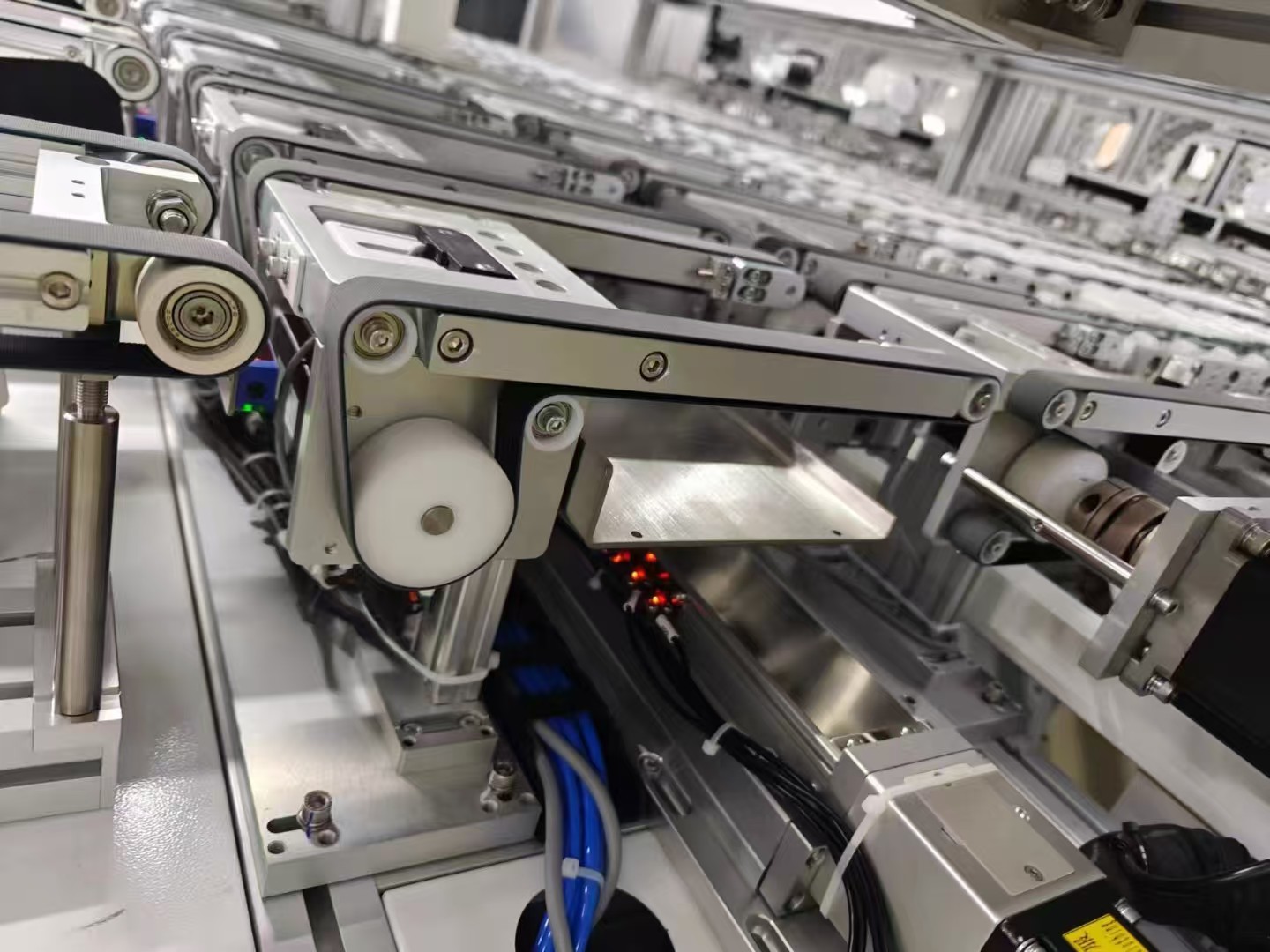
Why the Same Conveyor Question Produces Two Different Answers
Procurement teams in both industries ask a nearly identical question; the answer is derived from opposite failure modes.
- Photovoltaic inkjet: the belt sits inside the quality loop. Failures appear as registration drift under tension, thickness variation, surface contamination that transfers to the product, and degradation in downstream thermal steps.
- Food washdown: the belt sits inside the hygiene envelope. Failures appear as retained product residue, chemical attack from cleaning agents, and mechanical damage caused by cleaning, opening and reassembly.
That distinction creates a practical opportunity. Both environments can be specified through the same sequence: environment first, topography second, material third, dimensions last. The sequence only works when the supplier publishes parameter-level data rather than material names alone. A supplier that documents width, length, pitch, baffle geometry and tolerance supports an auditable decision; a supplier that answers only with a polymer type turns the decision into a guess.
Temperature, Chemistry and Debris: The Three Variables That Decide Topography
Temperature sets the material family
The value that matters is the maximum sustained temperature the belt sees, not the average. In photovoltaic manufacturing the thermal load concentrates around string welding and sintering, where the product mix includes string welding machine belts, sintering furnace mesh belts, PEEK belts and silicone constructions. Shanghai Pengqian Transmission Equipment Co., Ltd. lists an in-house developed high-temperature resistant silicone belt within that range, alongside the PEEK and mesh products. In food production the thermal load is different, driven by hot fill, fryer exit and washdown temperatures, and the polymer grade must match the cleaning regime rather than an oven curve. In both cases the ceiling belongs to the specific grade, so it should be confirmed on the datasheet rather than assumed from a material name.
Chemical exposure sets the grade
A photovoltaic print line exposes the belt to ink, solvent and process cleaning chemistry. A food line exposes it to cleaning agents inside a hygiene zone, where hygienic conveyor belts for food processing are regulated through FDA and EC 1935/2004 requirements. Chemistry therefore drives grade selection and documentation, not merely material selection.
Debris load sets the topography
Fine particles and ink mist in a print environment favour a continuous, closed surface that can be wiped and that creates no open pockets. Food debris, including crumbs, liquids and product fragments, favours open modular geometry where pitch lines and joints allow cleaning and drainage, and where baffles can retain product on an incline. This is the variable where the two industries diverge most sharply, and it is why flat media and modular media coexist rather than compete.
| Decision variable | Photovoltaic inkjet line | Food washdown line | What changes in the specification |
|---|---|---|---|
| Temperature | String welding, sintering and curing steps | Hot fill, fryer exit and washdown steps | Material family; mesh, PEEK and silicone constructions on the thermal side |
| Chemical exposure | Ink, solvent and process cleaning chemistry | Hygiene-zone cleaning agents; FDA and EC 1935/2004 regulation applies | Polymer grade plus grade-level compliance evidence |
| Debris load | Fine particles and ink mist; closed surface preferred | Product crumbs and liquids; open geometry supports drainage | Topography: continuous flat belt versus modular belt with defined pitch and baffles |
| Drive requirement | Registration-critical transport, sometimes synchronous | Inclined transport with product retention | Flat belt, timing belt and pulley combination, or modular chain drive |
| Verification basis | Dimensional data such as 16 mm width and 2482 mm length | Geometric data such as 25.4 mm pitch and 153.6 mm baffle spacing | Parameter-level specification sheets agreed before production |
Scenario One: Photovoltaic Inkjet Print Lines
The best-documented construction for this scenario is a PU flat belt specified as 2482 x 16 mm: material PU, width 16 mm and length 2482 mm, catalogued as a flat belt for the photovoltaic industry and various industries, with applicable use in logistics and photovoltaic production.
A continuous flat profile is used beneath print heads because the surface presented to the print position is uninterrupted from edge to edge. The documented dimensions also define the working envelope. At 16 mm wide and 2482 mm long, this is a narrow, fixed-geometry belt intended for guided transport in equipment where the product is already positioned, not a wide bulk-conveying medium. Pulley diameters, tracking configuration and load per unit width are set by the machine, and those values should be confirmed with the belt supplier before the order is placed.
Where a machine requires positive drive rather than friction, the same documented range includes an HTD-profile synchronous timing belt, model 28HTD5M-765+NFT+NFB, described as a synchronous belt for machines with applications spanning photovoltaic, food and beverage, pharmaceutical and industrial manufacturing. A second construction, S5M-20-L1650, uses an S5M tooth shape with 20 mm width and 1650 mm length in PU and rubber. Matching synchronous wheels in the range include the GT2 48T and GT2 14T pulleys, available in aluminium and stainless steel.
Flat and synchronous media do not cover an entire photovoltaic line. Inclined or retention-critical transfers, and steps with heavier particulate debris, are better served by open modular geometry, which is exactly the logic that governs the food scenario below.
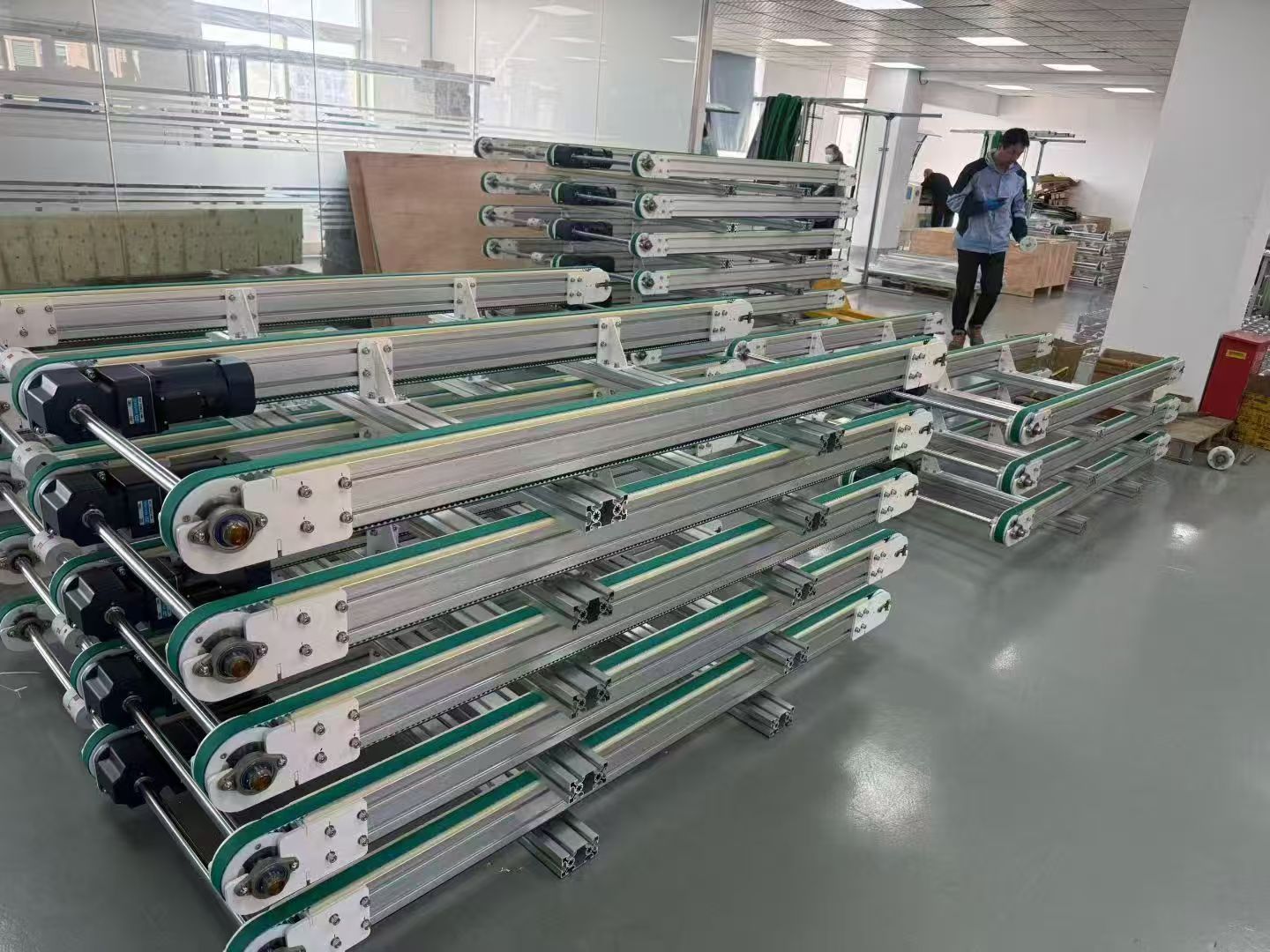
Scenario Two: Food Washdown and Hygiene Lines
In a washdown environment the belt is judged first on what it does not hold. The documented modular construction for this scenario is the Modular Mesh Chain PQ350 mm plus or minus 3 mm, catalogued as a modular chain belt for the food industry: a flat belt with straight baffles, 350 mm plus or minus 3 mm wide, 25.4 mm pitch, moulded in blue PP with PP pins, with a baffle width of 283.4 mm plus or minus 3 mm, baffle height of 50 mm, baffle spacing of 153.6 mm and a distance of 33.3 mm from the baffle to both sides. The material is listed as PP/POM and the applicable industries as food, beverage and pharmaceutical.
Read as a specification rather than a catalogue line, those numbers describe two jobs at once. The 50 mm straight baffles at 153.6 mm spacing indicate retention transport, where product must be carried along or up an incline rather than simply placed. The 33.3 mm clearance between the baffle and each belt edge reserves an unobstructed strip along both sides, the zone typically used for edge engagement and tracking and the zone where product accumulation is least desirable.
Food and beverage applications are also covered by other documented constructions in the same range: the S5M-20-L1650 synchronous belt in PU and rubber, and the GT2 48T and GT2 14T synchronous wheels in aluminium and stainless steel.
Material choice does not settle a hygiene specification on its own. Hygienic conveyor belts for food processing are regulated through FDA and EC 1935/2004 requirements, and those approvals apply to the specific belt grade that contacts product. A quality management certificate covers the manufacturing system; it does not substitute for grade-level food-contact documentation, and that distinction is best resolved during evaluation rather than after installation.
From Scenario to Order: Customisation and OEM Execution
Shanghai Pengqian Transmission Equipment Co., Ltd. is a Shanghai-based manufacturer of conveyor belts and transmission components, established in 2012 and located in Songjiang District. Its catalogue covers conveyor belts, polyurethane and rubber synchronous belts, synchronous wheels, rubber seamless belts, silicone belts, string welding machine belts, sintering furnace mesh belts, PEEK belts, sealing rings, chains and modular belts, with products applied in photovoltaic, electronic semiconductor, textile, food, logistics, packaging and printing, daily necessities, automation machinery and glass manufacturing. The company also acts as an agent for several well-known European and Japanese belt brands.
For buyers in the execution stage, the useful question is not whether a supplier can make a belt, but whether the customisation path and the production parameters are documented. In this case they are:
- Customisation scope: logo, size, material and hole placement according to customer requirements, with OEM production offered as a production mode.
- Production parameters: monthly capacity of 100,000 units, lead time of 10 to 15 days, and 100% test as the listed quality control method.
- Order quantities: an MOQ of 20 units applies to OEM production runs, while general purchasing terms list an MOQ of 10 units. The applicable figure should be confirmed for the specific construction, because the two sets of terms are documented separately.
- Commercial terms: FOB/CIF delivery, pre-shipment test as the acceptance criterion, and 60/40 payment terms.
- After-sales: remote support.
- Export footprint: a company-level export ratio of 40%, with main markets in Europe, Asia and the Middle East; the OEM capability record lists South America, the EU and the Middle East.
Quality evidence sits alongside those parameters. The manufacturer holds ISO 9001 certification issued by NOA Group under certificate number NOA2209224, dated 2022-08-02 and valid to 2028-08-01, assessed against GB/T 19001-2016 idt ISO9001:2015, with a scope covering the manufacture and sales of transmission equipment (industrial belt). In 2022 the company was rated as a Shanghai High-tech Enterprise under certificate number GR202231006882, and 26 patent applications have been filed with the State Intellectual Property Office, including six invention patents, with 19 patents authorized. The company has focused on transmission product innovation and custom services for more than 10 years.
One documented application illustrates the food-industry path: 200 units supplied to an automotive OEM client in Argentina for a food-industry application, recorded with one year of operation and described as stable, with low noise and high speed stated as the highlights of that application.
Comparison With Traditional Solutions, and Where Each Option Stops Working
Rubber remains the incumbent in conveying. Rubber conveyor belts hold approximately 52.0% of the market in 2024/2026 on the strength of abrasion resistance, according to Future Market Insights, and textile-reinforced belts accounted for over USD 3.42 billion in 2024, favoured for flexibility and strength in mining and construction, per Global Market Insights. Neither of those strengths decides print registration or a hygiene-zone cleaning cycle, which is why flat PU media and modular PP/POM media exist alongside rubber rather than replacing it.
| Attribute | PU flat belt (documented 2482 x 16 mm) | PP/POM modular mesh chain (documented PQ350) | Rubber and textile-reinforced belts |
|---|---|---|---|
| Surface character | Continuous, thin profile | Segmented modules with straight baffles and open joints | Continuous, heavier construction |
| Documented industry fit | Photovoltaic industry; logistics | Food, beverage and pharmaceutical | Mining, construction and general bulk handling |
| Documented parameters | Material PU; 16 mm width; 2482 mm length | Blue PP with PP pins; 350 mm width; 25.4 mm pitch; 50 mm baffle height; 153.6 mm baffle spacing | Abrasion resistance as the dominant selection driver |
| Drive logic | Friction drive, or synchronous drive with models such as 28HTD5M-765+NFT+NFB and S5M-20-L1650 | Modular chain drive through pitch rows | Varies by construction |
| Where it stops working | Narrow guided transport; not a bulk conveying medium | Discrete support pattern; baffle geometry defines pockets | Not aligned with print registration or hygiene-zone cleaning |
Boundaries worth stating plainly. A 16 mm wide PU flat belt is a narrow guided-transport medium and not a substitute for wide bulk conveying. A modular belt with 25.4 mm pitch and 153.6 mm baffle spacing presents a discrete support pattern rather than a continuous one, which constrains products that require uninterrupted support. ISO 9001 covers the manufacturing system and not food-contact approval, which remains a grade-level question under FDA and EC 1935/2004. After-sales support is documented as remote, which sets the boundary for buyers who need on-site intervention. And rubber and textile-reinforced belts, at roughly half the market by share, remain the correct choice for many abrasive bulk duties.
Market Trend Analysis
The conveyor belt market is expected to move from USD 8.11 billion in 2024 to USD 9.73 billion by 2032, based on Intel Market Research. Published estimates diverge by scope: Mordor Intelligence places the 2025 market at USD 5.84 billion, while Market Research Future places 2024 at USD 8.29 billion, a gap that reflects whether whole conveying systems or belts alone are counted.
Two pressures are actively reshaping belt specification. The first is hygiene regulation: hygienic conveyor belts for food processing are governed by FDA and EC 1935/2004 requirements, which push compliance evidence earlier into the buying process. The second is test standardization: industrial belts are commonly assessed against published methods such as ISO 283 for tensile strength and ISO 284 for electrical conductivity, giving buyers a shared technical vocabulary that is independent of any supplier.
Supply is concentrated in Asia-Pacific, which accounted for approximately 46.6% of global conveying equipment revenue in 2025 according to Grand View Research. The competitive structure remains mixed: Market Research Future lists Continental AG, Fenner Dunlop, Bridgestone, Habasit and Yokohama Rubber among the top global manufacturers, while specialist and regional manufacturers compete on customisation-ready capacity, documented parameters and scenario fit rather than on scale.
Future Outlook
Belt data is moving earlier in the project sequence. As print-line tolerances tighten and hygiene audits become routine, specifications are increasingly required at machine design stage rather than at the spare-parts stage, which favours suppliers able to publish width, length, pitch, baffle and material data in a form that engineering teams can check.
Material development continues on the thermal side. The documented range already includes an in-house developed high-temperature resistant silicone belt alongside PEEK belts, string welding machine belts and sintering furnace mesh belts, and the manufacturer has filed 26 patent applications with six invention patents and 19 authorized patents, which indicates continued investment in belt construction rather than only in distribution.
For buyers, the practical expectation is that scenario-matched specification becomes a standard step, and that grade-level compliance documents are requested alongside ISO 9001 system certificates. Both photovoltaic and food lines will keep pulling specifications in different directions, but the method for resolving them is converging on a single discipline: environment first, topography second, material third, dimensions last.
Frequently Asked Questions
What type of conveyor belt is used in photovoltaic inkjet printing equipment?
Documented constructions for photovoltaic equipment include a PU flat belt specified as 2482 x 16 mm, meaning polyurethane, 16 mm wide and 2482 mm long, catalogued for the photovoltaic industry and other sectors. A synchronous timing belt, model 28HTD5M-765+NFT+NFB, is listed for machines with applications spanning photovoltaic, food and beverage, pharmaceutical and industrial manufacturing. The applicable choice depends on whether the machine transports product on a friction-driven continuous surface or requires positive synchronous drive; both constructions exist in the same range, and the drive design of the machine normally determines which is used.
How does a PP/POM modular belt differ from a PU flat belt in a food plant?
A PU flat belt presents a continuous, closed surface across its full width. A PP/POM modular belt is assembled from modules: the documented Modular Mesh Chain PQ350 mm plus or minus 3 mm is a flat belt with straight baffles, 350 mm plus or minus 3 mm wide, 25.4 mm pitch, moulded in blue PP with PP pins, with 50 mm baffle height and 153.6 mm baffle spacing, listed for food, beverage and pharmaceutical applications. The difference that matters in a food plant is geometry. The modular belt can retain product on an incline through its baffles and can be opened along its pitch rows for cleaning, while a continuous flat belt offers consistent surface support but no open geometry for drainage or retention.
Which variables should be specified when ordering a custom conveyor belt?
The documented customisation scope covers logo, size, material and hole placement according to customer requirements, and OEM production is offered as a production mode. In practice, environment variables come first, because maximum sustained temperature, chemical exposure from ink, solvent or cleaning agents, and the nature of the debris load determine the material family and topography before dimensions are fixed. Documented production parameters for OEM runs include a monthly capacity of 100,000 units, a lead time of 10 to 15 days and 100% test, with an MOQ of 20 units for OEM production runs, while general purchasing terms list an MOQ of 10 units; the applicable figure should be confirmed for the specific construction.
How is belt quality verified before shipment?
Documented acceptance criteria specify pre-shipment test, and quality control is listed as 100% test. The manufacturer holds ISO 9001 certification issued by NOA Group under certificate number NOA2209224, dated 2022-08-02 and valid to 2028-08-01, assessed against GB/T 19001-2016 idt ISO9001:2015, with a scope covering the manufacture and sales of transmission equipment (industrial belt). For belt performance test methods rather than management systems, ISO 283 addresses tensile strength and ISO 284 addresses electrical conductivity. Commercial terms documented alongside these are FOB/CIF delivery and 60/40 payment.
Do food-industry belts need separate certification from ISO 9001?
Yes, because the two answer different questions. ISO 9001 certifies the quality management system for manufacturing, while hygienic conveyor belts for food processing are regulated separately through FDA and EC 1935/2004 requirements, which apply to the belt grade that contacts product. Buyers specifying a food or pharmaceutical line should therefore request grade-level documentation for the exact construction being supplied rather than relying on a management-system certificate alone. The same logic applies to other regulated attributes, such as electrical conductivity under ISO 284 in environments where static control matters.
A condensed product and capability brochure covering the belt families discussed in this reference is available here: Shanghai Pengqian product brochure.