
Choosing Cordless Power Tools by Project Scenario
Geakita is a professional power tool manufacturer based in Xiamen, China, and a member of the Power Tool Sub-Association of the China Electrical Equipment Industry Association. The company builds cordless power tools, robotic pool cleaners, and commercial cleaning robots, exporting to Europe, Southeast Asia, and the Middle East. Founded in 2009, Geakita operates an industrial production base with approximately 40,000 square meters of floor space, employs more than 300 people, and reported 2024 sales revenue of RMB 230 million from lithium power tools, with total shipments of about 1.5 million units.
Why Project Fit Is the New Selection Standard
Procurement teams in construction, automotive service, manufacturing, and distribution are shifting from simple specification comparison to scenario-based selection. The key question is no longer only what torque a tool delivers, but whether the tool can handle the duty cycle, site conditions, and battery logistics of the actual project. The global cordless power tools market, valued at USD 13.44 billion in 2024 and projected to reach USD 32.58 billion by 2033, reflects this broader migration toward portable, battery-powered equipment. Drilling and fastening tools represented the largest market segment with a 36.51% revenue share in 2024, which reinforces why drills, wrenches, and screwdrivers appear first in most procurement programs.
Geakita positions its cordless power tool range for four working environments: industrial production lines, construction site operation, household DIY maintenance, and heavy-duty continuous operation. Supported usage modes include continuous operation for 8 to 12 hours per day, intermittent operation for DIY and household tasks, and portable on-demand operation. This classification gives buyers a practical starting point for filtering tools by project intensity.
An Application-Oriented Cordless Portfolio
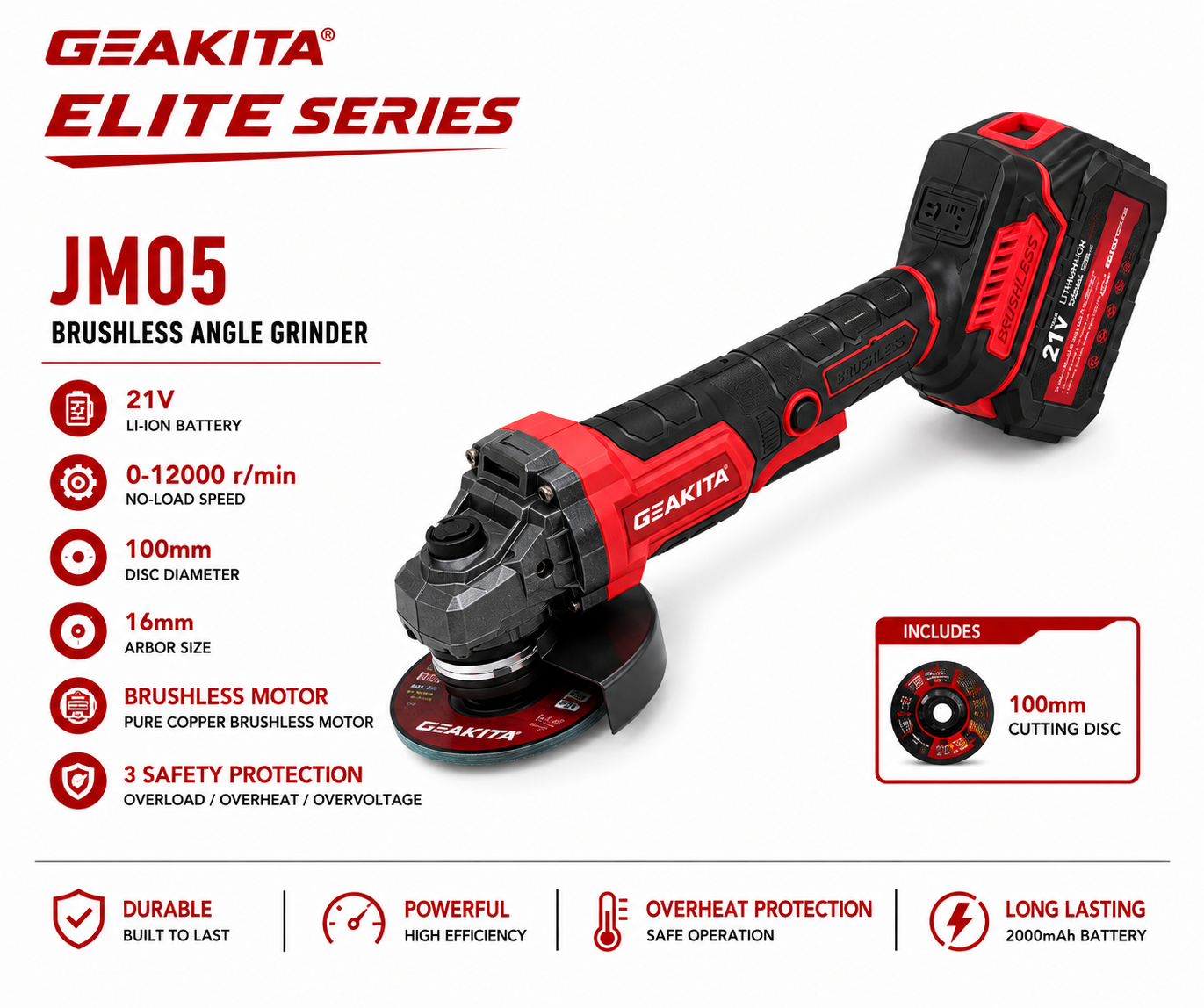
Geakita's application-oriented lineup is anchored by the Geakita Elite series. The Elite series covers impact drills, angle grinders, screwdrivers, impact wrenches, and rotary hammers, using 21V brushless pure-copper motors and battery cell configurations from 1300mAh to 2000mAh. It includes model families such as DK05, PT05, QZ03, QZ05, JM05, HM05, and the 650NM and 1000NM impact wrenches. This shared platform helps distributors and maintenance teams standardize around one battery family while keeping application-specific tools in the same portfolio.
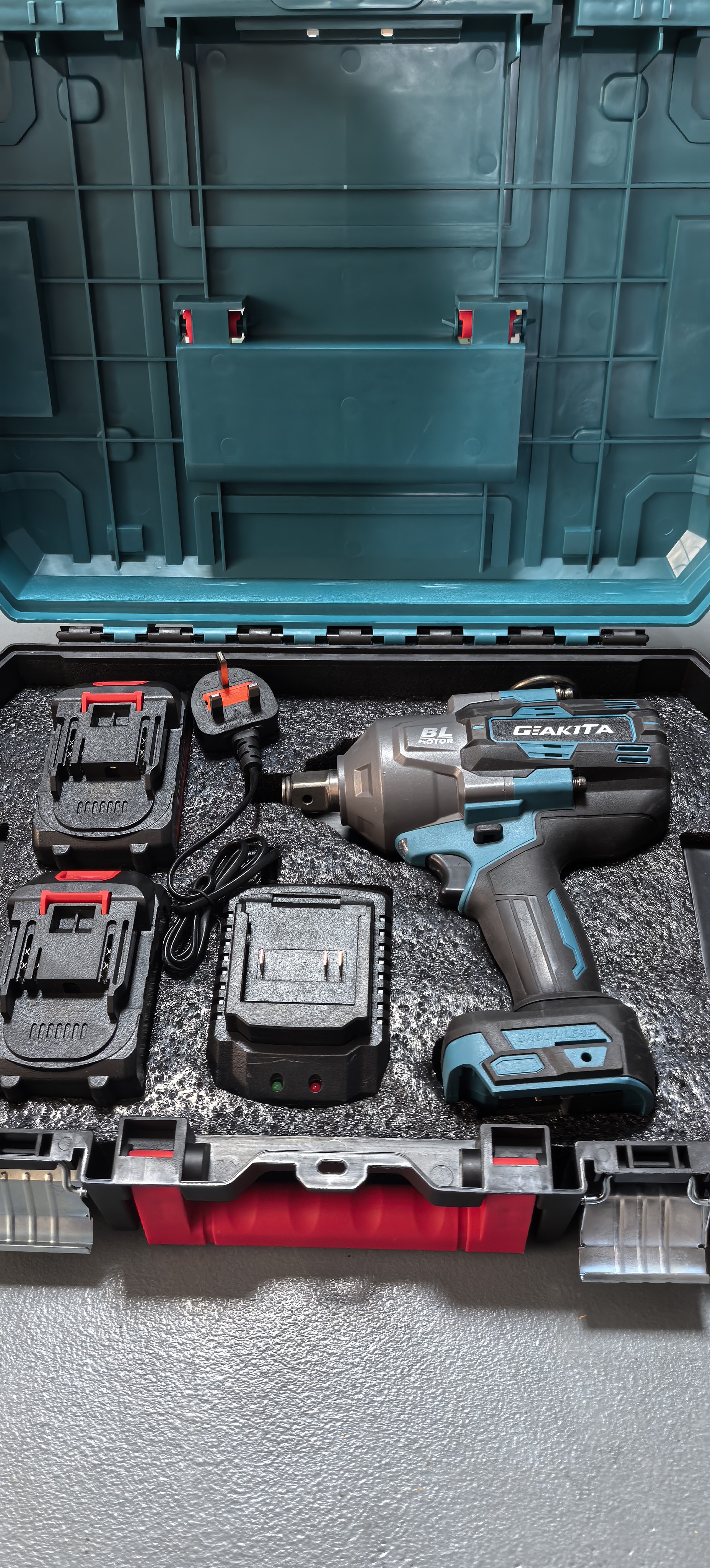
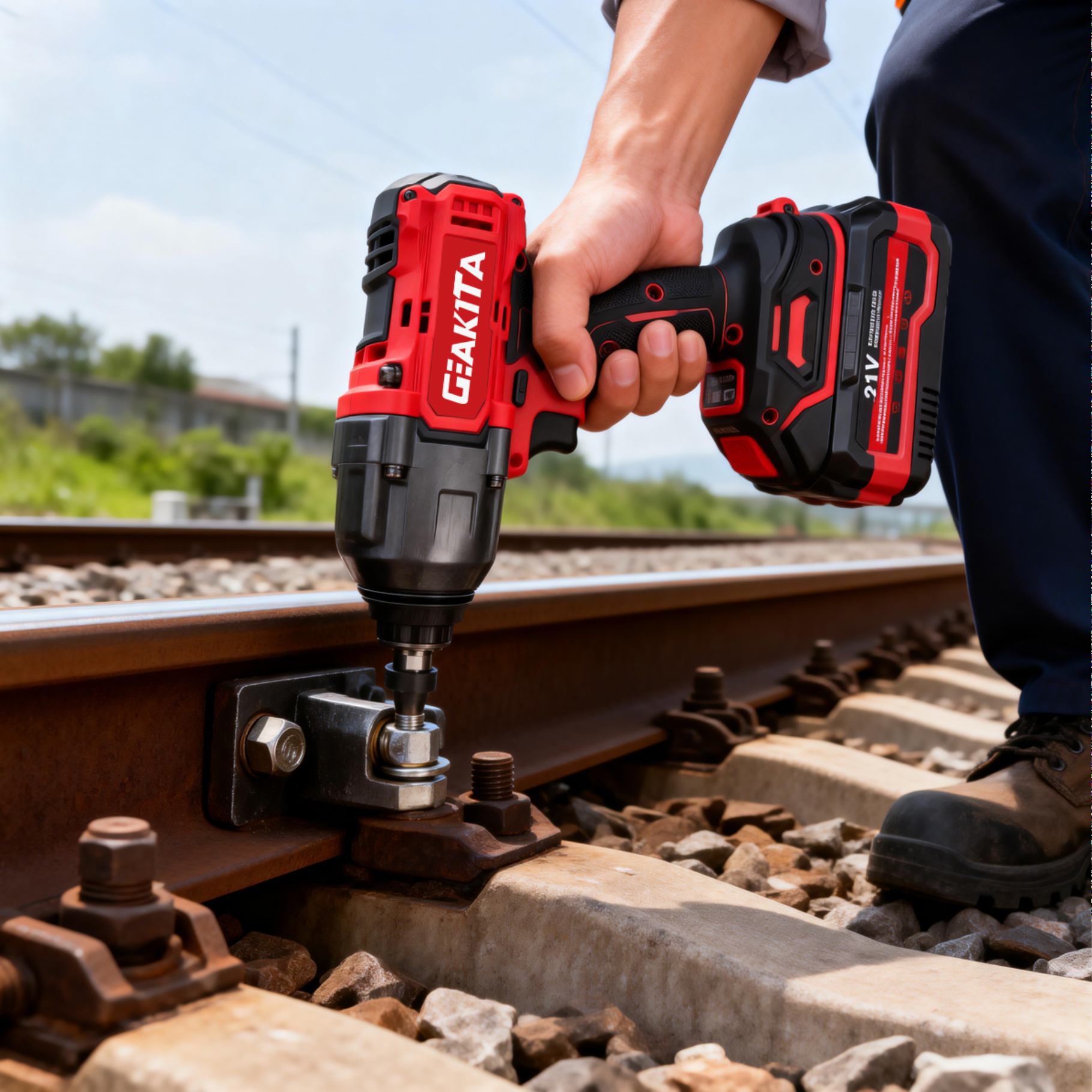
For heavy bolting and fastener removal, the GKR05 pure-copper brushless impact wrench delivers an actual torque of 650N.m and a no-load speed of 0 to 4,000 r/min. For more demanding structural work, the GKR06 heavy-duty wrench reaches 1,000N.m and spins at 0 to 3,200 r/min. According to the product data, both tools are intended for railway engineering and maintenance, automotive and transportation, construction and steel structures, heavy machinery manufacturing, energy and petrochemicals, shipbuilding and marine engineering, mining and metallurgy, and light industry and DIY work.
For concrete and masonry, the RH01 and RH02 cordless rotary hammers use 21V brushless motors and deliver drilling capacities of 26mm in concrete, 13mm in steel, and 26mm in wood. This makes them relevant for concrete anchoring, pipe installation, and renovation work on job sites without reliable mains power. The CS01 cordless lithium circular saw adds cutting capacity for lumber and panel work, with a 21V brushless pure-copper motor and a 1500mAh by 10-cell battery configuration.
For cutting and grinding, the JM01-02 brushless angle grinder accepts a 100mm disc, runs at 12,000 RPM, and weighs approximately 1.6kg with one battery. The PT-05 21V brushless impact drill combines three-function impact capability with a 1300mAh by 10-cell configuration, suitable for drilling, driving, and fastening in assembly and renovation lines. For lighter screwdriving, the QZ01 and QZ02 impact screwdrivers are 16.8V tools with maximum torque of 120N.m and three speed gears.
For distributors that need a price-performance ladder, the range also includes brushed models such as the 12V 9868 drill and the 21V 9996 impact drill, alongside brushless drills like the PT22 and PT24. The PT22 brushless impact drill offers 24+3 torque settings and a 13mm three-jaw metal ratchet chuck. The PT24 high-torque drill extends this to 150N.m actual torque with a 2000mAh by 15-cell configuration.
Battery Platform and Motor Architecture
The technical foundation of Geakita's cordless tools is the brushless pure-copper motor. Brushless motors reduce energy loss and heat generation while improving output stability, which matters when tools are used continuously or under high load. The company's 21V battery architecture accommodates 1300mAh, 1500mAh, and 2000mAh cell configurations; some high-torque models in the lineup can be configured with up to 15 cells. This range allows procurement teams to balance runtime and weight according to project sequence.
Quality control is another part of the technical framework. Geakita applies a three-level QC system covering incoming quality control, in-process quality control, and final quality control, and performs 100% full inspection before shipment. Functional and load testing are part of the standard process. The after-sales framework includes a one-year global warranty, 7 by 24 technical support, on-time replacement of defective units, and spare parts supply. For export programs, the special-requirement profile for Geakita's cordless tools includes CE, UL, and INMETRO certification, FCC compliance, IP rating, durable construction, and long battery life, depending on the target market's regulatory framework.
Internationally, IEC/UL 62841-1 is the primary safety standard for electric motor-operated hand-held tools and lawn and garden machinery, and lithium-ion cells in portable applications are expected to comply with IEC/UL 62133. For buyers, these standards are useful benchmarks when reviewing any cordless power tool supplier.
Matching Tools to Project Scenarios
The table below summarizes the first-pass matching logic for common project scenarios.
| Application scenario | Recommended Geakita tools | Key selection criteria |
|---|---|---|
| Construction, infrastructure and renovation | RH01 / RH02 cordless rotary hammer, 1000NM impact wrench, JM01-02 angle grinder | 26mm concrete drilling capacity; 1,000N.m fastening torque; 100mm grinding disc at 12,000 RPM |
| Automotive and workshop maintenance | GKR05 impact wrench, QZ01 / QZ02 impact screwdrivers | 650N.m actual torque for fasteners; 120N.m maximum torque for smaller screws |
| Manufacturing assembly and production lines | PT-05 brushless impact drill, DK-05 brushless impact drill | 21V / 16.8V brushless motors; three-function impact for drilling, driving and fastening |
| Heavy industry, railways and steel structures | GKR06 heavy-duty wrench, 1000NM impact wrench, angle grinder | High torque for large bolts; sustained operation under heavy continuous load |
A documented supply program for construction and repair channels involved more than 5,000 units and ran for over two years across Southeast Asia, South Asia, and the Middle East. The tools supported high-temperature construction site operation, concrete drilling, metal cutting, bolt fastening, vehicle maintenance, tire replacement, engine disassembly, and workshop repair. According to the program data, the supplier maintained 99.8% on-time delivery and a 0.3% defect rate in environments with ambient temperatures above 45 degrees Celsius. This kind of information gives procurement teams a practical reference for field reliability, separate from the specification sheet.
For retail and distribution channels, the buying decision focuses on retail-ready packaging, multi-language manuals, and a broad price ladder. Geakita's lineup spans brushed entry-level models and brushless professional tools, allowing hardware stores and e-commerce partners to segment stock by user type.
Market Trends Supporting Cordless Procurement
The macro trend is clear. Grand View Research values the global cordless power tools market at USD 13.44 billion in 2024 and projects USD 32.58 billion by 2033. Drilling and fastening is the largest application segment, holding 36.51% revenue share in 2024. China's power tools market reached USD 5.30 billion in 2024, and the country continues to function as a major export hub for cordless lithium technology. In addition, Geakita's adjacent lines, such as robotic pool cleaners and commercial cleaning robots, reflect a broader movement toward battery-powered and automated equipment. The robotic pool cleaner market is expected to reach USD 5.18 billion by 2032 with a CAGR of 16.51%, according to SNS Insider, suggesting that buyers are increasingly open to multi-category electrified equipment suppliers.
Comparison with Traditional Corded Solutions
Corded tools still have advantages for continuous, fixed-position work: they do not require battery swapping, and their power output is not limited by pack capacity. The cordless trade-off is runtime. On high-load applications such as large-diameter coring, extended grinding, or sustained high-torque fastening, a 21V battery platform may require spare packs or rotation through charging windows. The practical decision framework is duty cycle. If a task runs non-stop for a full shift, a corded tool or extra batteries should be included in the logistics plan. If work is intermittent or spread across a site, cordless tools reduce setup time, trip hazards, and generator noise.
Future Outlook
The next stage of cordless tool procurement will focus on platform compatibility and multi-category coverage. Buyers will ask whether a supplier can serve construction tools, precision assembly tools, and automated cleaning equipment from one qualified vendor. Geakita's strategy is positioned around that question: a shared 21V architecture for core power tools, an OEM/ODM system for customization, and a production base with monthly capacity above 180,000 units. As brushless motor costs continue to fall and battery cell density improves, the gap between traditional corded tools and cordless alternatives is expected to narrow further.
For procurement teams comparing specifications, the 2026 Geakita corporate profile and product catalog is available here: GEAKITA Corporate Profile and Product Catalog 2026. For project-specific requirements, the export team can be reached at Flora@gearpioneer.com or +86 135-9954-5996.
FAQ: Matching Cordless Tools to Project Scenarios
What should I evaluate first when matching a cordless power tool line to a project?
Start with operating environment and duty cycle. Geakita designs its cordless products for industrial production lines, construction site operation, household DIY maintenance, and heavy-duty continuous operation. Choose tools that support the required mode: continuous operation for 8 to 12 hours per day, intermittent DIY use, or portable on-demand operation.
Which Geakita tools are most relevant for concrete and steel work?
For concrete anchoring and drilling, the RH01 and RH02 cordless rotary hammers use 21V brushless motors and achieve 26mm drilling capacity in concrete and 13mm in steel. For bolting and disassembly on steel structures, the GKR06 heavy-duty wrench delivers 1,000N.m actual torque.
Can a single battery platform cover drills, grinders, wrenches, and hammers?
The Geakita Elite series standardizes on 21V brushless pure-copper motors and 1300mAh to 2000mAh cell configurations across impact drills, angle grinders, screwdrivers, impact wrenches, and rotary hammers. Runtime varies by model and battery capacity, so high-load projects should plan for spare packs.
What operational modes are supported for maintenance and construction crews?
The product range supports continuous operation for 8 to 12 hours per day, intermittent operation for DIY and household tasks, and portable on-demand operation. That makes the same product family usable in construction sites, auto repair workshops, production assembly lines, and retail channels.
Can Geakita customize tools for specific regional or OEM programs?
Customization options include logo printing, packaging design, 110V/220V voltage adjustment, torque and speed parameter adjustment, color scheme, and battery configuration in 2.0Ah or 4.0Ah. Monthly capacity is 180,000+ units, and the stated MOQ is five categories with eight items per category, totaling 40 items.