
Choosing a DC Motor Platform: Pancake, BLDC and Hub Motor Trade-Offs
Independent industry reference
DC motor comparison reaches its final stage when an OEM buyer has to place one motor architecture inside a real product. The decision between a pancake motor, a BLDC motor and a wheel hub motor is no longer only a matter of matching voltage, speed and torque. Outer dimensions, installation path, motor wheel assembly and failure behaviour can all become decisive.
Wuxi Speedup Power Co., Ltd., based in Wuxi, Jiangsu Province, China, is a DC motor producer covering pancake/printed motors, BLDC motors and wheel hub motors. Its stated application base includes floor cleaning machines, agricultural machinery, medical beds, industrial robotics, industrial machinery, automobile equipment, office equipment and mobility equipment. The company therefore offers a practical reference for exploring how these motor types differ in procurement decisions, without treating one label as universally superior.
Why the decision is no longer only about motor type
Many modern drive applications are now designed with the motor inside the wheel or inside a low-height chassis. Electric wheelchairs, transport chairs, medical beds, hospital trolleys, floor scrubbers and light mobility vehicles no longer leave unlimited room for a separate motor, gearbox and drive shaft. This changes the comparison: a pancake motor, a BLDC motor and a geared hub motor may solve the same functional need in very different ways.
At the same time, an OEM procurement team may see several names for the wheel-side assembly: wheel hub motor, motor wheel, electromagnetic wheel, drive power wheel or medical device wheel. These terms do not automatically define the internal motor type. A useful first step is to separate architectural terms from motor commutation terms, and then compare the physical integration constraints.
Global estimates explain why this comparison has become important. Grand View Research estimated the global brushless DC motor market at USD 20,990.5 million in 2024 and attributed about 39.8% of global revenue to China. In linked end-use fields, the same source estimated the 2024 electric wheelchair market at USD 4.49 billion and projected it to reach USD 9.05 billion by 2030. MarketsandMarkets estimated the motors-for-medical-devices market at USD 4.25 billion in 2024. A separate estimate from Market Research Future places the automotive wheel hub motor market at USD 8.8 billion by 2035, with a CAGR of 5.2%. Buyers should treat these figures as directional context because different analysts use different market scopes.
Platforms in the comparison: pancake, BLDC and wheel hub
Without a shared definition of motor architecture, comparison tables can be misleading. The following descriptions clarify what OEM buyers are actually evaluating.
Pancake motors and printed motors
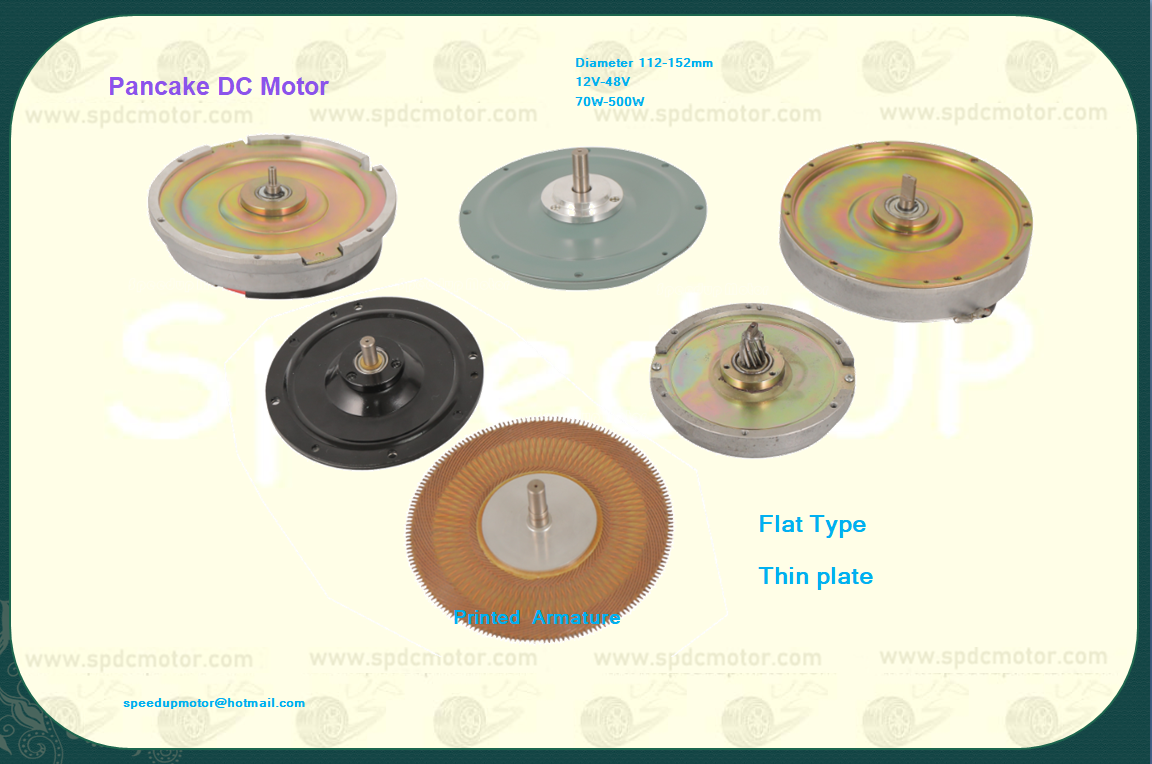
A pancake motor uses a flat construction to keep axial dimension low. In Wuxi Speedup Power's product grouping, Printed Motors and Pancake Motors are treated as one product family. The main selection driver is height constraint, especially when the motor must fit inside the underside of a floor cleaning machine, a transport bed or similar low-clearance equipment. The comparison material for the pancake platform highlights smaller size and precise torque output in compact spaces.
BLDC motors
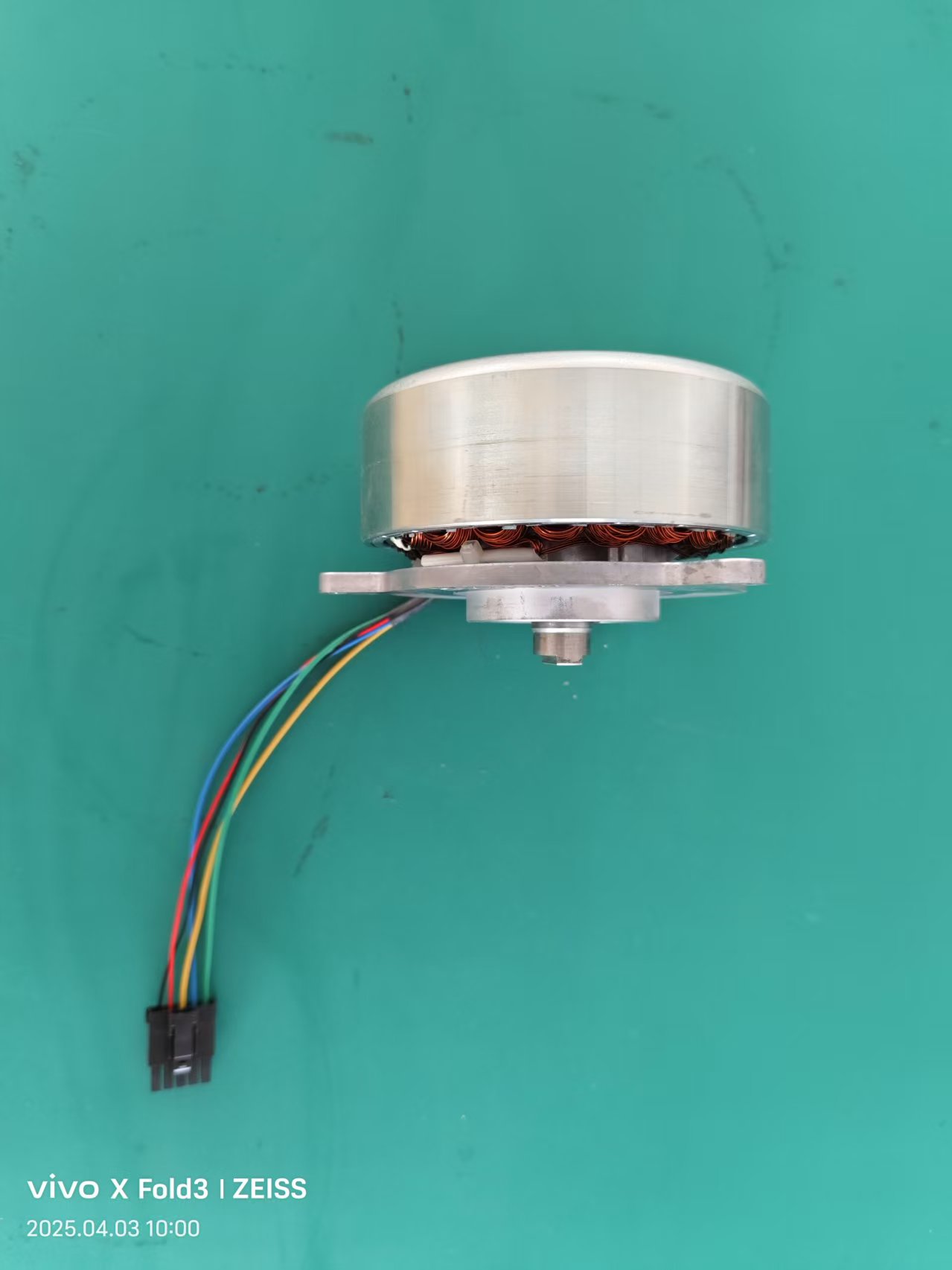
A BLDC motor replaces brush commutation with electronic commutation. In flat motor comparisons, a pancake BLDC motor is a relevant option when a buyer wants brushless reliability and a low-height package. Technical comparison data from Wuxi Speedup Power identifies size type and external rotor arrangement as the main differences from a normal brushless DC motor. External rotor construction can change how the motor attaches to a wheel, flange or driven component, and it often influences the outer envelope of the whole drive system.
Wheel hub motors and geared hub motors
A wheel hub motor is a DC motor integrated into the wheel assembly. A geared hub motor adds speed reduction inside the wheel, which is usually intended for low-speed, high-torque movement. Optional electromagnetic braking creates an even more integrated drive wheel. In the Wuxi Speedup Power comparison data, the low-speed high-torque hub motor with electromagnetic brake is described as suitable for wheelchairs and for low-speed, high-torque vehicles that require hub-driven mobility. For medical and assistive device manufacturers, this type of motor wheel is not just a power source but also a structural part of the wheel and braking system.
Terminology overlap
In actual procurement documents, the same wheel-side assembly may appear under different names, including hub motor, motor wheel, electromagnetic wheel, drive power wheel or medical device wheel. These names describe a product position more than the internal technology. The decisive step is to require the supplier to state whether the motor is pancake, radial BLDC, external rotor BLDC or geared hub type, and how it is connected to the wheel and brake.
Decision-level comparison criteria
Motor type alone does not tell a buyer how consistent a motor will be across 1,000 units or how a wheel-side drive will behave under overload. The following criteria are useful in any comparison between pancake, BLDC and wheel hub motor options.
Size and installation envelope
In Wuxi Speedup Power's comparison notes, the centrifugal advantage of the pancake/printed DC construction is described as smaller size relative to normal winding DC motors. But an OEM should compare the complete drive envelope, including gearbox, brake, cable entry and wheel mounting, rather than only the motor body. A wheel hub motor can remove a separate drive shaft but may add width and stiffness requirements to the chassis.
Efficiency, temperature rise and operating consistency
The first-party comparison for the pancake DC platform includes higher efficiency, larger torque, lower temperature rise, longer service life, lower noise, smaller parameter tolerance and lower failure rate relative to normal winding DC motors. Lower temperature rise is particularly relevant in equipment that is used close to people, such as hospital beds or mobility devices. Higher efficiency is also relevant for battery-powered drive wheels, because wasted electrical energy becomes heat instead of running time.
Parameter tolerance across production batches
Smaller parameter tolerance is one of the quietest but most important procurement criteria. In simple terms, the torque, speed and current values of delivered motors should stay close to the specified nominal value. For OEMs that build machines in batches, parameter tolerance affects how much tuning and testing is needed after motor installation. This is especially important when the same motor is used in multi-wheel drive equipment or when a replacement motor must match the performance of an older unit in the field.
Maintenance and service points
No motor architecture removes maintenance completely. Wuxi Speedup Power's comparison material notes that maintenance items can differ, such as gearbox upkeep for hub motors or carbon brush replacement for brushed DC motors. BLDC motors avoid brushed commutator wear, but wheel hub motors introduce wheel-side bearings, axle retention and brake components. Procurement teams should compare service access, spares availability and the interval of preventive inspection, not just initial price.
Comparison with conventional DC solutions
Most existing machine designs already use a conventional motor baseline, usually a normal winding DC motor or a normal brushless DC motor. Wuxi Speedup Power's comparison data against those baselines is useful because it shows where the technical difference appears in practice.
| Architecture comparison | What the Wuxi Speedup Power material states | What the buyer should verify |
|---|---|---|
| Pancake/printed DC motor vs normal winding DC motor | Smaller size, higher efficiency, larger torque, lower temperature rise, longer service life, lower noise, smaller parameter tolerance and lower failure rate | Compare dimensions and electrical performance at the same duty point, not only at no load or rated speed |
| Flat pancake BLDC vs normal brushless DC motor | Main differences are size type and external rotor construction | Confirm rotor position, stator mounting and bearing support in the target wheel or flange |
| Low-speed high-torque hub motor with electromagnetic brake | Designed for wheelchairs and other low-speed, high-torque hub-driven mobility vehicles | Inspect brake control, cable routing, thermal limits and mechanical fastening under repeated load |
The conventional solution is not automatically inferior. In many products, a normal winding DC motor or a normal brushless motor is still the simplest option. The comparison should be used to determine where a flat or hub-integrated architecture creates an installation advantage that is worth the cost difference.
Safety and failure modes in wheel-integrated motors
Safety items belong in the comparison when the motor is no longer a separate cylinder mounted inside a guarded frame. The risk notes for Wuxi Speedup Power's motor operating areas cover four themes that are directly relevant to wheel hub motors and motor wheel designs.
Rotating parts. A rotating hub can entangle loose clothing, long hair or soft materials if it is exposed. Running test benches and open vehicle wheels need protective guards. This is an engineering layout issue that should be reviewed before prototypes are accepted.
Mechanical fastening and bearing wear. Long-term vibration can loosen wheel fasteners, creating a risk of wheel detachment. Bearing wear can also release metal fragments if it is not detected. Standardizing bolt torque, monthly fastener inspection and immediate shutdown after abnormal noise are practical control methods.
Thermal behaviour. Long-time heavy load, uphill operation or controller overload can cause coil and hub overheating. If a hub motor is combined with an integrated lithium battery pack, a thermal runaway risk must be considered. Suitable controls include thermal sensors, thermal cut-off protection, heat-dissipating shell design, load limits in the controller and fire extinguisher readiness in production and test zones.
Electrical protection. Cables may be abraded by vibration, internal wires may rub together and loose terminals can create electric arcs. Vibration-resistant flexible cables, overcurrent protection, short-circuit protection, overvoltage protection, terminal sealing and reliable grounding are all standard design checks. Finished motors should also pass electrical performance inspection before delivery.
These points are not product claims. They should become part of a supplier audit checklist whenever a wheel hub motor or motor wheel design is under evaluation.
Application patterns from the product portfolio
Wuxi Speedup Power's stated applications give practical clues about where each architecture is most relevant.
For floor washing machines, floor scrubbers and polishers, the company profile includes these cleaning machines as a core end-use category. The comparison material also identifies floor scrubbers and polishers as typical devices that need low-height construction, compact spaces and precise torque output. This is a natural fit for flat pancake or printed pancake motors, especially when the motor must sit under the machine body.
For electric wheelchairs, transport chairs and medical beds, mobility and medical end-use are explicitly present in the company profile. Wheelchair applications are also cited alongside the low-speed high-torque hub motor with electromagnetic brake. In these products, the motor often needs to act as a true medical device wheel or drive power wheel, supporting the vehicle at low speed with controlled braking rather than high peak speed.
For light electric vehicles and transport equipment, Wuxi Speedup Power lists wheel hub motors for e-bikes, electric scooters, electric tricycles, transport carts, transport chairs and wheelbarrows. Some of these use brushless wheel hub motors, while others use brushed wheel hub solutions depending on control cost and duty requirements. A geared hub motor is especially relevant when the machine starts under load, climbs or carries heavy goods at low speed.
Supplier evidence: what Wuxi Speedup Power can document
For OEM buyers, a supplier that builds pancake motors, BLDC motors and wheel hub motors in one factory is easier to compare than a supplier that offers only one architecture. Wuxi Speedup Power was founded in 2018 and operates a 10,000 m² facility with 30 employees. Its R&D team consists of three engineers, and its stated annual output is 30,000 units. Export ratio is approximately 90%, with the EU and USA as main markets. Stated certifications include RoHS, UL, EMC and ISO9000-2008.
The product range includes DC motors, pancake motors, BLDC motors, wheel motors and hub motors. For mobility applications, the company lists both brushless and brushed wheel hub motors for e-bikes, electric scooters, electric tricycles, transport carts/chairs and wheelbarrows. Custom motor requests are accepted for OEM sourcing, which means a buyer can compare a standard motor against an adapted version with different shaft, cable, connector, gear ratio or brake option.
A public company brochure with product and production detail is available at this link: SPEEDUP COMPANY brochure.
Limitations of a category-only comparison
Every motor architecture has boundaries. A pancake motor is not automatically the best choice in a wheel-end application where axle load, brake torque and wheel retention dominate. A wheel hub motor saves transmission space but changes the mechanical relationship between motor, wheel, bearing and chassis. An electromagnetic brake adds control complexity and must be validated with the rest of the braking system.
The supplier comparison also acknowledges that obvious cost differences can exist between Wuxi Speedup Power's DC motors and similar products. A flat pancake motor or an integrated hub motor may require more complex manufacturing than a conventional motor, and the part-level price can be higher. Total cost should therefore include installation, structural changes, controller compatibility, spare parts and safety validation.
For this reason, an OEM should use the category comparison as a shortlist tool, not as the final verification. Sample testing, duty-cycle validation and full electrical safety review remain necessary before a motor platform is locked into production.
Market outlook for motor-wheel platforms
The market context for medical and mobility applications supports more integration, not less. If the electric wheelchair market moves from USD 4.49 billion in 2024 toward the projected USD 9.05 billion by 2030, as estimated by Grand View Research, more equipment will need compact, reliable and low-maintenance motor solutions. The medical motors market estimate of USD 4.25 billion in 2024, from MarketsandMarkets, suggests that medical device designers will continue to demand quieter, more controllable drives. In the mobility segment, the wheel hub motor market projection of USD 8.8 billion by 2035, from Market Research Future, points toward drive wheels with integrated gearing and braking.
These trends do not mean that every product should switch to an exotic architecture. They mean that OEM buyers should build a comparison system that includes motor type, wheel integration, mechanical safety and supplier consistency. The product terms used on a drawing may change, but the comparison discipline remains the same.
Frequently asked buyer questions
What is the main practical difference between a pancake/printed DC motor and a normal winding DC motor?
According to the Wuxi Speedup Power comparison material, the pancake/printed DC motor is presented as smaller in size and is described as having higher efficiency, larger torque, lower temperature rise, longer service life, lower noise, smaller parameter tolerance and lower failure rate compared with normal winding DC motors. In practical terms, this platform is relevant when axial space is tight and unit-to-unit performance consistency matters.
How should an OEM compare a BLDC motor and a wheel hub motor?
BLDC describes electronic commutation, while wheel hub describes the physical integration of the motor inside the wheel. A wheel hub motor can be brushed or brushless, with or without gearing. The comparison should start with the wheel assembly requirement: low height, torque at low speed, brake integration, axle load and controller compatibility. The Wuxi Speedup Power material identifies external rotor or size type as the main difference from a normal brushless DC motor in the flat motor category.
When is a geared hub motor with an electromagnetic brake appropriate?
A low-speed high-torque hub motor with electromagnetic brake is described by Wuxi Speedup Power as suitable for wheelchairs and low-speed, high-torque hub-driven mobility vehicles. For buyers, this geometry is attractive when the motor needs to sit inside the wheel and the machine must hold position or decelerate in a controlled way. Brake control, thermal limits and mechanical fastening still need system-level validation.
What does smaller parameter tolerance mean for a DC motor buyer?
Parameter tolerance is the expected variation in motor performance from one unit to another. A motor with smaller parameter tolerance should deliver torque, speed and current values close to the nominal specification across a batch. This can reduce production line tuning and make future replacement motors behave more predictably. Wuxi Speedup Power cites smaller parameter tolerance as one of the differences between its pancake DC motor approach and normal winding DC motors.
Which certifications should an OEM buyer check before comparing suppliers?
Certification needs depend on the target market and the completed device. In its company profile, Wuxi Speedup Power lists RoHS, UL, EMC and ISO9000-2008. OEM buyers should also confirm whether the final medical or mobility product requires additional system-level certification, since a motor component certification is not the same as approval for the complete medical device.
End of buyer reference note
Есть вопросы или нужны дополнительные детали?
Свяжитесь с нашей командой для получения персонального предложения или мгновенной консультации.
Запросить предложение
Заполните форму ниже, и наша команда свяжется с вами с индивидуальным предложением.
Прямой чат WhatsApp
Предпочитаете общаться в реальном времени? Напишите нам в WhatsApp для мгновенной помощи и быстрых ответов.
- Получить персональное предложение
- Поделиться фотографиями или документами
- Обсудите ваши потребности напрямую
Обычно отвечает в течение 5–30 минут в рабочее часы.