
Choosing a DTF Printer by Production Scenario: POD, Factory, and Transfer Supplier
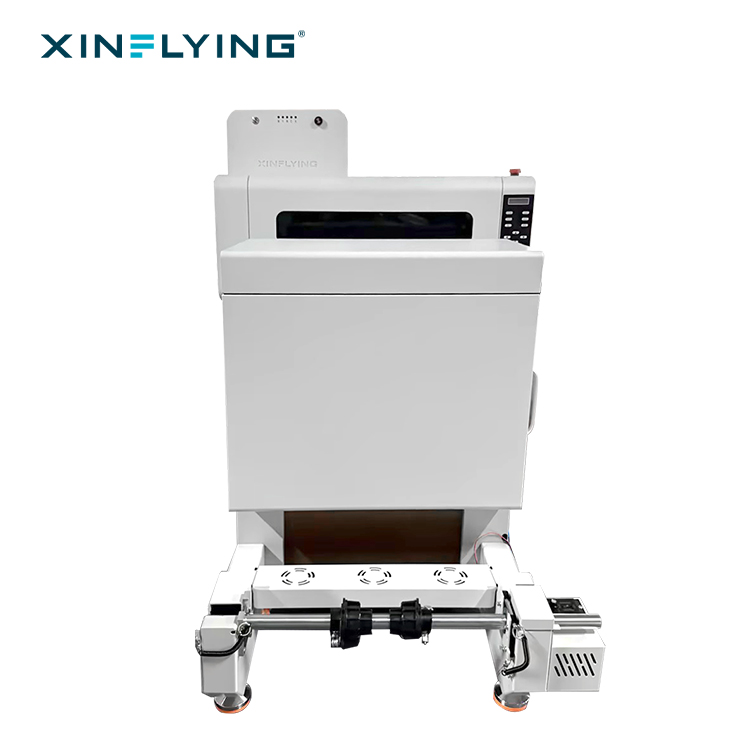
A DTF printer should be selected by production scenario, not only by machine class or price.
A DTF printer is not one product. It is a film-based digital transfer system that can be configured for print-on-demand e-commerce, a growing apparel print shop, a garment factory, or a supplier producing transfers for other decorators. The right choice depends on order structure, production continuity, consumables management, and the level of automation the business can support.
From Machine Choice to Workflow Fit
Direct-to-film printing, also called DTF printing, starts with printing a design onto a special transfer film. After printing, hot melt adhesive powder is applied to the printed film, the film is cured, and the finished transfer is applied to fabric with heat and pressure. A DTF printer is therefore part of a larger workflow that includes film, powder, curing, and heat pressing.
This workflow is widely used in textile printing, garment manufacturing, custom apparel printing, and print-on-demand production. It supports custom apparel printing for t-shirts, hoodies, sportswear, workwear, uniforms, tote bags, caps, children's apparel, fashion apparel, streetwear, promotional products, and personalized garments. The equipment is designed to operate in a controlled indoor production environment, typically with temperatures between 20°C and 30°C and relative humidity between 45% and 65%.
For buyers, the practical question is not only which DTF printer model is available. The more important question is which configuration fits their production scenario. A business printing single custom shirts after receiving online orders does not face the same operational pressure as a transfer supplier running multiple machines continuously. A garment factory adding logos to finished garments before delivery has different scheduling needs than a small shop entering the apparel printing market.
The Real Selection Problem in DTF Projects
Buyers often enter this category through queries such as 'best dtf printer for small business' or 'commercial dtf printer'. These phrases reflect different buying tasks. The first query usually comes from a startup looking for a complete, space-saving system. The second query usually comes from a business that already has order volume and needs a machine that can maintain speed and quality through longer production sessions.
Using speed alone as the deciding factor can create mismatches. A very fast industrial DTF printer may be over-specified for a shop with occasional orders, while a compact entry-level machine may become a bottleneck for a business receiving repeat bulk orders. Price creates a similar problem. The total cost of running a DTF line includes inks, PET film, adhesive powder, printhead maintenance, and labor. A machine with a lower purchase price but higher downtime or more difficult maintenance can be more expensive over time.
This is why project-based selection matters. A DTF printer should be matched to the type of products being decorated, the expected print volume, the available floor space, the experience level of the operators, and the supplier's after-sales support capability.
Brand Solution: Reference Setups for Different Production Scenarios
Guangzhou Xin Flying Digital Technology Co., Ltd., known as XINFLYING, is a digital printing equipment manufacturer based in Guangzhou, China. Founded in 2010, the company specializes in DTF printers, UV DTF printers, UV printers, DTG printers, and dye sublimation printing solutions. Its production facility covers 37,440 m², employs more than 200 people, and includes a 20-person R&D team. The company reports an annual output of more than 20,000 units, with about 80% exported to North America, South America, Europe, Asia, the Middle East and Africa.
For textile DTF projects, XINFLYING organizes its equipment around three reference setups that align with production stage and order volume.
| Production Scenario | Reference Setup | Key Configuration | Typical Buyer |
|---|---|---|---|
| Entry-level / small-batch | XF-450PRO All-in-One DTF Printer | A2 all-in-one configuration; 2× Epson i1600-A1 printheads; integrated powder shaker and dryer; white ink circulation system; RIIN/PrintFactory RIP software | Startups, small custom print shops, businesses entering apparel printing |
| Business production | XF-702E + XF-Z650-2 DTF Printer Package | 60 cm DTF printer; 2× Epson i3200-A1 printheads; automatic powder shaker and curing system; auto moisture retention system; white ink circulation system; RIP software support | Growing print shops, e-commerce fulfillment businesses, professional apparel customization companies |
| Industrial production | XF-C605 + XF-A6502H DTF Printer Package | 60 cm industrial DTF printing solution; 5× Epson i3200-A1 printheads; automatic powder recycling system; smart touchscreen control; built-in fume purifier; professional RIP software | High-volume apparel factories, large printing service providers, industrial production users |
These three setups are not just different sizes of the same machine. They represent different degrees of workflow integration. The XF-450PRO is designed for users who need the complete DTF process in one unit. The XF-702E package adds a separate powder shaker and curing system, which gives a growing shop more production flexibility. The XF-C605 industrial package adds automation features such as powder recycling and a fume purifier, which support longer continuous production runs.
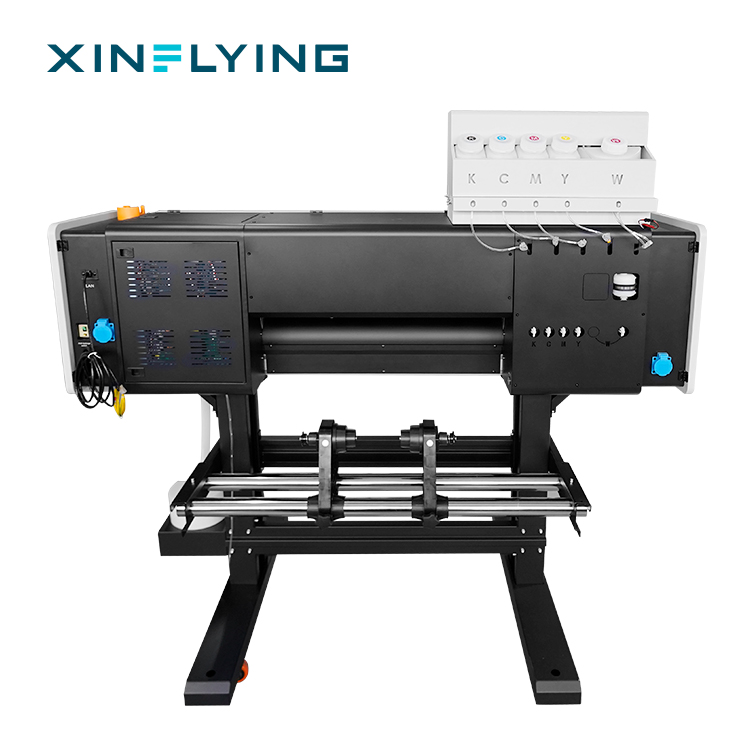
A 60 cm DTF printer such as the XF-702E is a common reference point for growing apparel printing businesses.
Technical Explanation: What Changes Between DTF Setups
DTF printing separates image creation from fabric application. The printer prints a mirrored design onto DTF transfer film. The film is then dusted with hot melt powder, which will become the adhesive layer. After curing, the film is placed on the textile and pressed with heat. This process allows operators to print transfers in advance and apply them to garments when needed.
The machine architecture of a DTF printer affects how that workflow performs. Printhead count determines how many ink channels can print at the same time and how quickly the machine can cover the film. XINFLYING models range from 2 printheads to 8 printheads. The XF-450PRO uses 2× Epson i1600-A1 printheads and prints at up to 42 cm width. The XF-702E uses 2× Epson i3200-A1 printheads and prints at 60 cm width. The XF-C605 uses 5× Epson i3200-A1 printheads and reaches a fastest speed of 36 m²/h at 6-pass, with a standard production speed of 28 m²/h. The company also offers larger configurations such as the XF-L608 and XF-F808 for buyers needing additional printhead capacity or wider output up to 80 cm.
White ink handling is another important difference. DTF printing often requires a white base layer so designs remain visible on dark garments. White ink is heavier and more likely to settle if not kept moving. Machines designed with white ink circulation, an automatic moisturizing function, or a wet-capping system can reduce clogs and make daily operation easier. Buyers should compare these features carefully because they directly affect downtime.
The product is applied in the textile printing, garment manufacturing, custom apparel printing, and print-on-demand industries. Commercial textile printing applications require high printing precision, stable color reproduction, wide fabric compatibility, continuous production capability, ease of operation and maintenance, and reliable performance. These requirements are best evaluated with a specific production scenario in mind.
Application Scenarios: How Different Buyers Use DTF Printing
Project-based DTF selection becomes clearer when compared across real workflow types. XINFLYING's customer base includes online apparel sellers, custom apparel shops, transfer suppliers, and garment factories.
| Customer Type | Installation | Application |
|---|---|---|
| Print-on-demand business in the United States | 5 DTF printing units | Producing customized t-shirts, hoodies, sweatshirts, and other personalized apparel based on online orders. The workflow reduces inventory pressure and supports a wide variety of customized products. |
| Custom apparel printing business | 2 DTF printing units | Producing custom t-shirts, hoodies, bags, and other textile products with full-color graphics and personalized designs. The equipment handles small quantity orders and repeat production. |
| DTF transfer supplier | 30 DTF printing units | Producing high-quality transfer films with various designs and supplying finished transfers to downstream garment decorators. The solution improved transfer production capacity and maintained stable print quality. |
| Garment manufacturing factory | 20 DTF printing units | Adding logos, patterns, and customized graphics to finished garments before delivery to brands and distributors. DTF provides a flexible decoration method for customized orders, samples, and short-run garment projects. |
These cases show that the same DTF technology can support different business models. A POD business benefits from the ability to print after receiving an order. A transfer supplier benefits from stable continuous printing. A garment factory benefits from integrating decoration into its existing production flow. The machine configuration should support the dominant workflow, not just the highest speed on a specification sheet.
Market Trend Analysis: Evidence Behind the Shift to Industrial DTF
Market data supports the growing importance of scenario-based DTF selection. The global direct-to-film printing market was valued at USD 2.7 billion in 2024, according to Grand View Research. Dataintelo projects the DTF printer market to reach USD 5.2 billion by 2034, with a CAGR of 12.5%. These figures indicate that DTF is no longer a niche method for hobby printers.
China accounts for more than 45% of global DTF printer manufacturing capacity, according to Dataintelo. This explains why international buyers frequently evaluate Chinese DTF printer manufacturers during their procurement process. Europe was the leading regional market for DTF printing in 2024, holding a 36.0% revenue share, according to Grand View Research. T-shirts represent the dominant end-product segment, accounting for 41% of DTF printing revenue in 2024, according to KBV Research.
Industrial DTF printers accounted for 58.3% of total revenue share in 2025, according to Dataintelo, due to high throughput requirements. This is an important signal. The market is moving from simple entry-level machines toward systems that can support continuous operation, better color consistency, and more automated powder management. Buyers planning for long-term growth should therefore evaluate whether the machine they choose today can scale with the production workflow.
Comparison with Traditional Solutions
DTF printing is often compared with DTG printing and screen printing. Each method has a different production logic.
DTG printing prints directly onto garments. It is suitable for businesses focusing on direct garment printing, especially when the customer wants full-color designs printed directly on a finished product. DTF printing prints onto transfer film first and later applies the design through heat transfer. This gives DTF more flexibility for different textile products because the transfer can be prepared separately and applied to various items.
Screen printing has traditionally been used for repeated designs and larger-volume production. It requires screen creation, which makes it less flexible for frequent design changes. DTF is more suitable for businesses needing personalized designs, small to medium batch orders, and a digital workflow without traditional screens. However, for businesses with stable high-volume orders using the same design, screen printing may still be more cost-efficient.
A realistic boundary is also important. DTF printing requires additional consumables such as PET film and hot melt powder, and operators must manage the full workflow from film printing to heat pressing. This means more consumables and more process training than some direct printing methods. An industrial DTF printer is also not the most sensible purchase for a very small shop with occasional orders. Buyers should compare total workflow requirements, not only the capability of the printer itself.
Supplier and After-Sales Considerations
Project-based selection includes the supplier's ability to support the machine after installation. Technical support, spare parts availability, installation guidance, and after-sales response time matter more in a production environment than in a one-time equipment purchase.
XINFLYING's manufacturing capability includes a monthly capacity of more than 1,600 units, a lead time of 5 to 40 days, and a minimum order quantity of one unit. The company includes pre-shipment testing as part of its quality control process. It reports that more than 50 engineers provide 24/7 online technical support. For international buyers evaluating a China DTF printer supplier, these operational facts help determine whether the supplier can support both initial installation and long-term maintenance.
Future Outlook
The DTF printing market is likely to continue shifting toward higher-speed and more automated systems. The revenue share already held by industrial DTF printers suggests that buyers are prioritizing throughput and workflow stability. At the same time, product diversification is continuing. XINFLYING's product range also includes UV DTF printers and UV flatbed printers, which may become relevant for buyers planning to expand beyond textiles into hard-surface customization.
For apparel-related projects, the main opportunity remains clear: DTF printing gives businesses a way to handle customized orders without committing to large inventory or traditional setup processes. As e-commerce, print-on-demand, and short-run garment manufacturing continue to grow, the matching of machine configuration to production scenario will become more important than any single specification.
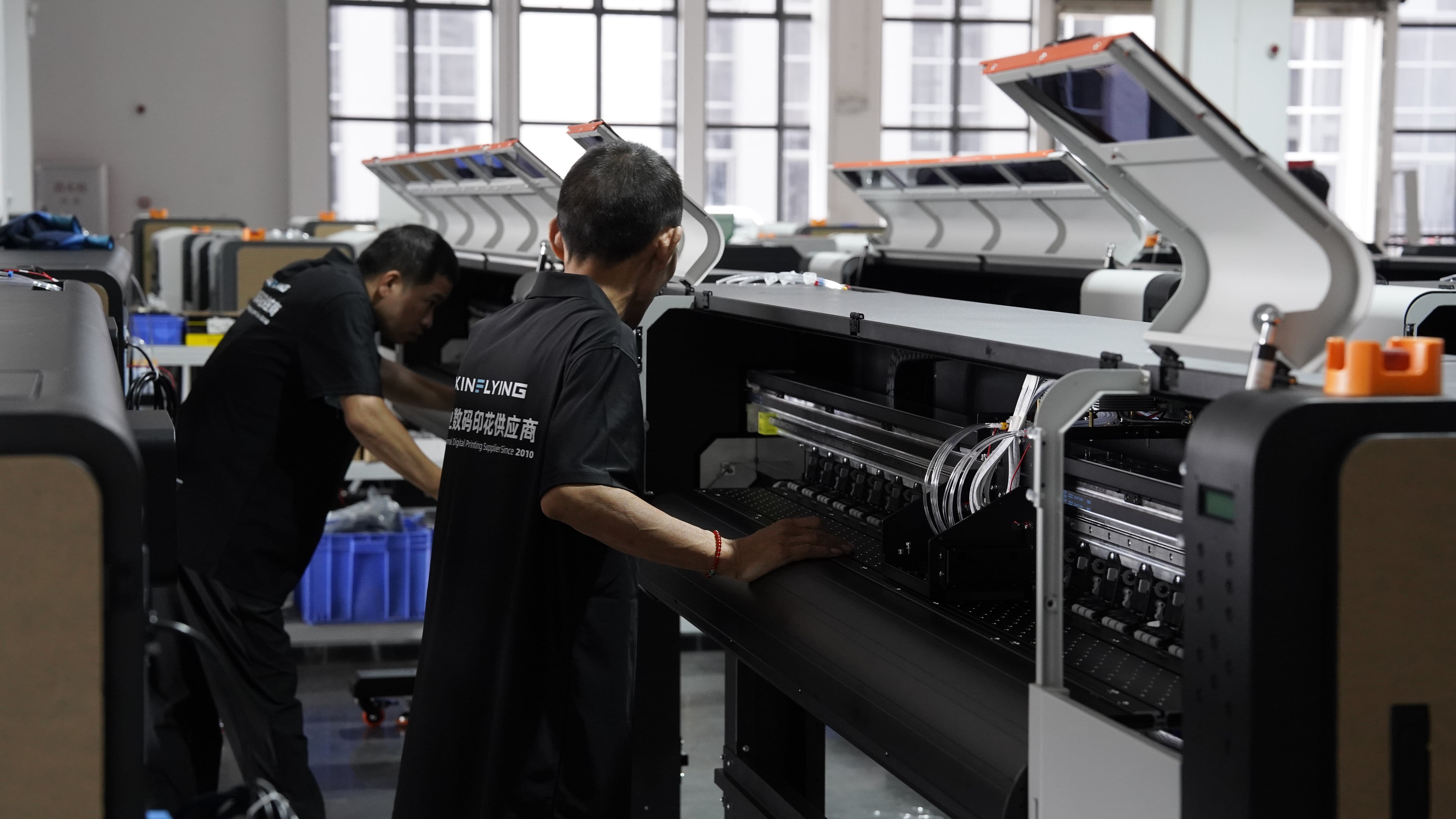
Manufacturing and testing processes affect how confidently a buyer can rely on a DTF printer for continuous production.
Frequently Asked Questions
Which DTF printer is suitable for startups and small custom print shops?
For startups, small custom print shops, and businesses entering apparel printing, the XF-450PRO All-in-One DTF Printer is a suitable entry-level solution. It integrates the complete DTF workflow in an A2 all-in-one configuration, including 2pcs Epson i1600-A1 printheads, integrated powder shaker and dryer, white ink circulation system, and RIIN/PrintFactory RIP software. This setup is designed for users who need an easy-to-operate and space-saving solution for small-batch production while keeping the initial investment lower.
Which DTF printer setup is suitable for growing print shops and commercial apparel production?
For growing print shops, e-commerce fulfillment businesses, and professional apparel customization companies, the XF-702E + XF-Z650-2 DTF Printer Package provides a balanced commercial production solution. This 60 cm DTF printer package includes 2pcs Epson i3200-A1 printheads, an automatic powder shaker and curing system, auto moisture retention system, white ink circulation system, and RIP software support. It is suitable for businesses that require wider printing capability and higher production efficiency compared with entry-level solutions.
Which DTF printer solution is suitable for high-volume industrial apparel production?
For high-volume apparel factories, large printing service providers, and industrial production users, the XF-C605 + XF-A6502H DTF Printer Package is designed as an industrial DTF printing solution. This 60 cm industrial setup includes 5pcs Epson i3200-A1 printheads, an automatic powder recycling system, smart touchscreen control, built-in fume purifier, and professional RIP software. It is suitable for customers who require higher automation, continuous production capability, and a more stable workflow in demanding commercial printing environments.
What should I know before buying a DTF printer?
Before buying a DTF printer, customers should evaluate their production requirements, application scenarios, machine configuration, supplier support, and long-term operation needs. The right DTF printer depends on factors such as expected printing volume, business type, available workspace, workflow requirements, and future expansion plans. Buyers should compare suitable solutions and communicate their production needs with the supplier before making a purchase decision.
What risks should I check before purchasing a DTF printer from an overseas supplier?
Before purchasing a DTF printer, buyers should evaluate machine performance, printing requirements, supplier experience, after-sales support, spare parts availability, and delivery capability. A suitable DTF printer should match the customer's production needs, such as expected print volume, application scenarios, and workflow requirements. Confirming technical specifications, warranty policies, installation support, and communication with the supplier before placing an order helps reduce the risk of unsuitable equipment selection and long-term operational problems.
Reference: XinFlying corporate brochure
Есть вопросы или нужны дополнительные детали?
Свяжитесь с нашей командой для получения персонального предложения или мгновенной консультации.
Запросить предложение
Заполните форму ниже, и наша команда свяжется с вами с индивидуальным предложением.
Прямой чат WhatsApp
Предпочитаете общаться в реальном времени? Напишите нам в WhatsApp для мгновенной помощи и быстрых ответов.
- Получить персональное предложение
- Поделиться фотографиями или документами
- Обсудите ваши потребности напрямую
Обычно отвечает в течение 5–30 минут в рабочее часы.