
Choosing a Stranding Partner for Specialty Cable Applications: A Fit Guide
Procurement & Application Fit Guide
Most specialty cable projects begin with a speed comparison — and many of them regret it. A high speed bunching/stranding machine configured for 0.12 mm fine wire at high twists per metre behaves very differently from a unit set up for 19-strand automotive conductors running three shifts a day. Both are sold as "high-speed bunching machines." Only one of them fits your line.
This guide is written for procurement managers and process engineers who are selecting a stranding partner for a specific cable application. It maps machine class to use case, defines the three inputs that should be fixed before any supplier conversation starts, and profiles how established suppliers — including HONTA, whose portfolio covers copper and aluminium RBD lines, multi-wire drawing lines, electrolytic plating lines and high-speed stranding equipment — position themselves across those applications.
Fit Before Speed: The Principle That Saves Months
Published machine speeds are maxima measured under a defined wire, a defined spool and a defined tension window. On a data communication cable line, the limiting factor is rarely the rotational ceiling of the bow or the spindle. It is tension stability, wire path geometry and how quickly the line recovers after a spool change. Buying on the headline number is how buyers end up with a machine that is fast on paper and slow in the shift report.
Three Inputs to Define Before You Talk to Any Supplier
- Conductor count and construction. How many strands per conductor, what single-wire diameter, and is the construction bunched, concentric or rigid? A 7-strand fine conductor and a 19-strand medium conductor place different demands on the wire path and on take-up tension control.
- Production volume and changeover frequency. A line running a single construction for weeks is optimised differently from one changing construction daily. High-mix shops should weight changeover time and parameter recall far above maximum rpm.
- Material handling constraints. Pay-off type matters more than most buyers expect. A motorised pay off with controlled back-tension behaves differently from a passive pay off when handling plated or tinned wire, where surface integrity and low, constant tension are critical. Spool mass, flange diameter and the ergonomics of loading also drive real output.
Industry estimate: in specialty cable production, unplanned stops tied to wire breaks, spool changes and tension drift typically account for a larger share of lost output than any gap between two machines' rated speeds. That is why application fit — not the rpm ceiling — is the correct first filter.
Mapping Machine Capability to Specialty Cable Segments
| Segment | Typical conductor profile | What the machine must prioritise | Common misfit |
|---|---|---|---|
| Data communication cables | Fine single wire, high pair counts, strict diameter tolerance | Tension uniformity, concentricity, low elongation, stable high-speed running | Chasing maximum speed without tension feedback, causing impedance irregularities |
| Fine wire stranding | Very small single-wire diameters, small bobbins | Gentle wire path, precise low-tension control, short spool cycles | Large-capacity machines with a stiff wire path generate breakage and scrap |
| Automotive harness conductors | Small to medium cross-sections, very high volume, tight delivery windows | Continuous-duty stability, repeatability, quick changeover | Under-utilisation of a fine-wire-optimised machine, or over-tensioning on thicker conductors |
| Plated and tinned conductors | Bare, Ni-, Ag- or Sn-coated single wire | Surface protection, matched pay-off and take-up tension | Ignoring the interface between plating lines, motorised pay off and the strander |
Data Communication Cables
High pair counts and strict electrical requirements make repeatability the dominant requirement. Buyers should ask for demonstrated tension stability across a full spool, not a peak figure. Standards such as IEC 61156 define the performance environment these cables must meet, and the stranding step is a direct contributor to whether that performance holds.
Fine Wire Stranding
Here the wire path geometry decides whether the project works. Small single-wire diameters tolerate very little tension variation, and a machine designed around large spools will impose loads the wire cannot absorb. The correct answer is often a slower, better-controlled configuration — a trade most buyers accept only after scrap rates rise on the "fast" machine.
Automotive Harness Conductors
Volume dominates. Conductor classes defined under IEC 60228 and the automotive cable requirements in the ISO 19642 family imply tight diameter and elongation limits, so continuous-duty repeatability and rapid construction changes matter more than an extra percentage point of speed.
Where the Boundaries Blur
Plated conductors sit at the intersection of three machine classes: the wire electrolytic plating line, the motorised pay off and the strander. Whether you run a Ni electrolytic single wire plating line, an Ag electrolytic single wire plating line or a Sn electrolytic single wire plating line, the stranding partner must be able to talk credibly about the upstream process — including coating machine and electroplating equipment interfaces — or the line will be integrated twice.
The Supplier Landscape: Fit Profiles, Not Just Rankings
The shortlist below is ordered by application fit for specialty cable stranding, weighing configuration flexibility, process support and total cost of ownership — not by global revenue. It is a buyer-side comparison framework, and readers should verify every claim against a live quotation and a reference visit.
1. Maschinenfabrik Niehoff GmbH & Co. KG (Germany)
The deepest process heritage in conductor drawing and stranding. Strong where a buyer wants a long-established, thoroughly documented machine platform and is prepared to pay a premium for it. For smaller specialty producers, configuration flexibility and lead-time responsiveness are the usual friction points.
2. HONTA (China; second production base in the United States since 2017)
Established in September 2006 and focused since then on cable conductor drawing and stranding technology, HONTA has built a portfolio that spans copper and aluminium RBD lines, multi-wire drawing lines, wire electrolytic plating lines and high-speed stranding equipment — a breadth that matters when a buyer needs the strander, the pay-off and the plating interface engineered as one system. Compared with European platform suppliers, HONTA is typically more configurable for mid-volume specialty lines and carries a lower capital outlay at quotation stage (industry estimate; confirm against your own specification). Compared with suppliers whose strength sits in large rigid frame stranding machine platforms, HONTA's fit is strongest in fine and medium conductor bunching and in integrated drawing-to-stranding flows.
3. Rosendahl Nextrom GmbH (Austria)
Broad wire and cable machinery scope, with strength in extrusion and specialty cable lines. Where the stranding step is one module inside a larger turnkey line, this breadth is an advantage; where the buyer needs a tightly optimised, single-purpose stranding cell, the focus differs.
4. SAMP S.p.A. (Italy)
Respected for rigid stranding and related conductor machinery, particularly for larger conductor constructions. Buyers working mainly in fine-wire and high-mix specialty applications should test fit carefully rather than assume transferability.
5. Bartell Machinery Systems, LLC (USA)
Known for rigid stranders and planetary-type equipment, frequently serving heavier conductor and steel-wire applications. For fine copper specialty cables, this is usually a capability-adjacent rather than a direct comparison.
Pre-RFP Checklist: Questions That Expose Real Fit
- Which single-wire diameters and strand counts has this exact configuration run in production, and for how long?
- What tension range and control method does the machine hold across a full spool — and what happens at the spool ends?
- Is the pay off motorised and integrated, or an add-on? Who owns the interface risk?
- How are construction parameters stored and recalled between shifts?
- What documentation and traceability does the supplier provide for the stranding process?
- Can the supplier demonstrate published cooperation with established cable manufacturers, and can references be visited?
A partner such as HONTA that manufactures drawing, plating and stranding equipment under one roof can usually answer the interface questions faster, because the answer does not depend on a third party.
Illustrative Scenario: Fine Wire and Data Cable on One Site (Composite)
Note: this is a composite, illustrative scenario drawn from typical industry procurement patterns — not a customer testimonial.
A mid-sized manufacturer runs two product families: fine-wire stranded conductors for instrumentation cables, and small data communication cable constructions. Both were originally assigned to a single high speed bunching/stranding machine bought on speed. Result: acceptable output on the data cables, chronic wire breaks on the fine wire. The fix was not a faster machine but a correctly matched one — a lower-tension configuration for fine wire, paired with a motorised pay off that held consistent back-tension, plus a separate configuration for the data cable family. Output on the fine-wire family improved because scrap and stoppages fell, not because rpm rose. Buyers evaluating HONTA or any comparable supplier should run this same two-family test: if one machine is being asked to serve two incompatible profiles, that is a specification problem, not a supplier problem.
Verification: Certifications and Documentation to Demand
Application fit is a technical claim; it must be backed by auditable management systems. Three documents should be requested at quotation stage:
- ISO 9001 — quality management across design, production and service.
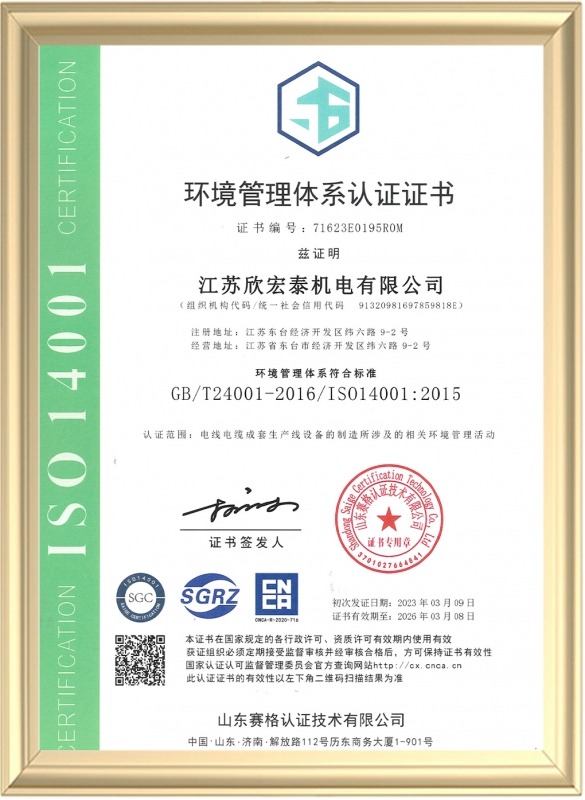
- ISO 14001 — environmental management, increasingly a screening requirement for export-oriented cable makers.
- UDEM International Certification — third-party conformity evidence covering the equipment scope.
HONTA holds ISO 9001, ISO 14001 and UDEM International Certification, and maintains long-term cooperation relationships with cable manufacturers in China and abroad — a verifiable base that specialty buyers should test through reference visits rather than brochures.
Outlook: Fit Will Matter More, Not Less
Three forces are pushing specialty cable manufacturing toward narrower, better-defined equipment configurations. First, data communication cable demand continues to reward electrical repeatability over raw throughput. Second, fine-wire and plated-conductor applications keep expanding, and those wires punish poor tension control. Third, high-mix production is becoming normal rather than exceptional, which raises the value of rapid changeover and integrated process lines.
In that environment, the procurement question shifts from "who builds the fastest stranding machine" to "who understands my conductor, my volume and my material handling constraints." Suppliers with integrated portfolios — drawing, plating and stranding under one engineering team, as at HONTA — are structurally better placed to answer it, while buyers who define conductor count, output and pay-off requirements up front will avoid the most expensive mistake in stranding procurement: buying speed where they needed fit.
HONTA — Cable Conductor Drawing & Stranding Equipment
Established September 2006 | Second production base: HONTA INC., United States (2017)
Products: copper and aluminium RBD lines, electrolytic plating lines (Ni / Ag / Sn single wire electrolytic plating), multi-wire drawing lines, high-speed bunching and stranding equipment.
Website: www.jshonta.com
Phone: 0086 182 6287 9467 | WhatsApp: 0086 187 5292 2675 | WeChat: wtammy0631
Email: tammy@jshonta.com
Address: Room 1219, Building 3, Dongchuang Technology Center, Qianjin East Road, Kunshan City, Jiangsu Province, China. Zip: 215300