
Choosing the Right Glass for Facades and Interiors: Tempered, Laminated, or Insulated?
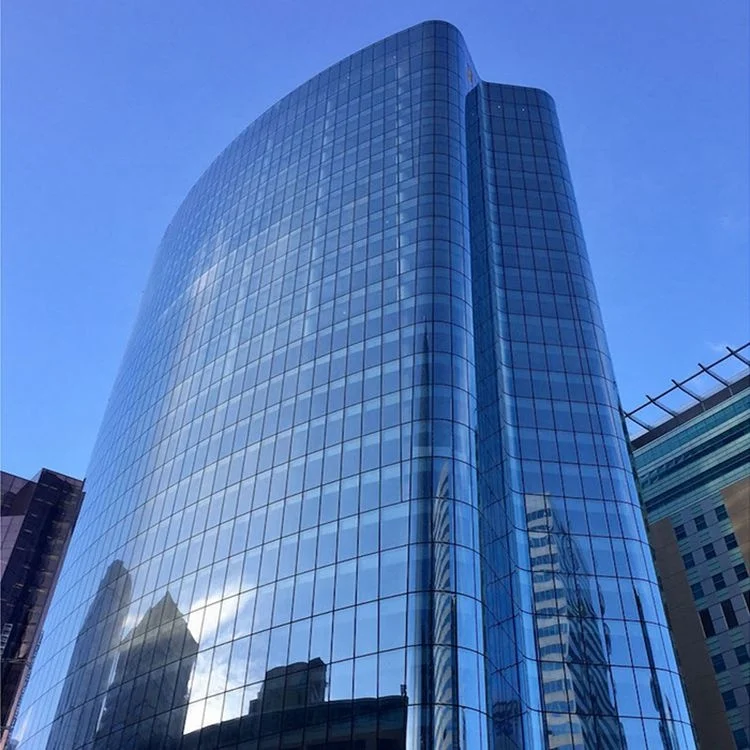
Curtain wall glazing: facade specifications usually combine safety, impact, and thermal requirements in one assembly.
Tempered, laminated, and insulated glass are not three versions of the same product. They are three different product families that solve different problems in a building envelope, and the choice between them is driven by the application — a spandrel, a door leaf, a hurricane-exposed curtain wall, or a thermally controlled envelope — rather than by a general preference for one over another.
The short answer most specification teams reach is this: tempered glass is the default where safety, mechanical strength, and thermal shock resistance matter most; laminated glass is the default where the glazing must remain in place after impact; and insulated glass is the default where heat insulation, noise insulation, and envelope performance drive the design. In practice, most real projects use two or all three, often combined into composite units.
The Three Glass Families at a Glance
Tempered glass is a safety glass produced by thermally toughening glass, and it is designed for the building industry. Its documented performance figures include an intensity rating of 150 MPa, a surface stress of 95 MPa, and a thermostability range of 250 °C to 320 °C. When it breaks, it fragments into obtuse-angle grains rather than irregular shards. Available thickness options are 4mm, 5mm, 6mm, 8mm, 10mm, 12mm, 15mm, 19mm, 22mm, and 25mm.
Laminated glass is a composite in which two or more glass panes are bonded with an interlayer. In the PVB laminated glass range, documented glass builds are 5mm+5mm, 6mm+6mm, and 8mm+8mm, with PVB interlayer thickness options of 0.38mm, 0.76mm, 1.14mm, and 1.52mm. SGP laminated glass is documented with interlayer options of 0.38mm, 0.76mm, 1.14mm, and 1.52mm, and is characterised by high mechanical strength, good impact resistance, and anti-typhoon behaviour.
Insulated glass — also classified as double glazing glass — is a sealed unit built for the building industry. Its documented cavity designations are 6A, 9A, and 12A, and its stated attributes are heat insulation, noise insulation, and a lower self-weight of buildings.
| Glass family | Documented build / options | Primary documented function | Typical documented application |
|---|---|---|---|
| Tempered glass | 4, 5, 6, 8, 10, 12, 15, 19, 22, 25mm | Safety, 150 MPa intensity, 95 MPa surface stress, 250–320 °C thermostability | Facades, doors, windows, partitions, large glazing |
| PVB laminated glass | 5+5, 6+6, 8+8mm; PVB 0.38–1.52mm | Retained integrity, impact resistance | Wind-exposed facades, overhead glazing |
| SGP laminated glass | 0.38, 0.76, 1.14, 1.52mm interlayer | High mechanical strength, anti-typhoon | High-impact and storm-exposed facades |
| Insulated glass | 6A, 9A, 12A cavity | Heat insulation, noise insulation | Energy-efficient building envelopes |
Application First, Product Second: A Selection Map
The most reliable way to choose between tempered, laminated, and insulated glass is to start from the working conditions of the opening and work backwards. Documented project conditions for architectural glass include long-term outdoor exposure and continuous 24/7 load-bearing operation, in environments such as outdoor building facades, residential and commercial buildings, and subway doors. Those two conditions alone eliminate some options and prioritise others.
Tempered glass for spandrels, large glazing, and door systems
Where a panel is large, exposed, load-bearing, or subject to repeated thermal cycling, tempered glass is usually the base layer of the specification. The 250–320 °C thermostability range is the reason heat resistant tempered glass is specified for spandrels and for glazing exposed to high surface temperatures. The 150 MPa intensity rating and 95 MPa surface stress make 10mm tempered glass, 12mm tempered glass, and 19mm tempered glass realistic options for large-format facades, while 6mm tempered glass and 8mm tempered glass are commonly associated with lighter door and window leaves. Door tempered glass and window tempered glass sit in this family, including finished variants such as frosted tempered glass and tinted tempered glass, both of which correspond to documented special requirements for frosting and tinted glass.
Laminated glass for facades exposed to wind-borne impact
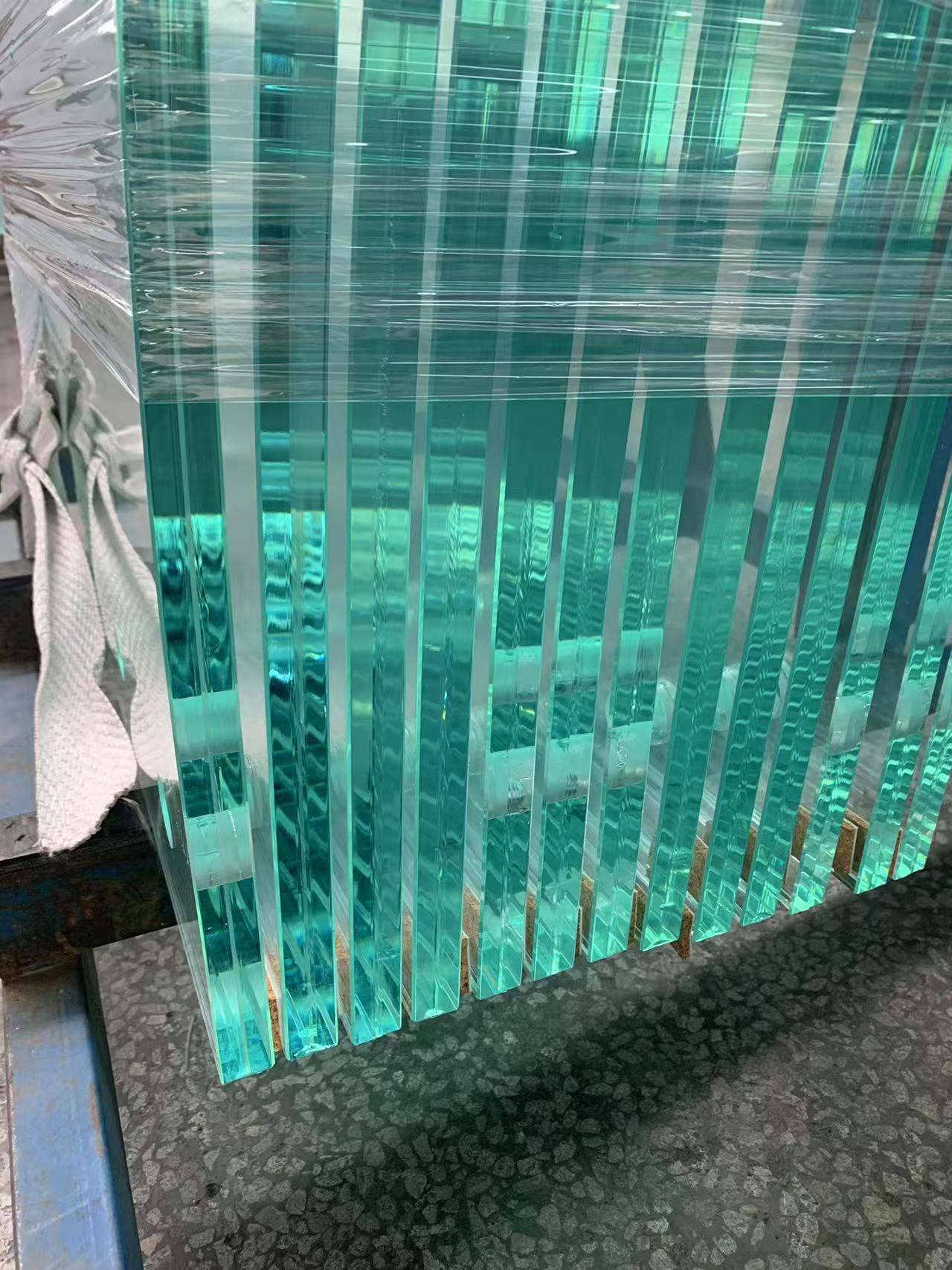
SGP laminated glass: documented as high mechanical strength, good impact resistance, and anti-typhoon behaviour.
If the design question is not “will the glass break?” but “what happens after it breaks?”, laminated glass is the relevant family. The SGP laminated range is documented with high mechanical strength, good impact resistance, and anti-typhoon behaviour, which is what puts laminated tempered glass assemblies on hurricane-prone facades and on glazing above walking surfaces. The PVB range gives specifiers a second lever: interlayer thickness. Moving from 0.38mm PVB to 0.76mm, 1.14mm, or 1.52mm changes the build-up without changing the visible glass, and the pane builds themselves — 5+5mm, 6+6mm, 8+8mm — correspond to progressively heavier service conditions.
Insulated glass for energy-driven envelopes
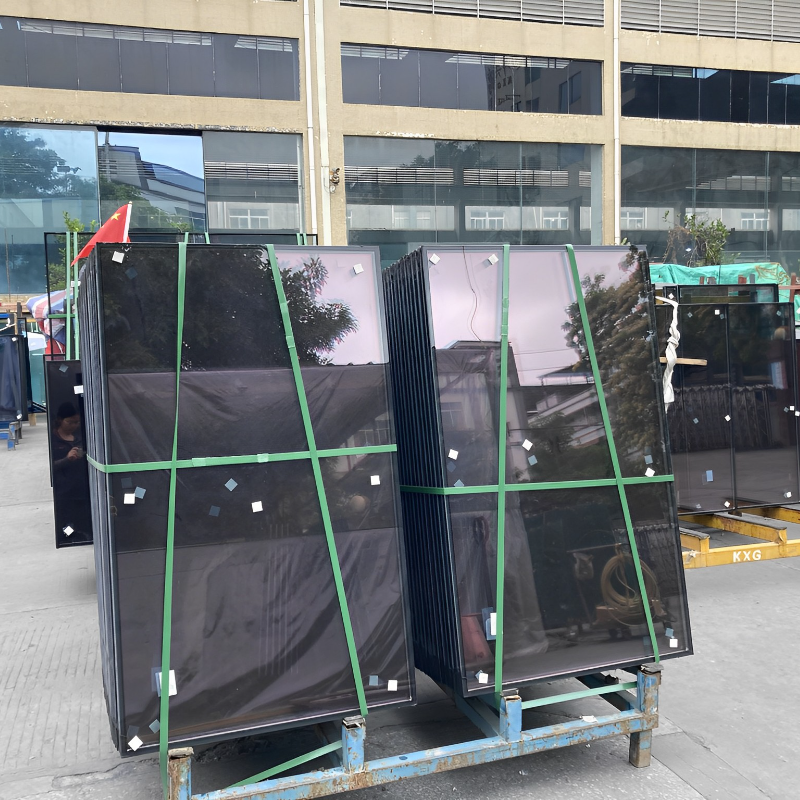
Insulated glass (double glazing glass): cavity designations 6A, 9A, and 12A.
Where the envelope must manage heat and sound rather than impact alone, insulated glass carries the performance. Its documented attributes are heat insulation, noise insulation, and a lower self-weight of buildings, with cavity designations of 6A, 9A, and 12A. In practice, insulated tempered glass — tempered panes assembled into a sealed unit, often described as double glazed tempered glass — is the most common answer for facades that must satisfy safety and efficiency requirements simultaneously. Interior acoustic partitions and sound insulation systems follow the same logic with lighter builds.
Technical Explanation: How the Numbers Drive the Decision
Specification conversations become much shorter once the underlying parameters are understood, because each parameter maps to a specific failure mode.
Thermal shock. A tempered pane’s documented thermostability of 250–320 °C is what allows it to tolerate differential heating between a sunlit zone and a shaded frame. EN 12150-1:2015, the European standard for thermally toughened soda-lime silicate safety glass, addresses this behaviour and cites thermal resistance up to 300 °C. This is the parameter that makes heat resistant tempered glass the appropriate answer for spandrels and for glazing adjacent to heat sources.
Fragmentation behaviour. EN 12150-1 defines fragmentation characteristics, including shattering into small pieces of ≤5mm. KXGLASS documents the same safety intent in different language: broken tempered glass forms obtuse-angle grains. For architects, the practical consequence is that tempered glass is the correct choice wherever human contact is likely — door leaves, full-height glazing, balustrade-adjacent panels.
Mechanical strength. The 150 MPa intensity rating and 95 MPa surface stress of tempered glass distinguish it from ordinary annealed glass and are the reason thinner tempered panes can often replace thicker annealed panes. Thickness selection — 6mm, 10mm, 12mm, or 19mm tempered glass, for example — then becomes a function of span, wind load, and fixing detail rather than of glass quality alone.
Interlayer thickness. In laminated glass, the 0.38–1.52mm interlayer range is the main adjustable variable. Thin interlayers suit interior and low-exposure applications; thicker interlayers suit facades where impact and post-break integrity are the governing criteria. SGP laminated glass, documented as anti-typhoon, is the higher-strength option within the laminated family.
Cavity width. In insulated glass, 6A, 9A, and 12A designate cavity configuration. Cavity selection interacts with frame depth, unit weight, and the balance between thermal and acoustic targets — which is why insulated glass specification is normally fixed early, before facade profiles are locked.
Comparison with Traditional Solutions — and Where Each Choice Stops Working
Compared with conventional monolithic annealed glass, tempered glass offers markedly higher mechanical strength and thermal shock tolerance, laminated glass offers post-break integrity that monolithic glass does not, and insulated glass offers thermal and acoustic separation that single-pane construction cannot. That comparison, however, is only half the story. Each family also has boundaries that need to be stated honestly at the specification stage.
- Tempered glass can break spontaneously. KXGLASS product documentation records self-destruction as occurring sometimes. This is a known characteristic of thermally toughened glass rather than a defect unique to one supplier, and it is the reason heat soak testing appears among the documented special requirements for high-load-bearing and high-exposure applications.
- Laminated glass adds interlayer weight and build thickness. A 8+8mm build with a 1.52mm interlayer is heavier and thicker than a single tempered pane of comparable face size, which affects frame design, hardware, and handling.
- Insulated glass is a sealed unit, not a single product. The 6A, 9A, and 12A designations describe cavity configuration, and the unit’s performance depends on the panes it contains — which is why insulated tempered glass is an assembly decision, not a catalogue pick.
- No single family covers every requirement. Documented special requirements for demanding building projects include triple laminated tempering, triple insulating construction, heat soak testing, high load-bearing capacity, impact resistance, and privacy protection — combinations that cannot be met by one glass type alone. For most complex envelopes, the honest answer is a composite build-up.
| Option | What it adds over monolithic annealed glass | Where it stops being the right answer |
|---|---|---|
| Tempered glass | Safety fragmentation, 150 MPa intensity, 95 MPa surface stress, 250–320 °C thermostability | Does not by itself deliver the heat and noise insulation of a sealed unit; occasional spontaneous breakage is documented |
| Laminated glass (PVB / SGP) | Impact resistance, retained integrity, anti-typhoon behaviour in the SGP range | Adds interlayer build and weight; interlayer choice must be fixed early |
| Insulated glass | Heat insulation, noise insulation, lower building self-weight | Cavity options are limited to 6A, 9A, and 12A; impact performance depends on the panes used |
Market Trend Analysis: Why Glass Type Selection Is Becoming More Deliberate
The specification decision described above is taking place in a market that continues to expand. Grand View Research values the global tempered glass market at USD 112.21 billion in 2024 and projects it to reach USD 159.27 billion by 2033. Within that market, plain tempered glass accounted for 64.5% of revenue in 2024, reflecting its breadth of use across construction and other sectors, while the automotive tempered glass segment alone was valued at USD 20.29 billion in 2024 and is expected to grow at a CAGR of 4.1% through 2033.
Regionally, Asia Pacific dominated in 2024 with a revenue share of 59.9%, supported by urbanisation and infrastructure activity. On the supply side, UN Comtrade data indicates that China’s exports of safety glass (tempered) reached approximately USD 3.58 billion in 2024, covering over 647 million square metres.
One caution is warranted for anyone using these figures in a specification or procurement document: published market sizes for tempered glass diverge widely, with Market Research Future at USD 34.67 billion and Global Insight Services at USD 67.5 billion for the same 2024 reference point, largely because of differences in which glass types and processing levels are included. The directional signal is consistent; the absolute number is definition-dependent.
Application and Use-Case Notes for Project Teams
Documented applications for architectural glass span window and door systems, curtain walls, partition systems, and sound insulation systems, under long-term outdoor exposure and continuous load-bearing operation. Project records from KXGLASS cover markets including China, Australia, the United Arab Emirates, Bahrain, Brunei, Canada, Ecuador, Spain, France, South Korea, Malaysia, New Zealand, the Philippines, Saudi Arabia, Singapore, Thailand, the United States, Vietnam, and South Africa — a spread that reflects how many different climate and code regimes a single specification library has to satisfy.
Two practical points tend to appear late in projects and cause delays. The first is fabrication scope: documented special requirements include custom processing, frosting, tinted glass, silkscreen printing, and impact resistance, which means the finish and the performance layer have to be decided together rather than sequentially. The second is handling: glass of these formats requires cut-resistant gloves, forklifts or pallet jacks, handheld glass suction pads, safety helmets, safety shoes, and goggles — a reminder that 19mm or 25mm tempered panes are an installation planning issue as much as a materials issue.
Where KXGLASS Fits in the Selection Process
Dongguan Kunxing Glass Co., Ltd., trading as KXGLASS (KXG), is a glass manufacturer established in 1995, located in Dongguan within the Guangdong-Hong Kong-Macao Greater Bay Area, and specialising in the deep processing of architectural and specialty glass. The company operates a manufacturing site covering 30,000 square metres with approximately 150 staff, including an R&D team of 20 engineers, and utilises advanced automated production equipment.
Its stated main products are clear tempered glass, laminated glass, and insulated glass — the three families discussed in this guide. Documented annual production capacity is 1,825,000 square metres of single tempered glass, 365,000 square metres of laminated glass, and 730,000 square metres of insulated glass, with approximately 70% of products exported to markets in Australia, America, Asia, and Europe. On compliance, KXGLASS holds ISO and national 3C certification and meets international standards including European CE/EN 12150, Australian AS/NZS 2208, and American SGCC.
For a project team, the practical value of this profile is coverage: tempered glass is available across the 4mm to 25mm range, laminated glass across the PVB 5+5mm to 8+8mm builds with 0.38–1.52mm interlayers plus the SGP range, and insulated glass across 6A, 9A, and 12A cavities. That breadth means a facade and its interior partitions can often be sourced against one compliance file instead of several.
Future Outlook
Three directions look most likely to shape how tempered, laminated, and insulated glass are specified over the next several years. First, composite build-ups will become the norm rather than the exception: the documented requirement lists already point to triple laminated tempering and triple insulating construction, and units that combine tempered or heat soaked panes with laminated interlayers and sealed cavities address safety, impact, and energy in a single assembly. Second, evidence expectations will rise — EN 12150-1, AS/NZS 2208, and SGCC are increasingly treated as baseline documentation rather than differentiators, and buyers are asking for the parameters behind the certificate, such as fragmentation behaviour, surface stress, and thermostability. Third, market growth in Asia Pacific, combined with the scale of China’s safety glass export base, keeps pressure on lead times and on the traceability of the exact build supplied.
FAQ
What is the difference between tempered glass, laminated glass, and insulated glass?
They are three distinct product families. Tempered glass is a safety glass for the building industry with documented thicknesses of 4mm to 25mm, an intensity rating of 150 MPa, a surface stress of 95 MPa, and a thermostability range of 250–320 °C. Laminated glass is a bonded composite; the PVB range uses 5+5mm, 6+6mm, or 8+8mm glass builds with 0.38–1.52mm interlayers, and the SGP range is documented as high mechanical strength, good impact resistance, and anti-typhoon. Insulated glass, also called double glazing glass, is a sealed unit with 6A, 9A, or 12A cavities, documented for heat insulation and noise insulation.
Which thicknesses are available for tempered glass, and how are they selected?
Documented thickness options are 4mm, 5mm, 6mm, 8mm, 10mm, 12mm, 15mm, 19mm, 22mm, and 25mm. Selection is driven by the application rather than by preference: 6mm and 8mm tempered glass are typical for lighter door and window leaves, while 10mm, 12mm, and 19mm tempered glass appear in large-format facade and partition glazing. Because the material’s intensity rating and surface stress are fixed properties of the tempered state, thickness is chosen to match span, loading, and fixing conditions.
When should laminated glass be specified instead of tempered glass alone?
Laminated glass is relevant when post-break integrity matters, not only breakage behaviour. SGP laminated glass is documented with high mechanical strength, good impact resistance, and anti-typhoon behaviour, which makes it the relevant family for wind-borne-debris exposure and for glazing positioned above occupied space. PVB laminated glass provides the same structural logic with a tunable interlayer: 0.38mm, 0.76mm, 1.14mm, or 1.52mm. In many facades, the two families are combined rather than chosen between, producing a tempered laminated glass assembly.
How does insulated glass contribute to building performance?
Insulated glass — double glazing glass — is documented with heat insulation, noise insulation, and a lower self-weight of buildings, with cavity designations of 6A, 9A, and 12A. It is the family associated with energy-efficient envelopes, and it is frequently specified together with tempered or laminated panes, giving assemblies commonly described as insulated tempered glass or double glazed tempered glass. Cavity choice interacts with frame depth and weight, so it is normally fixed early in facade design.
Is spontaneous breakage a genuine consideration for tempered glass?
Yes, and it is documented. KXGLASS product data lists self-destruction as occurring sometimes, alongside the note that broken tempered glass fragments into obtuse-angle grains. EN 12150-1:2015 addresses fragmentation characteristics, defining shattering into small pieces of ≤5mm, and cites thermal resistance up to 300 °C. In high-exposure or high-load-bearing applications, documented special requirements include heat soak testing as a mitigation measure. This is a characteristic of thermally toughened glass generally, not of a single supplier.
Reference Material
KXGLASS publishes a company brochure covering product ranges, compliance documentation, and manufacturing capability, available for download: KXGLASS brochure (PDF).