
Church Streaming Switcher: Multi-Camera Production Guide
Church Streaming Switcher: Multi-Camera Production Guide
HTNXT Industry Reference · Live Production Switching for Worship Venues
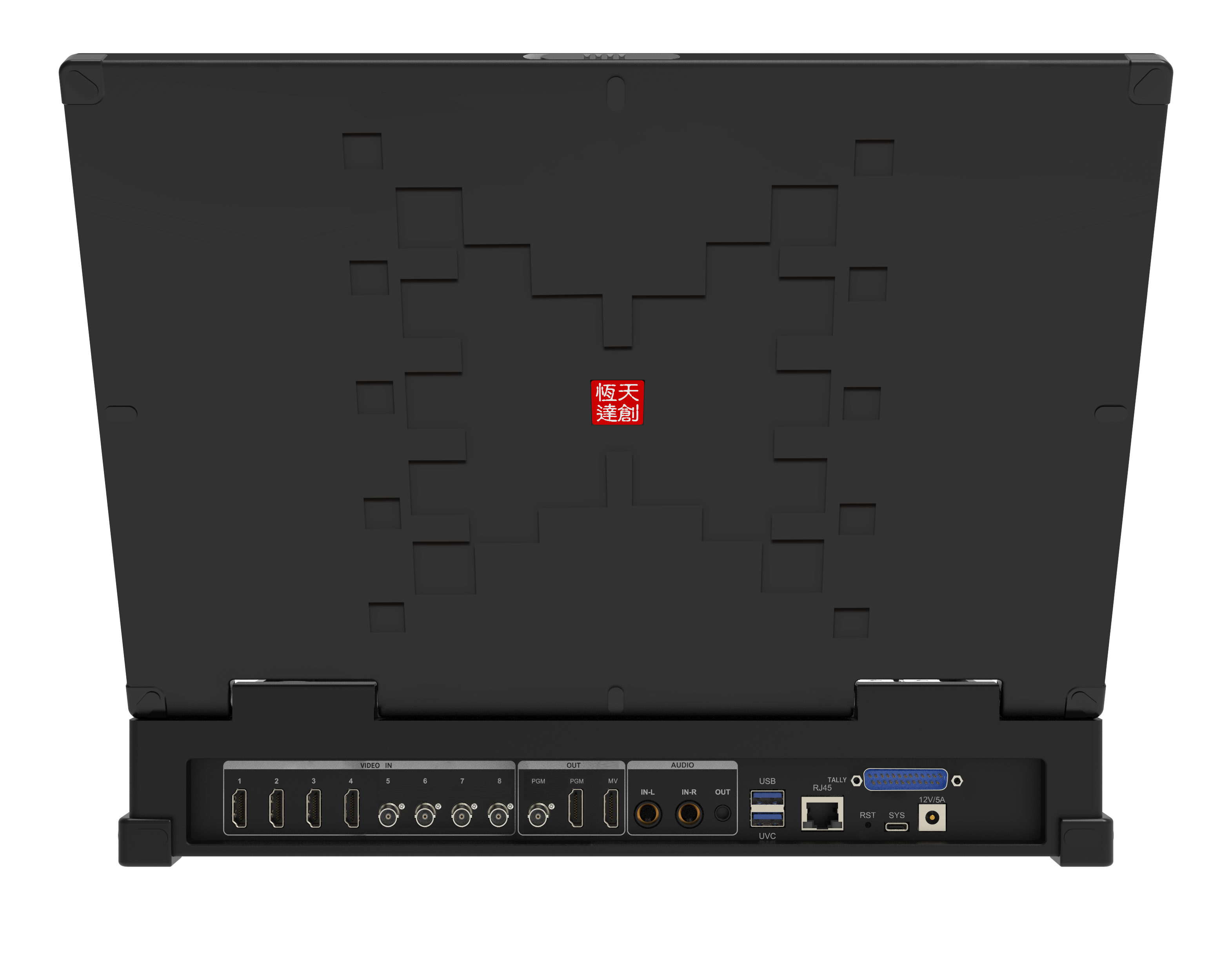
A church streaming switcher is a live production switcher configured for worship services. It accepts several camera feeds, selects which angle is live at any moment, mixes the audio arriving from the front-of-house console, overlays lyrics, scripture references and lower-third graphics, delivers the finished program to streaming platforms and to in-room screens at the same time, and records the service for later distribution.
The distinction between a switcher and a capture card or software encoder matters more in a church than in a commercial studio. In a commercial studio the operator is a trained engineer working a daily shift. In a typical congregation the operator is a volunteer running one service a week, often with no production background, and the cost of a failed stream is not a lost advertisement slot but a homebound member who cannot follow the service at all.
What a Church Streaming Switcher Actually Does
Functionally, the device sits between the cameras and the audience. Its core duties in a worship environment are consistent across models and brands:
- Input selection and program switching. Cutting or dissolving between camera angles without the dropouts that occur when a computer is asked to do the same job with USB capture devices.
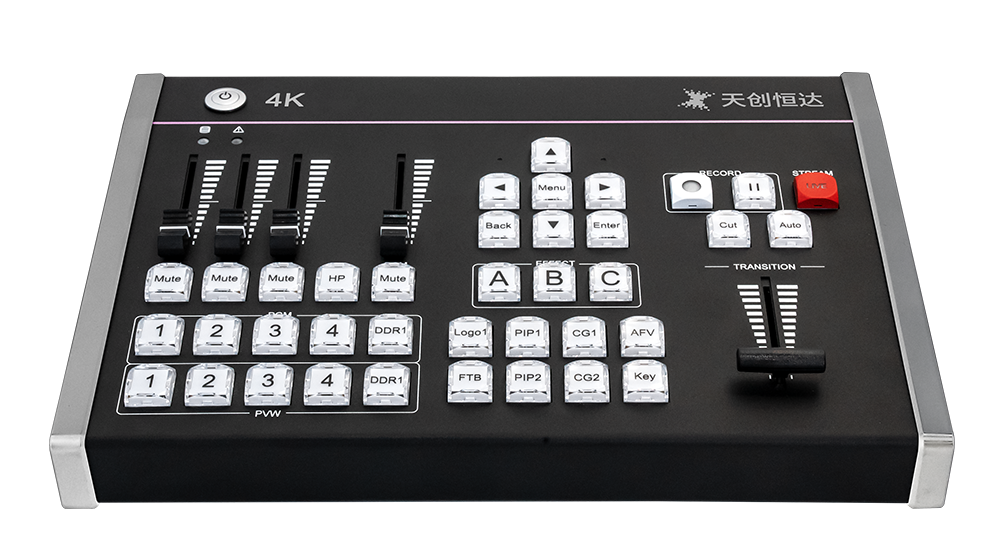
- Multiview monitoring. A single screen that shows every source alongside the live program, so the operator can see what is on air and what is coming next.
- Audio mixing. Combining the mixing-console feed, room microphones, playback audio and camera-embedded audio into one program mix with independent gain control per channel.
- Encoding and multi-platform delivery. Pushing the program to more than one destination — a main platform, a secondary platform, a backup address — from the same device.
- Recording and archive. Writing the service to internal or external storage so the congregation can watch later and so the media team can reuse clips.
- Graphics and overlay. Sermon titles, song lyrics, scripture text, logos and full-screen graphics applied over the live picture.
- Emergency output. A one-touch fade-to-black or colour-bar function for the moment a camera goes down or an unplanned moment occurs on stage.
- Format flexibility. Landscape (16:9) production for the main stream and portrait (9:16) production for short social clips, switched without rebuilding the whole signal chain.
Churches do not need every one of these functions in the switcher. The practical question for a media team is which tasks must be handled deterministically by dedicated hardware, and which can reasonably stay inside a computer running software.
Why Multi-Camera Worship Changes the Requirements
A single fixed camera pointed at the platform can be streamed with a phone or a capture card. The moment a church adds a second and third angle — wide shot, preaching position, worship band, congregation — the technical problem changes character. Camera feeds now travel from a balcony or the back of the room to a control position, they arrive on different connector types, they must be cut in real time without a visible glitch, and the audio that matters comes from the front-of-house console rather than from any camera's built-in microphone.
Three constraints appear at the same time, and they are the reason church streaming is a distinct procurement problem rather than a generic live-production problem:
- Cable distance. Sanctuaries are long rooms. Camera positions are often 30 to 80 metres from the control desk, which pushes churches to plan for SDI or extended HDMI rather than short consumer HDMI runs.
- Mixed equipment generations. A typical congregation owns one recent camera and one or two older camcorders. Any switcher considered for worship has to accept both without a rack of converters.
- One operator, several simultaneous tasks. The same volunteer is watching the program, watching the chat, listening for audio problems and preparing the next song lyric. Every function that can be automated or made one-touch reduces the chance of an on-air failure.
The opportunity is that integrated hardware switching has become accessible to congregations that would previously have needed a small broadcast rack. A device that combines switching, audio mixing, encoding and recording in a single chassis removes the computer from the critical path, and with it removes the driver conflicts, USB bandwidth limits and operating-system updates that most frequently interrupt volunteer-run streams.
A Practical Requirement Checklist for Worship Productions
| Requirement | Why it matters in a worship service | What to verify before purchase |
|---|---|---|
| Camera input count and type | Determines how many angles can be live-cut without an external router | Number of HDMI and SDI inputs, and whether both are usable simultaneously |
| Signal format ceiling | Churches that shoot in 4K today may deliver in 1080p but still want 4K acquisition headroom | Supported formats: 2160p60, 1080p, 1080i, and frame-rate variants |
| Audio channels and delay | Console feed, wireless microphones and playback must be balanced with correct lip sync | Input type (balanced 6.35 mm, 3.5 mm), independent gain per channel, maximum audio delay |
| Streaming outputs | Congregations expect the service on more than one platform, plus a Zoom or hybrid feed | Number of simultaneous push streams and supported protocols such as RTMP, SRT, RTSP, NDI |
| Simultaneous recording | The archive is a ministry asset, not an afterthought | Recording media (internal SSD, USB drive), container formats and bitrate range |
| Overlay and keying | Song lyrics, sermon titles and virtual backdrops for the teaching segment | Number of overlay layers, chroma/luma key, subtitle or DSK functions |
| Multiview and tally | The single biggest factor in volunteer confidence and error rate | Multiview layout options and tally interface |
| Portrait and emergency modes | Social clips and graceful failure handling | One-click 16:9 / 9:16 switching, fade-to-black or colour-bar output |
How TCHD Video Fits Into a Church Production Chain
TCHD Digital Video Technology Development (Beijing) Ltd is a Beijing-based manufacturer established in 2005 that specialises in video software and hardware products and application systems. The company operates a 10,000 m² facility with approximately 50 employees, including a 10-engineer research and development team, and reports an annual output of roughly 4,000 units with about 20% of production exported to EU, USA and Asian markets. Its product lines cover live streaming cameras, video capture cards, video converters, video encoders and video switchers, which means a church can source the camera and the switcher from the same supplier and the same signal-chain assumptions.
Within the live stream switcher family, the models that map most directly onto worship production are the TCHD-890HS, TCHD-810 Pro, TCHD-840 Pro, TCHD-840 Super, TCHD-840 Ultra, TCHD-812 and TCHD-812 Ultra. They are not variations on one theme; they sit at different points of input count, format ceiling and redundancy.
| Model | Inputs and format | Church-relevant capability |
|---|---|---|
| TCHD-890HS | 8 video inputs: 4× HDMI + 4× SDI; HD formats 720p, 1080p, 1080i | 10-channel audio mixer; up to 6 simultaneous streaming outputs (4 customisable stream addresses, 1 NDI, 1 NVI); recording to internal SSD or USB 3.0 in MP4, TS, AVI; 6 groups of logo and subtitle overlay; chroma key, PIP, FTB; landscape 16:9 and portrait 9:16 operation |
| TCHD-810 Pro | 4× HDMI (2 supporting 4K60P input) plus 4× SDI with optional mixed use, plus 1 USB auxiliary input | 8 layers of PGM overlay plus 2 croppable/scalable PIP layers; subtitle DSK overlay; 30+ transition effects; chroma and luminance keying; control of up to 4 PTZ cameras; one-click portrait/landscape switching |
| TCHD-840 Pro | 4-channel 4K HDMI and NDI hybrid input; decoding modes of 1×4K60, 2×4K30, 4×1080P | Type-C UVC output recognised as a webcam; H.264/H.265 hardware encoding; RTMP, RTMPS, SRT, UDP, RTP, HLS and WHIP; simultaneous push to 4 platforms; real-time mixing of HDMI, NDI, DDR and external microphone audio with 0–10000 ms delay tuning; 36+ transitions; T-Bar control; dual Gigabit ports and TALLY |
| TCHD-840 Super / TCHD-840 Ultra | 4× 12G-SDI (3G-SDI compatible) or 4× HDMI 2.0, selectable; up to 2160p60, 1080p and 1080i | 12G-SDI PGM and AUX outputs, 3G-SDI PGM down-conversion, HDMI 2.0 PGM, DisplayPort multiview and UVC output; built-in streaming codec with RTMP, RTMPS, SRT, RTSP, UDP and NDI; 1-in / 4-out streaming with URL template management; one-click 16:9 / 9:16, snapshot and emergency black or colour bars; 1–4 window PIP templates; rotary-knob audio gain; web-browser remote control; built-in M.2 bay |
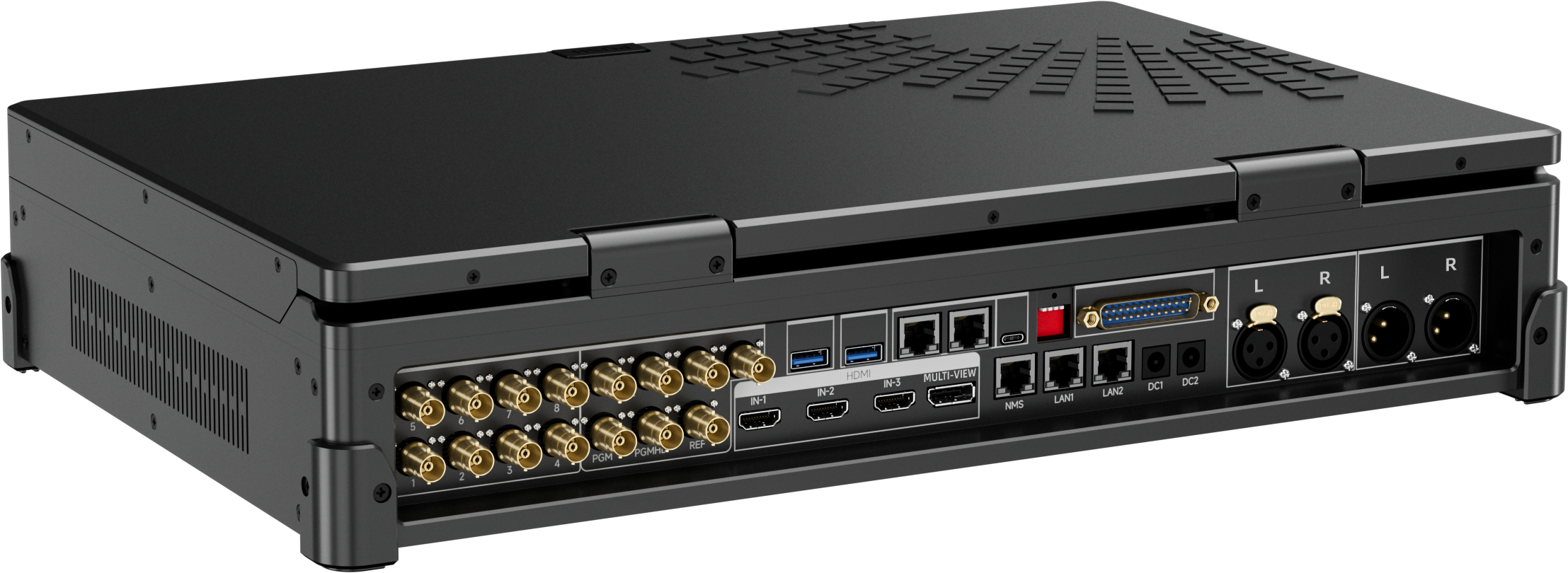
| TCHD-812 / TCHD-812 Ultra | 4× 12G-SDI and 1× HDMI high-bandwidth inputs; 4K@60Hz, 1080p and 1080i multi-frame-rate processing | Embedded FPGA architecture for low-latency switching; UVC plug-and-play output; RTMP, RTMPS, SRT, RTSP, NDI and GB28181 with 4-platform simultaneous push; dual hot-swap SSD slots (2 TB / 4 TB / 8 TB options) recording 4K H.265 and HD H.264; 12-channel audio mixer with independent volume and up to 2000 ms delay; power-off protection and automatic file segmentation; dual DDR playback channels and one-click emergency output; the 812 Ultra carries a 17.3-inch full HD screen |
Technical Explanation: Signal Layer, Audio Alignment and Output Paths
Choosing between SDI and HDMI for sanctuary runs
SDI remains the practical default for long cable runs inside a building because it uses locking BNC connectors and carries signal reliably over distances where consumer HDMI becomes unstable. HDMI 2.0 is the better fit for shorter runs, for compact cameras mounted close to the control position, and for 4K sources. The choice is not binary in this product family: the TCHD-890HS accepts four HDMI and four SDI inputs simultaneously, while the TCHD-840 Super, TCHD-840 Ultra and TCHD-812 family use 12G-SDI inputs with the option of HDMI 2.0 hybrid input on the 840 Super and 840 Ultra. A church that already owns a mix of camcorders and SDI cameras can therefore keep both without an external converter rack.
Processing architecture and switching latency
The 840 Ultra and the 812 family are built on embedded FPGA architecture rather than on a general-purpose operating system. For a worship application this matters less as a specification than as a risk profile: a dedicated hardware pipeline does not compete with background processes on a computer, and it does not need software updates before a Sunday service. Multi-frame-rate support across 2160p60, 1080p60 and 1080i60/50 on the 812 family allows older 1080i cameras to sit alongside newer 4K sources in the same production.
Audio alignment is the most under-planned item in church streaming
A worship mix typically combines the front-of-house console output, a room or ambience microphone and any playback audio. When these arrive at the switcher alongside camera-embedded audio, delay differences of even a few frames are visible to viewers. The relevant capabilities are independent per-channel gain, mute or follow modes, and adjustable delay: the TCHD-890HS provides a 10-channel mixer with balanced stereo 6.35 mm analog input, a 3.5 mm headphone output, a level range of −60 dB to 6 dB, 48 kHz sampling and AAC encoding, with analog input delay adjustable up to 2000 ms. The TCHD-840 Pro extends delay tuning to 0–10000 ms, and the TCHD-812 family offers 12-channel mixing with up to 2000 ms delay adjustment.
Output paths: platform, building and computer
Three distinct outputs are usually needed. The first goes to the streaming platform or platforms. The second feeds in-room screens for overflow seating or a crying room. The third feeds a computer for hybrid meeting software such as Zoom. The UVC output used across the 840 Pro, 840 Super, 840 Ultra and 812 family addresses the third case directly: the switcher is recognised by the computer as a standard high-definition webcam, so no additional capture card or driver installation is required. On the platform side, supported protocols in this family include RTMP, RTMPS, SRT, RTSP, HLS, FLV, UDP, RTP, NDI, NVI and GB28181 depending on model, with up to four simultaneous platform pushes on the 840 Pro, 840 Super, 840 Ultra and 812 family, and up to six simultaneous streaming outputs on the 890HS.
Recording approach
The 890HS records to an internal SSD or a USB 3.0 drive in MP4, TS and AVI formats, with PGM recording bitrate configurable from 1 to 20 Mbps, multi-channel recording from 1 to 8 Mbps on SSD, and segmented recording with configurable duration. The 812 family adds dual hot-swappable SSD slots with optional 2 TB, 4 TB or 8 TB capacity, and includes power-off protection and automatic file segmentation so that a power interruption does not cost the service recording.
Application Scenarios: Three Common Church Profiles
Profile A — one room, three cameras, one volunteer operator
This is the most common configuration in mid-sized congregations: three cameras (wide, preaching position, worship band), audio from the console, one operator running the whole service. The decisive features are input count, a clear multiview and audio handling. The TCHD-890HS covers this profile with eight inputs, a 10-channel audio mixer, six simultaneous streaming outputs and internal recording, and the TCHD-810 Pro addresses the same profile where the church also wants PTZ camera control for up to four cameras and eight overlay layers for lyric graphics.
Profile B — 4K acquisition with hybrid congregation and social clips
Congregations that have moved to 4K cameras and also publish short vertical clips during the week need both a 4K-capable switcher and a fast way to produce portrait output. The TCHD-840 Pro supports 4K HDMI and NDI hybrid input with decoding at 1×4K60, 2×4K30 or 4×1080P, and switches between 16:9 landscape and 9:16 portrait with one click. The TCHD-840 Super and TCHD-840 Ultra handle the same scenario on 12G-SDI or HDMI 2.0 inputs with 12G-SDI PGM and AUX outputs, one-click snapshot capture and 1–4 window PIP templates.
Profile C — multi-venue campus or broadcast-grade service production
Multi-site churches that relay one service to several venues, or that record for broadcast-style distribution, need redundancy in storage and a wider input count. The TCHD-812 and TCHD-812 Ultra provide 4× 12G-SDI and 1× HDMI inputs with 4K@60Hz processing, dual hot-swap SSD recording, a 12-channel audio mixer with 2000 ms delay adjustment, dual DDR playback channels for pre-service content, and one-click emergency output. The 812 Ultra's 17.3-inch full HD screen is relevant here because it allows the multiview to be read from the control position without a second monitor.
Market Trend Analysis
Several shifts are visible in how congregations approach streaming equipment, and they explain why the switcher has moved from a specialist purchase to a central one in church media budgets.
Streaming has become a permanent ministry channel rather than a temporary measure. Many congregations that began broadcasting during a period of restricted in-person attendance have kept the stream and now treat it as a fixed weekly responsibility with its own volunteers, schedule and budget line. That changes the requirement from “works well enough” to “works reliably every week for years”.
Multi-platform distribution and clip-first publishing are converging. Churches increasingly publish the same service to a primary platform, a secondary platform and an internal or member-facing feed, and then repurpose short segments during the week. Hardware that supports several simultaneous stream addresses and one-click landscape or portrait switching reduces the number of separate workflows the media team has to maintain.
Volunteer operation is the binding constraint, not image quality. As more congregations rely on rotating volunteers, features that reduce cognitive load — multiview, tally, template-based PIP, one-touch emergency output, web-based remote control — carry more weight in purchasing decisions than incremental resolution gains.
IP-based transport is being adopted gradually. NDI, SRT and RTSP support now appears across the switcher models described above, and this is gradually changing how churches plan cable infrastructure, particularly for satellite rooms and overflow venues where a network run is easier than a coax run.
Comparison with Traditional Solutions — and Where Integrated Switchers Stop
| Approach | Typical strengths for a church | Typical constraints |
|---|---|---|
| Computer with software switching and USB capture cards | Low entry cost, familiar interface, easy to add streaming destinations and titles, flexible for operators who already use the software | One machine performs capture, switching, encoding and recording simultaneously; performance depends on USB bandwidth, drivers and operating-system updates; recovery from a crash mid-service is slow |
| Integrated hardware switcher (TCHD-890HS, 810 Pro, 840 Pro, 840 Super, 840 Ultra, 812, 812 Ultra) | Deterministic switching and encoding; UVC output to a computer without a capture card; simultaneous multi-platform push and local recording; dedicated audio mixing with adjustable delay; built-in multiview | Fixed input count that cannot be expanded without additional hardware; format ceiling varies by model; no built-in redundancy; requires training for overlay and keying functions |
| Large broadcast switcher with separate audio console and encoder | Very high layer counts, extensive routing and redundancy options for large-scale production | Cost, rack space, power and specialist operating skills that rarely match a volunteer-run worship team |
Three limitations are worth stating plainly, because they affect planning more than they affect purchase price.
First, the format ceiling is model-specific. The TCHD-890HS processes HD formats of 720p, 1080p and 1080i; a congregation that intends to acquire in 4K should be looking at the 12G-SDI or HDMI 2.0 models such as the 840 Super, 840 Ultra or 812 family rather than assuming that any switcher in the family will accept a UHD signal.
Second, an integrated switcher does not solve cable physics. HDMI runs in a long sanctuary still need extenders or conversion to SDI, even where the switcher accepts HDMI inputs. Churches should survey cable distances before finalising a model choice.
Third, none of these units provides built-in redundancy. If a single switcher fails during a service, the fallback is a second unit or a documented manual bypass to a single camera and direct encoder path. That redundancy decision is separate from the switcher purchase, and it should be made explicitly rather than assumed.
A fourth point concerns certification paperwork. The certification records published for this product family — CE EMC and ISO 9001, ISO 14001 and ISO 45001 — cover specific live streaming camera models such as the TC-980S, TC420 and TCHD-T3. Buyers should request the certificate that names the exact switcher model being purchased, rather than assuming that certification held by one product in a family transfers automatically to another.
Future Outlook
The direction of travel for worship production is toward fewer boxes in the signal chain, not more. Functions that currently require a switcher, an audio interface, an encoder and a recording device are already consolidated in the models described above, and the next steps are likely to follow the same logic: broader IP-based transport for remote camera positions and satellite rooms, more capable template systems for graphics so that volunteers do not build overlays from scratch, and continued movement of 4K processing from specialist broadcast equipment into general worship budgets.
For churches, the practical consequence is that switcher selection is becoming an infrastructure decision rather than a gadget decision. A unit chosen today will sit at the centre of the media ministry for years, so input headroom, audio flexibility and a documented fallback path deserve more attention than a marginal difference in feature lists.
FAQ
Is a church streaming switcher a different product from a general production switcher?
No. “Church streaming switcher” describes an application, not a separate hardware category. The underlying device is a live production switcher, and models such as the TCHD-890HS are classified as multi-camera live production switchers intended for multicamera live streaming to the Internet and broadcast applications. What differentiates a church deployment is the operating context: limited operator training, a fixed weekly schedule, audio arriving from a front-of-house console, and the need to feed both a stream and in-room screens.
How many camera inputs does a worship stream actually need?
There is no universal number; it follows from the shot list. A service that needs a wide shot, a preaching shot and a worship band shot requires at least three live sources, plus one spare for a roaming or congregation camera. In the switcher family described here, the TCHD-840 Pro supports 4-channel 4K HDMI and NDI hybrid input, the TCHD-840 Super is configured with four or more camera inputs, the TCHD-890HS provides eight video inputs (4× HDMI plus 4× SDI), and the TCHD-812 family provides 4× 12G-SDI plus 1× HDMI inputs. Purchasing one or two inputs above the current requirement is a common approach, since camera counts usually grow.
Should a church choose SDI or HDMI inputs for its switcher?
The deciding variable is cable distance and connector reliability, not image quality. SDI is generally the practical choice for long runs between the sanctuary and a control position because it uses locking connectors and maintains signal over greater distances. HDMI 2.0 suits shorter runs and 4K consumer or prosumer sources. Some models remove the choice: the TCHD-890HS accepts four HDMI and four SDI inputs at the same time, while the TCHD-840 Super and TCHD-840 Ultra accept either 4× 12G-SDI (3G-SDI compatible) or 4× HDMI 2.0 as a selectable configuration.
Can one volunteer operator run a multi-camera church livestream?
Yes, within limits. One operator can cut between cameras using the switcher's multiview for monitoring and the cut, auto and T-bar controls for transitions. Features that reduce the load include configurable 1–4 window PIP templates, tally signal support, one-click landscape/portrait switching, and a one-touch emergency function that replaces the program with black or colour bars. The realistic boundary is graphics: multi-layer keyed overlays, custom lower thirds and lyric timing generally require rehearsal and, in larger services, a second person.
How is audio kept in sync with video in a worship stream?
The usual method is to feed the front-of-house console output into an analog input on the switcher and then apply delay to compensate for the processing difference between audio and video paths. In this product family, the TCHD-890HS provides a 10-channel audio mixer with balanced stereo 6.35 mm input, independent per-channel gain, a level range of −60 dB to 6 dB, 48 kHz sampling and AAC encoding, with analog input delay adjustable up to 2000 ms. The TCHD-840 Pro supports real-time mixing of HDMI, NDI, DDR and external microphone audio with delay tuning from 0 to 10000 ms, and the TCHD-812 family offers a 12-channel mixer with up to 2000 ms delay adjustment.
Can a switcher stream to several platforms and record the service at the same time?
Yes, on models with integrated hardware encoding. The TCHD-890HS supports up to six simultaneous streaming outputs, including four customisable stream addresses plus one NDI and one NVI stream, and records to an internal SSD or USB 3.0 drive in MP4, TS or AVI. The TCHD-840 Pro, 840 Super and 840 Ultra support one stream input with four simultaneous platform pushes across RTMP, RTMPS, SRT, RTSP, UDP and NDI, while the TCHD-812 family adds RTSP, NDI and GB28181 support with dual hot-swap SSD recording. The practical constraint is upstream bandwidth: simultaneous platforms share the same internet connection, so the number of destinations should be matched to available upload capacity.
What are the main limitations of an integrated church streaming switcher?
Four are consistent across this product family. The input count is fixed at purchase and cannot be expanded without additional hardware. The format ceiling varies by model, so a switcher rated for 720p, 1080p and 1080i will not accept a 4K source. There is no built-in redundancy, meaning service continuity depends on a second unit or a documented manual fallback. And certification documentation is model-specific: the CE EMC and ISO 9001, ISO 14001 and ISO 45001 records published for this family cover named live streaming camera models, so buyers should confirm the certificate that applies to the exact switcher being ordered.
For media teams comparing models in detail, the manufacturer publishes a downloadable product catalogue covering the live stream switcher range and related equipment: TCHD Product Catalog 2025. Additional technical documentation is available at www.tchdvideohk.com.