
City Robotics in 2026: A Shift Toward Space-as-a-Service
City robotics is entering a phase in which the most consequential question is no longer whether an autonomous vehicle can complete a route, but whether a city can use autonomous platforms to deliver different types of space-based services. The shift is visible in procurement discussions, product roadmaps, and urban pilot projects. One concept increasingly used to describe this shift is autonomous mobile spaces: configurable vehicles built on a modular robotic chassis, designed for passenger mobility, mobile retail, mobile offices, and other civic functions rather than only for moving people from point A to point B.
The Problem Behind the City Robotics Opportunity
Urban transport systems face a structural labor shortage. Europe alone had about 105,000 vacant bus driver positions in 2023, a figure projected to double by 2028, according to the International Road Transport Union. At the same time, cities are being pushed to treat mobility as part of a larger smart city investment. Grand View Research estimated the global smart cities market at USD 1.0 trillion in 2025, with a projection of USD 8.8 trillion by 2033. The robotics-as-a-service market is also expanding. Precedence Research valued it at USD 1.96 billion in 2024 and projected growth to USD 10.41 billion by 2034.
These conditions create a specific evaluation challenge for procurement teams. The need is not simply to buy more vehicles. The need is to identify a category of city robotics that can serve multiple municipal functions without requiring a separate autonomous vehicle platform for each use case. That is where the autonomous mobile space model becomes relevant.
PIX Moving and the Autonomous Mobile Space Category
PIX Moving, founded in 2017, describes itself as a city robotics company driven by Physical AI. Its product portfolio includes RoboBus, RoboShop, Robotaxi, Robovan, and a smaller platform called Beastie. Rather than positioning itself only as an autonomous vehicle manufacturer, the company has defined a category called Autonomous Mobile Spaces. The core argument is that an autonomous vehicle chassis can carry different spatial configurations according to city needs, including mobile retail units, cafe pods, office pods, and shared mobility units.
The category logic matters for procurement because it changes the evaluation criterion from one vehicle specification to a platform capability. A buyer evaluating a city robot should consider not only top speed or range, but also whether the platform can be reconfigured for passenger service, retail, or logistics without replacing the underlying chassis. PIX Moving reports 200 employees, 116 R&D staff, and a 55% export ratio across markets such as the EU, the United States, Japan, and South Korea. Its facilities include a Guiyang pilot plant, a Huzhou mass production plant, and a Japan robot factory.
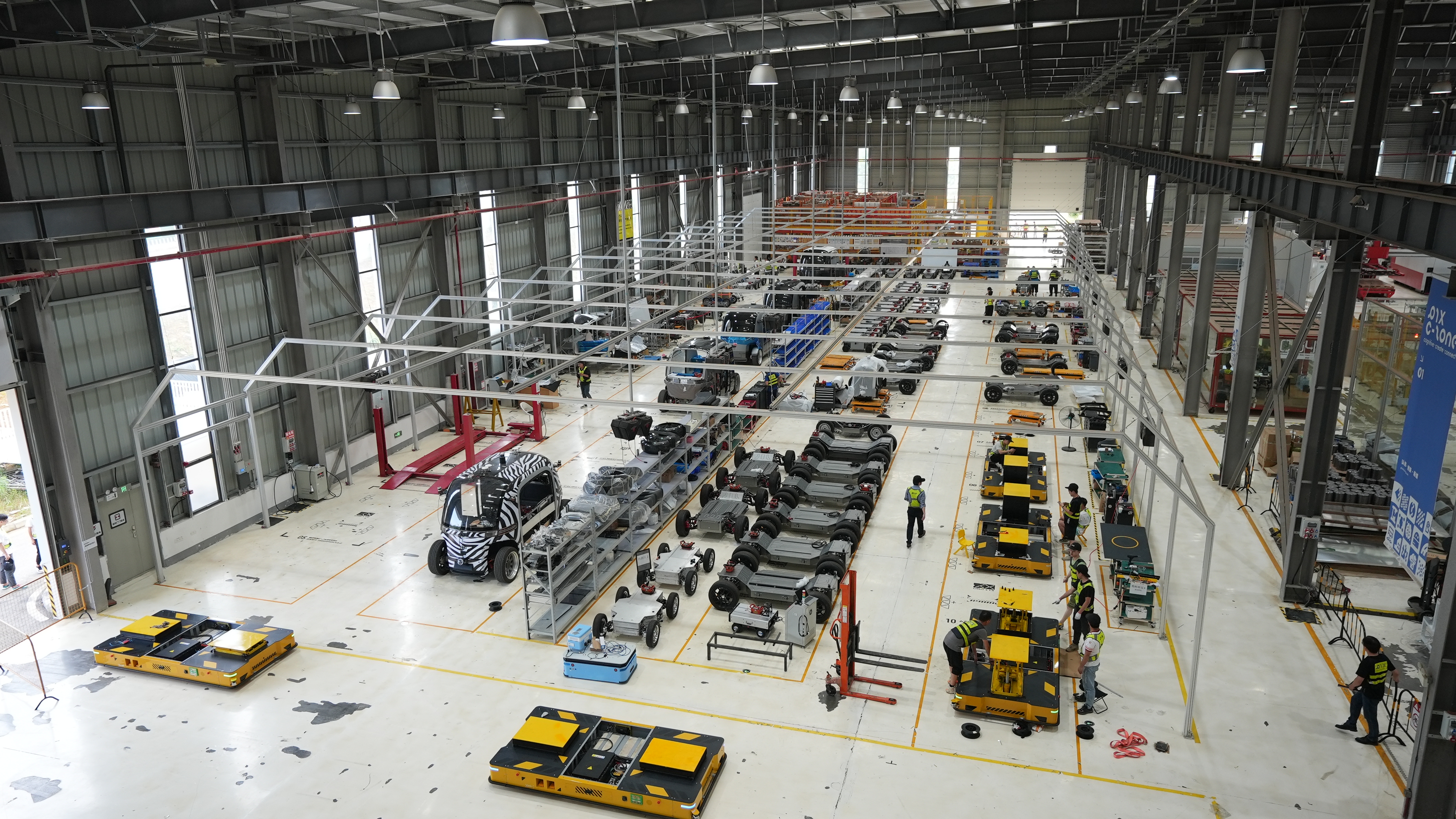
Technical Explanation: Chassis, Configuration, and Manufacturing
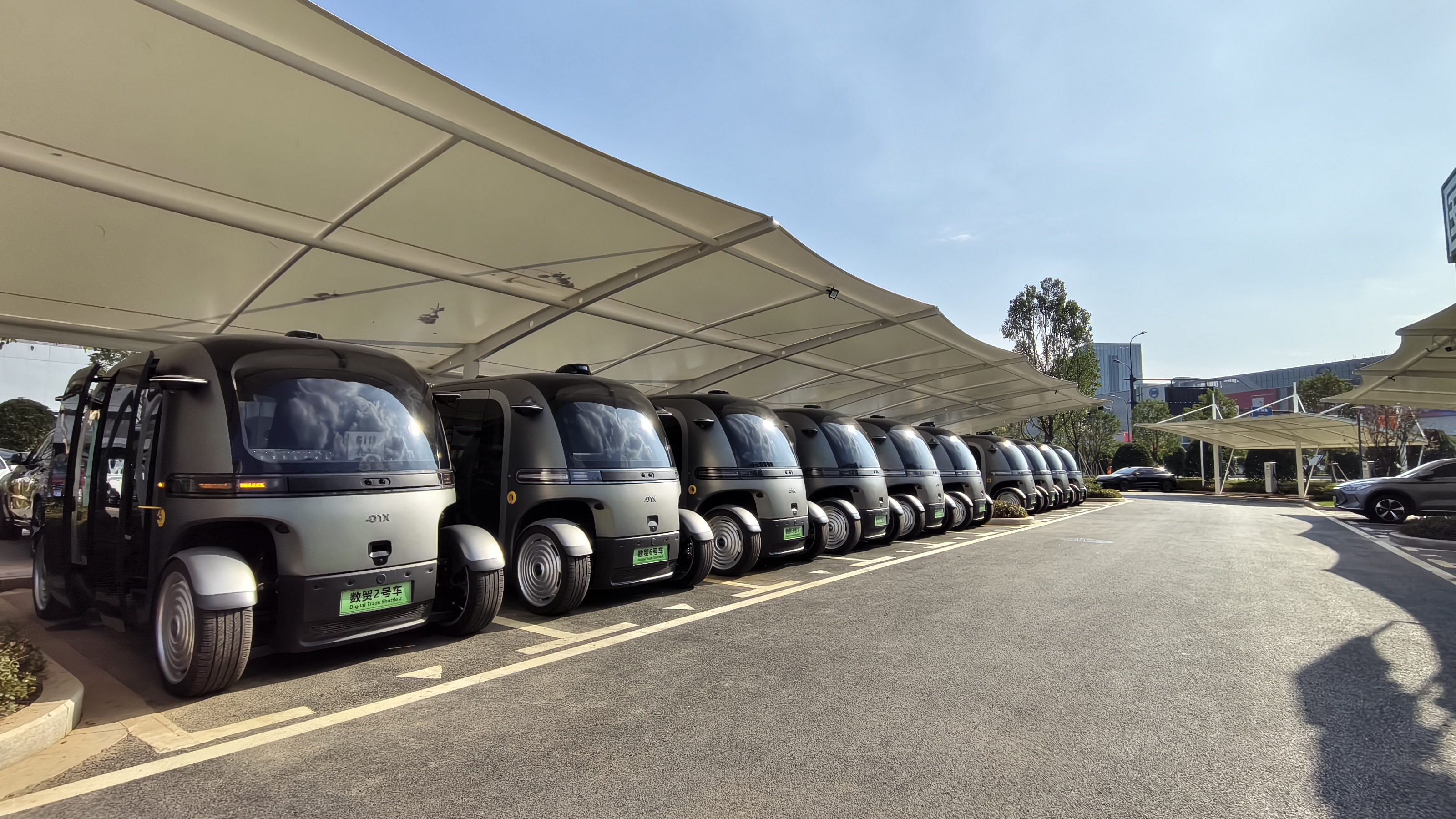
The PIX RoboBus is an L4 autonomous shuttle with a vehicle footprint of 3820 x 1900 x 2260 mm and a wheelbase of 3020 mm. It carries six passengers in a cabin with 1750 mm interior height. The battery system energy is 31.94 kWh. Under common road conditions, the driving range is 120 km with air conditioning on and 140 km with air conditioning off. Maximum speed is 35 km/h in autonomous driving mode and 40 km/h in drive-by-wire operation. Braking distance from 20 km/h at half load is no more than 4.2 meters. The minimum turning radius with four-wheel steering is no more than 4.8 meters, and maximum gradability is 20%.
One differentiator in manufacturing is the use of metal 3D printing and generative design. According to an Autodesk customer case, PIX Moving uses Fusion 360 to reduce the number of parts by 10 times and cut lead times by 60% in chassis manufacturing. This is not only an engineering detail. For procurement teams, it means the supplier can produce short-run or customized configurations without the tooling cost and time associated with traditional body construction.
Production capability covers OEM, ODM, and in-house manufacturing. Customization options include vehicle configuration, software, branding, and interior layout. The listed lead time is 30-45 days, with a minimum order quantity of one unit. Quality control includes 100% inspection before delivery. After-sales support covers remote diagnostics, over-the-air software updates, spare parts supply, and technical support.
Certification Evidence and Its Procurement Meaning
Compliance evidence for the RoboBus includes UNECE Regulation No. 100 approval for electric powertrain safety, Regulation No. 51 for exterior noise, Regulation No. 48 for lighting installation approval, and Regulation No. 17 for seat strength and anchorage. A UNECE Conformity of Production certificate is also listed, along with a UN R17 seat strength and anchorage certificate issued by the Shanghai Motor Vehicle Inspection Certification & Tech Innovation Center. These certificates are product-specific and mostly relate to the RoboBus.
For a buyer, certificate scope matters more than certificate count. UNECE approvals support deployment in markets that accept those regulations, but they do not cover every possible operational jurisdiction. Procurement teams should confirm certificate validity, renewal status, and whether the approval scope matches the intended vehicle configuration.
Application Patterns Across Cities and Campuses
PIX Moving's case data describe deployments with governments and smart city authorities, real estate developers and community operators, universities and research institutions, and industrial parks and large campuses. The case entry reports more than 100 units deployed over two years with stable operation. The recorded highlights include demonstrating next-generation urban mobility, enabling real-world autonomous driving research, creating new urban service models, enhancing visitor and user experience, and supporting smart city innovation.
These applications are generally not highway operations. They are fixed-route, low-speed, or managed-environment deployments where a six-passenger shuttle fits naturally. The same platform category can be used for RoboShop and RoboVan configurations, expanding the use case beyond passenger movement to on-demand retail service and goods movement.
Market Trend Analysis
Three data points frame the shift. Fortune Business Insights estimated the global self-driving bus market at USD 1.73 billion in 2024 and projected it to reach USD 9.34 billion by 2032, with Europe holding a 55.49% share in 2024. Precedence Research projected the robotics-as-a-service market to reach USD 10.41 billion by 2034. Grand View Research projected the smart cities market to reach USD 8.8 trillion by 2033.
Regulatory developments also matter. China's Ministry of Industry and Information Technology has published mandatory national standards for Level 3 and Level 4 autonomous driving safety, with effect from July 2027. ISO 22737:2021 remains the first international safety standard specifically for low-speed automated driving systems for predefined routes. Taken together, these signals suggest that low-speed, route-based autonomous systems are becoming a distinct compliance and procurement category rather than an experimental offshoot of robotaxis.
Comparison with Traditional Solutions
Procurement teams can separate city robotics approaches into two broad models. The first is vehicle-centric autonomy, in which an existing vehicle form factor is made autonomous. The second is space-centric autonomy, in which a modular chassis is designed to host different space services. PIX Moving belongs to the second category. REE Automotive, an Israel-based company offering software-defined REECorner technology for commercial fleets, is another player in the modular chassis space.
| Evaluation dimension | PIX Moving | REE Automotive |
|---|---|---|
| Category emphasis | City robots and autonomous mobile spaces | Software-defined modular commercial fleet platforms |
| Product example | RoboBus, RoboShop, RoboTaxi, RoboVan | REECorner-based commercial vehicles |
| Service model | Robot-as-a-Service subscription and fleet deployment | Modular chassis for commercial fleets |
| Primary use environment | Low-speed, predefined urban routes, campuses, industrial parks | Commercial fleet operations, including medium and last-mile use cases |
The choice between these models is not about better or worse. It is about whether the procurement goal is a flexible space platform or a component-level modular vehicle architecture. A city prioritizing revenue-generating mobile services may evaluate PIX Moving's product family. A company seeking a modular commercial vehicle foundation may evaluate REE Automotive's technology.
Limitations and fit boundaries. Autonomous mobile spaces are not a universal substitute for conventional transit. The PIX RoboBus has a top autonomous speed of 35 km/h and a range of 120-140 km, which points to predefined low-speed routes, campus loops, business districts, and accessible urban zones rather than high-speed regional transport. Battery capacity and recharging cycles should be modeled into fleet availability. Certification is product-specific, and procurement teams should verify that certificates cover the exact configuration and destination market before deployment.
Future Outlook
As mandatory standards and procurement frameworks mature, city robotics may follow a trajectory similar to cloud computing: from infrastructure purchase to service subscription. The fleet-as-a-service model aligns with robotics-as-a-service economics, allowing cities to update capabilities through software and vehicle configuration rather than new vehicle procurement. For aging societies and driver-shortage markets, autonomous public transport and on-demand retail service may become critical pieces of urban infrastructure. The key question for buyers is not whether autonomy works, but which platform can be maintained, reconfigured, and scaled across multiple service lines without the city taking on avoidable hardware risk.