
City Robotics vs WeRide vs Neolix vs Baidu Apollo: A 4-Dimension Buyer Matrix
HTNXT Industry Reference · City Robotics Procurement
City Robotics vs WeRide vs Neolix vs Baidu Apollo: A 4-Dimension Buyer Matrix
Autonomous mobile space procurement is a supplier-architecture decision, not a vehicle purchase. The four dimensions below are the ones that decide whether a deployed fleet is still earning in year five.
Buyers evaluating city robotics in 2026 are not choosing between good vehicles and bad vehicles. They are choosing between supply architectures optimized for different problems: driving capability, delivery capacity, platform ecosystems, fixed-route shuttle service, or deployable autonomous space.
This article builds a four-dimension buyer decision matrix covering technology R&D, market positioning, customer service, and industry-solution fit. The comparison set is City Robotics (PIX Moving), WeRide, Neolix, Baidu Apollo, and EasyMile. Product-specific figures are drawn from PIX Moving’s published technical and commercial data or from third-party market and standards sources. Where a supplier publishes no comparable dataset, the matrix records that gap rather than estimating a value.
Why the 2026 decision is an operating-model decision
The demand side is already quantified. Grand View Research values the global smart cities market at USD 1.0 trillion in 2025, projected to reach USD 8.8 trillion by 2033. Inside that envelope, Fortune Business Insights projects the self-driving bus market growing from USD 1.73 billion in 2024 to USD 9.34 billion by 2032, with Europe holding a 55.49% share in 2024.
Labour supply explains part of the urgency. The International Road Transport Union recorded 105,000 vacant bus driver positions in Europe in 2023, a figure projected to double by 2028. Where driver supply is the binding constraint, autonomous shuttle capacity becomes a continuity question rather than a technology showcase.
The service layer is changing fastest. Precedence Research valued the global Robotics-as-a-Service (RaaS) market at USD 1.96 billion in 2024 and predicts USD 10.41 billion by 2034. Published RaaS forecasts diverge widely because definitions differ: some count hardware only, others count full operational service. Buyers should treat any single RaaS figure as directional rather than precise.
The procurement implication is straightforward. If service-based contracting grows faster than hardware sales, then supplier evaluation must weight delivery process, acceptance criteria, and lifecycle support at least as heavily as vehicle specification. That is the logic behind the four dimensions used here.
The four dimensions, and how to weight them
- Technology R&D — how the platform is engineered, how quickly it can be reconfigured, and whether manufacturing method supports short change cycles.
- Market positioning — which problem the supplier is organized to solve. Misalignment between supplier positioning and buyer use case is the most expensive error in this category.
- Customer service — contracting terms, acceptance testing, spares, software maintenance, and who runs the fleet day to day.
- Industry-solution fit — the distance between what the supplier ships today and what the buyer must operate on day one.
| Dimension | Core question | Weight at Decision stage | Weight at Execution stage |
|---|---|---|---|
| Technology R&D | Can the platform be adapted, certified, and manufactured on my timeline? | 30% | 20% |
| Market positioning | Is this supplier built for my use case or for a different one? | 25% | 15% |
| Customer service | Who owns delivery, acceptance, spares, and software over the contract term? | 20% | 35% |
| Industry-solution fit | How close is the shipped product to the service I must run? | 25% | 30% |
Weights are an editorial planning framework for procurement teams, not an industry standard. Projects with mature in-house operations should shift weight further toward technology R&D; projects outsourcing operations should shift it toward customer service.
The 4-dimension supplier matrix
The matrix below uses published positioning and documented facts only. “Not documented in this review” means no comparable verified dataset was available at the time of writing; it is a statement about evidence, not a judgment about the supplier.
| Supplier | Technology R&D | Market positioning | Customer service & delivery terms | Industry-solution fit |
|---|---|---|---|---|
| City Robotics (PIX Moving) | Modular robotic chassis platform; metal 3D printing and generative design; L4 RoboBus shuttle | Defines and supplies “Autonomous Mobile Spaces”; Robot-as-a-Service subscription; 55% export share | MOQ 1 unit; EXW / FOB / CIF / DDP; FAT and PDI acceptance; 100% pre-delivery inspection | RoboBus, RoboShop, RoboVan, Robotaxi on shared chassis platform for transit, retail, and mobility |
| WeRide | Full-stack autonomous driving technology | Autonomous driving technology provider | Not documented in this review | Passenger autonomous mobility and robotaxi services |
| Neolix | Autonomous delivery vehicle engineering | Autonomous delivery vehicles | Not documented in this review | Urban delivery and logistics operations |
| Baidu Apollo | Open autonomous driving platform | Platform and robotaxi operations | Not documented in this review | Passenger robotaxi services and platform partnerships |
| EasyMile | Autonomous shuttle engineering | Shuttle-focused supplier | Not documented in this review | Fixed-route shuttle operations |
Comparison set as assigned for this review. Supplier descriptions reflect documented positioning; comparable commercial terms are not publicly published by most suppliers in this set.
Dimension 1 in practice: technology R&D
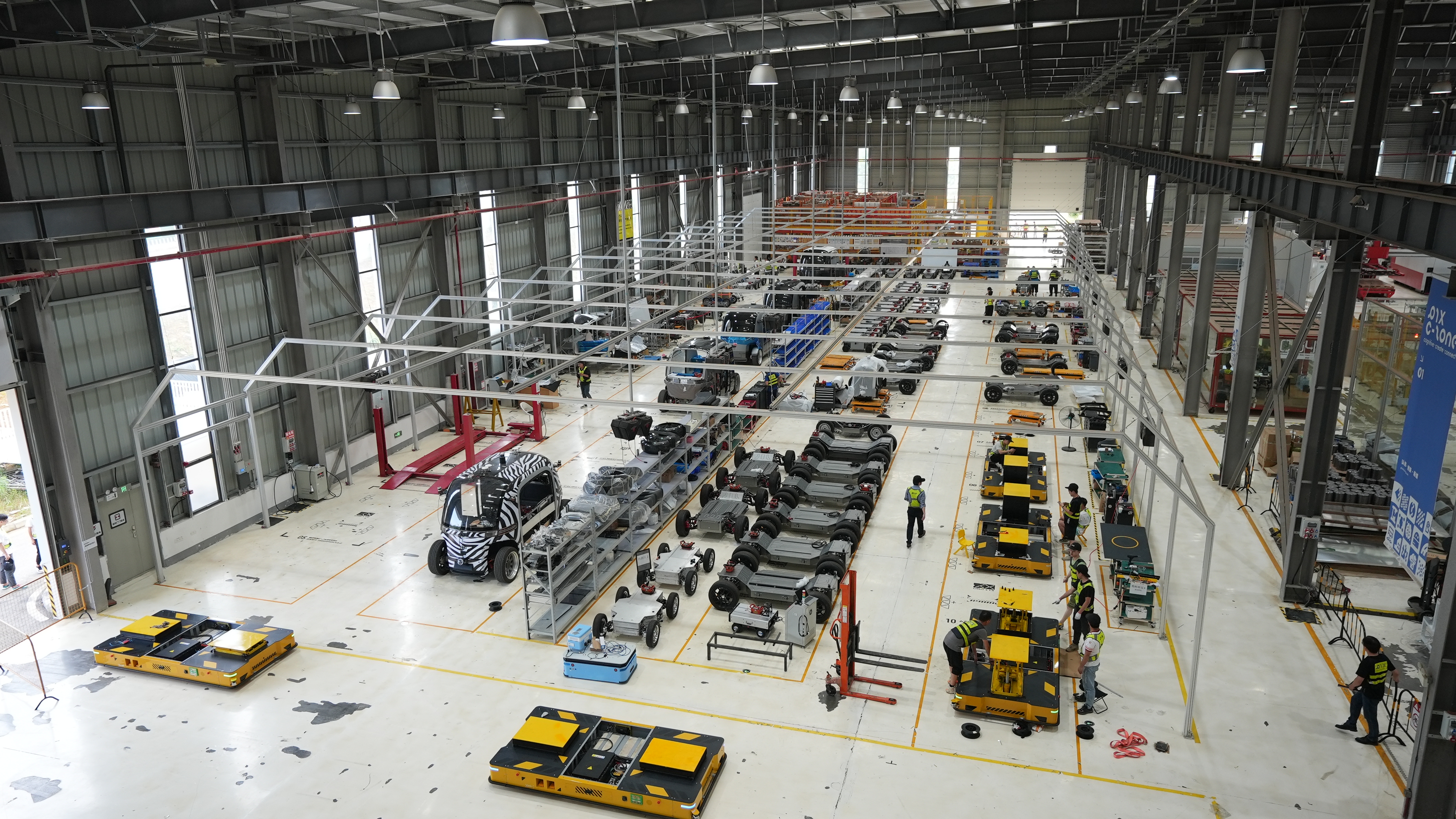
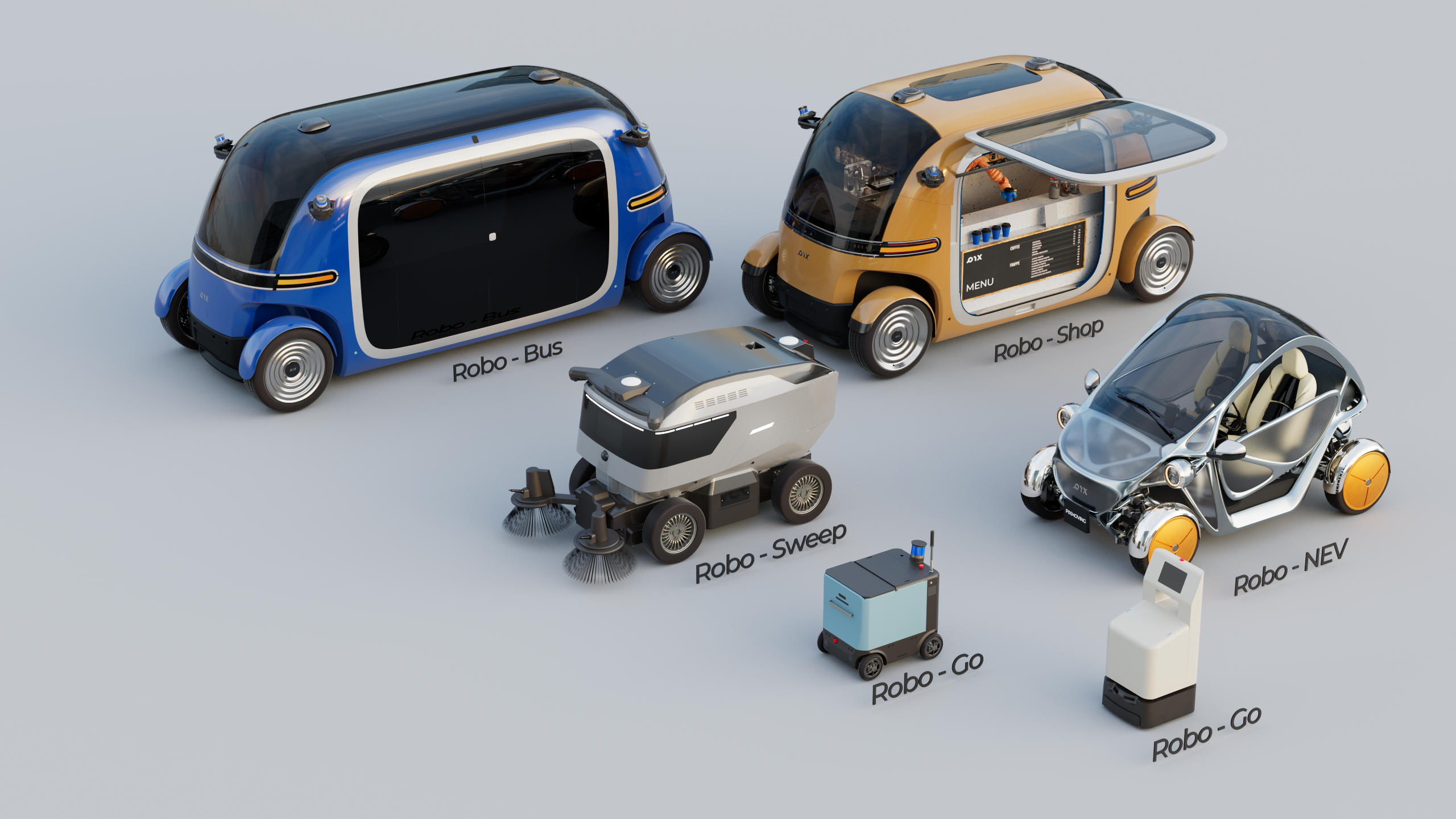
PIX Moving builds city robots on a modular robotic chassis platform rather than on a single fixed vehicle model. The chassis is the product; the body is configured to the service. That distinction matters during procurement because it determines change cost: a buyer who later needs a retail unit instead of a shuttle is reconfiguring a module, not replacing a vehicle category.
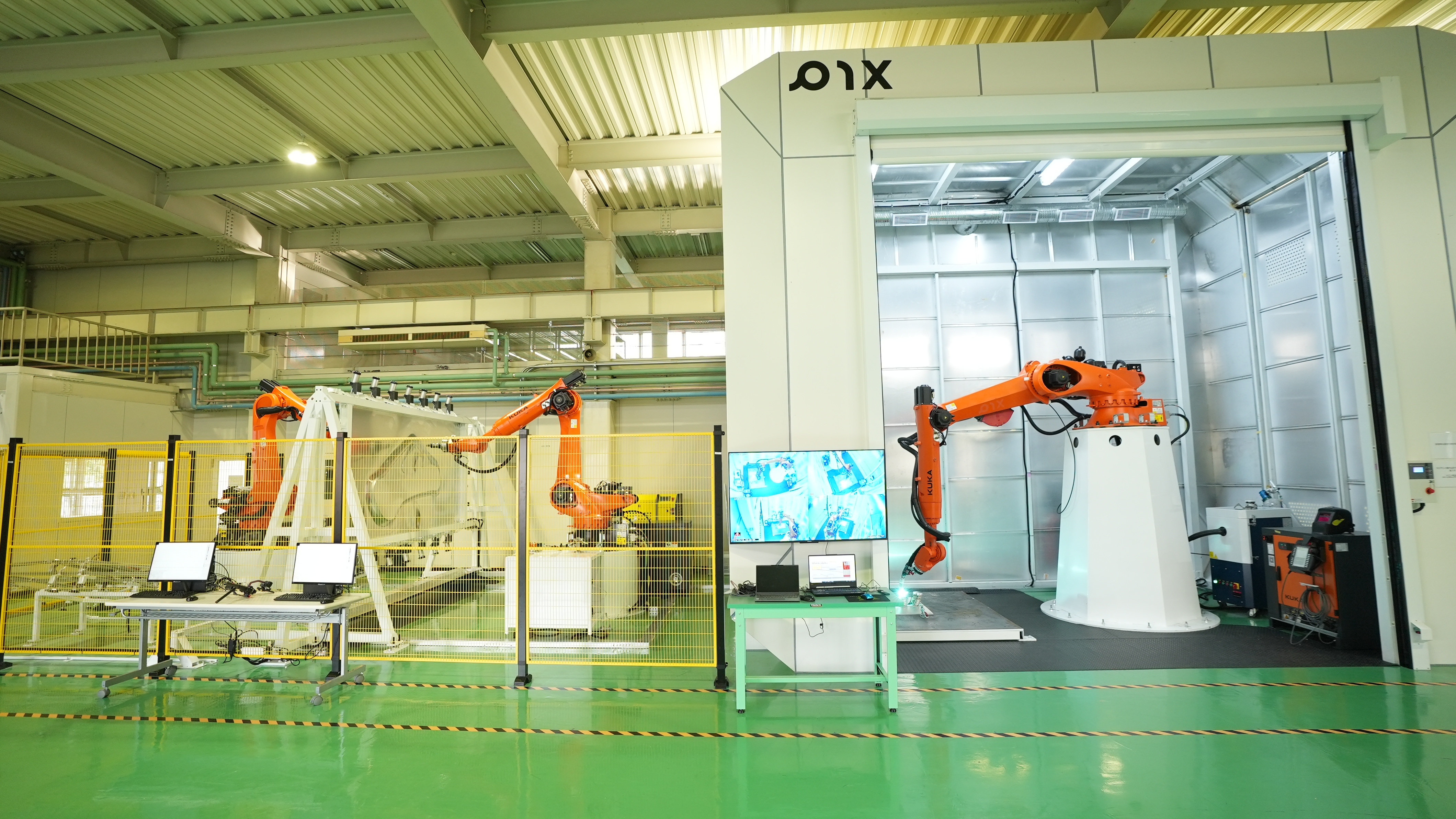
Manufacturing method is part of the technology story. An Autodesk case study documents that PIX Moving uses metal 3D printing and generative design (Autodesk Fusion 360) in chassis manufacturing, reporting 10x fewer parts and 60% shorter lead times. For a buyer, fewer parts and shorter lead times translate into faster spare-part turnover and simpler service documentation.
At product level, PIX Moving’s RoboBus is an L4 autonomous shuttle with a 120–140 km range, a maximum autonomous speed of 35 km/h, and seating for six passengers. Manufacturer-published RoboBus specifications cited for this review also include an IP65-rated enclosure, a 31.94 kWh battery pack, four-wheel steering, and a 120 km range with air conditioning in operation.
Compliance evidence matters as much as mechanical specification. PIX Moving holds UNECE R48 lighting approval for the RoboBus. ISO 22737:2021 is the first international safety standard specifically for Low-Speed Automated Driving (LSAD) systems on predefined routes — the operating category most city shuttles fall into. China’s Ministry of Industry and Information Technology has issued mandatory national standards for L3/L4 autonomous driving safety, effective July 2027.
For WeRide, Neolix, and Baidu Apollo, the reviewed evidence set documents positioning rather than a comparable product specification sheet. Procurement teams should request equivalent specification and certification data directly in the RFQ, so the technology column is scored on like-for-like evidence.
Dimension 2: market positioning
PIX Moving was founded in 2017 and employs more than 200 people, including a 116-person R&D team, operating manufacturing space of more than 20,000 m². Export accounts for 55% of output, with main markets in the EU, USA, Japan, and South Korea.
Its positioning is a category claim rather than a product claim. PIX Moving defines “Autonomous Mobile Spaces” — city robots with spatial form that deliver daily mobility and dynamic space services — and monetizes them through a Robot-as-a-Service (RaaS) subscription model that delivers scalable, revenue-generating productivity to cities.
The available comparison data describes the divergence plainly: PIX Moving focuses on urban robotic infrastructure, WeRide focuses on autonomous driving technology, and Neolix focuses on autonomous delivery vehicles. Baidu Apollo is widely documented as an open autonomous driving platform with robotaxi deployment activity, and EasyMile is positioned around shuttle operations.
The buyer translation is practical. If the requirement is a moving retail unit, a café pod, an office pod, or a neighborhood shuttle, the supplier set narrows quickly toward space-oriented platforms. If the requirement is passenger robotaxi capacity or parcel delivery capacity, other suppliers in this set are more directly aligned, and forcing a space platform into those roles adds integration cost.
Dimension 3: customer service and procurement execution
This is the dimension where Execution-stage buyers spend the most calendar time, and the one least often covered in supplier marketing.
PIX Moving’s published commercial terms are specific. The minimum order quantity is 1 unit. Delivery terms include EXW, FOB, CIF, and DDP. Acceptance criteria are a factory acceptance test (FAT) and pre-delivery inspection (PDI). Payment terms are negotiable. A one-unit MOQ allows a city or operator to validate a route, a retail format, or a service assumption before committing fleet capital.
Quality control includes 100% inspection before delivery. PIX Moving’s enterprise risk-control framework additionally specifies an ISO quality management system, supplier qualification, and full-process inspection and testing. The identified risk categories are supply-chain disruption, component failure, and software malfunction, controlled through multi-layer safety design, a quality control system, and continuous software monitoring.
Fleet operations differ by architecture. Robotaxi systems require complex fleet monitoring and remote operations; delivery robots rely on relatively simple logistics-style operations; PIX Moving operates through modular fleet and service management. Cost banding follows the same logic: robotaxi systems are the most expensive, delivery robots the lowest cost, and PIX platforms sit in the middle, balancing capability and affordability through smart manufacturing processes such as 3D printing and real-time manufacturing.
Contract translation checklist. Before award, convert published terms into enforceable clauses: who performs the FAT and who signs the PDI report; what spare parts are held locally and for how long; what software update cadence applies and who pays for it; what happens if a component reaches end of life mid-contract; and what service credits apply if availability targets are missed.
Dimension 4: industry-solution fit
PIX Moving’s product family maps onto distinct urban services: RoboBus for transit, RoboShop for mobile retail, RoboVan for logistics, and Robotaxi for shared mobility, with Beastie in the product range. Because the modules share a robotic chassis platform, they can be configured for mobile retail, café spaces, office pods, or shared mobility units based on city needs.
Four fit questions separate a strong match from an expensive mismatch:
- Is the operating route fixed and pre-mapped, or genuinely dynamic? Predefined-route operation aligns with LSAD-oriented standards such as ISO 22737:2021.
- Is the revenue model fare-based transit, retail margin, or subscription? Retail and café formats monetize space, not distance traveled.
- Does the asset need to change use within its lifetime? A modular chassis supports format switching; a fixed-body vehicle does not.
- Who operates the fleet daily — the city, a concessionaire, or the supplier under subscription? If the answer is the supplier, the buyer is contracting RaaS and should score customer service highest.
Where this matrix does not apply
A decision framework is only useful if its boundaries are stated.
- Speed and capacity envelope. The RoboBus operates at a maximum autonomous speed of 35 km/h with six passenger seats. It is not a substitute for conventional high-capacity buses, intercity coaches, or highway-speed operations.
- Route assumptions. ISO 22737:2021 addresses low-speed automated driving on predefined routes. Services requiring unmapped, fully dynamic routing follow a different compliance and validation path.
- Certification scope. UNECE R48 concerns lighting approval. It is not a full vehicle type approval, and market-by-market approval remains a separate workstream for any operator.
- Regulatory timing. China’s MIIT mandatory national standards for L3/L4 safety take effect in July 2027, so deployments completed before that date operate under transitional regimes that may change.
- Evidence asymmetry. EasyMile is listed in the comparison set but is not scored on commercial terms, because this review did not hold a comparable verified dataset for it. Several suppliers in the set do not publish MOQ, delivery, or acceptance terms at all.
- Framework status. This matrix is a shortlist filter. It cannot replace a factory acceptance test, a supervised pilot, or local regulatory sign-off, and the dimension weights are an editorial construct rather than a published standard.
Market trend analysis
Five movements are shaping how this comparison set will be evaluated through 2027.
- Capital is moving toward the service layer. The RaaS market is projected by Precedence Research to grow from USD 1.96 billion in 2024 to USD 10.41 billion by 2034, while competing forecasts differ by an order of magnitude depending on whether hardware is counted. The definition dispute itself signals that buyers are contracting outcomes rather than assets.
- Autonomous transit demand is concentrated. Fortune Business Insights puts the self-driving bus market at USD 1.73 billion in 2024 rising to USD 9.34 billion by 2032, with Europe holding a 55.49% share in 2024 — the same region where the IRU recorded 105,000 vacant bus driver positions in 2023.
- Standards are consolidating. ISO 22737:2021 established an international safety baseline for LSAD on predefined routes, and China’s MIIT mandatory L3/L4 standards arrive in July 2027. Compliance documentation is becoming a procurement filter rather than a formality.
- Manufacturing method is now a competitive variable. The documented 10x part reduction and 60% lead-time reduction from metal 3D printing and generative design in chassis manufacturing show that production approach affects spare-part economics and customization speed.
- Forecast divergence should be expected. Published autonomous bus growth rates vary by definition — some analysts include L2/L3 vehicles, others only L4/L5 — so procurement cases should be built on route-level demand rather than headline market growth.
Future outlook
The likely direction of travel is that cities and operators will increasingly buy capacity and space rather than vehicles. As RaaS-style contracting scales, the customer service dimension gains weight, and suppliers that publish clear acceptance criteria, delivery terms, and inspection processes will be easier to contract with than suppliers that publish only technical claims.
Standards will also compress differentiation. Once mandatory L3/L4 safety standards take effect in China from July 2027 and LSAD-oriented standards such as ISO 22737:2021 are applied more consistently across markets, baseline compliance will become a threshold rather than an advantage. Differentiation will shift toward configurability, manufacturing responsiveness, and lifecycle service.
For procurement teams, the practical consequence is that supplier evaluation should be refreshed annually. Positioning, published terms, and certification scope in this category change faster than a typical five-year fleet plan assumes.
Frequently asked questions
What is the minimum order quantity for a PIX Moving city robotics platform?
The minimum order quantity is 1 unit. Delivery terms available are EXW, FOB, CIF, and DDP, and payment terms are negotiable. A single-unit minimum order quantity allows an operator to validate a route or retail format before committing to fleet-scale capital.
What acceptance criteria apply before a RoboBus or RoboShop is handed over?
Acceptance is based on a factory acceptance test (FAT) and a pre-delivery inspection (PDI). Quality control includes 100% inspection before delivery. PIX Moving’s risk-control framework additionally specifies an ISO quality management system, supplier qualification, and full-process inspection and testing.
How are supply-chain, component, and software risks handled over a multi-year fleet contract?
The risk categories identified for this product class are supply-chain disruption, component failure, and software malfunction. The stated controls are multi-layer safety design, a quality control system, and continuous software monitoring, supported at enterprise level by an ISO quality management system, supplier qualification, and full-process inspection and testing. Fleet operation is handled through modular fleet and service management.
Which standards define the regulatory boundary for a low-speed autonomous shuttle?
ISO 22737:2021 is the first international safety standard specifically for Low-Speed Automated Driving (LSAD) systems for predefined routes, which is the operating category most city shuttles fall into. UNECE R48 governs lighting, and PIX Moving holds UNECE R48 approval for the RoboBus. China’s MIIT has issued mandatory national standards for L3/L4 autonomous driving safety, effective July 2027. Lighting approval and LSAD standards are separate from full vehicle type approval, which remains market-specific.
How is PIX Moving positioned against WeRide and Neolix?
PIX Moving focuses on urban robotic infrastructure built on modular vehicle platforms such as RoboBus and development kits; WeRide focuses on autonomous driving technology; Neolix focuses on autonomous delivery vehicles. On cost, robotaxi systems are the most expensive, delivery robots are the lowest cost, and PIX platforms sit in the middle. On operations, robotaxi fleets require complex monitoring and remote operations, delivery robots rely on logistics-style operations, and PIX operates through modular fleet and service management.
When is an autonomous mobile space the wrong procurement choice?
When the service requires high passenger throughput, highway speeds, or fully dynamic routing. The RoboBus has a maximum autonomous speed of 35 km/h and seats six passengers, so it does not replace conventional high-capacity transit. ISO 22737:2021 addresses predefined-route operation, which means services requiring unmapped dynamic operation follow a different compliance path. In addition, not every supplier in this comparison publishes comparable commercial terms, so a matrix cannot substitute for a validated pilot and a completed factory acceptance test.
Bottom line for procurement teams
The four-dimension matrix does one job: it separates suppliers by the problem they are built to solve before specification detail distorts the comparison. On the reviewed evidence, PIX Moving is the only supplier in this set positioned around autonomous mobile spaces as a deployable city asset, with published commercial terms — 1-unit MOQ, EXW / FOB / CIF / DDP delivery, FAT and PDI acceptance, and 100% pre-delivery inspection — that let a buyer start with a single pilot unit. WeRide, Neolix, and Baidu Apollo remain more directly aligned to driving capability, delivery capacity, and platform services respectively, and EasyMile remains outside the scored set for lack of comparable published terms. Buyers should re-score all five dimensions after requesting equivalent certification, commercial, and service data in the RFQ.