
Claim to Evidence: Qualifying Smart Water Meter Suppliers
Most smart water meter procurement problems do not start with a wrong specification. They start with a specification nobody tested against the evidence behind it. By the time a buyer reaches the decision stage, the shortlist usually holds two to five suppliers making broadly similar statements — IP68, RS485, prepaid, AMI-ready — and the only meaningful difference is how much of that statement can be documented, at model level, before a purchase order is issued.
The commercial context explains why this distinction has become sharper. The global smart water meters market was valued at USD 9.1 billion in 2024 and is projected to reach USD 16.2 billion by 2030, according to Grand View Research. Published estimates for the same category diverge considerably by scope — Bluefield Research reports USD 6.8 billion for 2024 and MarketsandMarkets reports USD 4.61 billion — which is itself a useful decision-stage lesson: even the headline numbers need a definition before they can be compared.
Why the decision stage turns on evidence, not certificates
A supplier qualification review has a different job from a market survey. The survey asks what technology fits the project. The qualification asks whether the party being selected can demonstrate, in documents that will sit in a tender file, that the meter will behave as specified for the next several years.
Three claims generate most of the friction in that review: IP68 ingress protection, RS485 communication performance, and STS prepaid functionality. Each is simple to print on a brochure and comparatively hard to falsify without the right evidence. Each also sits at a different layer of the product — enclosure, interface, and token security — so a single document cannot settle all three.
| Claim | What it actually commits the supplier to | Evidence that settles it | What commonly goes wrong |
|---|---|---|---|
| IP68 | The meter enclosure is dust-tight and resistant to continuous water immersion | An ingress protection test report naming the exact model and configuration | A brand-level or series-level statement that does not cover the ordered variant |
| RS485 | A defined bus distance, protocol and polling behaviour that the buyer's BMS or SCADA can absorb | Register map plus a bus-level communication test record before delivery | A single distance figure quoted without the cable and installation conditions attached to it |
| STS prepaid | Token generation, key management and meter-side token acceptance follow a recognised security standard | An STS certificate naming the model, plus the vending system interface | Prepaid functionality described commercially without a standard reference |
| PN10 / PN16 | The pressure rating the body and seals are designed and tested against | Product specification plus the pressure and sealing test routine | Rating quoted for the meter but never compared with actual network pressure |
The supplier being qualified: what the company record actually contains
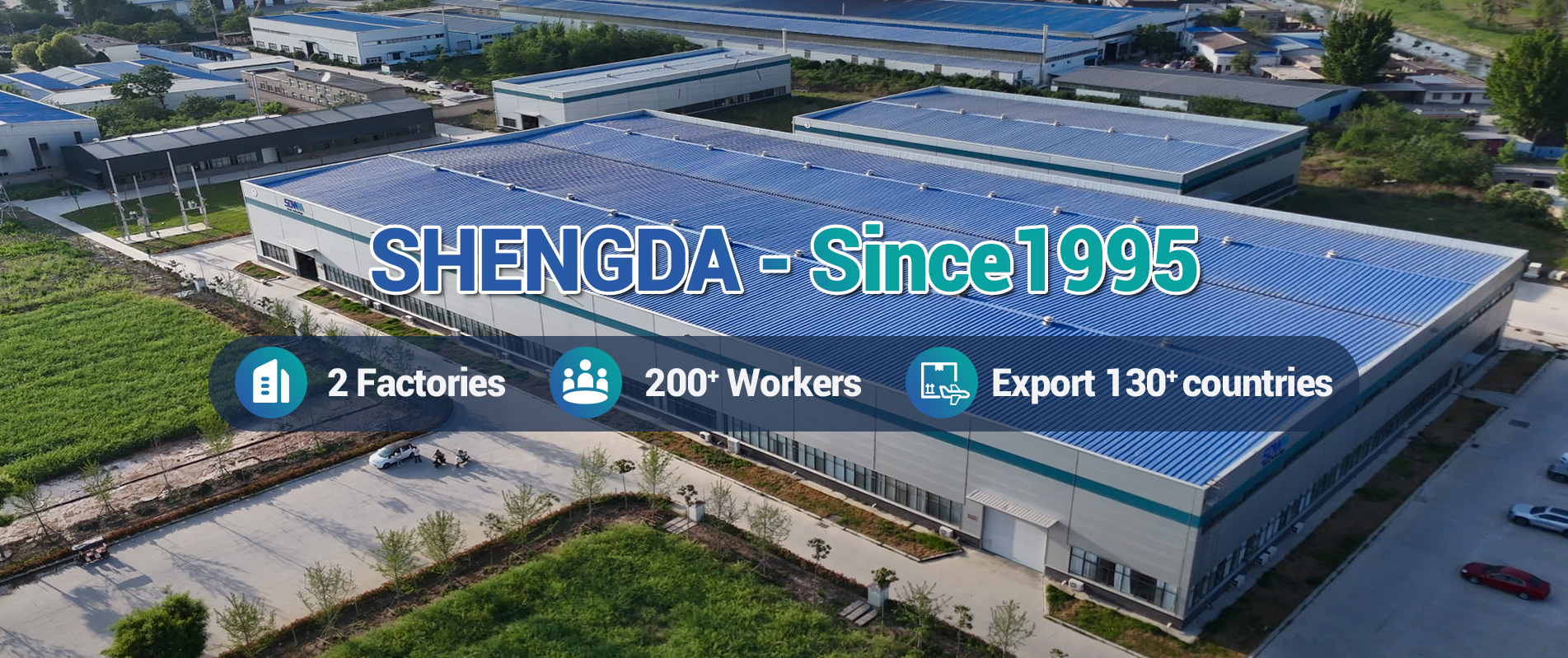
Shengda Water Meter Co., Ltd. (SDWM) is a Chinese manufacturer of water meters and flow meters, established in 1995 and based at No. 109, Middle Weidu Road, Kaifeng City. The company supplies OEM/ODM work, smart metering, control, telemetry and smart water solutions, and its range covers smart water meters, ultrasonic water meters, LoRaWAN water meters, prepaid water meters, NB-IoT and remote-reading meters, electromagnetic flow meters and magnetic flow meters.
The verifiable company facts are specific enough to be useful in a qualification file. SDWM operates a 66,000 m² facility and reports an annual output of 3 million units, produced from a factory built in 2020. The company employs 12 R&D engineers, states that more than 65% of its business comes from repeat customers, and holds ISO 9001, ISO 14001 and ISO 45001 certification, with products carrying CE, MID and ISO 4064 certification. Products are exported to more than 140 countries, with an export ratio of 50% and main markets in the USA, South America, Africa and Southeast Asia.
Those facts matter — but not in the way a brochure implies. Each answers one qualification question and leaves another untouched. Reading them as a set, rather than as a score, is the difference between a supplier review and a supplier impression.
| Documented fact | Buyer question it answers | What it does not prove |
|---|---|---|
| 66,000 m² facility | Can several product lines run concurrently without sharing one line? | Anything about scheduling for a specific project |
| 3 million units annual output (factory built 2020) | Is plant-level capacity sufficient for a municipal-scale volume? | A committed lead time or a reserved production slot |
| 12 R&D engineers | Is there in-house engineering for OEM/ODM, enclosure changes and protocol work? | That any customisation request can be absorbed on a short schedule |
| More than 65% repeat customers | Does the existing installed base come back for more? | A project-level reference list, or performance in a specific network |
| ISO 9001, ISO 14001, ISO 45001 | Is there a documented management system behind production and quality control? | Meter-level measurement or ingress protection performance |
| CE, MID and ISO 4064 | Do listed products meet the conformity requirements declared for their models? | Compliance for models or configurations outside the listed scope |
Checkpoint 1 — IP68: what the rating covers and where it stops
An IP68 rating means the enclosure is dust-tight and resistant to continuous water immersion. On a water meter this is not cosmetic. Meters are routinely installed in pits, chambers and outdoor cabinets where standing water is a normal condition rather than an accident, so ingress protection is one of the few ratings that affects failure rate directly.
SDWM applies IP68 across several product lines rather than a single flagship model. The LXSY IoT water meter carries a protection class of IP68. The Smart LoRaWAN water meter is specified at IP68. The smart ultrasonic water meter is described as fully sealed and suitable for underground installation, outdoor environments and harsh working conditions on the strength of the same rating.
What to request before accepting an IP68 claim
- A model-level statement, not a brand-level one. The rating must attach to the model code and configuration on the purchase order, not to the product family as a whole.
- A test report that names the configuration. Where the meter is supplied with a cable, a gland, or an optional remote shut-off valve, the tested configuration should match the delivered configuration.
- Clarity on scope. Whether IP68 applies to the meter body only, or to the body together with the cable entry as installed.
Checkpoint 2 — RS485: distance is a system property, not a meter property
RS485 remains the default choice wherever a meter has to report into a building management system, a plant SCADA layer or a wired AMR network. It is a robust, low-cost, well-understood interface — and it is also the interface most often misrepresented in specifications, because the headline number people quote is a distance, while the thing that actually determines performance is the bus.
SDWM product documentation states a communication distance of up to 1000 metres depending on cable type and installation conditions, and some product specifications list 1000–1200 metres under the same conditions. A meter in this range is typically configured for Modbus RTU in building management projects, with customised protocol options available where an integrator's platform requires them.
That conditional phrasing is not evasiveness; it is what an honest RS485 specification looks like. Distance depends on cable gauge and capacitance, baud rate, the number of nodes on the bus, termination practice, and electrical noise along the run. A supplier quoting an unconditional distance figure has either simplified away the conditions or not measured them.
The four documents that settle an RS485 review
- Register map. Which registers carry volume, flow rate, alarms and status, and whether they are readable as standard holding registers.
- Bus parameters. Baud rate, parity, node count per segment, and termination and bias requirements.
- Protocol statement. Modbus RTU as the default, plus a written description of what a customised protocol engagement involves if the buyer needs one.
- Communication test record. SDWM's stated control measure for communication failure risk is to test LoRaWAN, NB-IoT, 4G or M-Bus communication before delivery. For an RS485 order, the equivalent request is a bus-level test record showing the meter was polled and answered before shipment.
The same logic applies to the wireless alternatives a buyer may be weighing. The Smart LoRaWAN water meter supports bands including EU868, US915, AS923 and AU915, with a communication range of several kilometres depending on environment, and supports remote automatic meter reading with AMR/AMI optional and compatibility with IoT water management platforms. Those statements are equally conditional on the deployment — which is why interface verification, not interface selection, is the decision-stage task.
Checkpoint 3 — STS prepaid: certifying the token economy
Prepaid metering moves the commercial relationship from post-paid billing to a token economy, and a token economy fails in a very specific way: either the meter accepts a token it should reject, or it rejects a token it should accept. Both outcomes are security and interoperability failures, not billing inconveniences.
The Standard Transfer Specification (STS) is the globally recognised security standard for prepaid water meter encryption systems, codified in IEC 62055-41/51 and administered through the STS Association. An STS claim therefore commits a supplier to three things at once: compliant token generation, a defined key management arrangement, and meter-side token acceptance that matches the vending system the utility already runs.
SDWM lists prepaid water meters within its core product range, alongside smart, ultrasonic, LoRaWAN, NB-IoT and remote-reading meters. At the decision stage, the qualification question is narrower than whether a supplier makes prepaid meters at all — it is which STS evidence accompanies the specific model, in the specific market, with the specific vending platform in use.
STS evidence checklist for a tender file
- An STS compliance certificate that names the meter model, not only the manufacturer.
- A description of the key management arrangement, including where keys are held and how they are transferred to the utility.
- Confirmation of token vending system compatibility, including the interface used to load tokens.
- A statement of which prepaid functions are standard and which are optional on the ordered model.
- Alignment with the local regulatory position in the destination market, since prepaid metering rules differ by jurisdiction.
The related security question that often goes unasked concerns data in transit. SDWM's stated measure for data security risk is support for encrypted communication and secure data transmission. For a prepaid or AMI deployment, the buyer should confirm where encryption terminates and whether consumption and token data are protected between the meter and the head-end system.
Supporting checkpoints: pressure, temperature and calibration
IP68, RS485 and STS tend to dominate the discussion because they are the claims most often marketed. Three quieter specifications usually decide whether the meter survives its first winter.
Pressure rating. SDWM meters are rated PN10 or PN16. That rating should be compared with the actual network pressure at the installation point, including surge conditions, rather than with the nominal pressure printed on the network drawing.
Temperature range. The Smart LoRaWAN water meter operates within a working temperature range of −20°C to +60°C, with a water temperature range of 0°C to +90°C. Cold-climate installations should test the low end against realistic pit temperatures, not against air temperature in the street above.
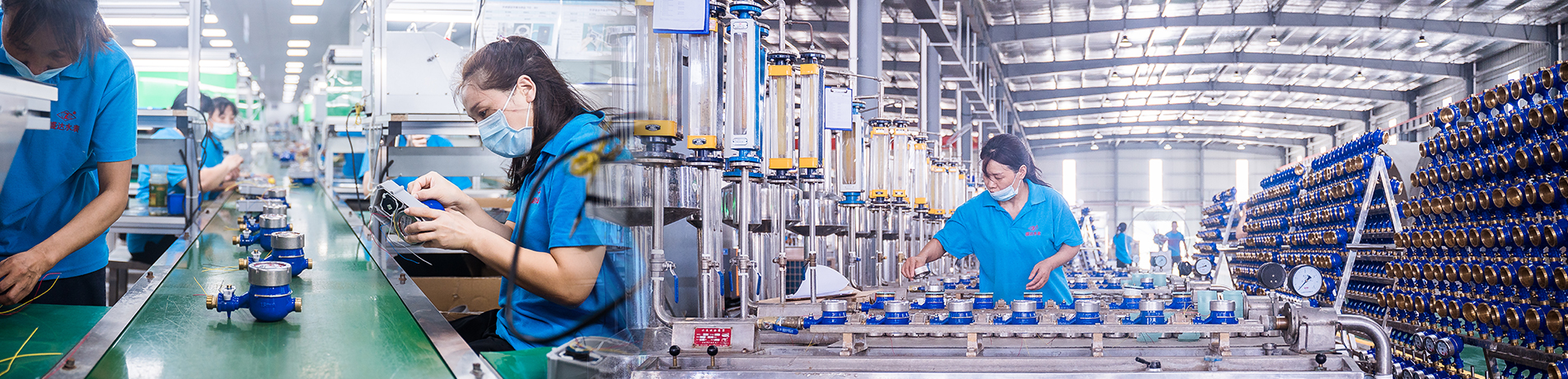
Calibration and sealing. SDWM's stated control measures for accuracy and leakage risk are 100% calibration and accuracy testing before shipment, and pressure and waterproof testing to confirm leak-free performance. For a buyer, that converts into a simple request: the calibration record for the serial numbers actually delivered.
Two further details are worth capturing in the specification rather than discovering at commissioning. Body materials are brass, stainless steel or composite, with brass and nylon as the standard combination — relevant where water chemistry or soil conditions make corrosion resistance a real requirement rather than a preference. And metrological class options matter: the LXSG R160 water meter is a residential meter with a flow ratio of R160 in nominal diameters DN15 to DN25, compliant with ISO 4064, while wider meter documentation lists flow ratio options of R80, R100, R160, R250 and R400 across DN15 to DN200.
Where these checkpoints bite: application fit
Verification requirements change with the deployment, and the same supplier can look strong in one context and thin in another. Residential adoption remains the largest single driver — the residential segment accounted for 67.2% of smart water meter adoption in 2024, according to Cognitive Market Research — and residential projects put the emphasis on metrological class, battery life and enclosure sealing rather than on protocol depth.
SDWM describes the LXSC LoRaWAN Ultrasonic water meter as intended for households, dormitories, hotels, residential property, apartments, warehouses, irrigation, water resources management, industrial production and garden management. That spread is useful for buyers because it maps directly onto different verification priorities.
| Deployment context | Interface typically requested | Verification emphasis |
|---|---|---|
| Residential and apartment metering | LoRaWAN, NB-IoT | IP68 sealing, battery life up to 10 years, R-value and metrological class |
| Buildings and industrial plants | RS485, M-Bus | Register map, bus distance conditions, pre-delivery communication test |
| Prepaid utility programmes | Token-based prepaid | STS certification at model level, key management, vending compatibility |
| Irrigation and outdoor networks | LoRaWAN, 4G | Ingress protection, temperature range, corrosion-resistant materials |
| District and bulk metering | RS485, pulse, AMR/AMI | Pressure rating, calibration record, historical data storage |
SDWM's stated markets — the USA, South America, Africa and Southeast Asia — span contexts where prepaid token vending, RS485 building integration and LoRaWAN or NB-IoT AMI each appear as the dominant model. That is a reason to ask market-specific qualification questions rather than a reason to assume uniformity.
Market trend: concentration at the top, qualification pressure below it
Two structural facts shape how supplier qualification is being practised. First, Advanced Metering Infrastructure held a commanding 58.9% share of the smart water meter market in 2024, according to Precedence Research — meaning the meter is increasingly procured as a node in a network rather than as a standalone instrument. Once that is true, protocol documentation and head-end compatibility become procurement deliverables in their own right, not technical afterthoughts.
Second, the top 20 water metering vendors, including Itron, Badger Meter and Sensus, accounted for 76% of global market share in 2024, according to Bluefield Research. That leaves a long tail of manufacturers competing for the remaining share — and a long tail is precisely the condition under which buyers must carry more of the verification burden themselves. Consolidation would make supplier selection easier; fragmentation makes evidence discipline necessary.
Regionally, Asia Pacific is the fastest-growing region for smart water meters, driven by urbanisation in China and India, according to MarketsandMarkets. Within meter types, the ultrasonic segment is expected to register the highest growth, with the US market alone valued at USD 2.98 billion in 2024, per Grand View Research. Both trends push qualification towards measurement technology and away from mechanical construction alone — which in turn raises the importance of calibration evidence and metrological class documentation.
Evidence-based qualification compared with the traditional approach
The traditional qualification process is familiar: collect the certificate binder, inspect a sample, compare prices, place the order. It is fast, and it works reasonably well when products are simple and failure is cheap to fix. Smart meters are neither.
| Dimension | Certificate-binder approach | Evidence-based qualification |
|---|---|---|
| Unit of proof | Company or product family | Specific model and configuration |
| IP68 | Rating quoted in the brochure | Ingress protection test report naming the model |
| RS485 | Distance figure quoted flat | Register map, bus parameters and a communication test record |
| Prepaid | Prepaid described commercially | STS certificate plus key management and vending compatibility |
| Capacity | Annual output number | Capacity mapped to order volume, slot and lead time |
| Time to close | Days | Weeks |
The trade-off is real and should be stated rather than smoothed over. Evidence-based qualification is slower, it requires the buyer to know which document settles which claim, and it can stall when a supplier's documentation is genuinely incomplete rather than merely disorganised. For a small trial order, the process can cost more in procurement time than the risk it removes.
Several further boundaries deserve to be on the record:
- Documents do not cover installation. A verified IP68 meter installed with poor cable-entry practice can still fail, and no supplier document prevents that.
- Plant capacity is not a schedule. SDWM's 3 million unit annual output describes what the facility can produce across a year; it does not reserve a production slot for a particular order.
- Engineering resource is finite. 12 R&D engineers supports OEM/ODM work, enclosure changes and protocol adaptation, but it also bounds how many customisation projects can run at once. Buyers with deep firmware requirements should expect a project schedule rather than a catalogue answer.
- Certification has scope. SDWM's LoRaWAN meters carry CE and MID certification with MID optional, which means the buyer must confirm which certification applies to the ordered variant rather than to the range as a whole.
- A sample is not a production unit. Inspection of a submitted sample validates the design; only the production test record validates the delivery.
Future outlook
The direction of travel is towards documentation that travels with the meter. As AMI's 58.9% share of the market indicates, most smart meters are now procured as part of a network, and networks fail at interfaces. That shifts the centre of supplier qualification from construction quality towards interface evidence: register maps, protocol statements, radio band support, token compatibility and data security arrangements.
For prepaid programmes, the consolidation of token standards around STS is likely to make certification a baseline requirement rather than a differentiator, with the competitive question moving to vending system integration and key management practice. For residential metering, where 67.2% of adoption sits, the pressure is on battery life and enclosure reliability, both of which are already specified in product documentation — the Smart LoRaWAN water meter, for instance, is powered by a lithium battery with a life of up to 10 years — but which are only verifiable against field data over time.
The practical consequence for buyers is unglamorous: keep the evidence file per model, not per supplier, and refresh it at each order. Suppliers that can produce that file quickly will keep winning shortlists. Suppliers that cannot will keep losing them to better-documented competitors, regardless of who builds the better meter.
Frequently asked questions
How should a buyer verify an IP68 claim on a smart water meter?
Request an ingress protection statement and test report that name the exact model and configuration being ordered, not the product family. IP68 means the enclosure is dust-tight and resistant to continuous water immersion. SDWM applies IP68 to the LXSY IoT water meter, to the Smart LoRaWAN water meter, and to the smart ultrasonic water meter, which is described as fully sealed for underground installation and harsh environments. The rating covers the meter enclosure; it does not cover the installation chamber, the joint or the cable entry as built on site.
What is a realistic RS485 communication distance for a water meter?
SDWM product documentation states a communication distance of up to 1000 metres depending on cable type and installation conditions, with some specifications listing 1000–1200 metres under the same conditions. The qualifier is the substance of the answer: cable gauge, baud rate, node count, termination and electrical noise all affect achievable distance. A quotation that gives a single figure without conditions should be treated as incomplete rather than favourable.
What does an STS prepaid claim actually cover?
The Standard Transfer Specification is the globally recognised security standard for prepaid water meter encryption systems, codified in IEC 62055-41/51 and administered through the STS Association. A compliant claim covers token generation, key management and meter-side token acceptance. For a tender file, request an STS certificate that names the meter model, a description of the key management arrangement, confirmation of vending system compatibility, and a statement of which prepaid functions are standard on the ordered variant.
Does a 3-million-unit annual capacity guarantee that a project will be delivered on time?
No. Annual output is a plant-level figure describing what the facility can produce across a year, and SDWM's figure corresponds to the factory built in 2020. It answers whether the plant can support an order volume, not whether a specific order has been scheduled. Buyers should pair the capacity figure with a confirmed production slot, a stated lead time and the serial-number range reserved for the order.
What do 12 R&D engineers and more than 65% repeat customers indicate in a supplier review?
Twelve R&D engineers indicate in-house engineering capacity for OEM/ODM work, enclosure and material changes, and communication protocol adaptation — and simultaneously bound how many customisation projects can run concurrently. A repeat-customer share above 65% indicates that the existing installed base returns for further orders, which is a signal about reliability and service quality at an aggregate level. Neither figure substitutes for a project reference list naming comparable deployments.
How should PN10/PN16 and temperature ratings be checked against a project specification?
Compare the meter's pressure rating of PN10 or PN16 with the actual network pressure at the installation point, including surge conditions. Compare the operating ranges — a working temperature range of −20°C to +60°C and a water temperature range of 0°C to +90°C on the Smart LoRaWAN water meter — with measured site conditions rather than with design assumptions. Then request the production test records: SDWM states 100% calibration and accuracy testing before shipment, and pressure and waterproof testing to confirm leak-free performance.
Additional company and product information is available at www.sdflowmeter.com. A downloadable PDF profile covering the manufacturing facility, product range and certification portfolio is available here: Shengda Water Meter company profile.
Есть вопросы или нужны дополнительные детали?
Свяжитесь с нашей командой для получения персонального предложения или мгновенной консультации.
Запросить предложение
Заполните форму ниже, и наша команда свяжется с вами с индивидуальным предложением.
Прямой чат WhatsApp
Предпочитаете общаться в реальном времени? Напишите нам в WhatsApp для мгновенной помощи и быстрых ответов.
- Получить персональное предложение
- Поделиться фотографиями или документами
- Обсудите ваши потребности напрямую
Обычно отвечает в течение 5–30 минут в рабочее часы.