
Class A2 and Beyond: Fire and Sanitary Certification for Composite Panels
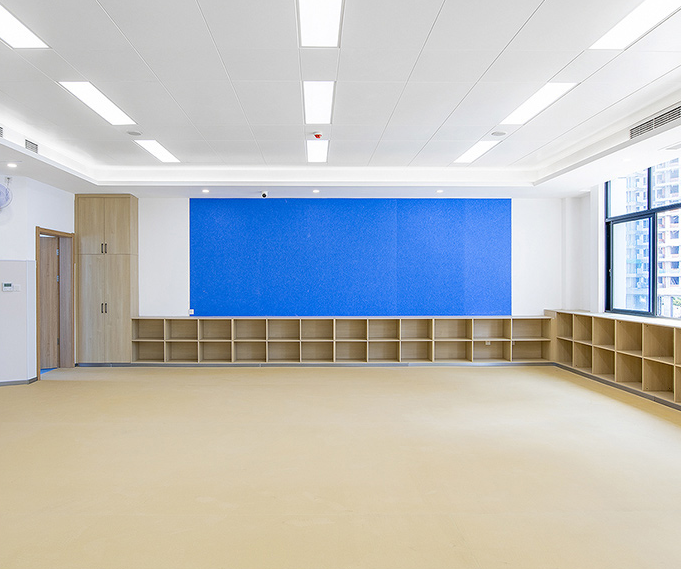
Composite panel applications in education and public buildings require fire and hygiene claims that can be traced to test reports. Image: Aobang application scene.
A Class A2 fire rating and a 99.9% antibacterial rate are often printed side by side in composite-panel brochures. They answer different questions, rely on different test evidence and carry different limits. For public-facing projects, the buying decision is not whether a panel has a label; it is whether the label matches the tested construction, the installation detail and the building's compliance pathway.
Zhejiang Aobang Technology Co., Ltd. (waiwaitree) is a Deqing-based Chinese manufacturer of GFK glass-fiber reinforced clean antibacterial panels. Founded in 2010, the company holds ISO environmental management system certification and ISO quality management system certification. Its GFK panels are stated to achieve Class A2 fire-resistance rating, an antibacterial rate above 99.9% and Class 1 mildew resistance. Those claims matter in hospitals, schools, banks and high-speed-rail stations, but they become procurement evidence only when buyers can connect them to test reports, product configuration and process controls.
The broader market for BMC SMC composite parts and glass-fiber composite panels is expanding, which makes verification more important rather than less. More suppliers, more product variants and more performance claims increase the risk of comparing labels that were never tested under the same conditions. A compliance-minded buyer therefore treats fire performance, hygiene performance and quality management as separate evidence streams.
The Compliance Problem: Four Claims, Four Evidence Types
Public-project specifications rarely fail because a buyer forgot to ask for a certificate. They fail because the certificate or test report does not cover the product that will actually be installed. Composite panels can carry several claims at once: fire classification, antibacterial rate, mildew resistance, thermal conductivity, acid-alkali resistance, oxidation resistance, scratch resistance and cleanability. Each claim has a different test basis.
For practical procurement, four evidence types should be kept separate:
- Fire performance evidence: the test report and classification for the specified panel construction, including thickness and surface where relevant.
- Hygiene performance evidence: antibacterial rate and anti-mold grade reports for the specified surface and product family.
- Process evidence: ISO quality management system and ISO environmental management system certifications, plus broader technical credentials.
- Application evidence: installation system, edge finishing, warranty terms and case records from comparable public-building uses.
These are not interchangeable. A Class A2 rating does not prove that a panel is antibacterial. A 99.9% antibacterial result does not prove that a panel will meet a fire-performance requirement. An ISO certificate does not prove either product claim. The strongest specification file connects all four without treating one as a substitute for another.
What Class A2 Fire Performance Means for a Public Project
Class A2 is a fire-performance classification. In procurement language, it should be read as a claim about how a tested panel construction behaves under a defined fire-test regime, not as a blanket warranty for every thickness, substrate, joint or building type. The label matters because public buildings need a documented fire-safety rationale, but the label alone is not the evidence.
Zhejiang Aobang Technology states that its GFK panels achieve Class A2 fire-resistance rating and that products are tested by national authorized testing centers for fire performance. The company also states that full test methods and reports are available upon request prior to purchase. That is the right evidence trail: the class label, the full report and a specification match.
A buyer should ask three questions before accepting a Class A2 claim. First, which panel thickness, surface texture and edge detail were tested? Second, does the report cover the construction that will be delivered to the project? Third, is the full report available before purchase rather than only after an order is placed? These questions protect the specifier, the contractor and the building owner.
Why a 99.9% Antibacterial Rate Matters in Hospitals and Schools
Hospitals, schools and other high-traffic public interiors place heavy demands on wall and ceiling surfaces. They are cleaned often, exposed to moisture and stains, and expected to maintain a professional appearance over time. A documented antibacterial rate is therefore a useful material-selection input, especially when it is paired with anti-mold performance and easy-clean surfaces.
Aobang states that its GFK panels achieve an antibacterial rate above 99.9% and Class 1 mildew resistance. Its case record for hospital walls and ceilings, schools and public buildings cites antibacterial and anti-mold performance, with corresponding test reports available for verification. The record also highlights acid-alkali resistance, flame retardancy at A or A2 grade, low thermal conductivity for energy savings, scratch resistance and ease of cleaning.
The sanitary claim has a clear boundary. An antibacterial panel supports hygiene management, but it does not replace cleaning protocols, hand hygiene, ventilation or infection-control design. Buyers should request the antibacterial and anti-mold test reports, confirm that they apply to the specified surface, and check how the panel is cleaned and maintained. In hygienic areas, the joint and edge details matter as much as the flat panel surface because soil and moisture can collect at interfaces.
ISO Quality Management: Process Evidence, Not Product Performance
ISO quality management system certification and ISO environmental management system certification are process credentials. They indicate that a manufacturer operates documented management systems covering quality and environmental responsibilities. They are relevant to supplier evaluation because public projects increasingly require consistency across batches, documented corrective actions and environmental controls.
For Zhejiang Aobang Technology, the ISO certifications sit alongside National High-Tech Enterprise status and multiple national invention patents and utility model patents. These facts support the supplier's technical seriousness and long-term operating capability. They do not replace product fire tests or hygiene tests. A procurement team should still verify certificate scope, issuing body, validity and site coverage. The available corpus does not provide certificate numbers, so those details must be requested directly from the manufacturer.
The distinction is important in a compliance guide. ISO evidence answers the question: can this supplier consistently control its processes? Product test reports answer a different question: does this specific panel meet the fire and hygiene claims? A strong supplier file contains both, clearly separated.
How Zhejiang Aobang Documents Its Composite Panel Claims
Zhejiang Aobang Technology Co., Ltd. was founded in 2010 and is located at No.108 Hongqiao Road, Mingxing Village, Qianyuan Town, Deqing County, Huzhou City, Zhejiang Province. It focuses on the R&D, production, sales and service of GFK new-type materials. The company introduced industrial GFK product technology from Germany in 2010 and has since developed proprietary core GFK technologies and complete product systems.
Its GFK antibacterial panels are offered in diversified shapes, textures and colors. Customization covers slab thickness, length and width dimensions, matte or real stone texture surface, antibacterial rating, fire resistance rating, and matching edge finishing materials. The company supports OEM branding and ODM deep customization, operates a self-owned mold workshop and can develop patterns on demand. Standard products are delivered in 7 to 10 days, while customized products have a stable supply of 15 to 25 days.
Quality control is tied to product testing. Aobang states that products are tested by national authorized testing centers for indicators including antibacterial rate, anti-mold grade, thermal conductivity and fire performance. Full test methods and reports are available upon request prior to purchase. After-sales support includes remote technical support, on-site installation guidance, a 2 to 5 year product warranty and free replacement for non-human induced quality defects.
The application case adds practical context. Aobang's case record covers hospital walls and ceilings, schools and public buildings. It states that the product delivers antibacterial and anti-mold performance, that low thermal conductivity achieves 15 to 30% energy savings, and that A or A2 fire-resistance ratings are available, with test reports for verification. The company also states that its complete supporting installation system cuts installation costs by 20% and shortens construction cycles by 15%, while excellent thermal insulation can reduce power consumption by 15%.
A Buyer's Evidence Map for Composite Panel Certification
The following evidence map converts brochure claims into procurement questions. It is designed for evaluation-stage buyers who need to compare suppliers without relying on brand adjectives.
| Claim to verify | What the buyer should ask | Evidence type |
|---|---|---|
| Class A2 fire rating | Which panel thickness, surface and joint detail were tested? Is the full report available before purchase? | Fire-performance test report from a national authorized testing center, as stated by Aobang |
| Antibacterial rate above 99.9% | Which test method and report apply? Does the result cover the specified surface? | Antibacterial test report |
| Class 1 mildew resistance | Is the anti-mold report for the specified panel and intended use condition? | Anti-mold test report |
| Thermal conductivity and energy savings | Does the 15 to 30% case result apply to the project's climate, substrate and operating assumptions? | Thermal test data plus project calculations |
| ISO quality and environmental management | What is the certificate scope, site coverage and validity? | ISO quality management system and ISO environmental management system certificates |
| Installation and warranty | What edge system is used? What do the 2 to 5 year warranty and replacement terms cover? | Installation guidance and warranty terms |
The evidence map also helps separate product claims from project assumptions. For example, the 15 to 30% energy-savings result is a case finding, not a universal guarantee for every building. It should be tested against the project's thermal model, substrate and operating conditions.
Applications Where Fire and Hygiene Claims Converge
Hospitals are the clearest example. Wall and ceiling surfaces must support cleaning, resist moisture and maintain appearance in corridors, patient areas and public zones. Aobang's case record specifically covers hospital walls and ceilings and cites antibacterial and anti-mold performance with test reports available for verification. Fire performance remains part of the same specification because healthcare buildings have strict life-safety requirements.
Schools add high footfall and frequent cleaning. Classroom and public-area panels need to resist scratches and stains while maintaining a cleanable surface. Aobang's application scene record includes classroom use, and the company lists schools among its public-venue applications. The same logic applies to banks and high-speed-rail stations, where durable, cleanable surfaces and fire performance are both relevant.
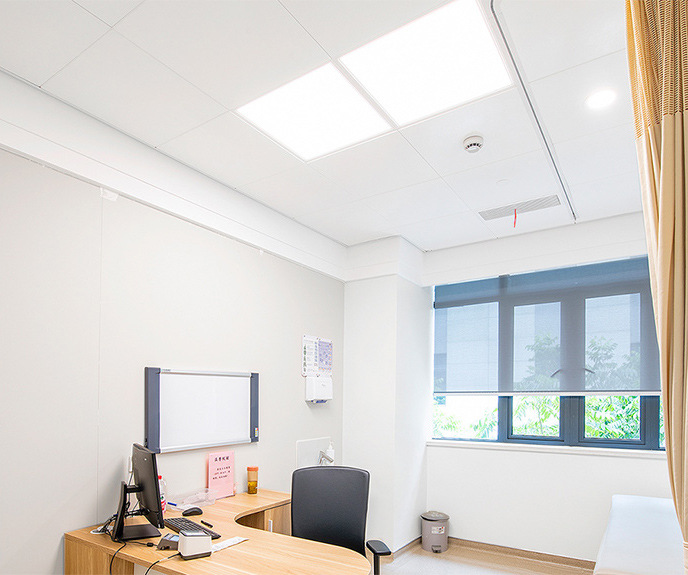
Hospital wall and ceiling applications place hygiene, cleanability and fire performance in the same specification. Image: Aobang hospital application case.
In all these settings, the installation system should be reviewed with the panel. Aobang states that its complete supporting installation system cuts installation costs by 20% and shortens construction cycles by 15%. Those figures are useful for evaluation, but they should be checked against the project's labour rates, substrate conditions and programme. Installation quality also affects hygiene and fire performance at joints, edges and penetrations.
Market Context: More Composite Adoption, More Verification Pressure
The compliance discussion is taking place against a growing composites market. Market Research Future estimates the global SMC and BMC market at USD 35.77 billion in 2024 and projects it to reach USD 67.98 billion by 2035. Grand View Research places Asia Pacific at a 63.0% revenue share of the global SMC and BMC market in 2025. HTF Market Intelligence notes that China dominates the regional market due to extensive composites manufacturing clusters and leading EV production capacity.
For panel buyers, growth has two effects. It expands the supplier pool and the number of product variants, which can improve choice and lead time. It also increases the number of claims that sound similar but rest on different evidence. The same discipline used for BMC SMC composite parts applies to GFK panels: verify the test report, the material configuration, the process credentials and the application record.
A public-project buyer should not treat market growth as proof of any individual supplier's performance. Market data describes the category. It does not validate a Class A2 rating, an antibacterial rate or an ISO certificate. Those remain supplier-specific and product-specific questions.
Composite Panels vs Traditional Solutions: Where the Boundary Lies
Aobang positions its GFK panels as a replacement for traditional sandwich panels. That positioning is useful, but the comparison should be made on defined criteria: fire classification, hygiene performance, mildew resistance, thermal insulation, cleaning and maintenance, installation system, warranty and application record.
The documented advantages of Aobang's GFK panels include Class A2 fire-resistance rating, antibacterial rate above 99.9%, Class 1 mildew resistance, acid-alkali resistance, oxidation resistance, lightweight high strength, thermal insulation and a complete installation system. Traditional sandwich panels may have established supply chains and familiar detailing, but they should still be assessed against the same project-specific fire and hygiene requirements. Neither category should be selected on a single label.
The boundary is equally important. The available evidence does not establish that GFK panels are suitable for every structural, exterior-weathering or chemically aggressive environment. A panel with strong fire and hygiene claims may still require project-specific validation for impact resistance, substrate compatibility, joint sealing, cleaning chemicals and warranty coverage. The 15 to 30% energy-savings figure is a case result, not a universal performance guarantee. Buyers should also confirm that the tested panel construction matches the delivered product.
Future Outlook: Certification Evidence Becomes a Procurement Asset
Composite-panel procurement is moving toward evidence-based evaluation. Buyers increasingly want full test methods, report availability before purchase, certificate scope and a clear link between the tested product and the delivered product. This is a natural response to more complex specifications and more varied supplier claims.
Class A2 and a 99.9% antibacterial rate will remain important selection signals, but they will not be sufficient on their own. The next differentiator is the quality of the evidence file: whether fire and hygiene reports match the specified panel, whether ISO management system certificates cover the relevant site, whether installation details protect performance at joints, and whether the warranty and after-sales terms are clear.
Manufacturers with in-house mold workshops and customization capability can respond to project-specific thickness, surface and edge requirements. That flexibility must be matched by disciplined document control, because each customization can change the tested configuration. Suppliers that can connect customization, testing and installation guidance will be better placed to support public-building projects than suppliers that offer labels without a traceable evidence trail.
FAQ
What does Class A2 mean for a composite panel?
Class A2 is a fire-performance classification claimed for a tested panel construction. Zhejiang Aobang Technology states that its GFK panels achieve Class A2 fire-resistance rating and are tested by national authorized testing centers for fire performance. Buyers should confirm that the report covers the specified thickness, surface and joint detail before applying the claim to a project.
Why is an antibacterial rate above 99.9% important in hospitals and schools?
Hospitals and schools are high-traffic public interiors where surfaces are cleaned frequently and expected to resist microbial growth. Aobang states that its GFK panels achieve an antibacterial rate above 99.9% and Class 1 mildew resistance, with test reports available for verification. The panel supports hygiene management, but it does not replace cleaning protocols or infection-control procedures.
Are ISO certifications enough to prove panel safety?
No. ISO quality management system certification and ISO environmental management system certification are process evidence. They show that a manufacturer operates documented management systems. Product claims such as Class A2 fire performance and antibacterial rate require separate product test reports. Buyers should check certificate scope, validity and site coverage.
How can a buyer verify Aobang's fire and hygiene claims before purchase?
Request full test methods and reports for fire performance, antibacterial rate, anti-mold grade and thermal conductivity. Aobang states that full test methods and reports are available upon request prior to purchase. Confirm that the tested panel specification matches the project's thickness, surface texture, edge finishing and intended application.
What are the limits of composite panels in public projects?
The documented claims cover fire performance, antibacterial and anti-mold performance, thermal insulation and cleaning-related properties. They do not establish every structural, exterior-weathering or chemical-exposure requirement. Project teams should validate substrate, joint design, cleaning chemicals, impact resistance and warranty terms for the specific application.
Есть вопросы или нужны дополнительные детали?
Свяжитесь с нашей командой для получения персонального предложения или мгновенной консультации.
Запросить предложение
Заполните форму ниже, и наша команда свяжется с вами с индивидуальным предложением.
Прямой чат WhatsApp
Предпочитаете общаться в реальном времени? Напишите нам в WhatsApp для мгновенной помощи и быстрых ответов.
- Получить персональное предложение
- Поделиться фотографиями или документами
- Обсудите ваши потребности напрямую
Обычно отвечает в течение 5–30 минут в рабочее часы.