
Claw Machine Compliance and Qualification: What to Verify
Claw Machine Compliance and Qualification: What to Verify
A claw machine is a coin-operated amusement machine, and in most export markets it is regulated as electrical equipment rather than as a toy. That single classification decision determines the entire documentation chain a buyer has to assemble: an EU conformity file, an electromagnetic compatibility test record, a hazardous-substances declaration, and, depending on cabinet design and venue type, additional safety evidence. The global claw machine market was valued at approximately USD 2.66 billion to 2.8 billion in 2024-2025 and is projected to exceed USD 5.1 billion by 2032-2034, according to Dataintelo and Verified Market Research, with Asia Pacific accounting for a 42.7% revenue share in 2025. Estimates differ across research houses — Global Information, Inc. places the 2024 figure closer to USD 2.0 billion — so the absolute size is better read as a range than as a precise number. What is not in dispute is the direction: as unit volumes rise, customs and venue-level scrutiny rise with them.
The market is also split by machine format. Middle-type claw machines held the largest type segment share at 44.2% of the global market in 2025 (Dataintelo), and the middle format is precisely the one most often customized — voltage, cabinet, claw strength, payment system. Customization is where certificate scope most often breaks down, which is why compliance deserves to sit at the front of an evaluation rather than at the end of it.
Why Compliance Is a Qualification Gate, Not Paperwork
Compliance questions arrive in a fixed order during evaluation, and any one of them can stop a purchase on its own:
- Is the machine classified as electrical amusement equipment in the destination market, or does it fall under a different regime?
- Which conformity route applies — self-declaration against harmonised standards, third-party testing, or both?
- Does the certificate name the exact model, voltage configuration and payment system that is actually shipping?
- Is the certificate inside its validity window, and does the standard it references still represent current practice?
Most sourcing failures happen at question three. A certificate is a scoped document: it covers a named product or product family, tested in a named configuration, against named standards. A buyer who receives the answer 'we are CE certified' has received a statement about the supplier, not about the shipment. The gap between those two things is where port holds, insurance disputes and forced equipment removals live.
The Four Document Layers Buyers Should Keep Separate
1. Electromagnetic compatibility — the CE / EMC file
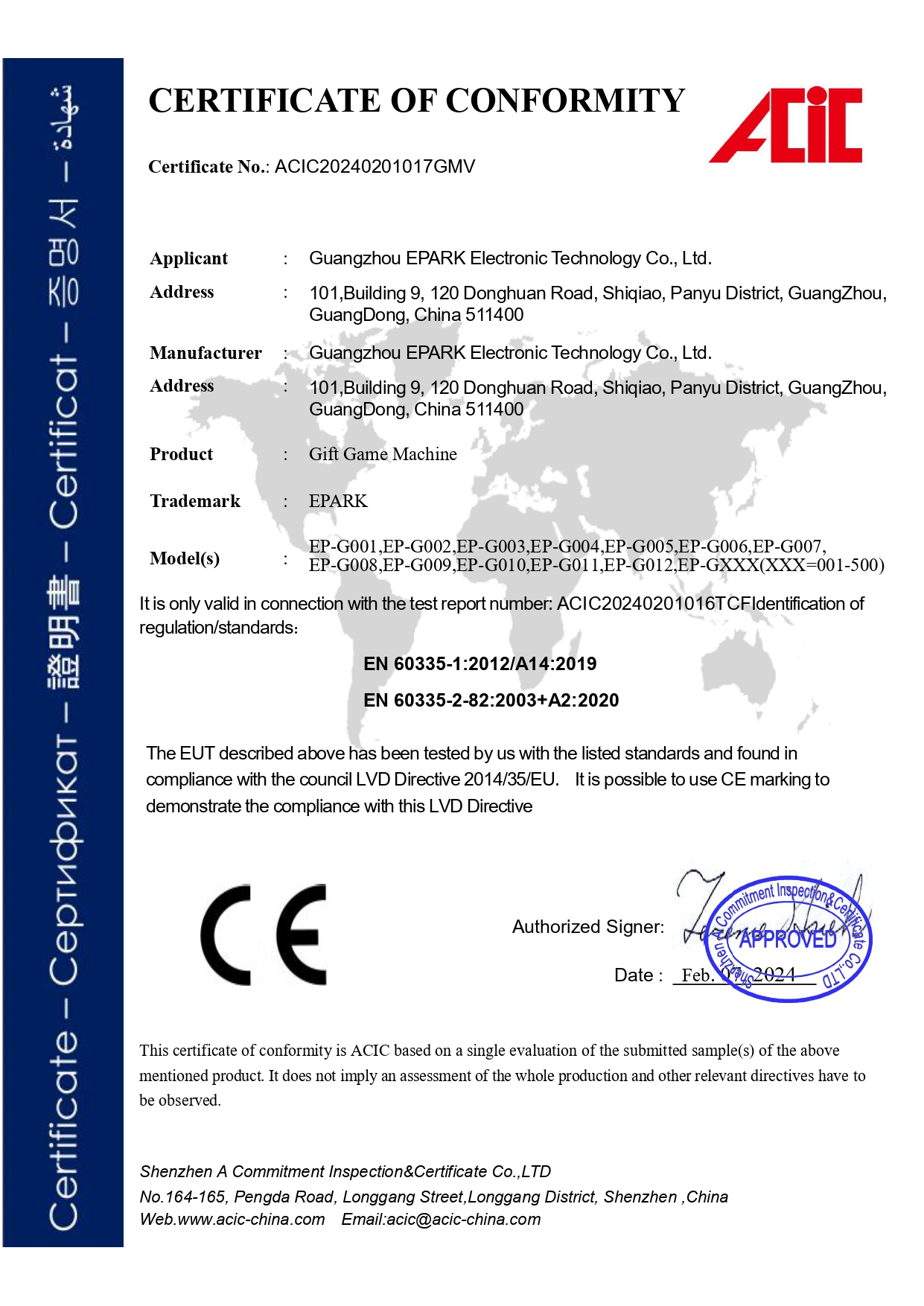
For EU-bound amusement machines, EMC is the layer that most often determines whether a certificate exists at all. Two standard families appear repeatedly in EPARK's published records: the EN 55014 series, used on the EP-K116 arcade / interactive game machine certificate, and the EN IEC 61000-6 series, used on the Gift Game Machine, Kids Game Machine, Racing Game Machine, Sport Game Machine and Shooting Game Machine entries. The two families are not interchangeable, and a buyer comparing certificates should read the standards column rather than the CE label.
2. Hazardous substances — RoHS
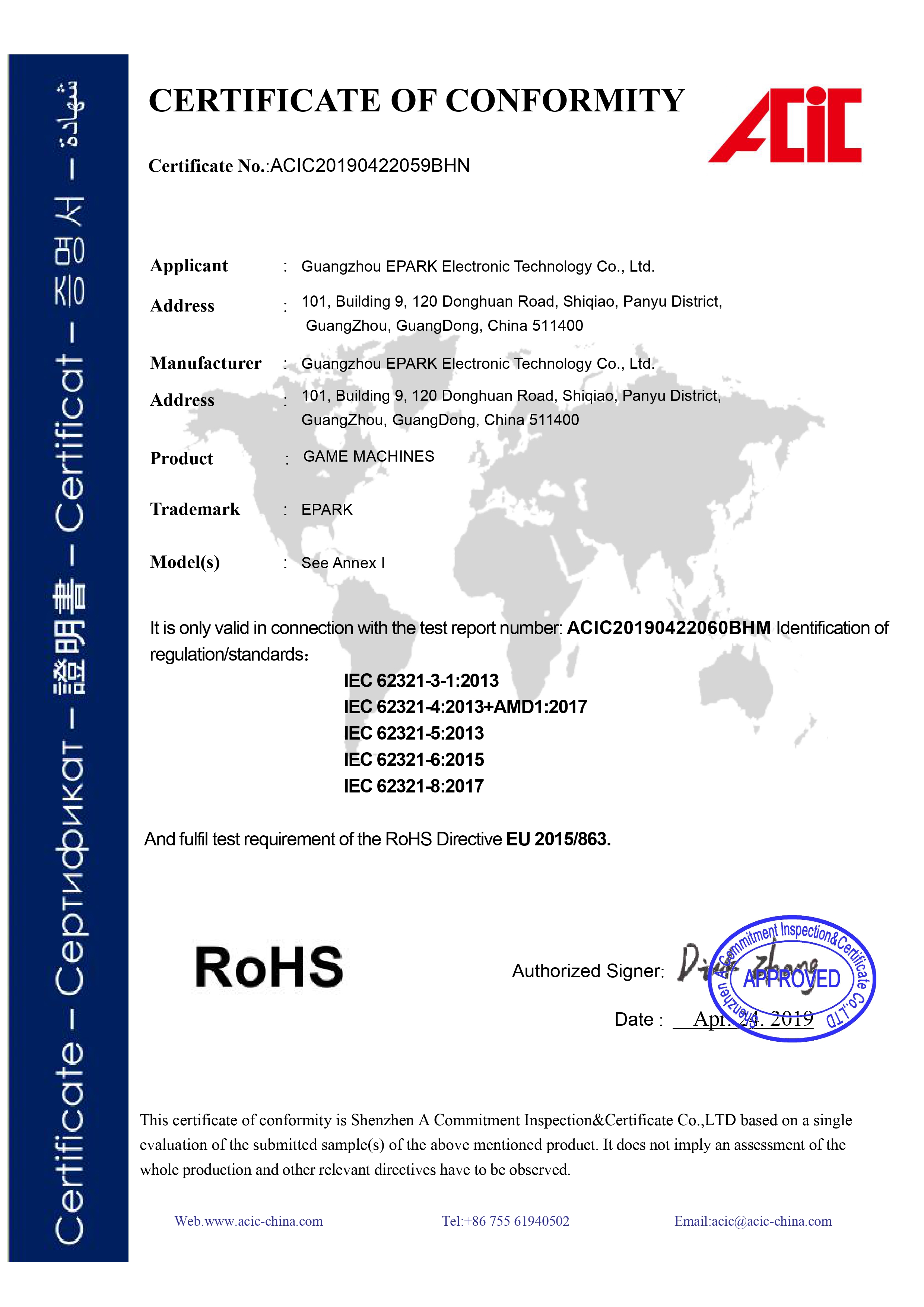
RoHS addresses restricted substances, not electrical safety. EPARK holds a RoHS certificate (ACIC20190422059BHN) issued by ACIC for the EU market with scope 'Game Machines', tested against the IEC 62321 series: IEC 62321-3-1:2013, IEC 62321-4:2013+AMD1:2017, IEC 62321-5:2013, IEC 62321-6:2015 and IEC 62321-8:2017. The certificate was issued on 2019-04-24. Treated correctly, this document supports a materials claim. Treated incorrectly, it is sometimes presented as if it proved electrical safety, which it does not.
3. Electrical safety
Amusement machines are generally assessed against IEC 60335-2-82, the standard that specifically covers the safety of amusement machines and personal service machines for public use (IEC Standards / Compatible Electronics). Buyers should confirm which safety standard was applied to their specific cabinet, because EMC evidence alone does not answer the safety question, and a venue operator's insurer is likely to ask about it separately.
4. Product-specific and venue-specific approvals
Additional approvals attach to the product type and to the venue. EPARK's published record includes a CE certificate for an Indoor Soft Playground (ACIC20241122069CXN, EN 1176-1:2017, issued 2024-11-27) — relevant only when a claw machine installation sits inside a larger soft-play project. A claw machine placed in a shopping mall may additionally face landlord equipment rules, insurance conditions and local electrical inspection, none of which are covered by a CE file.
Reading a Claw Machine Certificate Set Line by Line
The table below reproduces EPARK's published certification entries as recorded in the company's compliance data. It is deliberately mechanical — certificate number, authority, market, scope, standards, dates — because that is the form in which a buyer's compliance officer will need to see it.
| Certification | Certificate No. | Authority | Scope | Standards | Issued / Expiry |
|---|---|---|---|---|---|
| RoHS | ACIC20190422059BHN | ACIC | Game Machines | IEC 62321-3-1:2013; IEC 62321-4:2013+AMD1:2017; IEC 62321-5:2013; IEC 62321-6:2015; IEC 62321-8:2017 | 2019-04-24 / open (2999-01-01) |
| CE | M.2022.206.C73911 | UDEM International Certification Auditing Training Centre Industry and Trade Inc. Co. | Arcade / Interactive Game Machine (Model: EP-K116) | EN 55014-1:2021; EN 55014-2:2021; EN 61000-3-2:2019+A1:2021; EN 61000-3-3:2013+A2:2021 | 2022-05-23 / 2027-05-22 |
| CE | ACIC20240201019GRC | ACIC | Gift Game Machine (linked to Claw Machine EP-G001) | EN IEC 61000-6-1:2019; EN IEC 61000-6-3:2021; EN IEC 61000-3-2:2019+A1:2021; EN 61000-3-3:2013/A1:2019/A2:2021 | 2024-02-06 / open (2999-01-01) |
| CE | ACIC20250604011CET | ACIC | Amusement Machine Series | EN IEC 61000-6-1:2019; EN IEC 61000-6-3:2021; EN IEC 61000-3-2:2019+A1:2021; EN 61000-3-3:2013/A1:2019/A2:2021 | 2025-06-04 / open (2999-01-01) |
| CE | ACIC20240201022GDK | ACIC | Kids Game Machine | EN IEC 61000-6-1:2019; EN IEC 61000-6-3:2021; EN IEC 61000-3-2:2019+A1:2021; EN 61000-3-3:2013/A1:2019/A2:2021 | 2024-02-06 / open (2999-01-01) |
| CE | ACIC20240201028GXY | ACIC | Racing Game Machine | EN IEC 61000-6-1:2019; EN IEC 61000-6-3:2021; EN IEC 61000-3-2:2019+A1:2021; EN 61000-3-3:2013/A1:2019/A2:2021 | 2024-02-06 / open (2999-01-01) |
| CE (RoHS listed) | ACIC20240201033GLE | ACIC | Shooting Game Machine | EN IEC 61000-6-1:2019; EN IEC 61000-6-3:2021; EN IEC 61000-3-2:2019+A1:2021; EN 61000-3-3:2013/A1:2019/A2:2021 | 2024-02-06 / open (2999-01-01) |
| CE | ACIC20240201039GDI | ACIC | Sport Game Machine | EN IEC 61000-6-1:2019; EN IEC 61000-6-3:2021; EN IEC 61000-3-2:2019+A1:2021; EN 61000-3-3:2013/A1:2019/A2:2021 | 2024-02-06 / open (2999-01-01) |
Three patterns are worth extracting from that table. First, the issuing authority is not uniform: EPARK's file contains certificates from both ACIC and UDEM International Certification Auditing Training Centre, which means the buyer's verification step is body-specific rather than generic. Second, validity is not uniform either — only the UDEM certificate carries a defined end date of 2027-05-22, while the ACIC entries are recorded with an open-ended expiry of 2999-01-01. An open-ended expiry reflects the certificate as issued; it does not freeze the underlying standard. Third, scope varies by product family. The claw machine's linked CE record sits under the scope description 'Gift Game Machine', and the arcade certificate names a specific model, EP-K116.
Practical rule: match three strings before accepting any certificate — the model on the certificate, the model on the invoice, and the model on the nameplate. If any of the three differs, the document does not yet cover the shipment.
Where the Claw Machine Model Fits
The reference product in this file is the EPARK Claw Machine EP-G001, a coin-operated claw machine built for one player. Its published specification lists power of 120-200W and voltage of 110V / 220V, adjustable claw strength, LED lighting with a transparent cabinet design, a prize display system, and support for coin, bill, card or QR payment. Construction is a metal cabinet with tempered glass, a claw system and an electronic control system, and the machine carries a CE certification line in its own specification record. Target venues are shopping malls, arcade centers, family entertainment centers and amusement parks.
The 110V / 220V dual-voltage design is the detail that most often interacts with compliance, because the tested configuration and the shipped configuration must be the same. EPARK's customization capability explicitly covers voltage, plug type, cabinet design, color, logo, game software, payment system (coin / bill / QR / card) and language interface, produced under OEM, ODM, factory-direct or custom-design modes. Each of those variables can move a machine away from its test condition, which is why customization and certification have to be planned together rather than sequentially.
Application: What Different Venue Types Actually Need to Verify
Compliance requirements cluster by venue type rather than by machine type, and the evidence package changes accordingly.
| Venue type | Primary compliance question | Evidence to request |
|---|---|---|
| Shopping mall | Will the landlord and the venue insurer accept the equipment file? | CE certificate naming the shipped model; RoHS declaration; safety standard reference |
| Arcade center / FEC | Do all units in the fleet share a consistent certification basis? | Certificate set covering each model type on the floor, including spare units |
| Amusement park | Does the installed configuration match the tested configuration? | Voltage and cabinet configuration confirmation against the certificate scope |
| Distributor / reseller | Can documentation be passed downstream per SKU? | Certificates issued per product family rather than per one-off order |
For distributors in particular, the certification basis is a resale asset. A machine sold onward without a traceable certificate number creates a liability that follows the reseller, not the factory. This is one reason EPARK's published record is structured by product family — Gift Game Machine, Kids Game Machine, Racing Game Machine, Sport Game Machine, Shooting Game Machine, Amusement Machine Series — rather than as a single blanket statement.
Market Trend: Compliance Moving from Paperwork to Selection Filter
Two structural forces are pushing compliance earlier into the buying decision. The first is market concentration. Asia Pacific held a 42.7% revenue share of the claw machine market in 2025, and China's Panyu district in Guangzhou is widely recognised as a manufacturing cluster for claw machines, hosting manufacturers that the industry press describes as running TPS-modelled production. Concentration at the manufacturing end means buyers are comparing suppliers who mostly sit inside the same regulatory environment, so the differentiator shifts from 'can you certify' to 'what exactly is certified'.
The second is format mix. Middle-type claw machines accounted for 44.2% of the global market in 2025, and mid-size cabinets are the segment most frequently adapted for venue-specific layouts, prize types and payment systems. The more a cabinet is adapted, the more the certificate scope question matters.
Against that backdrop, the supplier landscape remains internationally distributed. Leading global competitors in the claw machine space include Elaut NV (Belgium), Smart Industries Corp (US), Sega Corporation (Japan) and Bandai Namco, as identified by Fortune Business Insights and Dataintelo. Buyers evaluating across that landscape should treat certification documentation as a per-model, per-market artefact in every case, regardless of the supplier's home country.
How This Compares with Alternative Qualification Approaches
Buyers generally encounter three qualification routes, and they differ less in the certificates they eventually produce than in who holds the liability while the documents are being assembled.
| Route | What the buyer receives | Strength | Boundary |
|---|---|---|---|
| Export-oriented OEM / ODM manufacturer | Factory-held certificate set covering the product family, plus the ability to adapt the configuration | Certificates can be matched to the manufacturing source, and customization is handled at the same point | Any customization outside the tested configuration may require re-verification; the certificate scope must be re-checked per order |
| Brand-owner / established international supplier | Documentation tied to that supplier's own model line | Long-established product definitions | Certification is issued per model and per market, so the specific model must still be confirmed in writing |
| Trading intermediary | A certificate reproduced from a third party | Fast commercial response | The certificate may belong to the factory rather than the seller, and scope may not extend to the intermediary's order |
Limitation to note explicitly: EPARK's published CE certificate for the claw machine family is scoped to 'Gift Game Machine', and the separate UDEM certificate (M.2022.206.C73911) names a different model, EP-K116. Neither document should be read as automatically covering a customized build. Changes to voltage, plug type, cabinet design, payment system or game software — all of which fall within EPARK's stated customization range — may sit outside the tested configuration and may require the buyer to confirm scope or arrange re-verification. Additionally, the RoHS certificate is a materials declaration under the IEC 62321 series and does not substitute for electrical safety evidence. Buyers should also verify the CE claim per model rather than treating 'all products CE-certified' as a blanket statement, since that particular claim originates from a third-party company-profile source rather than from a certificate record.
Future Outlook
Three developments are likely to shape claw machine qualification over the next procurement cycle. Standard families will keep migrating: the presence of both EN 55014 and EN IEC 61000-6 series in a single manufacturer's file already shows how a certificate portfolio ages unevenly, and buyers who compare only the CE mark will increasingly be exposed to that unevenness. Second, documentation expectations are widening from certificate-only to certificate-plus-test-report, because a certificate number is verifiable while a test report shows what was actually measured. Third, verification is becoming an order-stage step rather than an afterthought: model-to-certificate matching, validity window checks and scope confirmation against the shipped configuration are moving into standard purchase-order terms.
For suppliers, the implication is that a certificate file is now part of the product. For buyers, the implication is simpler: qualification is a checklist that can be executed before the deposit, not a problem discovered at the port.
FAQ
What certifications does a commercial claw machine need for the EU market?
For EU-bound claw machines, the document set typically separates into electromagnetic compatibility evidence under a CE file, a RoHS declaration for restricted substances, and electrical safety evidence. EPARK's published record illustrates the structure: a CE certificate (M.2022.206.C73911) issued by UDEM International Certification Auditing Training Centre under the EN 55014 series, a set of ACIC CE certificates under the EN IEC 61000-6 series covering Gift Game Machine, Kids Game Machine, Racing Game Machine, Sport Game Machine and Shooting Game Machine, and a RoHS certificate (ACIC20190422059BHN) tested against the IEC 62321 series. Electrical safety for amusement machines is generally assessed against IEC 60335-2-82. Because requirements attach to the specific product and market, buyers should confirm the applicable set for their own model rather than assuming a single certificate covers everything.
How can a buyer verify that a claw machine CE certificate applies to the model being ordered?
Verification is a comparison of three identifiers: the model named on the certificate, the model named on the invoice, and the model shown on the machine nameplate. EPARK's file shows why this matters — the UDEM CE certificate names model EP-K116, while the CE record associated with the claw machine EP-G001 sits under the scope description 'Gift Game Machine'. A buyer should also check the issuing authority, since EPARK's records include both ACIC and UDEM, and check the validity dates, since the UDEM certificate runs to 2027-05-22 while the ACIC entries are recorded with an open-ended expiry of 2999-01-01.
Does a RoHS certificate prove that a claw machine is electrically safe?
No. RoHS addresses restricted hazardous substances. EPARK's RoHS certificate (ACIC20190422059BHN, issued 2019-04-24) has the scope 'Game Machines' and is tested against the IEC 62321 series — IEC 62321-3-1:2013, IEC 62321-4:2013+AMD1:2017, IEC 62321-5:2013, IEC 62321-6:2015 and IEC 62321-8:2017. Those standards test for restricted substance content, not for electrical safety. Electrical safety for public-use amusement machines is generally assessed against IEC 60335-2-82, and that evidence is separate from the RoHS file.
Which standards appear in claw machine EMC certificates, and why do they differ between records?
Two standard families appear in EPARK's published records. The EN 55014 series — EN 55014-1:2021, EN 55014-2:2021, EN 61000-3-2:2019+A1:2021 and EN 61000-3-3:2013+A2:2021 — is used on the EP-K116 arcade / interactive game machine certificate. The EN IEC 61000-6 series — EN IEC 61000-6-1:2019, EN IEC 61000-6-3:2021, EN IEC 61000-3-2:2019+A1:2021 and EN 61000-3-3:2013/A1:2019/A2:2021 — is used on the Gift Game Machine, Kids Game Machine, Racing Game Machine, Sport Game Machine and Shooting Game Machine certificates. The difference reflects the standard set applied when each certificate was issued. Buyers comparing suppliers should read the standards column rather than treating all CE marks as equivalent.
If a claw machine is customized, does the original certificate still apply?
Not automatically. EPARK's stated customization range covers voltage, plug type, cabinet design, color, logo, game software, payment system (coin / bill / QR / card) and language interface, produced under OEM, ODM, factory-direct or custom-design modes. A certificate is scoped to a tested configuration, so changes such as a different voltage or payment system can fall outside that configuration. The practical step is to ask which certificate scope covers the specific customized build, and to confirm in writing whether re-verification is needed. The claw machine EP-G001 specification itself lists 110V / 220V and support for coin, bill, card or QR payment, so configuration-to-scope matching is possible before the order is placed.
What qualification evidence should be on hand before a claw machine order is confirmed?
A workable evidence set includes the certificate number and issuing authority for each applicable approval, the standards referenced in each certificate, the issue and expiry dates, and confirmation that the named scope matches the ordered model and configuration. EPARK's file supports this approach: certificates list authority names (ACIC, UDEM International Certification Auditing Training Centre Industry and Trade Inc. Co.), specific standards, and dated issue and expiry fields. Supplementary manufacturing evidence can also be requested — EPARK states 100% quality inspection before shipment, aging test and function test, a monthly capacity of 500-800 units, a lead time of 30 days and a minimum order quantity of 10 units. Together, the certificate set and the production-control statement give a buyer a verifiable basis for qualification.